
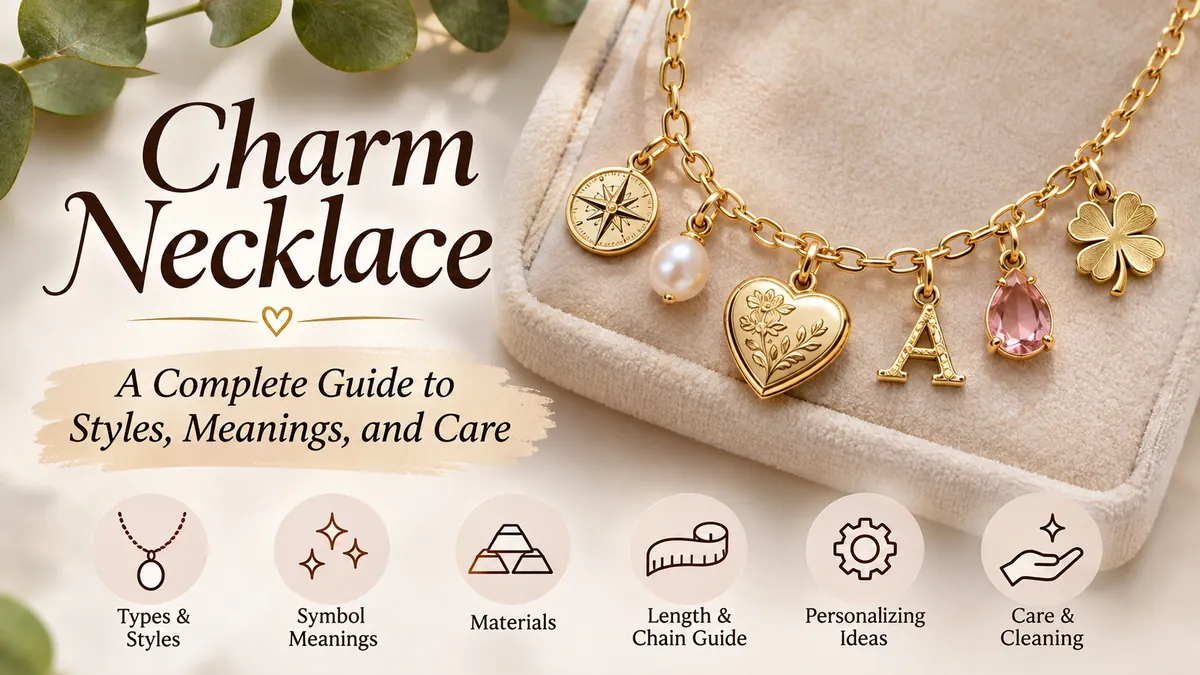
A charm necklace can tell a story without saying a word. A tiny heart might represent someone special, a birthstone can mark an important birthday, and a travel-inspired pendant may bring back memories of a favorite destination.
Unlike a conventional necklace with a single decorative centerpiece, charm jewelry allows different symbols, shapes, and keepsakes to come together in one personal design.
A charm necklace is a piece of jewelry featuring one or more small decorative ornaments attached to a chain. These ornaments, called charms, may represent personal memories, interests, beliefs, relationships, or milestones. Charm necklaces come in many materials and styles, from delicate gold chains to colorful, layered designs.
Their appeal lies in flexibility. Some people prefer a single meaningful charm, while others build a collection that changes over time.
What Is a charm necklace?
A charm necklace is a necklace decorated with small ornaments that may be permanently attached or removable. The ornaments can include initials, symbols, gemstones, miniature objects, religious motifs, and other meaningful designs.
The necklace generally consists of three main components:
- Chain: The foundation that sits around the neck and supports the charms.
- Charms: Decorative elements that add meaning, personality, or visual interest.
- Clasps and connectors: Hardware used to secure the necklace and, in some designs, attach or rearrange charms.
Some designs also include a central charm holder, which allows several ornaments to hang together.
How Is a Charm Necklace Different From a Pendant Necklace?
Although the terms are sometimes used interchangeably, they describe slightly different jewelry styles.
| Feature | Charm necklace | Pendant necklace |
|---|---|---|
| Decorative elements | One or multiple charms | Usually one main pendant |
| Personalization | Often highly customizable | Depends on pendant design |
| Arrangement | May allow charms to be added or removed | Usually centered around one ornament |
| Appearance | Can be playful, layered, or symbolic | Often simple and focal |
| Common purpose | Personal storytelling and decoration | Decoration or symbolic expression |
The distinction is not absolute. A necklace with a single charm may also be described as a pendant necklace, particularly when the ornament hangs freely from the chain.
The History and Evolution of Charm Necklaces
Decorative ornaments worn around the neck have existed for thousands of years. Ancient jewelry often carried meanings beyond appearance, including protection, identity, status, and spiritual belief.
Ancient Origins
In ancient Egypt, people wore amulets associated with protection and religious symbolism. Scarab-shaped ornaments, for example, were connected with renewal and transformation.
Ancient Greek and Roman jewelry also incorporated symbolic ornaments, religious imagery, and miniature representations of meaningful objects.
These early pieces were not identical to modern customizable charm necklaces, but they established the tradition of wearing small symbolic objects as jewelry.
Medieval and Victorian Influences
During the Middle Ages, religious medals, crosses, and protective symbols were worn as personal ornaments.
In the Victorian era, sentimental jewelry became especially fashionable. Queen Victoria’s interest in personal and commemorative jewelry helped popularize pieces associated with loved ones, family events, and remembrance.
Lockets, engraved ornaments, and miniature keepsakes reflected the emotional value that jewelry could carry.
Modern Charm Jewelry
During the twentieth century, charm bracelets became popular as collectible jewelry, particularly for commemorating travel, celebrations, and personal achievements.
The same concept eventually expanded into necklaces featuring initials, birthstones, miniature pendants, and interchangeable ornaments.
Contemporary jewelry makers now offer modular designs, allowing wearers to change arrangements without replacing the entire necklace.
Popular Types of charm necklace Designs
Charm necklaces range from understated everyday jewelry to elaborate statement pieces. The main differences involve chain construction, charm placement, materials, and the way ornaments attach.
1. Minimalist Charm Necklaces
Heart Charm Chain Necklace – PALMONAS
Tiny Star Charm Necklace – Silver Rain Silver
David Jones Online | Shop Fashion, Beauty, Home & More
7
Minimalist designs feature one or two small ornaments on a fine chain. Common motifs include stars, hearts, circles, initials, and tiny gemstones.
Their simplicity makes them suitable for everyday wear and layering with other necklaces.
A single charm can also have a strong personal meaning without requiring an elaborate design.
2. Personalized Initial and Name Charm Necklaces
Collar de letras personalizadas – J&CO Jewellery
Personalized Initial Disc Necklaces | Made by Mary – Made By Mary
15
Initial necklaces feature letters representing a person’s name, family members, or meaningful words.
Some designs combine several initials with small hearts, birthstones, or engraved discs.
Nameplate necklaces are related but generally use a complete name or word as the primary decorative element rather than separate letter charms.
3. Birthstone Charm Necklaces
Birthstone necklaces incorporate gemstones associated with particular birth months.
The stones may be natural, laboratory-grown, or simulated, depending on the design.
| Month | Traditional modern birthstone |
|---|---|
| January | Garnet |
| February | Amethyst |
| March | Aquamarine |
| April | Diamond |
| May | Emerald |
| June | Pearl, Alexandrite, Moonstone |
| July | Ruby |
| August | Peridot, Spinel, Sardonyx |
| September | Sapphire |
| October | Opal, Tourmaline |
| November | Topaz, Citrine |
| December | Turquoise, Tanzanite, Zircon |
Birthstone traditions vary by country and historical period, so more than one gemstone may be associated with a particular month.
4. Vintage and Antique-Inspired Charm Necklaces
Vintage-inspired necklaces often feature ornate metalwork, engraved lockets, floral motifs, and aged-looking finishes.
Common details include filigree, decorative borders, and small medallions.
An antique necklace is generally at least 100 years old, while vintage jewelry is typically associated with an earlier period but is not necessarily antique. Definitions can vary among sellers and collectors.
5. Multi-Charm and Cluster Necklaces
No.5 Silver Necklace – Nixie Studio
22
Multi-charm necklaces place several ornaments along a chain or gather them around a central connector.
They may combine different textures and shapes, such as a coin charm, pearl, heart, and miniature key.
Cluster necklaces create a fuller appearance because the ornaments hang close together.
6. Locket Charm Necklaces
A locket is a small pendant that opens to reveal a compartment, traditionally used for photographs or tiny keepsakes.
Lockets can function as standalone pendants or as part of a larger charm arrangement.
They are particularly associated with sentimental jewelry because they can hold a personal reminder close to the wearer.
7. Travel and Hobby Charm Necklaces
Travel-themed charms may depict landmarks, airplanes, compasses, seashells, or miniature maps.
Hobby-related ornaments can represent music, reading, sports, gardening, photography, and other interests.
These designs are often built gradually, with new charms added to commemorate experiences.
Charm Necklace Symbols and Their Meanings
One of the most appealing aspects of charm jewelry is its symbolism. Small decorative objects can represent feelings, memories, aspirations, or personal beliefs.
However, charm meanings are not universal. Cultural traditions, individual experiences, and design context all influence interpretation.
| Charm symbol | Common meaning |
|---|---|
| Heart | Love, affection, relationships |
| Star | Hope, guidance, ambition |
| Moon | Change, cycles, intuition |
| Butterfly | Transformation, growth |
| Four-leaf clover | Good fortune |
| Key | Opportunity, discovery, new beginnings |
| Anchor | Stability, hope, connection |
| Tree of life | Growth, family, interconnectedness |
| Infinity symbol | Continuity, lasting connection |
| Evil eye | Protection in certain cultural traditions |
| Compass | Direction, travel, guidance |
| Cross | Christian faith |
| Hamsa hand | Protection in several cultural and religious traditions |
| Flower | Beauty, renewal, personal growth |
| Zodiac symbol | Astrological identity |
Choosing Symbols With Personal Meaning
A charm does not need a widely recognized symbolic meaning to be valuable.
A miniature book might represent a favorite childhood story. A small dog-shaped ornament could commemorate a beloved pet. A simple engraved date may recall an important achievement.
Personal meaning often matters more than the symbol’s conventional interpretation.
Can Different Charm Symbols Be Combined?
Yes. Combining symbols is a common way to create a more personal design.
For example, a necklace featuring a compass, star, and birthstone might represent travel, ambition, and identity.
The symbols do not need to share a single theme, although repeating a metal finish or design detail can help the arrangement look cohesive.
Materials Used in Charm Necklaces
The material of a charm necklace affects its appearance, weight, durability, maintenance requirements, and comfort.
Understanding the difference between solid metals, plated finishes, and decorative materials helps explain why similar-looking necklaces may behave differently over time.
Sterling Silver
Sterling silver is a popular material for charm jewelry because of its bright appearance and versatility.
Jewelry marked 925 generally contains 92.5% silver, with the remaining portion made from other metals, commonly copper.
Sterling silver can tarnish when exposed to certain substances in the environment. Tarnishing is a surface reaction rather than proof that the jewelry is poor quality.
With appropriate care, sterling silver jewelry can remain wearable for many years.
Solid Gold
Gold necklaces are commonly made from alloys rather than pure 24-karat gold because alloying improves strength for everyday jewelry.
Common gold purities include:
- 10K gold: Approximately 41.7% gold.
- 14K gold: Approximately 58.3% gold.
- 18K gold: 75% gold.
Gold alloys may appear yellow, white, or rose depending on their composition and finishing.
Solid gold does not have an external gold plating layer that gradually wears away, although its surface can still scratch.
Gold-Plated and Gold Vermeil Jewelry
Gold-plated jewelry has a thin layer of gold applied over another metal.
The base metal may be brass, copper, sterling silver, or another suitable material.
Gold vermeil is a more specific category involving gold plating over sterling silver, subject to applicable standards for gold purity and plating thickness.
Both finishes can wear with friction and repeated exposure to moisture or chemicals. The rate depends on plating thickness, construction, and usage.
Stainless Steel
Stainless steel is valued for its strength, corrosion resistance, and relatively low maintenance.
It is commonly used for contemporary charm necklaces, particularly designs with simple geometric ornaments.
However, stainless steel alloys vary, and some contain nickel. People with known metal sensitivities should consider the specific alloy and skin-contact components.
Pearls, Enamel, Glass, and Gemstones
Decorative charms may include materials beyond metal.
Enamel adds color to miniature shapes and symbols. Glass, including Murano-style glass, creates colorful patterns and translucent effects.
Pearls provide a softer appearance, while gemstones add color, texture, and symbolic associations.
These materials require different levels of care. Pearls, opals, turquoise, and certain treated gemstones can be damaged by cleaning methods that are safe for plain metal jewelry. gia+1
Material Comparison
| Material | Main advantage | Main limitation |
|---|---|---|
| Sterling silver | Versatile, classic appearance | Can tarnish |
| 14K solid gold | Durable precious-metal option | Can scratch |
| 18K solid gold | Higher gold content | Generally softer than 14K alloys |
| Gold-plated metal | Gold appearance with less gold used | Plating can wear |
| Gold vermeil | Gold finish over sterling silver | Still subject to plating wear |
| Stainless steel | Strong, corrosion-resistant | Alloy composition varies |
| Enamel | Bright decorative colors | May chip with impact |
| Pearls | Distinctive natural luster | Sensitive to abrasion and chemicals |
How to Choose the Right Charm Necklace Length and Chain
Necklace length changes where the charms sit on the body and how they interact with clothing.
The most suitable length depends on neck circumference, body proportions, charm size, and personal preference.
Common Necklace Lengths
| Length | Typical position |
|---|---|
| 14–16 inches | Close to the neck or collarbone |
| 18 inches | Around the collarbone or upper chest |
| 20 inches | Slightly below the collarbone |
| 22–24 inches | Mid-chest, depending on body proportions |
| 30 inches or longer | Lower chest, suitable for long layering styles |
These positions are approximate. The same chain can sit differently on different people.
An adjustable extension chain can provide flexibility, especially when changing between necklines.
Which Chain Style Works Best?
Several chain constructions are used in charm jewelry.
Cable chains consist of interconnected oval or round links. They are versatile and commonly used with small pendants and charms.
Rolo chains feature rounded links and can work well with decorative charm arrangements.
Box chains have square-shaped links that create a smooth, structured appearance.
Snake chains have closely fitted segments that form a continuous-looking surface. Certain large-hole bead charms are designed specifically for this style.
Paperclip chains feature elongated links and are often used with clip-on charms and decorative connectors.
Rope chains have a twisted appearance, adding texture even when only one charm is attached.
Chain compatibility matters. A charm’s bail, jump ring, or clasp must fit the chain, and the chain must be strong enough to support the combined weight of the ornaments. Gem Society+1
How to Personalize a charm necklace
Personalization transforms an ordinary accessory into a piece associated with specific memories, relationships, or interests.
A personalized necklace can be simple or elaborate. The most effective arrangements usually balance meaningful details with practical considerations such as weight, spacing, and comfort.
Step 1: Choose a Theme
Start with an idea that connects the charms.
Possible themes include family, travel, nature, personal achievements, friendship, or significant life events.
A theme helps guide the arrangement without requiring every ornament to look identical.
Step 2: Select a Main Charm
Choose one ornament as the visual centerpiece.
It could be a locket, birthstone, engraved disc, initial, or symbolic shape.
A focal charm gives the design structure and makes it easier to arrange smaller ornaments.
Step 3: Add Supporting Charms
Supporting charms can provide additional meaning or visual interest.
For example, a necklace celebrating a graduation might combine an initial, graduation-cap charm, and engraved year.
A family-themed design could feature several birthstones or initials.
Step 4: Balance Size and Weight
Place the charms on a flat surface before attaching them.
A large charm surrounded by smaller ornaments often creates a more balanced composition than several equally large pieces crowded together.
If the necklace uses multiple attachment points, distribute weight carefully so the chain hangs comfortably.
Step 5: Check the Attachment Method
Not every charm is interchangeable.
Common attachment methods include:
- Jump rings: Small metal rings that connect charms to chains or holders.
- Lobster clasps: Spring-operated fasteners that can allow easy rearrangement.
- Bails: Metal loops or fittings through which a chain passes.
- Hinged charm holders: Connectors that open to accommodate multiple charms.
- Soldered rings: More permanent connections that generally require tools to alter.
Some modular systems are designed for specific charm collections. Compatibility should be checked rather than assumed.
Can Bracelet Charms Be Used on a Necklace?
Often, yes.
Many charms are suitable for both bracelets and necklaces, provided their attachment mechanisms fit.
However, some bead-style charms require specialized carriers, while certain heavy or bulky ornaments may not hang comfortably from a delicate necklace.
Jewelry makers such as Pandora and James Avery offer different charm and attachment systems, illustrating why dimensions and compatibility are important. James Avery+1
How to Style a Charm Necklace for Different Occasions
Charm necklaces can complement casual clothing, formal outfits, and layered jewelry combinations.
The overall effect depends on the number of charms, their scale, and how the necklace relates to the neckline.
Everyday Styling
Gold Charm Necklace – Etsy Ireland
A delicate chain with one or two lightweight charms works well with simple shirts, knitwear, and casual dresses.
For a subtle appearance, choose small ornaments with similar finishes.
A necklace containing a single initial or birthstone can provide personal detail without dominating the outfit.
Layering Multiple Necklaces
Kansas City Brand Photography | Personal Branding + Editorial | Colleen Christi Studio
Layering creates depth by combining necklaces of different lengths and textures.
For example, a 16-inch plain chain, an 18-inch charm necklace, and a 20-inch pendant necklace can form a graduated arrangement.
To prevent the layers from looking crowded, vary the chain thickness and avoid placing several large ornaments at the same height.
A necklace separator may help reduce tangling, although it cannot eliminate movement entirely.
Mixing Gold and Silver
Gold and silver jewelry can be worn together.
One approach is to repeat both metal tones across the arrangement rather than introducing a single contrasting piece.
A mixed-metal charm can also connect a silver chain with gold-colored accessories.
The choice is aesthetic rather than a strict jewelry rule.
Statement Charm Necklaces
A statement design uses larger ornaments, bold colors, or a substantial cluster of charms.
These necklaces can become the focal point of an outfit.
Keeping surrounding jewelry relatively simple often makes the charms easier to appreciate.
Matching Necklines
Different necklines affect the appearance of a necklace.
A V-neck can complement a charm arrangement that follows the neckline’s shape. Crew-neck clothing often works with necklaces that sit above or below the collar.
Open-collar shirts provide space for shorter charm necklaces, while higher necklines may suit longer chains.
Comfort and personal preference matter more than rigid styling rules.
How to Clean and Care for a charm necklace
Regular maintenance helps preserve the appearance of a necklace and reduces the risk of damaged connectors, tangled chains, or lost ornaments.
Cleaning methods should always account for the most delicate material in the piece.
Cleaning a Plain Metal Charm Necklace
For suitable plain gold or sterling silver jewelry:
- Inspect the necklace for loose stones, damaged links, or weakened attachments.
- Prepare lukewarm water with a small amount of mild dish soap.
- Gently clean with a soft cloth or an appropriate soft brush.
- Rinse carefully in a separate container rather than directly over an open drain.
- Dry thoroughly with a clean, lint-free cloth.
- Check that clasps and charm connectors remain secure.
This general method is not suitable for every necklace, especially those containing delicate gemstones, glued elements, or moisture-sensitive materials.
The Gemological Institute of America recommends matching cleaning methods to gemstone properties and treatments. gia
Caring for Gold-Plated Jewelry
Gold plating can gradually wear through contact and abrasion.
To help preserve the finish, avoid repeated exposure to perfume, chlorine, cleaning chemicals, and excessive friction.
Use a soft cloth for routine cleaning and avoid abrasive polishing products unless specifically approved for the jewelry.
Caring for Pearls and Delicate Gemstones
Pearls are relatively soft and can be damaged by harsh chemicals or abrasive materials.
Opals, turquoise, and some treated gemstones also require special precautions.
Ultrasonic cleaners are not universally safe. Vibrations, heat, or cleaning solutions can damage certain stones and settings.
For complex jewelry with multiple materials, professional cleaning may be safer than experimenting with household products.
How to Store Charm Necklaces Without Tangling
Necklaces are especially prone to tangling when several chains are stored together.
Useful storage practices include keeping each necklace in a separate compartment, fastening the clasp before storage, and using individual soft pouches or hanging organizers.
Sterling silver benefits from suitable anti-tarnish storage materials.
Avoid leaving jewelry loose in drawers where metal surfaces and gemstones may rub against one another.
Can You Wear a Charm Necklace in the Shower?
Removing charm necklaces before showering is generally advisable.
Soap residue, repeated moisture exposure, and friction may affect finishes, connectors, and decorative materials.
Swimming presents additional concerns because chlorine and saltwater can affect certain metals and gemstones.
Removing necklaces before vigorous exercise and sleeping can also reduce snagging and mechanical stress.
Common Charm Necklace Problems and How to Prevent Them
Even well-made necklaces can develop problems through ordinary wear.
Recognizing early warning signs can prevent more serious damage.
Charms Keep Sliding to One Side
This usually happens when the charms have uneven weight or the necklace lacks fixed attachment points.
A centered charm holder, suitable spacers, or a more balanced arrangement may help.
Some designs intentionally allow movement, so a completely fixed appearance is not always possible.
Necklace Chains Become Tangled
Multiple delicate chains can twist together during wear.
Using different chain lengths and textures can reduce overlap.
For layered necklaces, a multi-strand clasp or necklace separator may improve organization.
Charm Connectors Open Unexpectedly
Jump rings can loosen when subjected to repeated pulling or twisting.
Inspect connectors regularly, particularly when the charms have sentimental value.
A jeweler can evaluate whether a soldered connection or more secure clasp would be appropriate.
The Necklace Causes Skin Irritation
Skin irritation may be associated with friction, trapped moisture, or sensitivity to certain metals, including nickel.
A gold-colored finish does not necessarily mean the underlying metal is nickel-free.
People with known metal allergies should examine the materials used in the chain, clasp, charms, and connectors.
If irritation occurs, stop wearing the piece until the cause has been assessed.
Charms Scratch Each Other
When several ornaments hang together, their surfaces may rub or collide.
This is especially relevant when combining hard gemstones with softer metals or delicate materials.
Spacing the charms, reducing the number of ornaments, or using separate attachment points can limit contact.
Charm Necklace Ideas for Meaningful Milestones
Charm jewelry is often associated with important personal events because individual ornaments can represent particular moments.
A graduation necklace might feature an engraved year, academic symbol, or school-related motif.
An anniversary necklace could incorporate initials, a meaningful date, or a gemstone associated with the occasion.
Travel-inspired designs may include miniature landmarks, coordinates, or symbolic objects connected to memorable destinations.
Family-themed necklaces often combine birthstones, initials, hearts, or engraved discs.
Some people also create remembrance jewelry using lockets, meaningful symbols, or personalized engravings.
The central idea is continuity: charms can be added as new experiences become part of a person’s story.
How Many Charms Should a Necklace Have?
There is no universal ideal number.
A single charm may be enough for a minimalist design, while three to five small ornaments can create a noticeable cluster without necessarily becoming overwhelming.
Larger statement necklaces may accommodate more, depending on their construction.
The practical limit is determined by chain strength, connector security, total weight, spacing, and comfort—not simply appearance.
Are Charm Necklaces Suitable for Everyday Wear?
Many are, particularly those made with sturdy chains, secure attachments, and lightweight ornaments.
However, delicate gemstone settings, thin plating, sharp-edged charms, and heavy clusters may be less suitable for constant wear.
The necklace should also be removed during activities where it could catch on equipment or other objects.
Do Charm Necklaces Have to Match?
No. A charm collection can combine different themes, metals, colors, and time periods.
A necklace may look intentionally eclectic rather than coordinated.
For visual balance, repeating one design element—such as shape, color, or metal tone—can help connect otherwise unrelated ornaments.
Are Charm Necklaces Still Popular?
Charm necklaces remain a recognizable category of personalized jewelry, with contemporary collections featuring engraved ornaments, birthstones, interchangeable connectors, and layered arrangements.
Their continued presence in jewelry collections reflects the appeal of customization and sentimental design rather than dependence on one specific fashion trend.
Modern interpretations include minimalist chains, mixed-metal styling, bold charm clusters, and colorful enamel ornaments. AJLuxe+1
Unlike accessories built around a single seasonal appearance, a charm necklace can evolve as personal interests and memories change.
That flexibility helps explain its enduring appeal.
Final Thoughts on Charm Necklaces
A charm necklace combines decoration with personal expression. Its charms can represent relationships, achievements, interests, beliefs, or memories, making even a simple necklace meaningful.
Understanding the different styles, metals, chain lengths, attachment methods, and care requirements makes it easier to appreciate how these pieces are designed and maintained.
The most meaningful charm necklaces are not necessarily the most elaborate. Sometimes a single small ornament carries an entire story.