
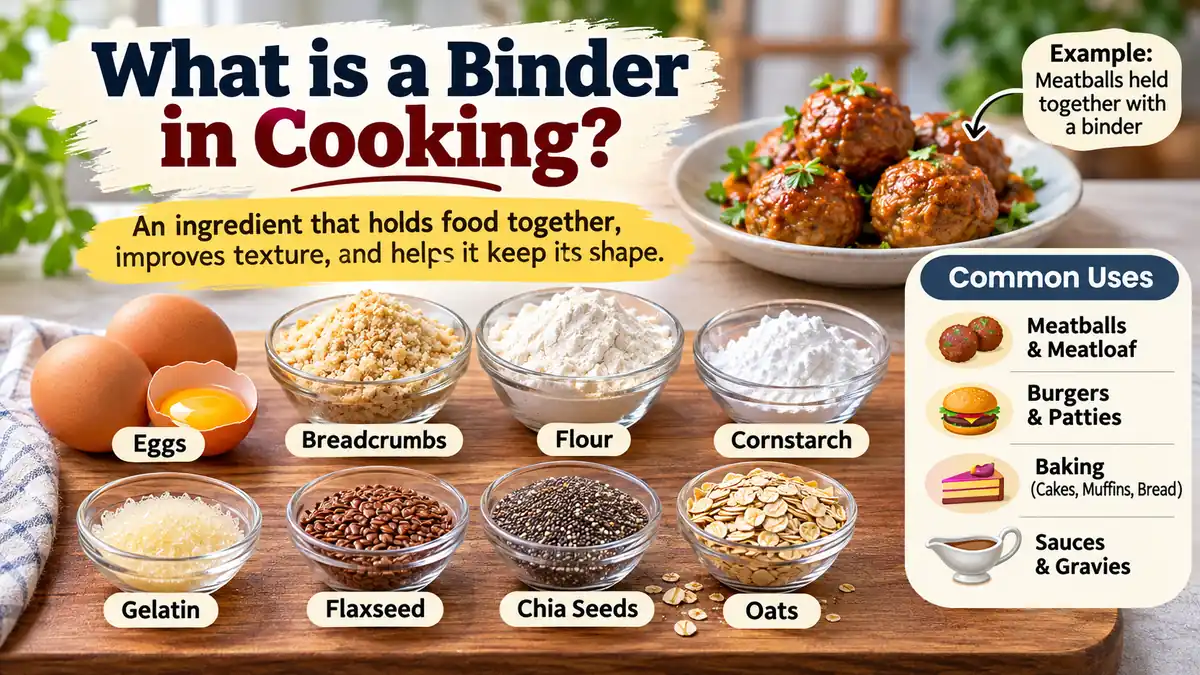
Meatballs that fall apart, vegetable patties that crumble, and cakes that lose their structure often have something in common: insufficient binding. A suitable binding ingredient can solve these problems without significantly changing the flavor of your food.
But what is a binder in cooking, and how do you know which one to use?
A binder in cooking is an ingredient that holds other ingredients together, improves texture, and helps food maintain its shape during preparation and cooking. Common binding agents include eggs, breadcrumbs, flour, cornstarch, gelatin, and flaxseed. They work through protein coagulation, moisture absorption, adhesion, or gel formation. India Science and Technology+1
what is a binder in cooking and how does it work?
A culinary binder connects ingredients that might otherwise separate or crumble. It creates a stable structure that allows food to retain its intended consistency during cooking and serving.
Binding agents perform several functions in food preparation:
- Hold loose ingredients together.
- Improve food structure and consistency.
- Absorb excess moisture.
- Reduce crumbling and breaking.
- Help seasonings and coatings stick to food.
- Support moisture retention.
- Improve the texture of cooked dishes.
Different ingredients achieve these results through different food science processes.
Protein coagulation
Protein-based binders, such as eggs, develop structure when exposed to heat. Their proteins unfold and form a network that helps secure surrounding ingredients.
This explains why eggs are particularly useful in meatballs, cakes, casseroles, and other cooked mixtures.
Starch gelatinization
When starch is heated with sufficient water, its granules absorb moisture and swell. This creates a thicker consistency that provides structure to sauces, fillings, and batters.
Cornstarch, potato starch, wheat flour, and tapioca starch are common examples.
Moisture absorption
Breadcrumbs, oats, and certain flours absorb liquid from surrounding ingredients. This helps control excess moisture while improving the consistency of ground meat and vegetable mixtures.
Gel formation
Ingredients such as gelatin, agar-agar, and hydrated chia seeds form networks that help stabilize food. Their setting mechanisms differ, making each suitable for particular cooking temperatures and textures.
Food manufacturers also use hydrocolloids to manage moisture, firmness, and product stability. India Science and Technology
Common types of binding agents in cooking
Most kitchens already contain several ingredients that can function as food binders. Understanding their differences makes it easier to choose an appropriate option.
| Binding agent | Common uses | Main function |
|---|---|---|
| Eggs | Meatballs, cakes, meatloaf | Structural support |
| Breadcrumbs | Patties, croquettes, meatloaf | Moisture absorption |
| Wheat flour | Bread, fritters, sauces | Structure and thickening |
| Cornstarch | Gravies, fillings, puddings | Thickening |
| Rolled oats | Burgers, meatloaf | Moisture retention |
| Gelatin | Cheesecakes, mousse, desserts | Gel formation |
| Flaxseed | Vegan cookies and muffins | Plant-based binding |
| Chia seeds | Egg-free baking | Gel formation |
| Psyllium husk | Gluten-free bread | Dough structure |
| Mashed potatoes | Vegetable patties, croquettes | Cohesion |
Eggs
Eggs are among the most versatile natural binding agents. Their proteins create structure during cooking, while their moisture helps combine dry ingredients.
Egg yolks also contain lecithin, which assists emulsification. This makes eggs useful for several purposes beyond binding.
They are especially effective in meatloaf, fish cakes, baked goods, and breaded foods.
Breadcrumbs and oats
Breadcrumbs absorb liquid and help distribute moisture throughout a mixture. They can prevent ground meat preparations from becoming excessively wet or dense.
A combination of bread and milk or stock is known as a panade. It is frequently used to help meatballs and meatloaf maintain a tender texture.
Rolled oats provide an alternative when a slightly more substantial texture is desirable.
Flour and starches
Wheat flour contributes structure through both starch and gluten development. Cornstarch primarily provides thickening, making it suitable for recipes that do not require a gluten network.
Other useful starch-based ingredients include:
- Potato starch
- Rice flour
- Tapioca starch
- Arrowroot powder
- Chickpea flour
Each produces a different consistency, so replacing one with another may require adjusting the recipe.
Gelatin and agar-agar
Gelatin is an animal-derived ingredient commonly used in chilled desserts. It dissolves when properly hydrated and heated, then develops a soft gel as it cools.
Agar-agar comes from red algae and provides a plant-based alternative. It generally produces a firmer gel than gelatin and requires different preparation methods.
These ingredients should not automatically be substituted in equal amounts.
How to use binders in meatballs, burgers, and meatloaf
Ground meat dishes require a balance between structural strength and tenderness. Excessive binding can make the finished product tough, while insufficient binding may cause it to break apart.
What is the best binder for meatballs?
Eggs combined with breadcrumbs are a traditional choice for meatballs because they provide complementary functions.
The egg contributes cooked structure, while breadcrumbs help manage moisture.
For approximately one pound (450 grams) of ground meat, a practical starting point is:
| Ingredient | Suggested quantity |
|---|---|
| Ground meat | 1 pound |
| Egg | 1 large |
| Breadcrumbs | ¼–½ cup |
| Milk or stock | 2–4 tablespoons |
Adjust these amounts according to the moisture and fat content of the meat.
Mix gently. Excessive mixing can develop a compact, rubbery texture.
Do hamburgers need a binder?
Traditional beef hamburgers generally do not require eggs, flour, or breadcrumbs. Ground beef can hold its shape through its natural protein structure when handled correctly.
However, a separate binder may help patties containing chopped vegetables, beans, grains, or other loose ingredients.
What can you use to bind meatloaf without eggs?
Moistened breadcrumbs, mashed potatoes, and hydrated starches are possible egg substitutes.
The University of Illinois Extension suggests combining two tablespoons of breadcrumbs with two tablespoons of water as one possible egg replacement for patties and meatballs. Illinois Extension
The ideal quantity depends on the complete recipe rather than the meat alone.
Binding agents in baking and gluten-free cooking
Baking requires ingredients that maintain structure as dough and batter undergo physical and chemical changes in the oven.
Without adequate binding, baked goods may sink, crack, or crumble after cooling.
What is a binder in baking?
In baking, a binder helps create a stable relationship between wet and dry ingredients.
Eggs contribute protein structure, while wheat flour develops gluten when mixed with water. Together, these properties help cakes and bread maintain their shape.
However, eggs can also provide moisture, richness, and aeration. Replacing their binding function does not necessarily replace their other functions.
Gluten-free binding agents
Gluten-free baking requires alternative ingredients to compensate for the absence of gluten.
| Gluten-free binder | Best application |
|---|---|
| Xanthan gum | Cakes and gluten-free flour mixtures |
| Guar gum | Batters and baked goods |
| Psyllium husk | Bread and pizza dough |
| Tapioca starch | Flexible doughs and pastries |
| Potato starch | Tender baked goods |
| Ground flaxseed | Muffins and cookies |
Psyllium husk absorbs water and helps create a flexible dough. Xanthan gum and guar gum help stabilize mixtures and improve consistency.
Using too much of these ingredients may produce a sticky or gummy texture. Follow the quantities specified in a tested gluten-free recipe.
People with celiac disease should also check ingredient labels for gluten cross-contact, particularly when using oats.
Natural and vegan binders you can use instead of eggs
Egg-free cooking does not mean sacrificing structure. Many plant-based ingredients provide effective binding when matched to the correct recipe.
Flaxseed egg
A flax egg is a useful substitute in cookies, pancakes, muffins, and some vegetable patties.
To prepare one:
- Measure one tablespoon of ground flaxseed.
- Combine it with three tablespoons of water.
- Allow the mixture to rest for approximately 5–10 minutes.
- Add the thickened mixture to your recipe.
This provides binding but does not reproduce the aeration of whipped eggs.
Chia seed gel
Chia seeds develop a gel when combined with water. Ground chia seeds can produce a more uniform consistency than whole seeds.
Chia gel works particularly well in dense baked goods, breakfast bars, and plant-based patties.
Mashed banana and applesauce
Fruit purées contribute moisture and help hold ingredients together in sweet recipes.
Unsweetened applesauce is suitable for muffins and quick breads, while mashed banana works particularly well in pancakes and breakfast cookies.
Banana has a noticeable flavor, so it may not suit every recipe.
Aquafaba
Aquafaba is the liquid obtained from cooked chickpeas, including the liquid found in canned chickpeas.
It can contribute binding and aeration, depending on its preparation. It is especially useful in certain egg-free desserts and baked goods.
Vegan binder substitution chart
The following measurements are approximate starting points for replacing one large egg.
| Egg substitute | Quantity | Suitable recipes |
|---|---|---|
| Ground flaxseed | 1 tbsp + 3 tbsp water | Cookies, muffins |
| Chia seeds | 1 tbsp + 3 tbsp water | Patties, baked goods |
| Applesauce | ¼ cup | Cakes, quick breads |
| Mashed banana | ¼ cup | Pancakes, muffins |
| Mashed potato | ¼ cup | Savory patties |
| Silken tofu | ¼ cup | Dense cakes, fillings |
| Aquafaba | 3 tbsp | Selected egg-free baked goods |
| Breadcrumbs | 2 tbsp + 2 tbsp water | Meatballs, patties |
These substitutions are not universally interchangeable, particularly in recipes that depend heavily on eggs for rising or setting. Illinois Extension+1
what is a binder in cooking when grilling, frying, or making sauces?
The meaning of a binder changes slightly depending on the cooking technique. Sometimes its purpose is to attach ingredients to a surface rather than create internal structure.
Binders for barbecue and smoked meat
In barbecue cooking, a binder is often a thin coating applied to meat before adding a dry rub.
Common choices include mustard, olive oil, mayonnaise, and hot sauce.
Their primary purpose is to improve seasoning adhesion. For example, a thin coating of yellow mustard can help a spice mixture remain attached to brisket or ribs.
A barbecue binder is optional when the meat’s surface already holds seasoning effectively.
Binders for fried food
Egg wash is commonly used to attach breadcrumbs to chicken, fish, and vegetables.
A traditional breading process involves coating the food with flour, dipping it into beaten egg, and finishing it with breadcrumbs or panko.
The flour helps prepare the surface, while the wet layer allows the outer coating to adhere. Uttarakhand Open University
Buttermilk and suitable flour-based batters can also serve this purpose.
Binders for sauces and gravies
Flour, cornstarch, and arrowroot help improve the consistency of liquid-based dishes.
A roux is prepared by cooking flour with fat before incorporating liquid. It is widely used in creamy sauces and traditional gravies.
A cornstarch slurry is prepared by mixing cornstarch with cold water before adding it to a hot liquid.
Although these ingredients are sometimes described as binders, their primary function in sauces is thickening.
Binder vs. thickener vs. emulsifier
These culinary terms describe related but distinct functions.
| Ingredient function | Purpose | Examples |
|---|---|---|
| Binder | Maintains cohesion | Eggs, breadcrumbs |
| Thickener | Increases liquid viscosity | Cornstarch, flour |
| Emulsifier | Stabilizes oil and water mixtures | Lecithin, egg yolk |
| Gelling agent | Creates a gel structure | Gelatin, agar |
| Leavening agent | Helps food expand and rise | Yeast, baking powder |
Some ingredients perform multiple functions. Eggs, for instance, can contribute binding, emulsification, thickening, and aeration.
How to choose the right binder and avoid common mistakes
The best binding agent depends on the ingredients, cooking temperature, dietary requirements, and desired texture.
Match the binder to the recipe
For tender meatballs, consider a moistened breadcrumb mixture. For vegetable burgers, mashed beans, oats, or chickpea flour may work well.
For gluten-free bread, a recipe containing psyllium husk may provide better dough flexibility. For chilled vegan desserts, agar-agar may be more appropriate.
There is no single binding agent that performs equally well in every dish.
Avoid using too much binder
Adding more binding ingredients does not always improve structure.
Excessive flour can make patties pasty. Too many breadcrumbs can create a dry mixture, while excessive gums can make gluten-free baked goods unpleasantly sticky.
Add small quantities and allow moisture-absorbing ingredients time to hydrate before deciding whether more is necessary.
Correct excess moisture first
Vegetables such as zucchini, mushrooms, and spinach can release significant amounts of water.
Drain, squeeze, or precook these ingredients when appropriate. Removing unnecessary moisture may solve a binding problem without requiring extra flour or eggs.
Allow mixtures to rest
Resting gives ingredients such as oats, breadcrumbs, and ground seeds time to absorb liquid.
Refrigerating a suitable patty mixture before cooking can also make shaping and handling easier.
Test a small portion before cooking
When developing or modifying a recipe, cook a small sample before preparing the entire batch.
This allows you to evaluate firmness, moisture, flavor, and texture. If the sample crumbles, adjust the binding ingredients gradually.
Never taste raw mixtures containing uncooked meat or eggs.
Conclusion
Understanding what is a binder in cooking helps you prepare dishes with better structure, consistency, and texture. From eggs and breadcrumbs to flaxseed, psyllium husk, and agar-agar, each binding ingredient offers different culinary properties.
The key is to select a binder according to its intended function rather than treating every binding agent as interchangeable.
Start with a tested recipe, maintain a suitable moisture balance, and adjust quantities gradually. With the right approach, you can prepare tender meatballs, stable vegetable burgers, smooth sauces, and well-structured baked goods without unnecessary ingredients.