
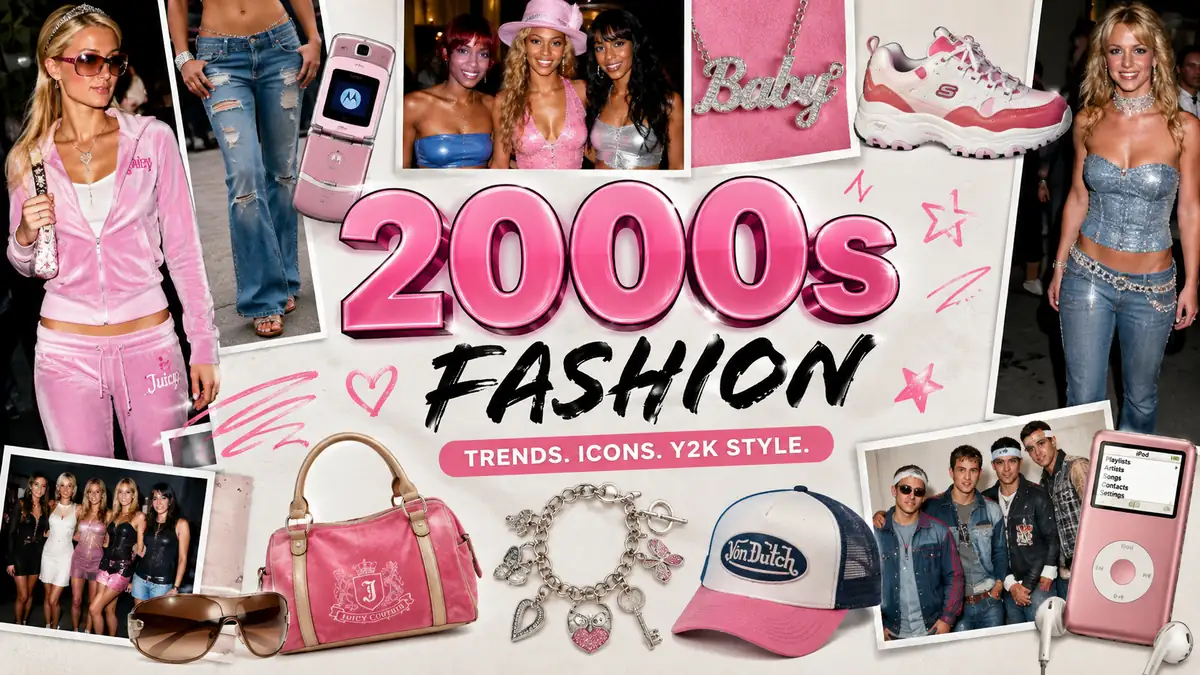
Few fashion decades are as instantly recognizable—or as debated—as the 2000s. Low-rise jeans, tiny shoulder bags, velour tracksuits, trucker hats, rhinestones, cargo pants, oversized sunglasses, and logo-covered accessories all competed for attention.
But 2000s fashion was much broader than the handful of Y2K trends now circulating on social media. The decade moved from futuristic millennium dressing and celebrity-driven glamour to boho chic, indie rock, skinny jeans, statement accessories, and increasingly accessible fast fashion.
The Fashion History Timeline at the Fashion Institute of Technology notes that the decade initially continued many late-1990s ideas, while technology and the rapid circulation of celebrity images increasingly influenced what people wore. Denim remained especially important throughout the period.
2000s fashion was an eclectic mix of futuristic Y2K styling, casual sportswear, denim, logomania, celebrity glamour, bohemian clothing, hip-hop influences, pop-punk and indie style. Signature pieces included low-rise jeans, cargo pants, crop tops, velour tracksuits, mini skirts, graphic tees, UGG boots, ballet flats, trucker hats, oversized sunglasses, and statement handbags.
What Defined 2000s Fashion?
The easiest mistake is treating the entire decade as one aesthetic.
Fashion in 2000 looked noticeably different from fashion in 2009. The beginning of the decade carried over elements of late-’90s minimalism while simultaneously embracing a shiny, technology-inspired vision of the future. By the middle of the decade, celebrity culture, boho dressing, designer bags, and casual glamour dominated. Later, silhouettes became slimmer and influences from indie music and the 1980s became increasingly visible.
Fashion historians consequently describe the decade as a mixture rather than a single unified look.
Several forces shaped that mixture:
- rapidly expanding internet culture
- celebrity magazines and paparazzi photography
- MTV and music videos
- reality television
- hip-hop, pop-punk, emo, and indie music
- designer logomania
- faster trend cycles
- expanding fast-fashion retail
- nostalgia for earlier decades
- technological optimism surrounding the new millennium
Celebrity style became particularly powerful. Britney Spears, Paris Hilton, Jennifer Lopez, Beyoncé, Christina Aguilera, Destiny’s Child, and other entertainment figures helped turn everyday outfits into widely copied looks.
The decade also marked an important transition in how people encountered fashion. Vogue describes the 2000s as fashion’s first digital decade, when celebrity culture and emerging digital media increasingly brought fashion directly to consumers.
Early 2000s Fashion and the Original Y2K Aesthetic
When people talk about Y2K fashion today, they are usually referring most strongly to the years around the turn of the millennium and the early 2000s.
“Y2K” literally refers to the year 2000, and the original aesthetic developed alongside excitement and anxiety about entering a technology-driven new millennium.
That atmosphere translated into clothing.
Silver, metallic fabrics, glossy materials, futuristic sunglasses, strappy tops, fitted silhouettes, bright colors, and playful accessories looked appropriate for a world fascinated by computers, the internet, and futuristic design.
Vogue characterizes the Y2K aesthetic as bold, shiny, body-conscious, and heavily connected with low-rise denim, crop tops, logos, It bags, platforms, strappy shoes, and other attention-grabbing pieces.
Low-Rise Jeans Became a Defining Look
Nothing symbolizes early 2000s fashion quite like low-rise jeans.
Waistbands moved dramatically downward compared with many earlier denim styles. Bootcut and flared legs were common, while jeans could be distressed, embellished, faded, or decorated with elaborate pockets.
They were often paired with:
- baby tees
- fitted tank tops
- halter tops
- crop tops
- camisoles
- statement belts
- pointed shoes
- sneakers
The combination deliberately emphasized the waist and midriff.
Low-rise denim became so closely associated with the era that its modern return has become one of the clearest signs of the wider Y2K revival. Even current interpretations, however, often use slightly higher rises and more relaxed proportions than some original versions.
Cargo Pants Mixed Utility With Pop Style
Cargo pants were another essential part of early 2000s wardrobes.
Rather than being purely practical, they appeared in denim, cotton, satin, and other materials. Some were extremely baggy; others sat low on the hips and were paired with tiny fitted tops.
The contrast became a recognizable Y2K formula: loose bottoms plus a fitted top.
Cargo styling also crossed cultural boundaries. Pop stars, hip-hop artists, skaters, and everyday teenagers could all wear versions of the trend while giving it completely different identities.
The Velour Tracksuit Turned Loungewear Into Fashion
One of the decade’s most memorable combinations required almost no complicated styling: matching velour pants and a zip-up hoodie.
Velour tracksuits blurred the boundary between sportswear, leisurewear, and celebrity fashion. Bright colors, fitted cuts, logos, and embellishments transformed an otherwise comfortable outfit into a status-conscious fashion statement.
Juicy Couture became especially associated with this aesthetic.
The tracksuit worked because it captured a central contradiction of 2000s style: people wanted to look glamorous while appearing casual.
That idea never really disappeared.
2000s Women’s Fashion Was Built on Contrasts
Women’s fashion during the decade could move from glamorous to deliberately casual within the same outfit.
A dressy handbag might accompany distressed jeans. UGG boots could appear with a mini skirt. A sparkling going-out top might be worn with ordinary denim.
That high-low mixture was part of the appeal.
Baby Tees, Tank Tops, and Going-Out Tops
Small fitted tops were everywhere.
Baby tees often featured graphics, slogans, logos, or playful prints. Camisoles and tank tops were frequently layered, while halter and scarf tops provided dressier alternatives.
Then there was the famous “going-out top.”
Instead of building an entire evening outfit, a typical formula involved pairing jeans with a noticeably dressier top featuring sequins, satin, lace, ruching, metallic fabric, or embellishment.
Simple idea. Very 2000s execution.
Denim Went Far Beyond Jeans
Denim was arguably the decade’s most persistent material.
Fashion History Timeline describes jeans as ubiquitous throughout the 2000s, even as other styles changed.
But denim did not stop at trousers.
The decade embraced:
- denim mini skirts
- denim jackets
- distressed denim
- embellished jeans
- bootcut jeans
- flared jeans
- skinny jeans
- denim dresses
- cropped denim
- head-to-toe denim combinations
Britney Spears and Justin Timberlake’s coordinated denim appearance in 2001 became one of the era’s most memorable celebrity fashion moments, demonstrating how completely denim had entered pop culture.
Mini Skirts and Dresses Over Pants
Some 2000s combinations make perfect sense today.
Others require a little historical context.
One of the most unmistakable layering trends involved wearing dresses or skirts over jeans or trousers. Tunics, asymmetric dresses, and floaty tops could all be layered over denim.
Modern Y2K revivals often select the easiest elements of the decade to reinterpret, but Vogue points out that skirts over pants and similar styling ideas have also resurfaced.
Fashion cycles rarely bring an era back exactly as it was.
They edit it.
Mid-2000s Fashion and the Rise of Boho Chic
By the middle of the decade, the glossy futurism associated with early Y2K style shared space with something much softer.
Boho chic became a major influence.
Instead of metallic fabrics and obvious futurism, this look favored flowing shapes, earthy colors, embroidery, layered necklaces, oversized handbags, wide belts, peasant tops, maxi skirts, and relaxed dresses.
Sienna Miller became particularly associated with the aesthetic, while celebrity street photography helped spread the look.
Typical boho-inspired pieces included:
- tiered skirts
- peasant blouses
- tunic tops
- wide leather belts
- crochet details
- embroidered clothing
- slouchy handbags
- oversized sunglasses
- cowboy boots
- layered jewelry
The popularity of boho demonstrates why reducing the entire decade to “Y2K” misses so much.
A person dressing fashionably in 2005 did not necessarily resemble someone following millennium-inspired trends in 2000.
2000s Fashion Accessories Were Impossible to Ignore
If the clothing could be bold, the accessories were often even louder.
Trucker Hats
Trucker hats moved from functional headwear into mainstream pop culture.
Von Dutch became one of the names most closely connected with the trend. Celebrities wearing logo-heavy trucker hats helped make them a recognizable symbol of early-2000s casual style.
Oversized Sunglasses
Subtle eyewear was not always the goal.
Large frames, tinted lenses, gradient lenses, wraparound designs, and shield-like sunglasses were widely visible throughout the decade.
They complemented the celebrity aesthetic perfectly: dramatic, recognizable, and useful for hiding from paparazzi—or at least looking as if you needed to.
Statement Belts
Because many jeans and trousers sat low on the hips, belts became highly visible.
Wide belts, studded belts, chain belts, metallic buckles, and decorative styles could transform otherwise simple outfits.
Tiny Bags and It Bags
The handbag became more than storage.
Designer bags functioned as visible status symbols, while smaller shoulder bags fit naturally with the fitted silhouettes of Y2K fashion.
Logomania played a major role. Louis Vuitton, Dior, Fendi and other luxury houses produced instantly recognizable bags that became deeply connected with celebrity culture.
Vogue identifies It bags and prominent logos as central features of early-2000s fashion.
Shoes That Defined 2000s Fashion
The decade produced an unusually broad footwear mix.
UGG Boots
UGG boots became a celebrity-casual phenomenon.
They appeared with jeans, leggings, tracksuits, and—perhaps most memorably—short skirts.
The unexpected proportions were part of the point.
Ballet Flats
As the decade progressed, ballet flats became a practical alternative to heels.
Simple round-toe designs worked with skinny jeans, leggings, skirts, and dresses and became particularly prominent toward the later 2000s.
Platform and Strappy Sandals
Y2K’s futuristic party aesthetic favored height and shine.
Platforms, kitten heels, strappy sandals, and open-toe mules provided different versions of the glamorous look. Vogue’s overview of Y2K style highlights pumps, ballet flats, strappy sandals, mules, chunky sneakers, and platforms as characteristic footwear.
2000s Men’s Fashion: From Baggy to Slim
Men’s fashion experienced its own dramatic transformation.
The early years leaned heavily toward relaxed silhouettes influenced by hip-hop, skate culture, sportswear, and late-’90s streetwear.
Common pieces included:
- baggy jeans
- cargo pants
- oversized graphic tees
- tracksuits
- hoodies
- basketball jerseys
- polo shirts
- chunky sneakers
- baseball caps
- trucker hats
- studded belts
Hip-hop style had enormous influence. Wide-leg denim, sneakers, tracksuits, prominent jewelry, baseball jackets, and flat-brim caps all became familiar components of youth fashion.
But the silhouette changed later.
By roughly the second half of the decade, skinny jeans, slim jackets, fitted cardigans, V-neck shirts, and indie-rock styling increasingly challenged the oversized proportions of the early 2000s. Contemporary fashion histories of men’s style similarly describe this shift from baggier early-decade clothing toward tighter late-decade silhouettes.
Music Subcultures Created Their Own 2000s Style
Mainstream celebrity fashion tells only part of the story.
Music scenes produced some of the decade’s most distinctive aesthetics.
Hip-Hop Fashion
Hip-hop had a major impact on mainstream clothing.
Baggy jeans, jerseys, tracksuits, sneakers, caps, statement jewelry, puffer jackets, and branded streetwear became influential well beyond music itself.
Sneaker culture also continued expanding, making footwear an increasingly important part of personal identity.
Pop-Punk and Emo Fashion
Pop-punk and emo offered a darker alternative to glossy celebrity glamour.
Typical elements included:
- band T-shirts
- skinny jeans
- studded belts
- hoodies
- Converse sneakers
- Vans
- dark eyeliner
- wristbands
- layered hairstyles
The aesthetic grew especially visible during the middle and later years of the decade.
Scene Style
Scene fashion pushed some emo and alternative ideas toward brighter, more exaggerated territory.
Colorful skinny jeans, graphic hoodies, neon accessories, dramatic hair, bows, cartoon imagery, Converse, Vans, and shutter-style sunglasses became associated with the look.
By the end of the decade, online communities were helping youth subcultures spread styles more rapidly than traditional fashion magazines ever could.
Late 2000s Fashion Changed the Silhouette
Around 2007–2009, fashion was moving away from several early-decade proportions.
Skinny jeans became increasingly important.
Leggings were worn as everyday clothing, often underneath oversized shirts, sweater dresses, or tunics. Ballet flats remained popular, while gladiator sandals became another recognizable footwear trend.
The 1980s revival also introduced:
- neon colors
- oversized tops
- leggings
- acid-wash denim
- geometric prints
- bold accessories
- fitted leather jackets
This period provided a bridge between 2000s fashion and many trends that would dominate the early 2010s.
Celebrity Culture Changed How Trends Spread
Celebrity influence was not invented in the 2000s, but the machinery surrounding it changed dramatically.
Reality television expanded. Celebrity magazines flourished. Paparazzi photographs circulated online. Fashion blogs emerged. Social platforms began appearing.
Suddenly an airport outfit or coffee-run tracksuit could attract nearly as much attention as a red-carpet dress.
Paris Hilton became strongly associated with velour tracksuits, mini dresses, oversized sunglasses, tiny bags, and overtly glamorous casualwear.
Britney Spears influenced denim, crop tops, tracksuits, and pop-star styling.
Jennifer Lopez helped define the era’s glamorous, body-conscious approach. Her green Versace dress at the 2000 Grammy Awards became a landmark fashion moment; Vogue notes that enormous online interest in images of the dress contributed to the development of Google Image Search.
Beyoncé and Destiny’s Child brought coordinated stage fashion, embellished denim, crop tops, bold color, and glamorous performance wear into the broader visual vocabulary of the decade.
These weren’t simply celebrity outfits.
They were becoming searchable images.
That distinction helped shape modern fashion culture.
Logomania and Fast Fashion Reshaped the Decade
Two seemingly opposite forces expanded simultaneously: luxury branding and inexpensive trend-driven clothing.
Logo-heavy bags, belts, tracksuits, sunglasses, and accessories communicated status immediately. Recognizable branding worked particularly well in an increasingly image-driven celebrity culture.
At the same time, consumers expected trends to reach stores faster.
Retailers such as Zara, H&M, and Forever 21 helped accelerate the fast-fashion model, allowing consumers to imitate changing runway and celebrity styles without luxury prices. Historical overviews identify this expansion of fast fashion and online retail as an important development during the decade.
That acceleration foreshadowed today’s much faster social-media trend cycle.
Y2K Fashion vs. 2000s Fashion: What’s the Difference?
The terms are often used interchangeably, but they are not identical.
| Y2K Fashion | 2000s Fashion |
|---|---|
| Closely associated with the millennium and early 2000s | Covers the entire 2000–2009 decade |
| Futuristic and technology-inspired | Includes many competing aesthetics |
| Metallics and bright colors | Includes metallics, earth tones, neon, dark alternative styles, and more |
| Low-rise denim and crop tops | Also includes boho, emo, indie, hip-hop, and late-decade skinny silhouettes |
| Glossy, playful aesthetic | Changes significantly from early to late decade |
| Often the focus of today’s revival | Broader historical fashion category |
So, is all 2000s fashion Y2K? No.
Y2K is one of the most influential aesthetics within the decade, but boho chic, emo, scene, indie, hip-hop, and the late-2000s 1980s revival are also important parts of the period.
That distinction matters if you’re trying to recreate an authentic look rather than a social-media interpretation of the decade.
Why Is 2000s Fashion Popular Again?
Fashion rarely moves in a straight line.
A new generation eventually rediscovers the clothing that an older generation recently considered outdated.
That cycle is especially visible with Y2K.
Gen Z has revisited low-rise and baggy denim, baby tees, cargo pants, ballet flats, capri pants, mini bags, UGG boots, and other recognizable 2000s pieces. Vogue has connected this revival partly to generational reinterpretation: younger designers and consumers are revisiting the cultural references of the era rather than simply reproducing complete historical outfits.
The revival remains active. Recent fashion coverage continues to highlight early-2000s references including low-rise denim, capris, halter tops, velour tracksuits, cargo pants, and oversized sunglasses.
Nostalgia is only one reason.
Today’s digital culture is particularly suited to Y2K imagery. Metallic accessories, bright colors, tiny tops, distinctive sunglasses, chunky shoes, and recognizable silhouettes communicate an aesthetic instantly on a small screen.
Ironically, an era shaped by the early internet has become perfectly suited to the social-media age.
How to Wear 2000s Fashion Today Without Looking Like a Costume
Recreating the decade does not require copying a 2003 celebrity photograph piece for piece.
Usually, one or two recognizable references work better.
1. Start With the Denim
Choose bootcut, flared, baggy, or low-rise jeans depending on the specific 2000s aesthetic you want.
Pair them with a simple baby tee or fitted tank.
That alone establishes the reference.
2. Balance the Proportions
One of the most useful early-2000s formulas was a small top with larger trousers.
Try:
fitted baby tee + relaxed cargo pants + sneakers
The proportions communicate Y2K without relying on excessive logos or accessories.
3. Add One Recognizable Accessory
A baguette-style shoulder bag, tinted sunglasses, statement belt, trucker hat, or chunky necklace can shift an otherwise contemporary outfit toward the decade.
You do not need all of them simultaneously.
4. Modernize the Most Extreme Trends
You can reference low-rise jeans without choosing the lowest possible waistband.
Likewise, a velour zip hoodie can work with modern straight-leg denim instead of a complete matching tracksuit.
This approach captures the influence without turning the outfit into fancy dress.
5. Choose a Specific 2000s Subculture
Instead of mixing every trend together, decide which part of the decade you actually like.
For example:
Y2K pop: low-rise jeans, baby tee, shoulder bag, tinted sunglasses.
Boho: flowing skirt, fitted tank, slouchy bag, layered jewelry.
Pop-punk: band tee, skinny jeans, studded belt, Converse.
Hip-hop inspired: relaxed denim, oversized graphic tee, sneakers, cap.
Late-2000s indie: skinny jeans, fitted jacket, graphic tee, ankle boots.
The outfit immediately feels more intentional.
The Real Legacy of 2000s Fashion
The biggest legacy of 2000s fashion may not be any individual garment.
It was the changing speed and visibility of fashion itself.
The decade began when magazines, television, music videos, and physical stores still played enormous roles in discovering trends. It ended with social media emerging, online shopping becoming normal, celebrity images circulating instantly, and digital culture changing how people consumed style.
The clothes captured that transition.
Low-rise jeans, velour tracksuits, cargo pants, baby tees, UGG boots, designer It bags, ballet flats, trucker hats, skinny jeans, boho dresses, oversized sunglasses, and graphic tees now act as visual shorthand for the era. Yet the full decade was far more diverse than its most nostalgic images suggest.
That is precisely why its revival has lasted.
You can borrow the futuristic optimism of early Y2K, the relaxed glamour of celebrity street style, mid-decade boho, hip-hop’s oversized silhouettes, pop-punk attitude, or late-2000s indie minimalism.
The most convincing way to revisit the era is not to reproduce every famous trend at once. Pick the pieces that still make sense, understand where they came from, and reinterpret them for the way people dress now.