
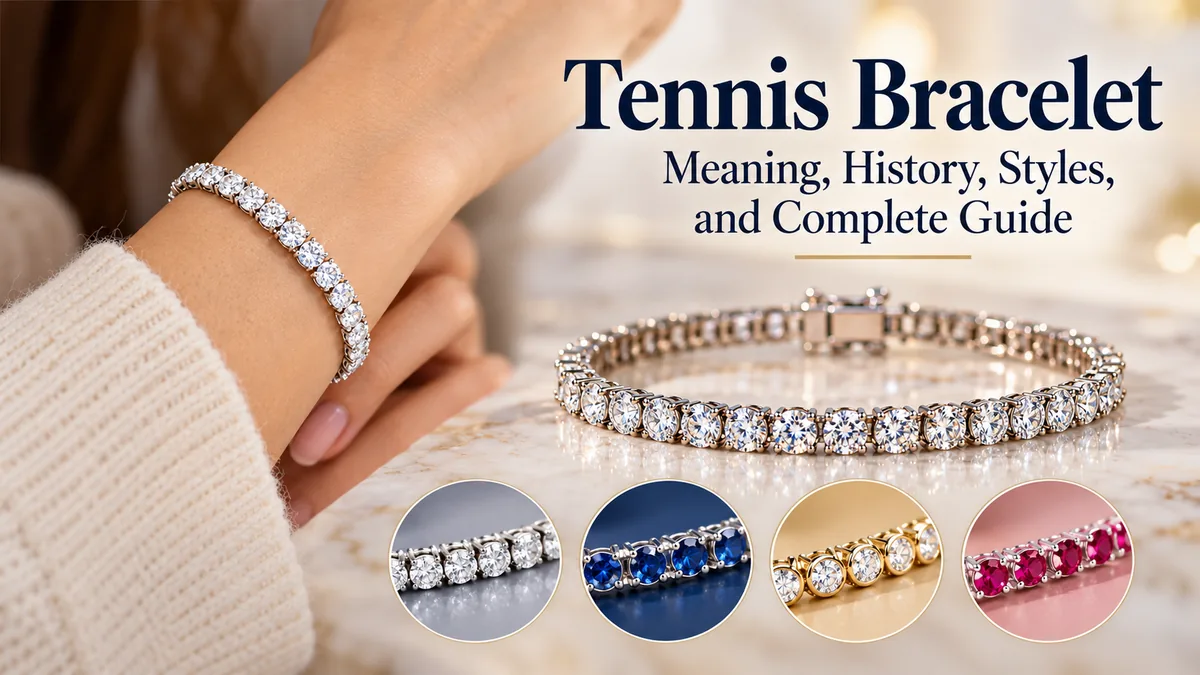
Few pieces of jewelry combine simplicity and elegance as naturally as a tennis bracelet. Its continuous line of sparkling stones creates a timeless look that works with everyday outfits, formal clothing, and special occasions.
But what exactly makes a bracelet a tennis bracelet, and why does it have such an unusual name?
A tennis bracelet is a flexible jewelry bracelet featuring a continuous or nearly continuous row of individually set gemstones, traditionally diamonds, connected by small metal links. Most designs use gold or platinum and include a secure clasp. Its name became popular through an association with professional tennis player Chris Evert.
Understanding the design, history, gemstone quality, materials, and proper fit makes it easier to recognize the craftsmanship behind this classic jewelry style.
What Is a tennis bracelet?
A tennis bracelet is a type of fine jewelry distinguished by its symmetrical arrangement of gemstones along a flexible chain or linked setting.
Unlike a charm bracelet, which features hanging decorative elements, or a bangle, which maintains a rigid circular shape, a tennis bracelet bends naturally around the wrist.
The traditional version contains round brilliant-cut diamonds set in precious metal. However, modern variations feature lab-grown diamonds, sapphires, emeralds, rubies, moissanite, and cubic zirconia.
Key characteristics of a tennis bracelet
Most traditional designs share several recognizable features:
- Continuous gemstone arrangement: Stones form a consistent line around the wrist.
- Flexible construction: Small articulated links allow comfortable movement.
- Individual stone settings: Prongs or bezels hold each gemstone securely.
- Balanced appearance: Matching stones create a uniform visual pattern.
- Secure closure: A box clasp, often with an additional safety mechanism, helps prevent accidental opening.
- Minimalist styling: The design emphasizes gemstones rather than large decorative components.
Some contemporary bracelets use graduated gemstones, alternating colors, or multiple rows, but the flexible line of stones remains their defining feature.
How is it different from a regular bracelet?
The distinction lies primarily in construction and gemstone arrangement.
| Feature | Tennis bracelet | Regular chain bracelet | Bangle |
|---|---|---|---|
| Structure | Flexible linked settings | Flexible chain links | Usually rigid |
| Gemstones | Continuous or near-continuous line | Optional | Optional |
| Appearance | Symmetrical and refined | Varies widely | Solid circular form |
| Closure | Usually a clasp | Usually a clasp | Slip-on or hinged |
| Common materials | Gold, platinum, silver | Gold, silver, steel | Various metals |
| Typical styling | Everyday to formal | Casual to formal | Casual to formal |
A tennis bracelet is therefore a specific bracelet design rather than simply another name for a diamond bracelet.
Why Is It Called a tennis bracelet?
The name has an interesting connection to professional tennis and one of the sport’s most recognizable players.
The Chris Evert connection

The name is widely associated with Chris Evert, the American tennis champion who regularly wore a diamond line bracelet during matches.
The best-known story concerns the 1987 US Open, when Evert’s diamond bracelet reportedly came loose during a match. Play was interrupted while the jewelry was recovered.
The incident helped popularize the term tennis bracelet, although accounts of the precise history and timing of the name differ.
Before the tennis connection, similar designs were commonly called diamond line bracelets or eternity bracelets.
Why did the name become so popular?
The association with a world-famous athlete made the jewelry memorable.
Evert’s bracelet also challenged the traditional separation between fine jewelry and sportswear. A delicate diamond bracelet was no longer viewed exclusively as something reserved for evening events.
Over time, the name became standard terminology among jewelers and jewelry enthusiasts.
Today, tennis bracelets remain popular even among people who have never played tennis.
Different Types of Tennis Bracelets
Tennis bracelets come in several designs, distinguished by gemstone arrangement, setting style, number of rows, and materials.

Classic single-row
One continuous line of evenly matched stones.

Multi-row
Two or more parallel lines for a wider appearance.

Bezel-set
Metal surrounds each gemstone’s edge.

Graduated
Stone sizes increase toward the center.
Classic diamond tennis bracelet
The classic design features a single row of round brilliant-cut diamonds, usually secured in three-prong or four-prong settings.
Round diamonds are particularly common because their faceting produces noticeable brilliance when exposed to light.
The uniform arrangement creates a balanced appearance that pairs easily with other jewelry.
Bezel-set tennis bracelet
A bezel setting surrounds the outer edge of each gemstone with a thin metal rim.
This design offers a smoother profile and protects more of the gemstone’s perimeter from direct impact.
However, the additional surrounding metal can change how much of the stone is visible compared with an open prong setting.
Multi-row tennis bracelet
Multi-row designs contain two, three, or more parallel lines of gemstones.
They create a broader, more noticeable appearance and generally require more stones than comparable single-row designs.
The additional weight and width can influence comfort, especially during extended wear.
Graduated tennis bracelet
Graduated bracelets use stones of different sizes, usually placing larger gemstones near the center and smaller ones toward the ends.
This arrangement creates a focal point while preserving the flexible construction of the traditional design.
Colored gemstone tennis bracelet
Not every tennis bracelet contains diamonds.
Popular alternatives include:
- Blue sapphires for rich, deep color
- Rubies for vivid red tones
- Emeralds for distinctive green hues
- Pink sapphires for softer color
- Aquamarines for pale blue tones
- Mixed gemstones for multicolored patterns
Gemstone hardness, toughness, and setting protection should be considered because not all colored stones tolerate daily wear equally well.
Tennis Bracelet Materials and Diamond Quality
The appearance and durability of a bracelet depend on more than its overall design.
Metal composition, gemstone quality, setting construction, and craftsmanship all influence how the piece performs over time.
Natural diamonds vs. lab-grown diamonds
Natural and laboratory-grown diamonds share essentially the same chemical composition and crystal structure.
Their main distinction is origin.
Natural diamonds form through geological processes, while lab-grown diamonds are produced using controlled technological methods such as high-pressure high-temperature (HPHT) or chemical vapor deposition (CVD).
| Characteristic | Natural diamond | Lab-grown diamond |
|---|---|---|
| Composition | Crystalline carbon | Crystalline carbon |
| Hardness | 10 on Mohs scale | 10 on Mohs scale |
| Formation | Geological processes | Laboratory processes |
| Appearance | Depends on quality | Depends on quality |
| Origin | Mined | Manufactured |
| Market pricing | Generally higher for comparable specifications | Generally lower for comparable specifications |
Lab-grown diamonds are genuine diamonds, not diamond simulants.
Moissanite and cubic zirconia alternatives
Moissanite and cubic zirconia are commonly used in diamond-like jewelry, but neither is diamond.
Moissanite is silicon carbide and has a hardness of approximately 9.25 on the Mohs scale. It is known for its strong brilliance and colorful fire.
Cubic zirconia is a manufactured zirconium dioxide material, typically rated around 8–8.5 on the Mohs scale. It offers a diamond-like appearance but is more susceptible to surface scratching and wear.
These differences can become more noticeable after extended use.
Understanding the 4Cs of diamonds
Diamond quality is often described using the 4Cs established by the Gemological Institute of America (GIA).
Cut: Describes the quality of a diamond’s proportions, symmetry, and light performance. GIA’s overall cut grade applies specifically to standard round brilliant diamonds within its grading system.
Color: For diamonds in the D-to-Z range, grades describe how colorless or tinted a diamond appears. D represents the colorless end of the scale.
Clarity: Evaluates internal inclusions and external blemishes.
Carat weight: Measures diamond weight, not physical dimensions. One carat equals 0.2 grams.
For a bracelet containing many diamonds, visual consistency between neighboring stones can be just as noticeable as the grade of any individual diamond.
What does total carat weight mean?
Tennis bracelets are commonly described using total carat weight, abbreviated as TCW or CTW.
For example, a bracelet labeled 3.00 CTW contains diamonds whose combined weight is approximately three carats.
It does not mean that each diamond weighs three carats.
A bracelet containing 50 equal-sized diamonds with a combined weight of 3.00 carats would have an average diamond weight of:
\[ 3.00 \div 50 = 0.06 \text{ carats} \]
Actual stone sizes may vary depending on the design.
Common metals used in tennis bracelets

The metal affects color, durability, weight, and maintenance.
| Metal | Main characteristics | Considerations |
|---|---|---|
| 14K yellow gold | Warm color, relatively durable alloy | May scratch with wear |
| 18K yellow gold | Richer gold content and color | Generally softer than 14K alloys |
| White gold | Bright, silvery appearance | Some pieces require rhodium replating |
| Rose gold | Pinkish color from copper alloys | Copper content may matter for sensitive skin |
| Platinum | Naturally white, dense precious metal | Heavier and develops surface patina |
| Sterling silver | Accessible precious-metal option | Tarnishes and may need more maintenance |
Gold purity is expressed in karats. For example, 14K gold contains approximately 58.3% gold, while 18K contains 75%.
A metal’s suitability also depends on the exact alloy and the quality of the bracelet’s construction.
How Should a Tennis Bracelet Fit?
A properly fitted tennis bracelet should rest comfortably against the wrist while allowing enough movement for its linked construction to flex naturally.
An excessively tight bracelet may pull against the settings and clasp. One that is too loose can rotate constantly, catch on objects, or slip toward the hand.
How to measure your wrist

Measure around the wrist where the bracelet will normally sit.
Follow these steps:
- Wrap a flexible measuring tape around your wrist, near the wrist bone.
- Record the measurement without pulling the tape too tightly.
- Add approximately 1–1.5 cm (0.4–0.6 inches) for comfortable movement.
- Check whether one finger can fit between the bracelet and your wrist.
- Confirm that the bracelet cannot easily slide over your hand.
For example, a wrist measuring 16 cm may fit comfortably in a bracelet approximately 17–17.5 cm long, depending on its construction.
The one-finger guideline is widely recommended by jewelry specialists, including GIA.
GIA 4Cs
+1
Tennis bracelet size chart
The following measurements are approximate starting points rather than universal sizing standards.
| Wrist circumference | Suggested bracelet length |
|---|---|
| 14 cm (5.5 in) | 15–15.5 cm |
| 15 cm (5.9 in) | 16–16.5 cm |
| 16 cm (6.3 in) | 17–17.5 cm |
| 17 cm (6.7 in) | 18–18.5 cm |
| 18 cm (7.1 in) | 19–19.5 cm |
| 19 cm (7.5 in) | 20–20.5 cm |
Bracelets containing large gemstones or thick settings may require additional length because the construction reduces the effective internal circumference.
Can a tennis bracelet be resized?
Many tennis bracelets can be shortened by removing links or individual gemstone settings.
Lengthening may also be possible when compatible links and gemstones are available.
However, resizing requires specialized jewelry work. The complexity depends on the setting, metal, stone arrangement, and clasp construction.
A professional jeweler should inspect the bracelet before attempting alterations.
How to Recognize a High-Quality Tennis Bracelet
A bracelet’s quality cannot be determined by sparkle alone.
Construction details often reveal more about its durability than the number or size of gemstones.
Examine the gemstone settings
Each gemstone should sit securely within its mounting.
Look for consistent alignment, evenly spaced stones, and prongs that do not appear bent or excessively thin.
A loose stone may produce a faint rattling sound when the bracelet moves, although not every loose setting creates an audible warning.
Channel settings, which hold gemstones between two continuous metal walls, offer a different appearance from traditional prongs. They can create a smooth profile but still require careful inspection.
Check the clasp and safety mechanism

A reliable closure is one of the most important construction features.
Common mechanisms include:
- Box clasp: A tongue-shaped component fits into a receiving box.
- Figure-eight safety latch: A secondary loop fastens over a small post.
- Side safety catch: An additional locking component provides backup security.
- Lobster clasp: A spring-operated closure used on some lightweight designs.
A clasp should close positively without requiring excessive force.
GIA specifically recommends additional safety catches and routine professional inspections to help reduce the risk of losing a bracelet.
GIA 4Cs
Evaluate gemstone matching
Traditional tennis bracelets achieve their distinctive appearance through consistent gemstones.
Compare neighboring stones for noticeable differences in:
- Color
- Diameter
- Brilliance
- Shape
- Setting height
- Spacing
Small variations are normal, particularly in handcrafted jewelry. However, significant differences can interrupt the bracelet’s visual continuity.
Test flexibility and comfort
A well-constructed bracelet should bend smoothly along its links without obvious stiffness or twisting.
When laid flat, the gemstones should follow an orderly line.
When worn, the bracelet should curve naturally around the wrist without creating uncomfortable pressure points.
Flexibility does not mean the bracelet should stretch. Most traditional diamond tennis bracelets are not elastic.
Understand gemstone documentation
Diamond grading reports and jewelry appraisals serve different purposes.
A laboratory grading report describes characteristics of the diamond or gemstone examined. An appraisal estimates value for a specified purpose, such as insurance.
A complete tennis bracelet may contain dozens of small diamonds that are not individually graded.
Consequently, a document describing the bracelet’s total weight and estimated quality is not equivalent to individual laboratory reports for every stone.
How Much Does a Tennis Bracelet Cost?
Tennis bracelet prices vary substantially depending on gemstone type, total carat weight, metal, craftsmanship, and brand.
There is no universal price because bracelets that look similar in photographs can have very different materials and specifications.
Main factors affecting price
| Factor | How it influences cost |
|---|---|
| Gemstone origin | Natural diamonds often cost more than comparable lab-grown diamonds |
| Total carat weight | Greater combined diamond weight generally increases cost |
| Diamond quality | Cut, color, clarity, and matching affect valuation |
| Metal | Platinum and gold usually cost more than silver or base metals |
| Construction | Complex settings and precise craftsmanship add labor |
| Brand | Designer recognition and retail positioning can influence pricing |
A cubic zirconia bracelet made from plated base metal may cost a small fraction of a platinum bracelet containing natural diamonds.
Even among diamond bracelets, two pieces with identical total carat weights may have noticeably different prices because of their gemstone quality and construction.
Is a tennis bracelet a good investment?
A fine jewelry bracelet may retain some material value, but it should not automatically be treated as a financial investment.
Retail prices include manufacturing, distribution, branding, and other costs that may not be recovered during resale.
Natural diamond resale values vary, while lab-grown diamond prices have experienced significant market changes.
Precious-metal content may contribute to resale value, but the condition of the jewelry and current market demand also matter.
For insurance purposes, an up-to-date appraisal can help document replacement value. That amount should not be confused with an expected resale price.
How to Style a Tennis Bracelet
One reason tennis bracelets have remained fashionable is their versatility.
Their symmetrical design complements a wide range of clothing and accessories without requiring elaborate styling.
Wearing a tennis bracelet every day

A slim single-row bracelet works well with everyday clothing, including knitwear, shirts, and tailored outfits.
Smaller gemstones generally create a more understated appearance.
For frequent wear, smooth settings and secure clasps are especially helpful because bracelets regularly come into contact with desks, sleeves, bags, and other surfaces.
Pairing a tennis bracelet with a watch
A tennis bracelet can be worn alongside a wristwatch.
A narrow bracelet often complements a minimalist watch, while a wider gemstone bracelet creates a more noticeable contrast.
Wearing both on the same wrist may cause metal and gemstones to rub against the watch case or bracelet.
For delicate watches or gemstone settings, wearing them on separate wrists can reduce contact and potential scratching.
Stacking multiple bracelets
Bracelet stacking involves wearing several pieces together.
Popular combinations include a diamond tennis bracelet with a simple gold chain, a slim bangle, or another gemstone bracelet.
The most comfortable combinations typically use bracelets with compatible sizes and profiles.
Heavy stacking can increase friction between settings, potentially loosening stones or damaging polished surfaces.
Styling for formal occasions
For weddings, celebrations, and evening events, a tennis bracelet can complement diamond stud earrings, a pendant necklace, or a simple ring.
A classic white diamond design pairs with many colors, while sapphire or ruby versions can introduce a stronger visual accent.
A bracelet with larger stones may become the focal point of an outfit, making additional statement jewelry unnecessary.
Can men wear tennis bracelets?
Yes. Tennis bracelets are not limited to women’s jewelry.
Men’s designs may feature wider links, larger gemstones, black diamonds, darker metals, or more substantial settings.
However, classic single-row bracelets are also suitable for anyone who prefers a refined, understated style.
The main considerations are wrist size, comfort, and personal preference rather than gender.
How to Clean and Care for a Tennis Bracelet
Regular maintenance helps preserve the appearance of gemstones and reduces the likelihood of unnoticed setting problems.
Diamonds are extremely resistant to scratching, but they are not indestructible. Strong impacts can chip a diamond, especially near vulnerable edges.
Gold, silver, and platinum settings can also bend, scratch, or wear over time.
How to clean a diamond tennis bracelet at home
For a structurally sound diamond bracelet with a suitable metal setting, gentle cleaning is usually sufficient.
- Inspect the bracelet for loose stones or damaged prongs before cleaning.
- Mix a small amount of mild dish soap with lukewarm water.
- Gently clean accessible surfaces using a very soft brush.
- Rinse carefully in a small bowl of clean water rather than over an open drain.
- Dry with a soft, lint-free cloth.
- Allow the bracelet to dry completely before storing it.
Avoid harsh household cleaners, abrasive products, and excessive scrubbing.
These instructions are not appropriate for every gemstone. Emeralds, treated stones, porous gems, and certain assembled jewelry pieces may require specialized cleaning.
If the bracelet has loose stones or damaged settings, professional inspection should come before cleaning.
Can you shower with a tennis bracelet?
Removing the bracelet before showering is generally advisable.
Soap residue, shampoo, and other products can accumulate around gemstone settings and reduce visible sparkle.
Repeated exposure to moisture and chemicals may also affect some metal finishes and gemstone treatments.
Swimming pools introduce additional concerns because chlorine can damage certain jewelry alloys over time.
Can you sleep wearing a tennis bracelet?
Although some people wear tennis bracelets continuously, removing them before sleeping helps reduce unnecessary stress on the links and clasp.
Bedding can catch on raised prongs, and movement during sleep may place pressure on delicate settings.
Removing the bracelet is particularly sensible if it contains larger gemstones or has a high-profile design.
How should you store it?
Store the bracelet in a separate soft-lined compartment or jewelry pouch.
Avoid placing it directly against other gemstone jewelry, especially pieces with exposed diamonds.
Diamonds can scratch other diamonds and many other jewelry materials when stored in contact.
Before putting the bracelet away, fasten the clasp and arrange it without sharp bends.
How often should a tennis bracelet be inspected?
A professional inspection approximately every 6–12 months is a reasonable maintenance practice for frequently worn diamond bracelets.
More frequent checks may be appropriate if the bracelet receives heavy use or has previously required repairs.
A jeweler can examine the prongs, links, clasp, safety catches, and gemstone security.
GIA also emphasizes routine inspections and cleaning as important parts of tennis bracelet maintenance.
GIA 4Cs
Common Tennis Bracelet Problems and How to Prevent Them
Even a carefully made bracelet can develop issues after years of use.
Recognizing early warning signs can prevent minor damage from becoming more serious.
Loose or missing gemstones
A gemstone may become loose when a prong bends, wears down, or suffers an impact.
If a stone appears unstable, stop wearing the bracelet until a jeweler examines it.
Continuing to wear a bracelet with a loose setting increases the possibility of losing the gemstone.
Broken clasp
Clasps experience repeated movement and mechanical stress.
A closure that no longer clicks securely, opens unexpectedly, or feels unusually loose should be repaired.
A secondary safety latch offers additional protection but does not replace a functioning main clasp.
Twisted or stiff links
Articulated bracelet links should move smoothly.
If a section becomes rigid, twisted, or unusually loose, forcing it back into position may worsen the damage.
Professional inspection can determine whether the problem involves a bent connector, worn joint, or damaged setting.
Dull-looking diamonds
Diamonds attract oils and can collect residue from skin-care products and everyday handling.
This buildup may reduce their apparent brilliance even when the gemstones themselves remain undamaged.
Gentle cleaning often restores sparkle, provided the stones and settings are secure.
Skin irritation
Some people experience irritation from certain metal alloys, particularly those containing nickel.
A bracelet described as gold or silver may still contain alloying metals.
If irritation occurs, discontinue wear and consult an appropriate professional if symptoms persist.
Metal composition and any plating should be verified rather than assuming a particular precious-metal label guarantees compatibility.
Tennis Bracelet vs. Tennis Necklace
A tennis necklace uses a similar continuous gemstone arrangement but is designed to rest around the neck rather than the wrist.

Tennis bracelet
Flexible gemstone line designed for the wrist.

Tennis necklace
Longer gemstone line designed for the neck.
Both styles may feature round, oval, emerald-cut, or princess-cut diamonds.
The main differences involve length, curvature, weight distribution, and the way the jewelry sits against the body.
A necklace typically requires more gemstones because it covers a longer distance.
The two pieces can also be worn together as a coordinated jewelry set.
Why Tennis Bracelets Remain Popular
The lasting appeal of tennis bracelets comes from their uncomplicated design.
Unlike jewelry built around a large central ornament, a traditional tennis bracelet distributes visual interest evenly around the wrist.
Its appearance also adapts to changing fashion trends.
The same basic construction can support classic diamonds, colorful gemstones, modern bezel settings, or contemporary mixed-metal designs.
The style continues to appear in professional tennis and celebrity fashion. Players including Serena Williams and Maria Sharapova have helped sustain the broader association between fine jewelry and tennis.
Vogue
Beyond fashion, the bracelet’s flexible construction makes it comfortable for many everyday situations when appropriately fitted and maintained.
Its simplicity is also the reason the design has remained recognizable for decades.
Final Thoughts on the tennis bracelet
A tennis bracelet is more than a continuous row of sparkling stones. It is a distinctive jewelry design combining flexible construction, carefully matched gemstones, and understated elegance.
Its famous association with Chris Evert gave the style a memorable name, but its appeal comes from its balanced appearance and versatility.
Understanding gemstone quality, metal choices, clasp security, sizing, and maintenance makes it easier to appreciate what separates a well-crafted bracelet from one that merely looks attractive.
For anyone learning about fine jewelry, the tennis bracelet is an excellent example of how thoughtful construction and simple design can create something enduring.
