
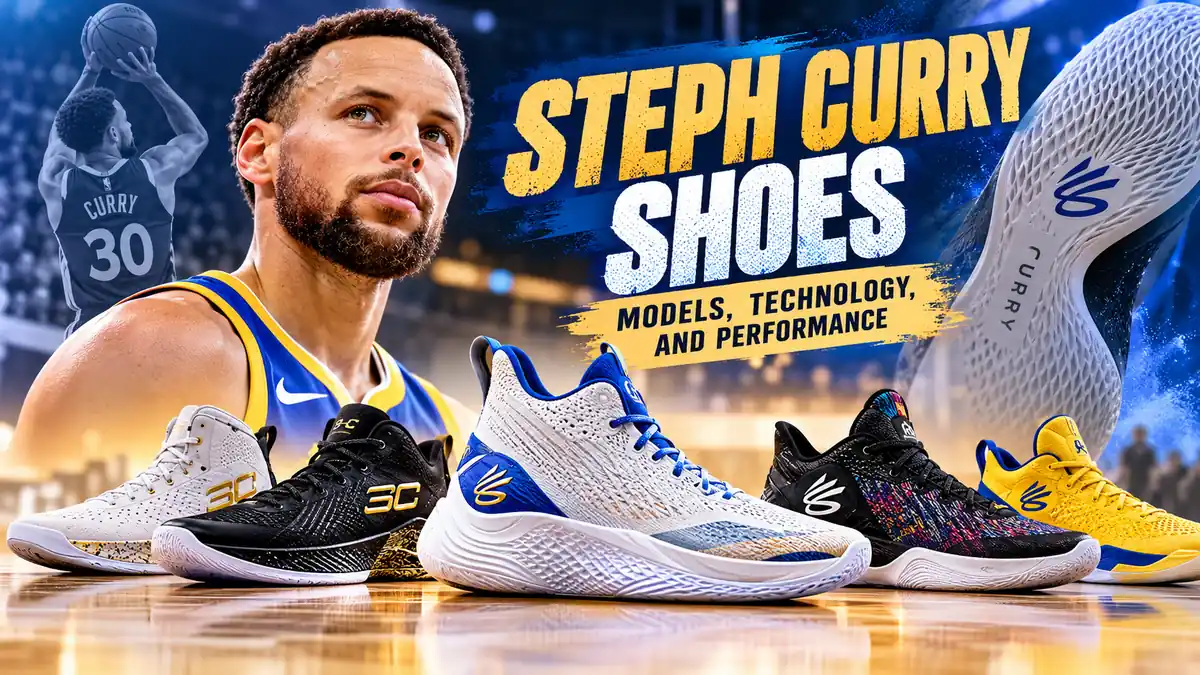
Few basketball players have influenced the modern game as dramatically as Stephen Curry. His extraordinary shooting range, quick footwork, and ability to change direction have also shaped the design of his signature footwear.
The story of steph curry shoes goes beyond recognizable designs and player endorsements. It involves years of experimentation with traction, cushioning, stability, and lightweight construction to support one of the NBA’s most distinctive playing styles.
Steph Curry shoes are signature basketball sneakers associated with NBA superstar Stephen Curry, best known for his partnership with Under Armour and the development of Curry Brand. The collection emphasizes responsive cushioning, court grip, lateral stability, and lightweight movement, with technologies such as UA Flow and UA HOVR appearing across different generations.
Understanding how these shoes evolved can help basketball players appreciate their design, performance characteristics, and influence on modern basketball footwear.
What Are steph curry shoes?
Steph Curry shoes are basketball sneakers developed around the playing style and professional identity of Stephen Curry, the Golden State Warriors point guard and four-time NBA champion.
Curry’s signature footwear became widely recognized through his long-running relationship with Under Armour, which began in 2013 after his earlier association with Nike.
His first official Under Armour signature basketball shoe, the Curry One, debuted in 2015.
Unlike basketball shoes primarily designed around powerful jumping and above-the-rim play, Curry’s footwear has historically emphasized the demands of a guard who relies on:
- Rapid acceleration and deceleration.
- Sharp cuts and lateral movement.
- Reliable traction during sudden changes of direction.
- Stability when planting the feet for jump shots.
- Responsive cushioning during extended playing sessions.
- Lightweight construction that supports quick footwork.
These priorities reflect Curry’s approach to basketball, although individual models differ significantly in their materials and performance.
Why Stephen Curry’s Playing Style Matters
Stephen Curry transformed expectations for NBA point guards through his three-point shooting, movement without the ball, and ability to create space against defenders.
His footwear must accommodate repeated movements such as step-back jump shots, crossovers, hesitation dribbles, and quick changes of direction.
For example, a player attempting a step-back three-pointer needs enough grip to stop abruptly without excessive sliding.
At the same time, the shoe must allow the foot to transition smoothly from movement into a balanced shooting position.
This relationship between movement and footwear explains why traction and court feel feature prominently in discussions of Curry basketball shoes.
The History and Evolution of Steph Curry Signature Shoes
The development of Curry’s signature sneakers reflects changes in basketball footwear technology over more than a decade.
Early releases focused on conventional rubber outsoles, foam cushioning, and supportive uppers. Later generations introduced more experimental materials and traction systems.
Early Curry Signature Models

Curry One (2015)
The first signature model introduced UA Charged Cushioning and Anafoam construction, helping establish Curry’s footwear identity during his first NBA MVP season.

Curry Two (2015)
Known for its supportive upper and responsive platform, the Curry Two became closely associated with Curry’s historic 2015–16 season, when he became the NBA’s first unanimous MVP.

Curry 3 (2016)
This generation emphasized structure and lateral support, including the use of Threadborne-related upper technology.

Curry 4 (2017)
Featuring a streamlined silhouette and distinctive knit collar, the Curry 4 became associated with the Warriors’ 2017 championship run.
The Transition Toward Modern Performance Designs
The Curry 5, Curry 6, and Curry 7 continued experimenting with lightweight construction, cushioning responsiveness, and traction.
The Curry 6 used UA HOVR cushioning, a technology designed to provide a balance between impact absorption and energy return.
The Curry 7 combined HOVR and Micro G cushioning concepts, seeking to balance comfort with responsiveness.
These models demonstrated that the Curry series was not built around one unchanging design formula.
Instead, the technology evolved as Under Armour developed new materials and responded to changing expectations among basketball players.
The Introduction of Curry Brand
In 2020, Under Armour introduced Curry Brand as a dedicated brand associated with Stephen Curry.
The initiative expanded his presence beyond individual signature shoe releases into basketball apparel, footwear, and community-focused initiatives.
Curry Brand also became closely associated with UA Flow, a cushioning and traction technology that substantially changed the construction of several subsequent Curry models.
This was an important development because the brand could build a more recognizable identity around Curry’s playing philosophy rather than treating each shoe as an isolated release.
Curry 8 Through Curry 13: The Flow Era

Curry Flow 8 (2020)
Introduced UA Flow technology, eliminating the need for a traditional rubber outsole. It became a defining release for Curry Brand.

Curry Flow 9 (2021)
Continued using Flow cushioning while introducing updated upper construction and memorable Sesame Street collaborations.

Curry Flow 10 (2022)
Combined UA Flow with UA Warp upper technology, designed to improve foot containment during explosive movements.

Curry 11 (2023)
Refined the Flow platform with dual-density cushioning to provide a more balanced combination of responsiveness and comfort.

Curry 12 (2024)
Featured improved Flow cushioning, strong indoor traction, and a lightweight engineered-mesh upper. Performance reviewers praised its comfort and grip.
WearTesters
+1

Curry 13 (2026)
Released as the final Curry Brand signature shoe produced through the Under Armour partnership, marking the end of an important chapter in the collection’s history.
What Changed in 2025 and 2026?
An important development occurred on November 13, 2025, when Under Armour and Stephen Curry announced their decision to separate Curry Brand from the sportswear company.
Under the agreement, Curry Brand would become independent, while Under Armour would complete the Curry 13 release in February 2026 and continue additional planned products through October 2026.
This means the history of Steph Curry footwear should no longer be described as an uninterrupted, ongoing exclusive partnership with Under Armour.
The Curry 13 represents the final signature release from that collaboration, although the Curry Brand identity and its future are separate matters.
PR Newswire
+1
Technology Behind steph curry shoes
The defining characteristics of Curry basketball sneakers come from their traction systems, cushioning platforms, and supportive construction.
Understanding these technologies makes it easier to distinguish one generation from another.
UA Flow Cushioning and Traction
UA Flow is one of the most recognizable technologies associated with modern Curry footwear.
Traditional basketball sneakers generally combine a cushioning midsole with a separate rubber outsole.
Flow uses a specialized foam platform that provides both cushioning and direct contact with the playing surface.
This construction offers several potential advantages:
- Reduced weight by eliminating a separate rubber outsole.
- Direct court contact and responsive movement.
- Strong grip on suitable indoor basketball surfaces.
- Smooth transitions between acceleration and stopping.
- A relatively low-profile playing experience.
However, Flow also has limitations.
The exposed foam can wear more quickly on abrasive outdoor courts than some durable rubber outsole compounds.
Dust accumulation can also affect traction, depending on the court surface and the specific model.
Independent testing of the Curry 12 highlighted excellent grip and improved cushioning while identifying outdoor durability as a weakness.
WearTesters
UA HOVR and Micro G Cushioning
Before Flow became central to the signature collection, several Curry models used Under Armour’s other cushioning technologies.
UA HOVR is designed to balance impact absorption with responsiveness. It appeared in models such as the Curry 6 and Curry 7.
Micro G is a lightweight foam cushioning technology used in various Under Armour basketball shoes, including footwear associated with Curry’s earlier career.
These cushioning systems differ in firmness, rebound sensation, and overall court feel.
A softer platform may feel more comfortable during repeated landings, while a firmer platform can provide a more immediate sense of contact with the floor.
Neither approach is automatically superior. Much depends on body weight, playing style, court conditions, and personal preference.
Upper Materials and Foot Containment
Basketball shoes must keep the foot secure when a player cuts sharply or changes direction.
Different Curry generations have used engineered mesh, knit textiles, synthetic reinforcements, and structured heel components.
UA Warp technology, featured in the Curry 10, was developed to improve support during dynamic movement.
Other models rely on reinforced sidewalls, supportive overlays, or external heel counters.
The goal is to reduce unwanted foot movement inside the shoe without making the upper unnecessarily stiff.
Traction Patterns and Court Feel
Early Curry models used conventional outsole patterns, including herringbone-inspired designs.
These patterns create edges that interact with the basketball court during multidirectional movement.
Later Flow-based models moved toward a different approach, relying on the grip characteristics of exposed foam.
Court feel refers to how directly a player senses the playing surface through the shoe.
A lower, more responsive platform can make rapid foot adjustments feel natural, although players who prefer substantial cushioning may favor a different design.
Comparing Popular Steph Curry Basketball Shoe Models
The following comparison summarizes major design characteristics across several generations.
| Model | Main technology | Defining characteristic |
|---|---|---|
| Curry One | Charged Cushioning | Early signature stability and support |
| Curry Two | Charged Cushioning | Secure fit and responsive performance |
| Curry 4 | Speed plate, knit upper | Streamlined construction |
| Curry 6 | UA HOVR | Responsive cushioning |
| Curry 7 | HOVR and Micro G | Dual cushioning approach |
| Curry Flow 8 | UA Flow | Rubberless traction platform |
| Curry Flow 9 | UA Flow | Grip and foot containment |
| Curry Flow 10 | Flow and Warp | Dynamic upper support |
| Curry 11 | Dual-density Flow | Improved cushioning balance |
| Curry 12 | Updated Flow | Strong grip and greater comfort |
| Curry 13 | Final UA collaboration | Last Under Armour signature generation |
The differences between these models are more meaningful than simply comparing their release dates.
For example, someone accustomed to the traditional rubber outsole of the Curry Two may notice a substantially different underfoot sensation when wearing the Curry Flow 8.
Likewise, the Curry 12’s cushioning improvements may appeal to players who found earlier Flow models relatively firm.
Performance testing and individual fit remain more useful than assuming the newest generation must always perform better.
WearTesters
+1
Are Steph Curry Shoes Good for Basketball?
Steph Curry signature shoes have developed a reputation for traction, responsive movement, and support for guard-oriented playing styles.
However, their suitability depends on how and where someone plays basketball.
Performance for Point Guards and Shooting Guards
Guards frequently perform movements that require rapid changes in speed and direction.
These include crossovers, defensive slides, pull-up jump shots, and transitions from dribbling to shooting.
The low-profile construction and traction-focused design of many Curry models can complement these movements.
Players who value quick footwork and a secure connection to the court may appreciate this approach.
That does not mean the shoes automatically improve shooting accuracy or ball-handling ability.
Footwear can influence comfort, traction, and stability, but skill development remains dependent on practice and technique.
Can Forwards and Centers Wear Curry Shoes?
Yes. Curry shoes are not exclusively intended for point guards.
A forward or center may find certain models comfortable, particularly newer generations with more accommodating cushioning.
However, players who frequently jump, land, and absorb contact may prefer shoes with additional impact protection.
The Curry 12, for example, received favorable reviews for improved cushioning and versatility compared with earlier Flow-based designs.
WearTesters
The best fit depends on the athlete rather than the position printed on a team roster.
Are Curry Shoes Suitable for Outdoor Basketball?
This is one of the most important distinctions in the collection.
Indoor basketball courts typically provide smoother surfaces than outdoor asphalt or concrete courts.
Many Flow-based Curry models perform particularly well on clean indoor hardwood.
However, exposed Flow foam may experience faster wear on rough outdoor surfaces.
Older models with conventional rubber outsoles may offer a different durability profile, although the rubber compound and tread thickness still matter.
For frequent outdoor basketball, inspect the outsole construction and durability information for the specific model rather than assuming every Curry shoe behaves the same way.
Performance on Dusty Courts
Even excellent basketball traction can become inconsistent on dusty surfaces.
Flow outsoles may accumulate dust, reducing their ability to grip effectively until cleaned.
The Curry 12 performed particularly well on clean courts in independent testing, but reviewers observed that dust could collect on its tacky traction surface.
WearTesters
Regular cleaning and attention to court conditions help maintain more consistent performance.
Steph Curry Shoes Sizing, Fit, and Comfort
A basketball shoe’s fit affects its performance as much as the cushioning or traction technology.
An overly loose shoe can allow excessive movement inside the upper.
An overly tight shoe can create pressure points, restrict comfort, and cause irritation during extended play.
Do Steph Curry Shoes Run True to Size?
There is no universal sizing answer across the entire Curry collection.
Different generations use different lasts, upper materials, and internal constructions.
For example, performance reviewers found the Curry 12 generally true to size, while noting that players with wider feet should evaluate its fit individually.
WearTesters
A practical fit assessment should consider toe space, heel security, midfoot pressure, and lateral containment.
How to Check Basketball Shoe Fit
- Measure both feet while standing, preferably later in the day.
- Wear the basketball socks normally used during games.
- Check for comfortable toe clearance without excessive empty space.
- Confirm that the heel stays secure when walking and changing direction.
- Perform controlled lateral movements to identify unwanted sliding.
- Check for pressure around the arch, forefoot, and ankle.
The shoe should feel secure without producing numbness, pinching, or sharp pressure.
Are Curry Shoes Good for Wide Feet?
Fit varies by generation.
Some models use narrow or closely structured uppers, while others offer more accommodating forefoot space.
The Curry 12 has been described as potentially suitable for some wider-footed players, but that does not establish a consistent fit across all Curry releases.
Players with wide feet should pay particular attention to the forefoot and midfoot rather than relying only on the numerical shoe size.
Do High-Top Curry Shoes Prevent Ankle Injuries?
No basketball shoe can guarantee protection against ankle sprains.
High-top designs may provide a different sensation of ankle coverage, but collar height alone does not determine injury prevention.
Footwear stability, fit, physical conditioning, ankle strength, balance, and previous injury history all matter.
Players with recurring ankle instability should seek individualized guidance from an appropriate healthcare professional.
Steph Curry Shoes vs. Other Signature Basketball Sneakers
Curry’s signature footwear occupies a distinctive place among athlete-led basketball collections.
Other major signature lines include Nike LeBron, Nike KD, Nike Sabrina, and Jordan Brand footwear.
Each collection contains multiple generations with different performance characteristics, making broad comparisons less reliable than model-specific evaluations.
Curry Shoes vs. LeBron Shoes
LeBron James signature footwear has often emphasized substantial cushioning and structural support, reflecting the physical demands associated with his playing style.
Curry shoes have traditionally focused more heavily on traction, quick movement, and responsive court feel.
However, individual LeBron and Curry releases can overlap considerably in cushioning, weight, and support.
Curry Shoes vs. KD Shoes
Kevin Durant’s signature shoes frequently combine flexible upper construction with responsive cushioning systems such as Nike Zoom Air.
Curry models, particularly those using Flow, approach traction and underfoot responsiveness differently.
The choice comes down to the specific generation and the player’s preferred balance between cushioning and floor contact.
Curry Shoes vs. Sabrina Shoes
Sabrina Ionescu’s signature basketball line has become another prominent option for players seeking versatile performance footwear.
Both collections include models designed for rapid movement, lateral support, and court control.
However, cushioning systems, outsole materials, and fit profiles differ.
The important lesson is that signature shoes are not restricted to athletes who play exactly like the player whose name appears on the shoe.
Curry Brand Colorways, Collaborations, and FloTro Models
Performance technology explains much of the Curry collection’s reputation, but its visual identity has also contributed to its popularity.
Popular Curry Shoe Colorways

Sesame Street collaborations
Character-inspired Curry 9 designs introduced playful colors and distinctive details.

Dub Nation
Blue-and-gold color combinations reflect Curry’s association with the Golden State Warriors.

Black and white designs
Neutral colorways highlight the structure and silhouette of individual models.

Championship-inspired editions
Gold accents and commemorative themes reference important moments in Curry’s career.
Some colorways commemorate milestones, while others reference personal interests, community initiatives, or collaborations.
Special player-exclusive designs, commonly called PEs, may differ from standard retail releases.
What Are Curry FloTro Shoes?
FloTro combines the idea of Flow technology with retro-inspired footwear design.
These releases reinterpret older Curry silhouettes using newer performance components.
Examples include the Curry 4 FloTro and Curry 2 Low FloTro.
The concept allows recognizable designs from earlier generations to return with updated underfoot technology.
A FloTro model should not automatically be treated as identical to the original shoe.
Its cushioning, outsole behavior, and overall feel may differ substantially from the historical release.
WearTesters
+1
Why Collectors Appreciate Curry Shoes
Certain releases are closely associated with Curry’s NBA achievements, including his MVP seasons, championship victories, and three-point shooting records.
For collectors, the appeal can involve design history, cultural significance, limited colorways, and the relationship between particular shoes and memorable basketball moments.
However, collectible value is separate from actual basketball performance.
An older or rare model may have historical appeal without being the most practical option for regular court use.
How to Clean and Maintain Steph Curry Shoes
Proper care can help preserve appearance, traction, and material condition.
Cleaning methods should account for the shoe’s specific upper and outsole construction.
Cleaning the Outsoles
For routine outsole maintenance:
- Remove loose dust using a soft brush or dry cloth.
- Wipe the outsole gently with a slightly damp cloth.
- Use a small amount of mild soap if necessary.
- Remove soap residue with a clean damp cloth.
- Allow the shoes to air-dry completely before use.
Avoid harsh solvents, abrasive tools, and prolonged exposure to excessive heat.
For Flow-based models, gentle cleaning is particularly appropriate because the exposed foam also functions as the traction surface.
Cleaning Mesh and Knit Uppers
Engineered mesh and knit materials should generally be cleaned carefully to avoid damaging their structure.
Use a soft brush, mild cleaning solution, and minimal moisture.
Do not aggressively scrub delicate textiles or place shoes near direct heating equipment to speed drying.
Follow any model-specific care instructions provided by the manufacturer.
How Long Do Curry Basketball Shoes Last?
There is no fixed lifespan that applies to every Curry model.
Durability depends on playing frequency, body weight, movement patterns, court surface, and maintenance.
Outdoor concrete courts usually produce more abrasive wear than smooth indoor hardwood.
Signs that a basketball shoe may need replacing include:
- Significant loss of outsole traction.
- Visible breakdown or uneven compression of cushioning.
- Damaged upper materials that no longer contain the foot securely.
- Excessive heel movement caused by structural wear.
- Persistent discomfort that develops as the shoe deteriorates.
Inspecting these signs is more useful than relying on a universal number of months.
The Influence of Steph Curry Shoes on Basketball Footwear
Stephen Curry’s impact on basketball extends beyond three-point shooting.
His signature footwear helped establish Under Armour as a recognizable competitor in the basketball shoe category.
The collection also contributed to wider interest in traction-focused, lightweight footwear designed for fast directional changes.
How Curry Helped Shape Basketball Shoe Design
Basketball footwear has historically been associated with powerful athletes, high-top silhouettes, and substantial cushioning.
Curry’s signature models demonstrated the appeal of another approach centered on speed, responsiveness, and precise court movement.
The introduction of Flow technology was especially notable because it challenged the conventional separation between a foam midsole and a rubber outsole.
That design choice introduced clear performance advantages as well as practical trade-offs involving surface conditions and durability.
Curry Brand Beyond Professional Basketball
Curry Brand was established with ambitions extending beyond professional athlete endorsements.
Its initiatives included expanding access to basketball and supporting opportunities for young players.
The brand’s identity connected footwear development with Curry’s broader involvement in youth basketball and community programs.
The 2025 announcement separating Curry Brand from Under Armour marked a significant business transition, but it did not erase the technological and cultural legacy of their collaboration.
Final Thoughts on steph curry shoes
The evolution of steph curry shoes illustrates how signature basketball footwear can reflect an athlete’s playing style while adapting to new technology.
From the Curry One’s Charged Cushioning to the Flow-based designs of later generations, the collection consistently explored traction, court feel, stability, and responsive movement.
The Curry 13 marked the final signature collaboration between Stephen Curry and Under Armour, closing a chapter that began with their partnership in 2013.
For basketball players, the most useful way to understand the collection is to evaluate individual models according to fit, cushioning, traction, court surface, and durability.
For sneaker enthusiasts, the series also documents an important period in modern basketball history, connecting innovative footwear design with one of the NBA’s most influential players.