
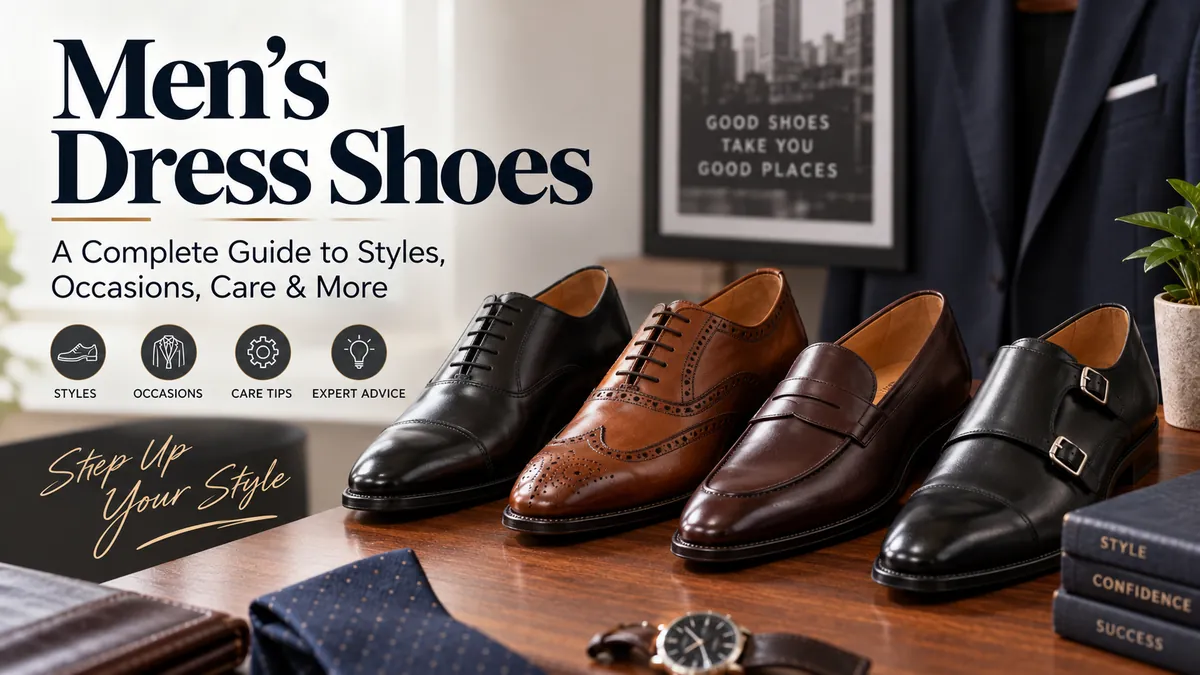
A polished suit can lose much of its impact when the shoes underneath it feel out of place. Yet choosing dress footwear is confusing because terms such as Oxford, Derby, brogue, wingtip, loafer, and monk strap are often treated as though they describe the same thing.
men’s dress shoes are refined footwear designed for formal, business, and smart-casual clothing. The main families include Oxfords, Derbies, monk straps, loafers, and dress boots. Their formality depends largely on the fastening system, leather or suede used, color, toe design, decoration, sole, and overall shape of the shoe.
Once you understand those elements, choosing an appropriate shoe becomes much easier. You can look at almost any pair and quickly work out what it is, how formal it appears, and what clothes will complement it.
Types of men’s dress shoes and How They Differ
Most classic dress footwear can be understood through a handful of basic shoe families. The fastening system is often the easiest identification method: closed lacing indicates an Oxford, open lacing generally indicates a Derby, buckles characterize monk straps, while loafers have no laces at all.
| Shoe style | Main identifying feature | Typical formality | Common use |
|---|---|---|---|
| Oxford | Closed lacing | Very formal | Suits, business formal, ceremonies |
| Derby | Open lacing | Formal to smart-casual | Office, suits, tailored separates |
| Monk strap | Buckle closure | Formal to dressy casual | Business wear, weddings, dinners |
| Loafer | Slip-on construction | Smart-casual to dressy | Office, travel, warm-weather tailoring |
| Dress boot | Ankle-height construction | Varies | Cold weather, business, smart casual |
There is another distinction worth learning immediately: brogue, wingtip, cap toe and plain toe usually describe decoration or toe design rather than completely separate shoe families.
An Oxford, for example, can be plain-toe, cap-toe or brogued.
Oxford Shoes
The Oxford is identified by its closed lacing system. Its eyelet facings are attached beneath the vamp, creating a neat, streamlined appearance when the shoe is tied.
That construction generally makes Oxfords the most formal everyday dress shoes.
Common variations include:
- Plain-toe Oxford
- Cap-toe Oxford
- Wholecut Oxford
- Quarter-brogue Oxford
- Semi-brogue Oxford
- Wingtip or full-brogue Oxford
A smooth black cap-toe Oxford is particularly useful for conservative business clothing, formal weddings, interviews, funerals, and dark suits.
Wholecuts take minimalism further. Their uppers are formed from essentially one continuous piece of leather, apart from the necessary rear seam, producing a particularly clean appearance.
Decoration changes the equation. Adding extensive broguing to an Oxford makes it visually busier and therefore generally less formal.
Derby Shoes
A Derby uses open lacing. Instead of being tucked beneath the vamp, its eyelet facings sit on top and can open outward.
That small construction difference has a surprisingly large visual effect.
The Derby looks more relaxed than an equivalent Oxford. It can still work beautifully with tailoring, but it moves more comfortably between formal clothing and smart-casual outfits.
Open lacing also provides greater adjustment around the instep. For that reason, some men with high insteps or wider feet find Derbies easier to fit than closely cut Oxfords.
Oxford vs. Derby: What’s the Actual Difference?
Ignore the color, toe shape and decorative perforations for a moment. Look directly at the laces.
Oxford: eyelet facings are sewn underneath the vamp.
Derby: eyelet facings are sewn on top of the vamp.
That’s the essential distinction.
A common mistake is assuming every wingtip is a Derby or every plain black lace-up shoe is an Oxford. Neither assumption is reliable because broguing and toe treatment are separate design characteristics.
Monk Strap Shoes
Monk straps replace conventional laces with one or more buckled straps.
The two familiar versions are:
- Single monk strap
- Double monk strap
Single monks generally appear cleaner and more restrained. Double monks create more visual interest because two buckles cross the upper.
Their unusual fastening system places monk straps somewhere between conservative lace-ups and more expressive dress footwear. They work particularly well with tailored trousers, suits and sophisticated smart-casual combinations.
The buckle itself matters. A thin, understated buckle feels dressier than oversized hardware.
Loafers
Loafers are slip-on shoes without a traditional lacing or buckle closure. Their simplicity makes them comfortable and versatile, although most are less formal than classic Oxfords.
Common styles include:
Penny loafers: Recognizable by the leather strap running across the vamp.
Tassel loafers: Decorated with tassels across the upper.
Bit loafers: Feature metal hardware across the vamp.
Venetian loafers: Minimal slip-ons without the characteristic penny strap, tassels or prominent bit hardware.
Loafers can move from chinos and tailored trousers to relaxed suits. Sleek leather versions are usually dressier, while soft suede and driving-style loafers lean casual.
Brogues and Wingtips
One of the most useful lessons in men’s footwear is that broguing describes decoration, not the basic fastening system of the shoe.
Broguing consists of decorative perforations punched into the leather.
The amount and arrangement create familiar categories:
- Quarter brogue
- Semi-brogue
- Full brogue
- Wingtip
A full brogue typically has a wing-shaped toe design that extends toward the sides of the shoe.
As decoration increases, formality usually decreases. A plain black Oxford therefore looks more formal than an extensively brogued Oxford of otherwise similar construction.
Dress Boots
Dress boots extend above the ankle while retaining the cleaner proportions, leather and construction associated with dress footwear.
Chelsea boots are among the most recognizable examples, although lace-up dress boots also exist.
A sleek black leather boot with a thin sole can work with tailoring in colder weather. Chunky soles, rugged leather and heavy detailing push a boot toward casual territory.
Understanding the Formality of men’s dress shoes
Shoe formality isn’t determined by one feature. Think of it as the combined effect of several design choices.
Generally, shoes become more formal when they have:
- Cleaner, simpler uppers
- Darker colors
- Smooth leather
- Minimal broguing
- Sleeker soles
- Refined toe shapes
- Closed rather than open lacing
Shoes usually become more casual as you introduce lighter colors, suede, heavy texture, visible decoration, thicker rubber soles or rugged shapes.
A useful general spectrum looks like this:
Black plain or cap-toe Oxford → dark Derby → monk strap → sleek leather loafer → heavily brogued shoe → suede loafer
This isn’t an absolute law. A highly polished black loafer can appear dressier than a chunky brown Derby, for example. The whole shoe matters.
What Are the Most Formal Dress Shoes for Men?
For conventional business and formal dressing, a polished black Oxford with minimal decoration remains one of the safest choices. Closed lacing, dark smooth leather and restrained detailing all push it toward the formal end of the spectrum.
For traditional black tie, however, dress codes can be more specific. Highly polished black footwear, including patent-leather evening shoes or appropriately formal Oxfords, is commonly used.
How to Choose the Right Dress Shoes for an Occasion
A shoe shouldn’t be judged in isolation. It needs to make sense with the clothes above it and the setting around it.
Business and Office Wear
A conservative workplace is usually the natural territory of Oxfords and refined Derbies.
A simple combination might be:
Charcoal suit + white shirt + black cap-toe Oxfords
For a less formal office:
Navy trousers + light-blue shirt + dark-brown Derbies
Business-casual workplaces create more freedom for loafers, brogues and suede.
Job Interviews
When you aren’t sure how conservative the employer is, restraint usually works better than experimentation.
Choose clean, polished footwear without dramatic buckles, exaggerated toe shapes or heavy decoration.
Black or dark-brown Oxfords and Derbies cover most traditional professional environments.
Weddings
The correct wedding shoe depends on the dress code.
A formal evening wedding may call for black Oxfords. A daytime suit allows greater freedom with brown or burgundy shoes, while a relaxed warm-weather ceremony can accommodate elegant loafers.
The same principle applies to the rest of wedding attire: let the stated dress code lead the decision rather than treating every wedding as equally formal.
Business Casual
This is where Derbies and loafers become especially useful.
Try combinations such as:
- Brown Derby + chinos + Oxford shirt
- Penny loafer + tailored trousers + knit polo
- Suede loafer + lightweight trousers + linen shirt
- Brogued Derby + textured blazer + chinos
The goal is to maintain refinement without looking as though you’re dressed for a board meeting.
Black, Brown or Burgundy: Choosing Dress Shoe Colors
Color has a major influence on both versatility and formality.
Black Dress Shoes
Black is traditionally the most formal and conservative choice.
It works naturally with:
- Black
- Charcoal
- Medium gray
- Dark navy
If you regularly attend formal events or work in a conservative professional setting, black footwear deserves a place in your wardrobe.
Brown Dress Shoes
Brown provides a much wider range of visual tones.
Dark brown can remain quite dressy, while medium brown and tan progressively become more relaxed.
Brown footwear works particularly well with navy, blue, gray, beige and earth-toned clothing.
Burgundy and Oxblood
Burgundy or oxblood occupies useful territory between black and brown.
It is distinctive without becoming difficult to coordinate and can complement navy, charcoal, gray and many brown-toned outfits.
Does Your Belt Have to Match Your Shoes?
The two don’t need to look as though they came from exactly the same hide, but keeping them within the same general color family creates a cleaner outfit.
Black shoes with a black belt are straightforward.
With brown footwear, aim for reasonably compatible brown tones rather than obsessing over an exact shade match.
Leather, Suede and Other Dress Shoe Materials
Material determines much more than appearance. It influences durability, maintenance, flexibility, weather resistance and how the shoe ages.
Full-Grain Leather
Full-grain leather retains the natural outer grain of the hide rather than having the surface aggressively corrected.
Quality full-grain leather can develop patina as it ages—the gradual changes in tone and character produced by wear, polishing and exposure.
It is valued for durability and its ability to age attractively when properly maintained.
Top-Grain and Corrected Leather
Top-grain leather has typically undergone more surface processing.
Corrected-grain leather may be sanded and finished to create greater visual consistency. This can produce an attractive, uniform shoe, although it won’t necessarily develop the same character as high-quality full-grain leather.
Be cautious about judging quality from marketing terminology alone. Leather grade is only one part of the shoe.
Calfskin
Calfskin is widely associated with quality dress footwear because its fine grain allows manufacturers to create smooth, refined uppers.
A well-finished calfskin Oxford can take polish particularly well.
Suede
Suede provides a softer, textured appearance.
That texture generally makes it more casual than smooth leather, which is why suede Derbies and loafers work so naturally with chinos, flannel trousers and relaxed tailoring.
The tradeoff is maintenance. Suede benefits from appropriate brushing and protection against dirt and moisture.
Goodyear Welt vs. Blake Stitch vs. Cemented Construction
Turn a dress shoe over and you’ll discover that two pairs looking similar from above can be built very differently.
Goodyear Welt Construction
A Goodyear-welted shoe uses a welt around the perimeter to help connect the upper and sole assembly.
The method is valued because well-made welted footwear can often be resoled, significantly extending its usable life.
The tradeoffs are straightforward: welted shoes can initially feel firmer, may have a slightly more substantial profile, and require more manufacturing work.
Blake-Stitched Construction
Blake construction stitches the upper and sole more directly together.
This allows manufacturers to create thin, flexible, closely trimmed soles and is particularly associated with sleek footwear.
Compared with Goodyear-welted construction, resoling can require more specialized machinery.
Cemented Construction
Cemented shoes use adhesive to bond the sole to the upper.
This method enables lighter and less expensive footwear and is common throughout the market.
Its main limitation is long-term repairability. Once heavily worn, many cemented shoes are less economical or practical to rebuild than quality stitched footwear.
Quick Takeaway: Construction matters most when you’re thinking about long-term ownership. A well-made, repairable shoe may remain useful through multiple sole replacements, while an inexpensive glued shoe is more likely to be replaced when the sole assembly fails.
Leather Soles vs. Rubber Soles
Neither sole material is automatically better. The right choice depends on where you’ll actually wear the shoes.
Leather Soles
Leather soles offer a traditional, elegant profile and are particularly appropriate for refined formal footwear.
Advantages include:
- Classic appearance
- Slim profile
- Natural flexibility as they wear in
- Appropriate look for formal shoes
The downside is traction and weather resistance. Smooth leather can be slippery when new and isn’t ideal for prolonged exposure to wet conditions.
Rubber Soles
Rubber offers practical advantages:
- Better grip
- Greater resistance to moisture
- Useful durability for pavement
- Practical everyday commuting
Modern dress shoes can use relatively thin rubber soles without looking bulky, so rubber no longer automatically means casual footwear.
If you walk extensively, commute in rain or spend much of the day on hard outdoor surfaces, discreet rubber can make more sense than traditional leather.
How men’s dress shoes Should Fit
A beautiful shoe with the wrong fit is still the wrong shoe.
Dress footwear should hold the foot securely without creating sharp pressure, numbness or persistent rubbing.
Check the Heel
Your heel should feel secure.
A tiny amount of movement in a new leather shoe can occur, but significant lifting usually indicates a poor fit or inappropriate last.
Check the Width
The sides of the shoe should support your foot without squeezing it painfully.
Do not buy an obviously narrow shoe expecting the leather to stretch an entire size. Leather may soften and conform somewhat, but it cannot correct a fundamentally wrong width.
Check the Toes
Your toes need enough space to sit naturally.
Don’t use the visible end of an elongated toe box as your only sizing guide. Many dress shoes deliberately extend beyond the toes as part of their design.
Check the Instep
This area is particularly important with Oxfords.
Because closed lacing offers less adjustment, a high instep may cause excessive pressure or prevent the facings from sitting appropriately.
An open-laced Derby can sometimes provide a more forgiving alternative.
Try Shoes at the Right Time
Feet can change slightly in volume throughout the day. Trying shoes later in the day, using the type of dress socks you normally wear, provides a more realistic impression of fit.
Most importantly, walk in them.
Standing still in front of a mirror tells you very little about heel movement, forefoot pressure and flex-point comfort.
Toe Shapes and Details That Change the Look
The toe has a surprisingly strong influence on the personality of dress footwear.
Plain Toe
A plain toe has minimal decorative structure across the front.
Its simplicity can look highly formal when combined with a sleek Oxford construction.
Cap Toe
A cap toe includes a seam across the front portion of the shoe.
Black cap-toe Oxfords are a classic conservative choice for business and formal clothing.
Wingtip
A wingtip uses a decorative toe piece extending backward along the sides in a wing-like shape.
Wingtips frequently feature broguing, giving them more visual texture and generally reducing formality.
Round, Almond and Square Toes
Classic round and gently almond-shaped lasts tend to age well stylistically.
Extreme shapes can date more quickly. Very elongated points or aggressively squared toes may dominate an outfit instead of supporting it.
Proportion is usually more important than following a temporary trend.
How to Spot Quality men’s dress shoes
Price and brand name don’t automatically reveal construction quality.
Instead, inspect the actual shoe.
Look at the Upper
Quality leather should feel substantial rather than plastic-like. Natural grain variation isn’t necessarily a flaw.
Check whether the panels are cleanly cut and whether corresponding parts of the left and right shoe look consistent.
Examine the Stitching
Stitching should generally be neat and controlled.
Look carefully around:
- Toe caps
- Eyelets
- Heel counters
- Welt edges
- Decorative seams
A few tiny cosmetic variations don’t necessarily indicate poor craftsmanship, but obviously crooked seams or loose threads deserve attention.
Inspect the Sole and Heel
Look for clean attachment, balanced heel construction and a shoe that sits level.
If you’re considering Goodyear-welted or Blake-stitched footwear specifically for repairability, verify the manufacturer’s actual construction description rather than assuming visible stitching proves the method.
Consider the Lining
Leather-lined interiors can feel comfortable and manage wear well, particularly around the heel and forefoot.
Also inspect internal seams. Rough finishing inside a shoe can create irritation even when the exterior looks excellent.
Quick Takeaway: Leather quality, last shape, stitching, lining, sole construction and fit should be judged together. One impressive feature cannot compensate for a shoe that simply doesn’t fit your foot.
How to Build a Small Dress Shoe Wardrobe
You don’t need ten pairs to cover ordinary situations.
The smartest approach is to add footwear according to how you actually dress.
First Pair: Dark Formal Lace-Up
If your life includes suits, interviews, formal ceremonies or conservative business clothing, a black cap-toe Oxford is a dependable starting point.
It covers situations where appearing slightly overdressed is usually preferable to appearing too casual.
Second Pair: Brown Derby
A dark- or medium-brown Derby expands your options dramatically.
It can work with navy tailoring, gray trousers, chinos and many business-casual outfits.
Third Pair: Loafer
A penny or tassel loafer introduces easy slip-on versatility.
Brown leather is especially adaptable, while suede offers an even more relaxed option for warm weather.
Fourth Pair: Something More Personal
Once the essentials are covered, you can consider:
- Burgundy footwear
- Double monk straps
- Brogues
- Suede Derbies
- Wholecuts
- Dress boots
At that point, personal style becomes more useful than another universal wardrobe rule.
Common Dress Shoe Mistakes
Knowing what not to do can save money and prevent uncomfortable purchases.
Buying Shoes That Are Too Small
The idea that painful leather shoes simply need to be “broken in” causes many poor purchases.
A stiff new shoe can soften. A fundamentally incorrect size won’t magically become correct.
Treating Brogue as a Shoe Family
Remember: broguing is decoration.
You can encounter brogued Oxfords, Derbies and other footwear. Identify the underlying construction first.
Choosing Formality by Color Alone
Black isn’t automatically formal.
A bulky black shoe with a thick lugged sole can look considerably more casual than a sleek dark-brown Oxford.
Evaluate color, construction, material, decoration and shape together.
Ignoring Your Actual Lifestyle
Buying delicate leather-soled shoes makes little sense if your normal day involves long walks on wet pavement.
Likewise, extremely rugged rubber soles may feel out of place if the shoes are primarily intended for formal indoor events.
Choose for your real routine rather than an imaginary one.
Wearing the Same Pair Every Day
Leather footwear benefits from time between wears.
Moisture from the foot needs time to dissipate. Rotating between pairs can therefore help preserve the lining, upper and shape.
How to Care for Leather Dress Shoes
Good maintenance doesn’t require an enormous collection of products.
Consistency matters more.
1. Brush Away Surface Dirt
After wearing the shoes, use a soft horsehair brush to remove dust and dirt before it works into the leather.
2. Use Shoe Trees
Wooden shoe trees can help maintain shape and absorb some moisture after wear.
Cedar is popular, but correct fit matters more than fragrance. A shoe tree should support the shoe rather than aggressively stretch it.
3. Condition the Leather
Leather gradually loses oils.
Occasional application of an appropriate leather conditioner helps keep the upper supple. Avoid excessive product; over-conditioning isn’t beneficial.
4. Polish When Needed
Shoe cream can restore color and provide a soft shine.
Wax polish can create greater shine and additional surface protection, particularly around the toe and heel.
You don’t need a mirror finish for ordinary business footwear. Clean, conditioned leather with a controlled shine is usually enough.
5. Let Wet Shoes Dry Naturally
If leather shoes become wet, remove excess moisture, insert suitable shoe trees when appropriate and let them dry naturally at room temperature.
Avoid radiators, hair dryers and intense direct heat. Rapid drying can damage leather.
6. Repair Before Damage Spreads
Watch the heels and soles.
A cobbler can address normal wear much more easily before it reaches structural parts of the shoe.
Can You Wear Dress Shoes With Jeans?
Yes, but the formality needs to make sense.
A highly polished black Oxford with faded distressed denim creates a sharp mismatch. A brown Derby, brogue or loafer generally makes the transition more naturally.
For the cleanest combination, choose:
- Dark or medium-wash jeans
- Minimal distressing
- A relatively clean leg shape
- Brown, burgundy or suede footwear
- A shirt, knitwear or jacket that connects the casual jeans with the smarter shoes
Think in terms of overall balance rather than asking whether one specific shoe is technically “allowed.”
Can Loafers Be Worn With a Suit?
They can.
A sleek leather loafer can complement a relaxed business suit, summer tailoring or less conservative wedding outfit.
For highly conservative business settings or formal ceremonies, Oxfords remain the safer traditional choice.
Material matters too. Smooth dark leather appears dressier than soft tan suede.
How Long Should Quality Dress Shoes Last?
There isn’t a meaningful universal number.
Longevity depends on:
- Construction
- Leather quality
- Frequency of wear
- Walking surfaces
- Climate
- Maintenance
- Rotation
- Whether the shoe can be resoled
- How quickly the owner repairs wear
A repairable stitched shoe cared for properly can potentially remain in service through multiple sole replacements, while heavily worn cemented footwear may reach the end of its practical life much sooner.
This is why cost per wear can be more informative than purchase price alone.
A Simple Way to Choose men’s dress shoes
When you’re faced with dozens of styles, reduce the decision to six questions:
- How formal is the occasion?
Start with the dress code and clothing you’ll wear. - Which fastening suits that level of formality?
Oxford for greater formality, Derby for versatility, monk straps for distinction, loafers for relaxed refinement. - Which color works with your wardrobe?
Black is conservative, dark brown is versatile, lighter brown is more casual, and burgundy adds character. - Which material fits the setting?
Smooth leather is generally dressier; suede creates a softer, more relaxed impression. - How will you actually use the shoes?
Consider walking, weather, office conditions and how frequently you’ll wear them. - Do they genuinely fit?
Never sacrifice comfort and correct sizing for a style you prefer visually.
The best men’s dress shoes aren’t necessarily the most expensive or elaborate pair. They’re the ones whose style, construction, material and fit suit both your wardrobe and your real life.
Learn to recognize the difference between an Oxford and Derby, understand what broguing actually means, pay attention to leather and sole construction, and choose formality according to the occasion. Once those fundamentals are clear, men’s dress shoes stop being a confusing collection of names and become a straightforward part of dressing well.