
Finding the right toddler shoes can be surprisingly challenging. A pair may look comfortable, but if it squeezes little toes, slips at the heel, or has an overly stiff sole, it can make walking harder than necessary.
Toddlers are still developing their balance, coordination, and walking skills. Their feet also grow quickly, so footwear that fit perfectly a few months ago may already be too small.
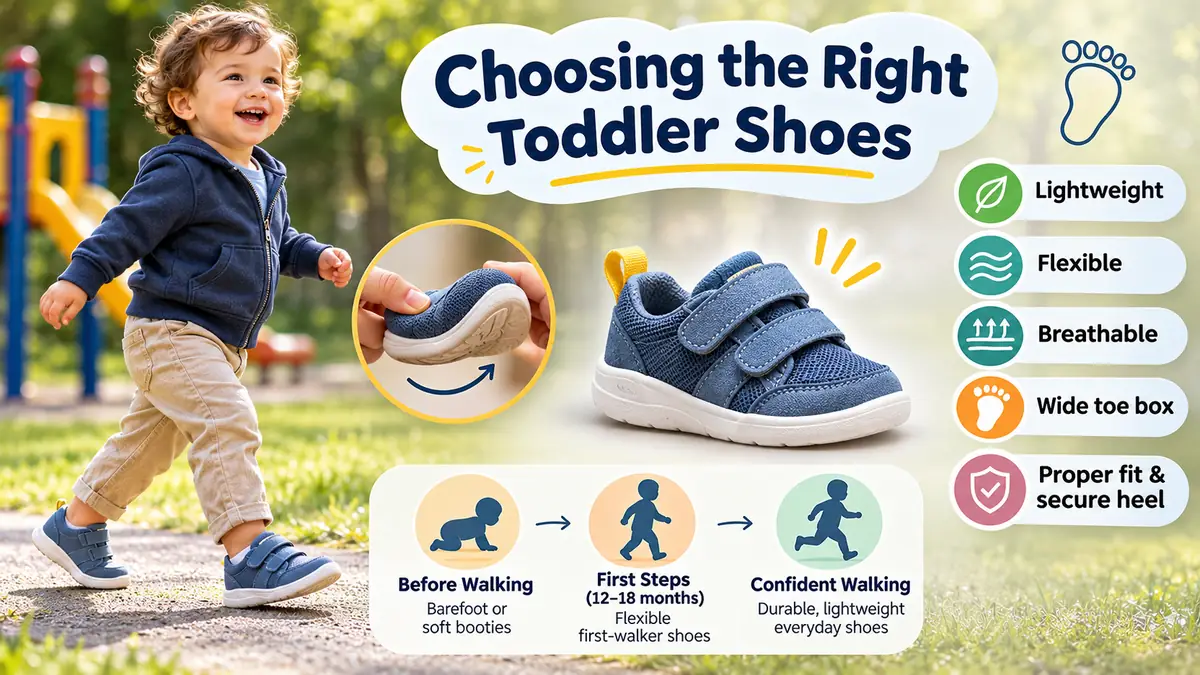
Toddler shoes should be lightweight, flexible, breathable, and properly fitted, with enough space for growing toes and a secure heel. For most children learning to walk, shoes are primarily needed outdoors to protect their feet. Indoors, barefoot movement on safe surfaces allows children to feel the ground and move naturally. APMA MAIN+2
Understanding how toddler footwear works makes it easier to recognize a comfortable fit, avoid common sizing mistakes, and choose appropriate shoes for different stages of development.
Why Choosing the Right toddler shoes Matters
A toddler’s feet are not simply smaller versions of adult feet. They are still growing and developing, with flexible structures, changing proportions, and developing muscles.
During early childhood, children learn to coordinate movements involving their feet, ankles, knees, and hips. Footwear should accommodate those movements rather than unnecessarily restrict them.
Supporting Natural Foot Movement
When toddlers walk, their feet bend, spread, and respond to the surface beneath them.
Appropriate footwear allows these movements while providing protection against rough ground, sharp objects, and uncomfortable temperatures.
Shoes that are excessively rigid may interfere with natural foot movement. Conversely, footwear that is too loose can make a toddler less stable.
The American Podiatric Medical Association (APMA) recommends lightweight, flexible footwear for younger children, emphasizing natural movement and proper fit. APMA MAIN
Helping Toddlers Maintain Balance
Early walking often involves a wide stance, short steps, and frequent changes in direction.
Shoes should provide enough traction for ordinary walking without being excessively bulky or heavy.
A comfortable pair can help children navigate playgrounds, sidewalks, and other everyday environments.
Preventing Common Footwear Problems
Poorly fitted shoes may contribute to:
- Blisters and skin irritation
- Pressure on the toes
- Redness around the heel
- Discomfort while walking
- Tripping caused by oversized footwear
- Ingrown toenails associated with repeated pressure
These problems are not always immediately obvious because young children may have difficulty explaining where their feet hurt.
Regular fit checks are therefore essential.
When Should Toddlers Start Wearing Shoes?
Children generally do not need structured footwear before they begin walking.
During the crawling and early standing stages, bare feet or comfortable socks are usually sufficient in safe indoor environments.
Once a child begins walking outdoors, protective footwear becomes more useful.
Before Walking: Barefoot or Soft Booties
Pre-walking babies benefit from freedom of movement.
Soft socks and nonrestrictive booties can keep their feet warm without limiting natural motion.
Rigid soles, elevated heels, and tight-fitting decorative footwear are unnecessary at this stage.
The American Academy of Pediatrics explains that babies do not need shoes during their early months and that footwear becomes important for protection when they begin walking outdoors. HealthyChildren.org
First Steps: Flexible First-Walker Shoes
Many children begin walking independently around 12 to 18 months, although development varies.
First walking shoes should prioritize:
- Low overall weight
- Flexible forefoot movement
- A wide toe area
- Secure fastening
- Comfortable, breathable materials
- Appropriate traction
These features help the shoe accommodate the child’s natural walking pattern.
Confident Walking: Everyday Toddler Footwear
Once toddlers become more confident, their activities expand.
They may begin running, climbing, walking on uneven ground, and exploring playground equipment.
At this stage, shoes still need flexibility, but durability and traction become increasingly relevant.
A lightweight sneaker with a secure closure is often a practical everyday option.
How to Choose the Best toddler shoes
The most useful way to evaluate children’s footwear is to focus on fit and function rather than appearance, price, or brand reputation.
Several design features deserve particular attention.
1. Flexible Soles That Bend Naturally
A toddler shoe should bend near the ball of the foot, where the toes naturally flex during walking.
To evaluate flexibility, gently bend the front of the shoe upward.
The forefoot should move without requiring excessive force.
However, flexibility does not mean the entire shoe must fold or twist without resistance. Some children, particularly those with specific foot conditions, may need more structured footwear recommended by a clinician.
2. A Wide, Foot-Shaped Toe Box
The toe box is the front portion of the shoe surrounding the toes.
Toddlers need sufficient width and depth to move their toes comfortably.
A narrow or sharply tapered toe box can create unnecessary pressure.
Look for a front shape that accommodates the natural width of the child’s foot.
The APMA recommends a toe box at least as wide as the widest part of the foot. APMA MAIN
3. Lightweight Construction
Heavy footwear may feel cumbersome to a child who is still learning to coordinate each step.
Lightweight materials allow toddlers to move more freely.
A shoe does not need to be extremely thin to be lightweight. The goal is a reasonable balance between protection, flexibility, and durability.
4. Breathable Upper Materials
Toddler feet can become sweaty during active play.
Breathable uppers help manage moisture and improve comfort.
Common materials include:
| Material | Main advantages | Possible limitations |
|---|---|---|
| Mesh | Lightweight, breathable | May offer limited water protection |
| Canvas | Flexible, breathable | Can absorb moisture |
| Soft leather | Durable, conforms to the foot | Breathability varies by construction |
| Synthetic fabric | Often lightweight and easy to clean | Some materials trap heat |
| Waterproof materials | Useful in wet conditions | May reduce ventilation |
The American Orthopaedic Foot & Ankle Society recommends breathable materials such as leather and canvas for young children. And What to Avoid!
5. Secure Fastenings
Shoes should remain comfortably attached during walking and running.
Hook-and-loop straps, adjustable laces, and properly fitted buckles can all work.
The closure should hold the foot securely without squeezing the instep.
A shoe that repeatedly slips off may be too loose, poorly shaped for the foot, or insufficiently adjustable.
6. Suitable Traction
Outsoles should provide reliable contact with everyday walking surfaces.
Rubber and other nonslip materials can be useful, particularly on smooth floors.
However, excessively bulky or aggressive tread patterns may be unnecessary for ordinary indoor activities.
The ideal outsole depends on where the child will wear the shoes.
Toddler Shoe Size Guide: How to Measure Growing Feet
Correct sizing is one of the most important aspects of choosing toddler shoes.
Shoe sizes vary between manufacturers, and children’s feet do not always grow at predictable rates.
A size that fits in one brand may feel noticeably different in another.
How to Measure a Toddler’s Feet at Home
Use this simple method to estimate foot length.
- Place a sheet of paper on a firm, flat floor against a wall.
- Have your toddler stand on the paper with their heel gently against the wall.
- Make sure their weight is distributed naturally.
- Mark the position of the longest toe.
- Measure from the wall edge to the mark.
- Repeat the process for the other foot.
- Use the larger measurement when comparing shoe sizes.
For greater accuracy, measure both feet while the child is standing rather than sitting.
If the child cannot stand independently, a professional fitting may be more reliable.
How Much Room Should Be Left in Toddler Shoes?
A useful starting point is approximately 10–15 millimeters of space beyond the longest toe.
This provides room for movement and some growth without making the shoe excessively long.
The APMA recommends approximately 10–15 mm of toe room, while the Canadian Paediatric Society suggests around 1.25 cm. APMA MAIN+1
The exact amount may vary depending on the shoe design and the child’s foot shape.
Understanding US, UK, and EU Toddler Sizes
Toddler shoe sizing commonly uses three systems:
- US children’s sizes
- UK children’s sizes
- European sizes
These systems do not convert perfectly across brands.
For example, a shoe labeled US toddler size 6 may not have exactly the same internal length as another manufacturer’s size 6.
Rather than relying on a generic conversion chart alone, compare the child’s measured foot length with the specific manufacturer’s sizing guide.
If possible, check the actual internal shoe length as well.
Foot Length Versus Shoe Length
Foot length and shoe length are different measurements.
A toddler whose foot measures 13 cm generally needs a shoe with an internal length greater than 13 cm to provide adequate toe clearance.
For example:
| Measurement | Illustrative value |
|---|---|
| Child’s foot length | 13.0 cm |
| Intended toe allowance | 1.2 cm |
| Approximate internal shoe length | 14.2 cm |
This example demonstrates the calculation, not a universal size recommendation.
Actual fit also depends on toe shape, shoe width, heel fit, and the construction of the upper.
How to Tell Whether toddler shoes Fit Correctly
A properly fitted shoe should feel comfortable from the beginning.
Toddlers should not need to endure a painful break-in period.
Check the Toe Area
With your child standing, gently locate the longest toe through the upper if the material allows.
Confirm that there is adequate space between the toe and the front of the shoe.
The toes should not press against the end.
If the upper is too stiff to feel the toe position, a removable insole can sometimes help assess available length.
Check the Heel
The heel should remain reasonably secure while walking.
A small amount of movement may be normal, but repeated slipping suggests the shoe may not fit properly.
The child should not need to curl or grip their toes to keep the shoe on.
Check the Width
Look for pressure along the sides of the forefoot.
The upper should not bulge dramatically because the foot is being compressed.
Red marks or discomfort along the sides may indicate insufficient width.
Observe Your Toddler Walking
Allow your child to walk naturally on a safe surface.
Watch for:
- Repeated stumbling
- Heel slipping
- Unusual hesitation
- Changes in walking pattern
- Attempts to remove the shoes
- Visible discomfort
These signs do not always mean the shoes are the cause, but they are reasons to reassess the fit.
Inspect the Feet After Wearing
Remove the shoes and socks after a period of activity.
Look for blisters, persistent redness, pressure marks, or irritated skin.
If these problems repeatedly occur in the same places, the footwear may need to be adjusted or replaced.
Types of toddler shoes and Their Uses
Different activities place different demands on footwear.
A shoe suitable for indoor play may not provide enough protection for rough outdoor surfaces.
Common toddler footwear types
First Walker Shoes for Baby & Toddlers | Ten Little
First-walker shoes
Designed for children taking their earliest independent steps. Lightweight construction, flexible forefoot movement, and a secure fit are the main priorities.
ST Runner Leather Toddlers’ Easy On Sneakers | PUMA Canada
Everyday sneakers
Often suitable for walking, running, daycare, and playground activities. They generally combine protective soles with adjustable closures.
Bobux Kids Shoes | White Cross Jump Sandals Step Up – The Elly Store
Toddler sandals
Useful in warm weather. Adjustable straps, secure heel retention, and protective toe coverage can be helpful for active outdoor play.
Rain Boots for Toddler & Kids | Ten Little
Rain boots
Protect feet from puddles and wet ground. Because many are relatively stiff and less breathable, they are generally better suited to wet-weather use than all-day wear.
See Kai Run | Gilman Winter Boots – CRAVINGS maternity-baby-kids
Winter boots
Provide insulation and protection in cold conditions. Proper sizing must account for socks without creating excessive tightness or looseness.
Are Slip-On Shoes Suitable for Toddlers?
Slip-on shoes can be comfortable when they fit securely.
However, some styles lack sufficient adjustability and may slide off during active movement.
For children with narrow heels or particularly wide forefeet, adjustable closures may provide a more reliable fit.
Are Barefoot-Style Toddler Shoes Better?
Barefoot-style footwear generally emphasizes a wide toe box, minimal heel elevation, low weight, and a flexible sole.
These characteristics can support natural movement.
However, the term barefoot shoe is not a guarantee of appropriate fit or quality.
A minimalist shoe may still be too narrow, poorly secured, or unsuitable for a particular activity.
The important question is whether the footwear protects the child’s feet while allowing comfortable movement.
Flexible Soles vs. Supportive Shoes: What Is Better?
Parents often encounter conflicting advice about whether toddlers need soft shoes or firm, supportive footwear.
The answer depends partly on the child’s development and whether any medical concerns are present.
For most healthy toddlers, lightweight shoes that bend appropriately at the forefoot and fit securely are suitable.
| Feature | Flexible everyday footwear | More structured footwear |
|---|---|---|
| Forefoot movement | Allows natural bending | May limit movement depending on design |
| Weight | Often lighter | Can be heavier |
| Foot protection | Depends on sole construction | Often provides more structure |
| Typical use | Everyday activities for healthy toddlers | Selected activities or individual clinical needs |
| Medical necessity | Usually no special prescription needed | Sometimes recommended for specific conditions |
A shoe can have a flexible forefoot and a reasonably stable heel counter at the same time.
These features are not mutually exclusive.
Do Toddlers Need Arch Support?
Most healthy toddlers do not need special arch-support footwear.
Young children’s feet often appear flat because their arches are still developing and because of the natural soft tissue beneath their feet.
The Canadian Paediatric Society explains that flat feet are common in early childhood and that corrective footwear is generally unnecessary when flatfoot does not cause pain or discomfort. Caring for kids
Do High-Top Shoes Provide Better Ankle Support?
High-top shoes may be useful because they can stay on more securely.
However, they do not automatically provide better developmental support than properly fitted low-top shoes.
The American Academy of Orthopaedic Surgeons notes that ordinary low-cut sneakers can be appropriate as young children develop balance and ankle stabilization. AAOS
Children with diagnosed foot or ankle conditions may have different needs.
How Often Should Toddler Shoes Be Replaced?
Toddler feet can grow remarkably quickly.
According to the Canadian Paediatric Society, toddlers may grow approximately half a shoe size every three months, although individual growth rates vary. Caring for kids
That does not mean every child needs new shoes on a fixed schedule.
Instead, parents should inspect fit regularly and replace footwear when it no longer accommodates the child’s feet.
Signs That Shoes Are Too Small
Common warning signs include:
- Toes reaching the front of the shoe
- Difficulty putting shoes on
- Red marks after wearing
- New blisters or pressure areas
- Complaints of discomfort
- Curling or overlapping toes inside the shoe
- A child repeatedly trying to remove footwear
The American Academy of Pediatrics recommends checking the fit approximately once a month during this rapid-growth stage. HealthyChildren.org
Can Toddlers Wear Shoes That Are Slightly Too Big?
Extra growth room is useful, but excessively large shoes can create problems.
If a shoe is too long or loose, the child’s foot may slide inside it.
That can contribute to instability, rubbing, and tripping.
Avoid choosing dramatically oversized shoes simply to extend their usable life.
Are Secondhand Toddler Shoes Safe?
Secondhand footwear can be reasonable when it remains in good condition and fits correctly.
Before reusing a pair, inspect the outsole for uneven wear, the heel for distortion, and the interior for damage.
Shoes that have become misshapen or excessively worn may no longer provide a comfortable fit.
Clean and dry used footwear appropriately before wearing.
The condition and fit matter more than whether the shoes are new.
Common Mistakes Parents Make When Choosing toddler shoes
Even carefully selected footwear can cause discomfort if important details are overlooked.
Choosing Shoes Based Only on Age
Age-based sizing charts provide rough estimates.
Two toddlers of the same age may have very different foot lengths and widths.
Measure the child’s feet instead of assuming a particular size corresponds to a birthday.
Prioritizing Appearance Over Fit
Decorative shoes may look appealing but have narrow toe boxes, rigid soles, or uncomfortable seams.
Appearance should not outweigh comfort and practical movement.
Assuming Expensive Shoes Are Always Better
A high price does not guarantee superior fit.
The American Academy of Pediatrics advises choosing well-made shoes without spending unnecessarily, especially because young children outgrow footwear quickly. HealthyChildren.org
Ignoring Foot Width
Length is only one part of sizing.
Some toddlers have wider forefeet, higher insteps, or narrower heels.
If the correct length still feels tight, a different width or shoe shape may solve the problem more effectively than increasing the size.
Keeping Shoes After They Become Tight
Children may continue wearing uncomfortable footwear without clearly explaining the problem.
Routine checks help parents identify when shoes need replacing.
Using One Type of Shoe for Every Activity
Rain boots, sandals, sneakers, and indoor slippers serve different purposes.
Choose footwear according to the environment, weather, and level of activity.
Toddler Foot Health: When to Seek Professional Advice
Most young children develop healthy feet without corrective shoes, orthotics, or special interventions.
However, some symptoms deserve medical attention.
Flat Feet in Toddlers
Flexible flat feet are common in young children.
The arch may become more noticeable as the child grows.
When flat feet are painless and do not interfere with activity, treatment is often unnecessary.
Persistent pain, stiffness, or difficulty walking should be assessed by a healthcare professional.
Intoeing and Out-Toeing
Some toddlers walk with their feet pointing inward or outward.
These patterns may reflect normal developmental variation.
Many cases of intoeing improve naturally as children grow, and corrective shoes generally do not resolve the underlying alignment pattern. Caring for kids
A pediatrician should assess significant asymmetry, pain, worsening gait changes, or functional difficulties.
Toe Walking
Occasional toe walking can occur when children are learning to walk.
Persistent toe walking, especially when accompanied by stiffness, pain, frequent falls, or developmental concerns, warrants professional evaluation.
Changing shoe styles alone should not be treated as a substitute for assessment.
When a Podiatrist or Pediatrician Can Help
Consider seeking medical advice if your toddler experiences persistent foot pain, repeated unexplained falls, limping, swelling, unusual shoe wear, or difficulty walking.
A pediatrician, pediatric orthopedist, or appropriately qualified podiatrist can evaluate the child’s needs.
Special footwear or orthotics should be based on an individual assessment rather than general advertising claims.
Caring for Toddler Shoes to Keep Them Comfortable
Regular care can help maintain comfort, hygiene, and traction.
Cleaning Everyday Shoes
Follow the manufacturer’s care instructions.
For many fabric shoes, gentle cleaning with mild soap and water is sufficient.
Remove loose dirt before cleaning and allow shoes to dry completely.
Avoid exposing materials to excessive heat unless the manufacturer specifically permits it.
Managing Moisture and Odor
Toddlers may sweat heavily during play.
Breathable socks, adequate drying time, and clean footwear can help reduce moisture buildup.
If shoes become soaked, dry them thoroughly before the next use.
Inspecting Soles and Fastenings
Check periodically for:
- Worn or damaged tread
- Loose straps
- Fraying seams
- Exposed interior stitching
- Cracked soles
- Damaged heel areas
Replace shoes when deterioration affects comfort, fit, or protection.
Choosing Appropriate Socks
Socks should fit smoothly without bunching around the toes.
Thick socks can change the effective fit of a shoe.
When checking sizing, have your child wear the type of socks they normally use with that footwear.
Practical Checklist for Choosing Comfortable Toddler Footwear
Before deciding whether a pair is suitable, evaluate the following characteristics.
Shoe fit checklist
0 of 8 checkedBoth feet have been measuredThere is approximately 10–15 mm of toe roomThe toe box accommodates the full width of the footThe forefoot bends naturallyThe heel stays reasonably secureThe upper feels comfortable and breathableThe outsole provides suitable tractionThe child walks comfortably without repeated slipping or tripping
Reset checklist
A shoe does not need to satisfy a particular fashion trend or carry a premium label to be appropriate.
Fit, comfort, protection, and freedom of movement remain the most useful considerations.
Final Thoughts on Choosing toddler shoes
The best toddler shoes are the ones that fit the child’s feet and suit their current stage of movement.
For most healthy toddlers, that means lightweight footwear with a flexible forefoot, a roomy toe box, breathable materials, reliable traction, and secure fastening.
Barefoot movement remains appropriate in safe indoor environments, while shoes provide valuable protection outdoors.
Because little feet grow quickly, checking the fit regularly is just as important as choosing the right pair initially.
The simplest next step is to measure both feet, inspect the shoes your toddler currently wears, and watch how comfortably they walk. These observations will tell you far more about suitable footwear than the size label, appearance, or price alone.
