
A good pair of shoes does more than complete an outfit. It supports your feet, affects how comfortably you move, and helps you dress appropriately for work, exercise, special occasions, and everyday activities.
With so many footwear styles available, understanding the differences between sneakers, running shoes, loafers, boots, and formal shoes can make choosing the right pair much easier.
Shoes for men come in several major categories, including athletic shoes, casual sneakers, dress shoes, boots, sandals, and work footwear. The right choice depends on foot shape, activity, fit, cushioning, support, materials, and the environment in which the shoes will be worn. Prioritizing comfort and function helps prevent common footwear problems while making everyday dressing simpler.
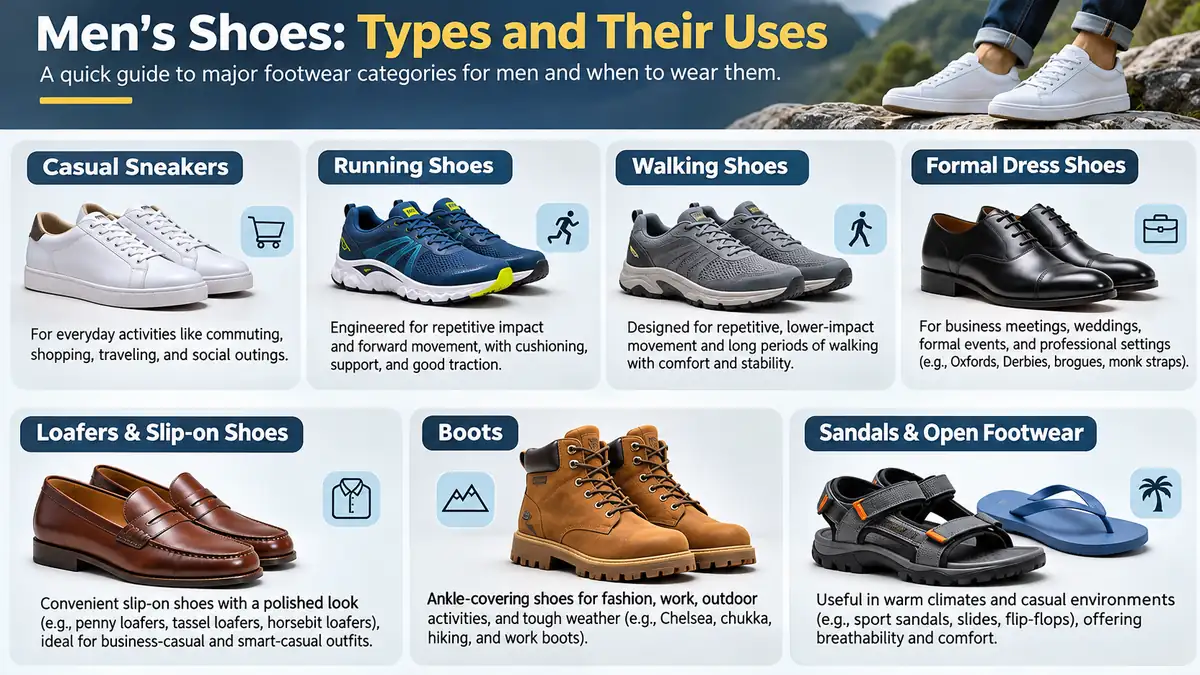
Types of shoes for men and their uses
Men’s footwear can be grouped by its primary purpose. Some designs emphasize comfort and flexibility, while others prioritize durability, weather protection, or formal appearance.
Understanding these categories is the first step toward selecting suitable footwear.
Casual sneakers
Men’s Minimalist Leather Relaxed Sneaker | Uniform Standard
9
Casual sneakers are designed primarily for everyday activities such as commuting, shopping, traveling, and social outings.
Common characteristics include cushioned insoles, flexible construction, rubber outsoles, and leather, canvas, or synthetic uppers.
Low-top sneakers offer a lightweight appearance and greater freedom around the ankle. High-top sneakers extend above the ankle and provide a different fit and style, although a higher collar does not automatically guarantee better ankle support.
White leather sneakers are popular because they coordinate easily with jeans, chinos, and casual trousers. Canvas sneakers often feel lighter and more breathable in warm weather.
Running shoes
Chaussures Trail Homme | Decathlon
La Sportiva Prodigio – Zapatillas de trail running Hombre | Envío gratuito | Bergfreunde
8
Running shoes are engineered to handle repetitive impact and forward movement.
Their construction commonly includes an engineered mesh upper, cushioned midsole, heel counter, and rubber outsole.
Important components include:
- Midsole cushioning: Helps manage impact and influences underfoot comfort.
- Heel-to-toe drop: The height difference between the heel and forefoot.
- Toe box: Provides space for toes to spread during movement.
- Outsole traction: Helps maintain grip on different surfaces.
- Upper ventilation: Allows heat and moisture to escape.
Road running shoes generally work best on pavement and other relatively even surfaces. Trail running shoes feature more aggressive outsole patterns for loose dirt, gravel, and uneven terrain.
A runner’s preferred cushioning level depends on individual comfort, running mechanics, and training conditions.
Walking shoes
Walking shoes are intended for repetitive, lower-impact movement.
They often feature flexible forefoot construction, supportive heel areas, and cushioning suitable for prolonged walking.
Although some running shoes also work well for walking, walking-specific designs may feel more stable during slower, heel-to-toe movement.
For long days on your feet, look for a secure heel fit, adequate toe space, and cushioning that remains comfortable after extended use.
Formal dress shoes
Loake Stonegate Carbon Black Mens Handcrafted Shoes – McConnell Shoes
6
Dress shoes are traditionally worn for business meetings, weddings, formal events, and professional settings.
The most recognizable styles include Oxfords, Derbies, brogues, monk straps, and loafers.
Oxford shoes have a closed-lacing construction, giving them a streamlined appearance. Black leather Oxfords are particularly appropriate for traditional formal business clothing.
Derby shoes use open lacing, which can provide more adjustment across the instep. They work with suits, tailored trousers, and some smart-casual outfits.
Brogues are distinguished by decorative perforations. Broguing can appear on Oxfords, Derbies, and other shoe designs rather than representing one separate construction type.
Monk strap shoes replace traditional laces with one or two buckle straps.
The degree of formality depends on the shoe’s shape, leather finish, color, and decorative details.
Loafers and slip-on shoes
Men’s Suede Loafers | Handmade in Spain | MORJAS
101381 – DARK BROWN CALF – E – Meermin Shoes – International
TLB Mallorca Sacchetto shoes | Men’s Sacchetto loafers | Model 111 in suede polo brown 2034
9
Loafers combine convenient slip-on construction with a relatively polished appearance.
Popular variations include penny loafers, tassel loafers, and horsebit loafers.
Leather loafers can complement business-casual outfits, while suede versions are often associated with relaxed seasonal dressing.
Because loafers do not have laces, fit is especially important. A loose heel can cause slipping, while a tight vamp may create uncomfortable pressure across the top of the foot.
Boots
Product Photography for Shoes & Footwear Brisbane
15 Best Men’s Desert Boots and Chukkas for Fall 2024 – Your Fall Foundations | Valet.
9
Boots cover at least part of the ankle and come in designs suited to fashion, work, outdoor activities, and difficult weather.
Common styles include Chelsea boots, chukka boots, hiking boots, and work boots.
Chelsea boots feature elastic side panels and a pull-on construction. Chukka boots generally have ankle-height uppers and a small number of eyelets.
Hiking boots emphasize traction, protection, and stability on challenging terrain. Work boots may incorporate protective toe caps, slip-resistant outsoles, and other occupational safety features.
Boot height alone does not determine protection. The outsole, materials, construction, and intended use matter just as much.
Sandals and open footwear
Sandals are useful in warm climates and casual environments.
Sport sandals commonly feature adjustable straps, textured footbeds, and durable outsoles. Slides have a simpler slip-on design, while flip-flops typically use a toe-post strap.
For extended walking, secure straps and a stable sole are usually more practical than loose, minimally supported designs.
Open footwear may not be appropriate for workplaces or activities requiring foot protection.
How to choose shoes for men based on foot shape and fit
Even a well-designed shoe can become uncomfortable when its shape does not match the wearer’s foot.
Proper fit involves more than selecting the usual numerical shoe size.
Measure both feet
Foot length and width can change over time due to aging, weight changes, activity, and other factors.
Measure both feet while standing, preferably later in the day when temporary swelling may be greater.
If one foot is slightly larger, use the larger foot as the starting point for sizing.
Shoe sizes vary between manufacturers, so a size 10 in one brand may not fit identically to a size 10 in another.
Check toe room
There should be enough space in front of the longest toe to avoid pressure during movement.
For many closed-toe shoes, approximately 10–12 millimeters of extra length is a useful starting point, although the appropriate clearance varies by footwear type and foot shape.
Your toes should be able to move naturally without pressing against the upper or sides.
A pointed dress shoe may look narrow externally while still providing adequate internal space, depending on its construction.
Understand foot width
Men’s shoes are available in different widths, although the labeling system varies by manufacturer.
In many US men’s sizing systems, D represents standard width, while 2E commonly indicates wide and 4E extra-wide.
However, these labels are not universal across all brands or countries.
People with wide forefeet may benefit from a broader toe box, while those with narrow heels may need more secure heel construction.
Choosing a longer shoe to compensate for insufficient width can create heel slippage and poor alignment.
Evaluate heel security
The heel should feel secure without excessive squeezing.
Minor movement may occur in some new leather dress shoes, but repeated slipping can cause rubbing and blisters.
Lacing adjustments, alternative lasts, or different shoe models may solve the problem more effectively than simply changing size.
Try shoes with appropriate socks
Sock thickness changes how footwear fits.
Try running shoes with the type of socks normally used for exercise, and test formal shoes with dress socks.
Walk around and pay attention to pressure points, heel movement, and how the forefoot bends.
Do not assume that painful shoes will eventually become comfortable after breaking in.
Understanding shoe materials and construction
Materials influence durability, flexibility, breathability, maintenance, and appearance.
The best material depends on how the footwear will be used.
| Material | Main advantages | Potential limitations |
|---|---|---|
| Full-grain leather | Durable, can develop an attractive patina | Needs maintenance; may be expensive |
| Suede | Soft texture, flexible appearance | Sensitive to moisture and stains |
| Canvas | Lightweight, breathable | Limited water resistance |
| Engineered mesh | Ventilation, low weight | Protection varies by construction |
| Synthetic leather | Consistent appearance, often easy to clean | Breathability and aging vary |
| Rubber | Traction, abrasion resistance | Weight and flexibility vary |
| EVA foam | Lightweight cushioning | Can compress with extended use |
| Polyurethane foam | Versatile cushioning and support | Performance depends on formulation |
Leather versus synthetic shoes
Leather can conform gradually to the foot and offers a classic appearance, particularly in formal footwear.
Full-grain leather retains the outer grain surface, while corrected-grain leather is processed to produce a more uniform finish.
Synthetic materials may provide lighter construction, lower maintenance requirements, and specialized performance characteristics.
Neither material is universally superior. A breathable mesh running shoe and a leather Oxford serve very different purposes.
Cemented, Blake-stitched, and Goodyear-welted construction
Shoe construction describes how the upper, insole, and outsole are connected.
Cemented construction uses adhesives to attach the sole. It is common in athletic footwear and many casual shoes because it supports lightweight, flexible designs.
Blake stitching uses stitching through the sole and upper assembly. It is often associated with relatively streamlined leather footwear.
Goodyear welt construction connects the upper to a welt, which is then attached to the outsole. Many Goodyear-welted shoes can be resoled by a qualified repair specialist.
Resoleability depends on the specific design and condition of the shoe, not simply the presence of visible stitching.
Comfort features that matter in everyday footwear
Comfort is influenced by several interacting factors rather than one isolated technology.
Cushioning and shock absorption
Cushioning materials such as EVA, polyurethane, and proprietary foam blends affect how a shoe feels under load.
Soft cushioning can feel pleasant during initial wear, but maximum softness does not necessarily produce the best comfort or stability for everyone.
A heavier person, a frequent walker, and a competitive runner may prefer different cushioning characteristics.
The best indicator is how the shoe feels during the intended activity.
Arch support
The foot’s longitudinal arch helps distribute forces during movement.
Foot arches are often described as low, neutral, or high, but arch shape alone does not reliably determine which shoe is best.
Some people prefer supportive insoles, while others feel more comfortable in flexible or neutral designs.
Individuals experiencing persistent arch pain should seek assessment from an appropriately qualified healthcare professional rather than relying exclusively on shoe labels.
Breathability
Breathability becomes especially important in warm weather or during exercise.
Mesh panels, perforated uppers, and moisture-managing socks can help improve ventilation.
Waterproof membranes may keep external water out, but they can also reduce ventilation under some conditions.
Choose the balance between weather protection and airflow according to the environment.
Traction and outsole design
Outsole tread patterns affect grip on different surfaces.
Smooth leather soles may work well in dry indoor environments but can become slippery on wet pavement.
Rubber soles with appropriate tread often provide better traction for everyday outdoor use.
For hiking, deeper lugs can help grip loose terrain. However, aggressive trail treads may feel uncomfortable or wear differently on hard pavement.
Flexibility and stability
Shoes should bend appropriately for their intended use.
Many walking shoes flex around the forefoot, while certain athletic and hiking designs use stiffer platforms for specific performance purposes.
Excessive flexibility is not automatically beneficial, just as rigid construction is not inherently better.
The ideal balance depends on activity, personal comfort, and individual biomechanics.
Choosing shoes for men for different occasions
Different activities place different demands on footwear. A shoe that works well for an office meeting may not provide the traction or flexibility needed for exercise.
| Occasion | Suitable footwear | Main consideration |
|---|---|---|
| Daily casual wear | Sneakers, canvas shoes | Comfort and versatility |
| Office and business casual | Derbies, loafers | Smart appearance and fit |
| Formal events | Oxfords, polished dress shoes | Formality and finish |
| Running | Road or trail running shoes | Cushioning and appropriate traction |
| Gym workouts | Training shoes | Stability and lateral support |
| Hiking | Hiking shoes or boots | Grip, protection, terrain |
| Travel | Walking shoes, comfortable sneakers | Extended walking comfort |
| Rainy conditions | Water-resistant footwear | Grip and moisture protection |
| Hot weather | Breathable sneakers, secure sandals | Ventilation and comfort |
Shoes for office and professional settings
Traditional corporate environments generally favor black or dark brown leather shoes.
Oxfords provide a formal appearance, while Derbies offer versatility across business and smart-casual dress codes.
In more relaxed workplaces, minimal leather sneakers or loafers may also be acceptable.
The key is to match footwear to the workplace’s expectations rather than assuming every office follows the same dress code.
Shoes for exercise and gym training
Athletic footwear should match the movement patterns of the sport.
Running primarily involves repetitive forward motion. Strength training and court sports can involve different stability and traction requirements.
Cross-training shoes typically provide a more stable platform for multidirectional exercise than highly cushioned running shoes.
For basketball, tennis, football, and other sports involving frequent changes of direction, sport-specific designs can offer more appropriate support and grip. The American Podiatric Medical Association recommends considering sport-specific footwear for activities performed regularly. APMA MAIN
Shoes for travel and long walking days
Travel footwear should be comfortable from the beginning.
Choose shoes with adequate toe room, reliable outsole traction, manageable weight, and materials suited to the destination’s climate.
A comfortable pair of walking sneakers may work for sightseeing, while waterproof hiking footwear can be more appropriate for wet trails.
Avoid taking an entirely new pair on a trip without testing it during shorter walks first.
How to match men’s shoes with clothing
Footwear helps establish an outfit’s level of formality. Choosing the right style and color creates a coordinated appearance without requiring complicated fashion rules.
Shoes with jeans
Jeans work with a wide variety of casual and smart-casual footwear.
White sneakers create a clean, relaxed look. Brown Chelsea boots pair well with dark denim, while suede chukka boots complement straight-leg jeans.
Loafers can also work with tailored or dark-wash jeans, especially when the rest of the outfit includes a shirt, knitwear, or blazer.
Shoes with chinos
Chinos are versatile because they sit between casual denim and formal trousers.
Brown leather Derbies, suede loafers, minimalist sneakers, and desert boots are common pairings.
For example, beige chinos with dark brown loafers create a classic smart-casual combination.
Navy chinos and white sneakers offer a more relaxed appearance.
Shoes with suits
Formal suits generally look most cohesive with streamlined leather footwear.
Black Oxfords are a traditional choice for dark business suits and formal ceremonies.
Dark brown Oxfords or Derbies can complement navy and medium-gray suits, depending on the event’s formality.
For black-tie dress codes, highly polished black formal footwear or patent leather shoes are more appropriate than ordinary casual sneakers.
Choosing shoe colors
Color versatility matters when building a practical wardrobe.
- Black: Particularly useful for formal clothing and conservative business settings.
- Dark brown: Versatile with navy, gray, beige, and many casual outfits.
- Tan: Works well with lighter trousers and relaxed clothing.
- White: Common for minimal sneakers and everyday casual wear.
- Navy: Coordinates easily with denim and neutral clothing.
- Burgundy: Offers an alternative to black and brown in dress footwear.
Matching shoes and belts in similar color families can create a coordinated formal outfit, although exact matching is not always necessary.
Shoe sizing systems and common fit problems
Shoe sizing differs internationally, and numerical conversions are approximate rather than universal.
US, UK, and EU shoe sizes
The following table shows approximate men’s shoe size conversions.
| US men’s | UK men’s | EU approximate |
|---|---|---|
| 7 | 6 | 40 |
| 8 | 7 | 41 |
| 9 | 8 | 42 |
| 10 | 9 | 43 |
| 11 | 10 | 44–45 |
| 12 | 11 | 45–46 |
| 13 | 12 | 46–47 |
Brand-specific charts should take priority because sizing conventions and shoe lasts differ.
Why do shoes feel tight across the toes?
Toe pressure can result from insufficient length, inadequate width, or a shoe shape that narrows too quickly.
Increasing length is not always the correct solution.
If the shoe already has sufficient front clearance, a wider model or differently shaped toe box may fit better.
Why does the heel slip while walking?
Heel slipping may occur when the shoe is too large, the heel cup is too wide, or the lacing system does not secure the foot effectively.
Some running shoes allow alternative lacing methods, including a heel-lock arrangement, to improve security.
However, lacing cannot fully correct a fundamentally unsuitable shoe shape.
Can shoes cause foot pain?
Poorly fitting footwear can contribute to rubbing, blisters, pressure on toes, and discomfort during walking.
Foot pain can also have medical or biomechanical causes unrelated to the shoes themselves.
The American Academy of Orthopaedic Surgeons emphasizes appropriate shoe fit and footwear selection for different activities. AAOS
Persistent pain, numbness, swelling, or recurring injuries deserve professional evaluation.
How to clean and maintain different types of shoes
Proper maintenance helps preserve footwear appearance and can extend its useful life.
Cleaning methods should always match the materials and manufacturer’s instructions.
Cleaning leather shoes
Remove loose dust with a soft brush or cloth.
Use a suitable leather cleaner when necessary, followed by an appropriate conditioner to help maintain the leather’s flexibility.
Apply matching shoe polish when a polished appearance is desired.
Allow the footwear to dry naturally rather than placing it near a heater.
Cleaning suede shoes
Suede requires gentler care because its textured surface can be affected by moisture and aggressive cleaning.
A suede brush helps remove surface dirt and restore the nap.
Specialized suede erasers may help with certain dry marks.
For deeper stains, use a cleaner specifically intended for suede and test it on an inconspicuous area.
Cleaning sneakers
Remove loose dirt from the upper and outsole.
A soft brush, mild cleaning solution, and microfiber cloth can handle many everyday stains.
Mesh and knit uppers should be cleaned gently to avoid damaging fibers or adhesives.
Machine washing is not suitable for every sneaker. Check the manufacturer’s instructions before using a washing machine.
Drying and storing footwear
Wet shoes should generally dry at room temperature in a ventilated area.
Remove insoles when appropriate and allow moisture to escape.
Shoe trees can help leather dress shoes retain their shape, while breathable storage areas reduce prolonged moisture exposure.
Rotating frequently worn shoes gives materials time to dry between uses.
When should men’s shoes be replaced?
Footwear does not have one universal replacement schedule.
Its useful life depends on activity, construction, body weight, walking or running surfaces, care, and frequency of use.
Common signs that shoes may need replacement include:
- Uneven or heavily worn outsole tread.
- Cushioning that feels noticeably compressed.
- Damaged heel counters or unstable soles.
- Holes, torn uppers, or detached components.
- Persistent discomfort that was not present previously.
- Reduced traction on surfaces where the shoes previously performed well.
Some running-shoe guidance uses mileage as a general replacement reference, but actual wear should also be assessed. The APMA provides activity-specific footwear guidance, including running-shoe replacement considerations. APMA MAIN
Leather dress shoes may last much longer than athletic shoes when properly maintained, particularly if their construction allows professional resoling.
Common mistakes when choosing men’s footwear
One frequent mistake is selecting shoes based entirely on appearance.
A fashionable design may not provide enough room for the toes, sufficient grip, or suitable support for the intended activity.
Another mistake is assuming that a familiar shoe size will fit consistently across different brands.
Other problems include wearing running shoes for sports requiring substantial lateral movement, choosing overly narrow dress shoes, ignoring worn outsoles, and expecting uncomfortable shoes to stretch enough to solve major fit problems.
It is also easy to confuse softness with support. A shoe can feel extremely cushioned while still being unstable or poorly matched to the foot.
A more reliable approach is to evaluate fit, function, construction, and comfort together.
Building a practical men’s shoe collection
A useful footwear collection does not need to include every available style.
For many men, a small selection covering everyday wear, formal occasions, exercise, and weather conditions is sufficient.
A versatile rotation might include everyday sneakers, dedicated athletic shoes, leather Derbies or Oxfords, loafers, and boots or sandals suited to the local climate.
The exact combination depends on lifestyle.
Someone who works in a formal office may need dress shoes more frequently, while a person who spends most of the day walking may benefit from additional comfortable casual footwear.
The purpose of a footwear rotation is to cover real activities rather than accumulate shoes that rarely get worn.
Final thoughts on shoes for men
Choosing shoes for men becomes simpler when footwear is evaluated according to its purpose, fit, materials, and construction.
Sneakers and walking shoes serve everyday comfort needs. Running and training shoes support specific physical activities. Oxfords, Derbies, and loafers cover different levels of formality, while boots and sandals address seasonal and environmental requirements.
The most useful next step is to assess the shoes you already wear. Check their fit, outsole condition, comfort, and suitability for your daily activities. This makes it easier to identify which footwear styles genuinely meet your needs and which problems can be solved through better sizing or maintenance.
