
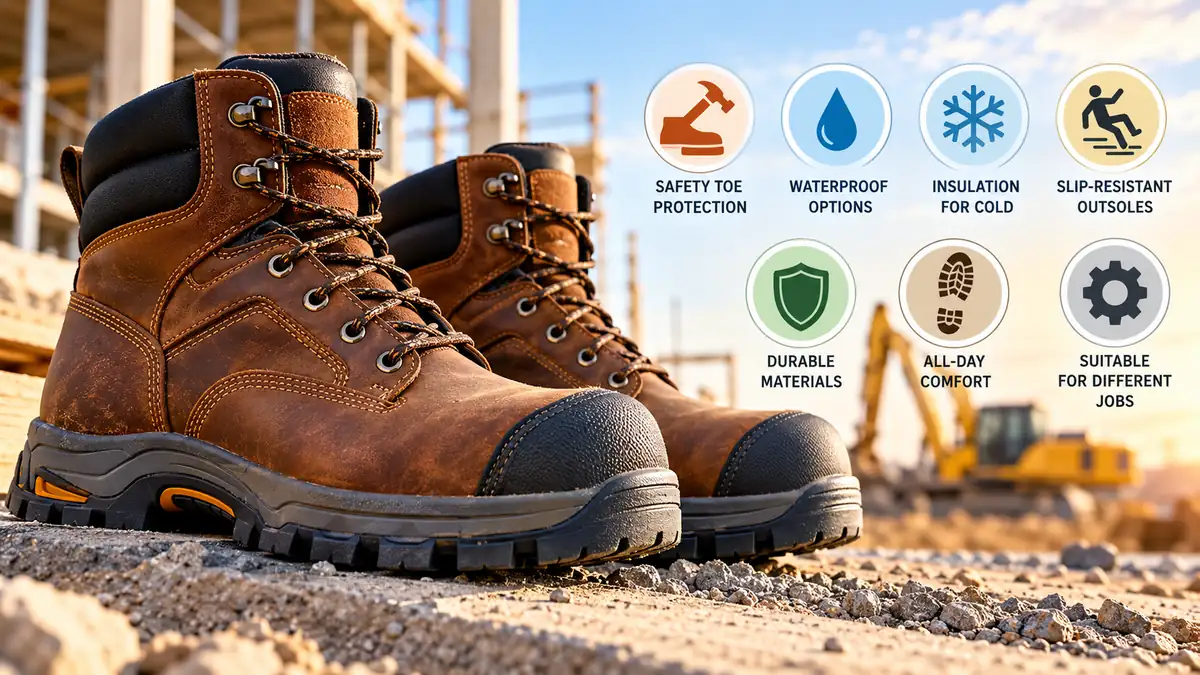
The wrong pair of work boots can turn an ordinary shift into eight hours of discomfort. Worse, footwear that does not match workplace hazards may leave your feet exposed to falling objects, sharp materials, slippery surfaces, or electrical risks.
Choosing protective footwear involves more than finding a rugged design. Toe protection, outsole construction, fit, materials, and safety certifications all matter.
Work boots are durable footwear designed to protect and support feet during physically demanding jobs. Depending on their construction, they may provide impact-resistant toes, puncture-resistant soles, slip-resistant outsoles, electrical hazard protection, and ankle support. The right type depends on workplace hazards, job requirements, working conditions, and individual comfort needs.
What Are work boots and Why Are They Important?
Work boots are specialized footwear built for environments where ordinary shoes may wear out quickly or provide insufficient protection.
They are commonly used in construction, manufacturing, agriculture, warehousing, landscaping, transportation, maintenance, and industrial work.
Unlike everyday footwear, many occupational boots incorporate protective components that address specific workplace risks.
Key Functions of Work Footwear
A suitable pair can provide several benefits:
- Foot protection: Protective toe caps can reduce injury from falling or rolling objects.
- Traction: Appropriate outsoles help reduce slipping on certain surfaces.
- Underfoot protection: Puncture-resistant components help guard against sharp objects.
- Support: A stable design may improve comfort during prolonged standing and walking.
- Durability: Reinforced materials withstand repeated abrasion and demanding conditions.
- Environmental protection: Waterproof or insulated designs help in wet and cold environments.
Not every boot provides every feature. A leather boot with a thick outsole, for example, is not automatically certified as protective footwear.
Common Industries That Require Protective Boots
| Industry | Typical hazards | Useful footwear features |
|---|---|---|
| Construction | Falling materials, nails, uneven ground | Safety toe, puncture resistance, traction |
| Manufacturing | Heavy equipment, rolling objects | Impact and compression protection |
| Warehousing | Pallets, carts, concrete floors | Protective toe, comfort, appropriate traction |
| Electrical maintenance | Certain electrical contact hazards | Task-appropriate electrical protection |
| Agriculture | Mud, moisture, machinery | Water resistance, grip, easy cleaning |
| Landscaping | Uneven terrain, sharp debris | Supportive construction, durable outsole |
| Food processing | Wet or greasy floors | Slip-resistant, easy-clean materials |
The hazards of a particular job should determine the footwear specification rather than the industry name alone.
Different Types of work boots Explained
Occupational footwear comes in several categories. Understanding their differences makes it easier to identify which features are necessary and which are optional.
Steel Toe Boots
Steel toe boots contain a steel protective cap positioned around the front of the foot.
They are widely used where falling or rolling objects could injure the toes.
Advantages:
- Strong impact and compression protection when properly certified
- Established performance in industrial applications
- Available in numerous styles and constructions
Limitations:
- Steel caps can add weight compared with some alternatives.
- Metal may conduct heat and cold more readily.
- Some workplaces have metal-detection restrictions.
A steel toe cap does not automatically make a boot suitable for electrical work.
H3: Composite Toe Boots
Composite toe boots use nonmetallic protective materials such as fiberglass, carbon fiber composites, or reinforced polymers.
They can provide certified impact and compression protection without a traditional steel cap.
Composite designs are often selected when reduced metal content or thermal comfort is desirable.
However, composite toe boots are not automatically lighter than every steel toe model. Weight depends on the entire boot.
H3: Alloy Toe Boots
Alloy toe caps use metals such as aluminum or titanium alloys, depending on the manufacturer.
They can provide protection comparable to other certified safety toe types while allowing different toe-cap shapes and weight characteristics.
Because alloy is metallic, it should not be treated as nonconductive.
Soft Toe Boots
Soft toe boots do not contain a certified protective toe cap.
They may offer durable uppers, cushioning, traction, and support, making them useful in lower-risk environments.
However, they are not a substitute for safety toe footwear when an employer’s hazard assessment requires impact or compression protection.
Waterproof Work Boots
Waterproof boots use materials, sealed seams, membranes, or molded constructions designed to limit water entry.
Common designs include leather boots with waterproof membranes and molded rubber or PVC footwear.
Waterproofing is especially relevant for outdoor construction, farming, utility work, and wet industrial settings.
One trade-off is breathability. Waterproof membranes may trap more heat and moisture inside the boot during warm-weather work.
Insulated Work Boots
Insulated boots help reduce heat loss in cold environments.
Manufacturers may use synthetic insulation, insulated liners, or specialized layered constructions.
Insulation ratings such as 200 g, 400 g, and 800 g generally describe the amount of insulation material used, not a guaranteed temperature rating.
Activity level, socks, moisture, circulation, and weather all influence actual warmth.
H3: Pull-On and Lace-Up Boots
Pull-on boots are convenient because they do not require laces. Wellington-style designs are common in agricultural and industrial environments.
Lace-up boots allow more adjustment around the instep and ankle.
Neither closure style is universally safer. Proper retention, fit, and task suitability matter more.
Understanding work boots Safety Standards and Ratings
Safety labels help distinguish tested protective features from ordinary marketing descriptions.
In the United States, the most relevant standards include ASTM F2413 and ASTM F2892. Internationally, ISO-based and European standards are also widely used.
ASTM F2413 Protective Footwear Standard
ASTM F2413 specifies performance requirements for protective footwear, including impact and compression protection and other optional protective characteristics.
A footwear label may contain markings such as:
- I: Impact resistance
- C: Compression resistance
- EH: Electrical hazard protection
- PR: Puncture resistance
- Mt: Metatarsal protection
- SD: Static dissipative properties
- Cd: Conductive properties
The exact marking format and applicable test requirements depend on the standard edition.
For example, an impact rating of I/75 relates to a test energy of 75 foot-pounds, approximately 102 joules. A C/75 designation corresponds to a compression test force of 2,500 pounds-force.
These ratings describe standardized laboratory performance, not a guarantee against every real-world injury.
ASTM F2892 for Soft Toe Occupational Footwear
ASTM F2892 applies to occupational footwear without protective safety toe caps.
Such footwear may be evaluated for certain other protective characteristics, but it should not be confused with ASTM F2413-certified safety toe footwear.
Always inspect the complete label rather than assuming that an ASTM reference means toe protection is included.
EN ISO 20345 Safety Footwear
EN ISO 20345 is an important European safety footwear standard.
It includes requirements for protective toe caps tested for 200 joules of impact energy and 15 kilonewtons of compression force.
Under the 2022 edition, common classification categories include:
| Classification | General meaning |
|---|---|
| SB | Basic safety footwear requirements |
| S1 | Basic requirements plus specified additional properties |
| S2 | S1-type requirements with water penetration and absorption protection for the upper |
| S3 | S2-type requirements plus puncture resistance and outsole requirements |
| S6 | S2-type requirements plus whole-footwear water resistance |
| S7 | S3-type requirements plus whole-footwear water resistance |
Additional suffixes distinguish particular protective characteristics and test methods.
Older and newer classification systems differ, so checking the edition printed on the footwear is essential.
Electrical Hazard vs. Static Dissipative Footwear
Electrical hazard footwear and static dissipative footwear serve different purposes.
Electrical hazard-rated footwear is designed to provide secondary protection against certain accidental electrical contact conditions. It is not a replacement for electrical isolation procedures or other required protective equipment.
Static dissipative footwear helps control static electricity by allowing charge to dissipate under specified conditions.
Conductive footwear is intended for environments requiring rapid static discharge.
These properties are not interchangeable.
For electrical work, footwear selection should follow the employer’s risk assessment and applicable safety procedures.
OSHA Requirements for Protective Footwear
The Occupational Safety and Health Administration (OSHA) requires employers to ensure appropriate protective footwear is used when workers face specified foot injury hazards.
Under 29 CFR 1910.136, these include hazards from falling or rolling objects, objects piercing the sole, and certain electrical risks.
Employers must assess workplace hazards and determine which protective features are necessary.
A safety toe rating alone does not mean footwear is appropriate for every hazardous environment.
Work Boot Materials and Construction Methods
The materials and construction methods used in occupational boots influence durability, flexibility, weight, breathability, and maintenance requirements.
H3: Full-Grain Leather vs. Synthetic Materials
Full-grain leather is widely used because of its abrasion resistance, durability, and ability to conform gradually to the foot.
Properly maintained leather can perform well in demanding environments, although it requires cleaning and conditioning.
Synthetic uppers may incorporate nylon, polyester, microfiber, and reinforced polymer materials.
They can offer reduced weight, flexibility, or improved ventilation, depending on their design.
| Material | Advantages | Limitations |
|---|---|---|
| Full-grain leather | Durable, abrasion-resistant, adaptable fit | Requires maintenance; can be heavy |
| Nubuck leather | Flexible, comfortable surface | Can stain and requires appropriate care |
| Synthetic mesh | Lightweight, breathable | May offer less abrasion resistance |
| Rubber | Excellent water barrier | Limited breathability |
| PVC | Water-resistant, easy to clean | Can feel stiff and trap moisture |
| Leather-synthetic combination | Balances durability and ventilation | Performance varies by construction |
Material quality is only one part of durability. Stitching, reinforcement, sole attachment, and maintenance also matter.
Goodyear Welt Construction
Goodyear welt construction uses a separate strip of material, called a welt, to connect major components of the boot.
It is associated with durable footwear and can make resoling possible.
However, not every welted boot is automatically waterproof, and replacing the sole of certified safety footwear may affect its protective compliance.
H3: Cemented Construction
Cemented boots use adhesives to bond the outsole to the upper.
This method can produce lighter, more flexible footwear with less break-in time.
A potential disadvantage is that some cemented boots are difficult or uneconomical to resole.
Direct-Attach Construction
Direct-attach boots use a molding or bonding process to connect the outsole directly to the upper.
Polyurethane is frequently used in these constructions.
Depending on the design, direct attachment can provide flexibility, cushioning, and resistance to water entry.
The construction methods differ in durability, flexibility, and repairability.
How to Choose Comfortable work boots for Long Shifts
Comfort becomes particularly important for workers who stand or walk for eight to twelve hours.
Foot shape, boot geometry, flooring, workload, and temperature all influence how footwear feels throughout a shift.
Choose the Correct Size and Width
A properly fitting boot should secure the heel and midfoot without squeezing the toes.
The protective toe cap should not press against the sides or top of the toes.
To assess fit:
- Measure both feet, preferably later in the day.
- Wear the socks normally used at work.
- Check the length and width of each boot.
- Walk on a firm surface to assess heel movement.
- Test the boots on an incline if possible.
- Check for pressure around the instep and ankle.
- Make sure the toes do not strike the front when walking downhill.
Footwear sizes vary between manufacturers. A size 10 in one brand may fit differently from a size 10 in another.
Understand Toe Box Shape
The toe box is the front section of the boot that surrounds the toes.
A narrow toe box can create pressure and discomfort, particularly during prolonged standing.
Wide toe box work boots may suit people with broader forefeet, but the overall boot should still hold the heel securely.
A protective toe cap generally will not stretch significantly during break-in.
If the cap presses against your toes when new, waiting for the boot to loosen is unlikely to solve the problem.
Cushioning and Arch Support
A comfortable boot distributes pressure and provides appropriate support for the wearer and task.
Common comfort components include:
- EVA foam midsoles for lightweight cushioning
- Polyurethane midsoles for cushioning and structural support
- Removable footbeds for maintenance and fit adjustments
- Heel counters that stabilize the rear of the foot
- Shanks that add structural support
- Padded collars and tongues that reduce localized pressure
More cushioning is not always better. Excessively soft footwear may feel unstable on uneven surfaces.
The goal is a balance between comfort, stability, and protection.
Lightweight vs. Heavy-Duty Boots
Lightweight work boots can reduce the amount of weight carried on each step.
They may be useful for warehouse workers, delivery personnel, and jobs involving extensive walking.
Heavy-duty boots may offer additional reinforcement, aggressive tread, or specialized protective features.
However, a heavier boot is not necessarily safer.
Certified protection and appropriate construction are more meaningful than weight alone.
Choosing the Right Outsole for Different Work Surfaces
The outsole is the part of the boot that contacts the ground.
Its material, tread pattern, flexibility, and condition affect traction and durability.
Rubber Outsoles
Rubber is commonly used because it can provide abrasion resistance and useful traction.
Performance varies according to rubber formulation and tread design.
Some compounds are optimized for wet surfaces, while others prioritize durability or resistance to heat and chemicals.
H3: TPU and Polyurethane Outsoles
Thermoplastic polyurethane (TPU) can offer good abrasion resistance and durability.
Polyurethane (PU) can provide cushioning and reduced weight.
Neither material guarantees superior slip resistance in every environment.
The specific outsole design and test results are more useful than the material name alone.
Wedge Sole vs. Lug Sole
Wedge soles usually provide a broad contact area and relatively flat bottom.
They are commonly associated with work on concrete and other firm surfaces.
Lug soles use deeper tread patterns that may provide improved traction on loose soil, gravel, and uneven outdoor terrain.
| Outsole design | Typical application | Main consideration |
|---|---|---|
| Wedge sole | Concrete, workshops, warehouses | Broad contact area |
| Lug sole | Mud, gravel, outdoor terrain | Deeper tread for loose surfaces |
| Defined heel | Certain ladder and outdoor tasks | Heel geometry may assist with specific footing |
| Slip-resistant tread | Wet or contaminated floors | Must match the actual surface and contaminant |
| Heat-resistant outsole | Hot industrial environments | Verify the relevant temperature rating |
No outsole is completely slip-proof.
Oil, water, grease, dust, and surface texture can change traction significantly.
What Does Slip-Resistant Really Mean?
Slip resistance describes a footwear outsole’s performance under particular test conditions.
A boot that performs well on wet ceramic tile may behave differently on oily metal flooring.
ASTM F3445 provides performance requirements related to slip resistance for protective footwear, while ASTM F2913 addresses whole-shoe slip resistance testing.
Look for relevant test information rather than relying only on phrases such as anti-slip or maximum grip.
How to Select work boots for Specific Jobs and Weather
Different jobs expose footwear to different combinations of hazards.
A practical selection process begins with the work environment.
Construction Work
Construction workers may encounter falling materials, protruding nails, uneven ground, and wet surfaces.
Depending on the hazard assessment, useful features include protective toe caps, puncture resistance, abrasion-resistant uppers, and suitable traction.
A puncture-resistant sole component is especially relevant where sharp debris is present.
Warehouse and Factory Work
Warehouse employees often walk or stand on concrete for extended periods.
Toe protection may be necessary around pallet trucks, forklifts, and heavy stored materials.
Comfortable midsoles, stable heel construction, and slip-resistant outsoles may also help.
Footwear should match the specific facility rather than assuming every warehouse requires the same type.
Outdoor and Landscaping Work
Landscaping and outdoor maintenance often involve loose soil, wet grass, rocks, and uneven ground.
Useful characteristics may include durable uppers, secure fit, appropriate lug patterns, and moisture protection.
Jobs involving chainsaws require additional consideration. Ordinary protective toe boots do not automatically provide chainsaw cut resistance.
Work in Cold Weather
Cold-weather work requires attention to insulation, moisture, and circulation.
Thick socks can help, but overly tight boots may restrict circulation and reduce comfort.
For winter conditions, consider insulated uppers, water resistance, sufficient toe room, and traction appropriate for snow or ice.
No ordinary outsole guarantees reliable grip on ice.
Work in Hot Weather
Hot-weather workers often prioritize ventilation and moisture management.
Breathable linings, moisture-wicking socks, and appropriate upper materials may improve comfort.
However, ventilation should not come at the expense of required protective features.
For example, an open mesh design may be unsuitable in an environment with hot metal fragments or sparks.
Electrical and Specialized Industrial Work
Electrical workers should follow job-specific requirements for electrical protective equipment.
Similarly, foundry work, welding, chemical handling, and forestry operations may require specialized footwear.
Metatarsal guards protect the upper foot against certain impact hazards, while chemical-resistant boots must be selected according to the chemicals involved.
A general-purpose safety boot should never be assumed to cover these specialized risks.
How to Break In, Clean, and Maintain work boots
Good maintenance helps footwear remain comfortable and functional.
It also makes damage easier to detect before a protective component fails.
How Long Does It Take to Break In Work Boots?
Break-in time depends on leather stiffness, construction, and fit.
Some flexible boots feel comfortable almost immediately. Stiffer leather models may require several days or weeks of gradual use.
To make the process easier:
- Wear the boots indoors for short periods.
- Use appropriate work socks.
- Gradually increase walking and standing time.
- Adjust the laces to prevent excessive heel movement.
- Inspect for persistent pressure or rubbing.
- Avoid forcing a painful break-in period.
Severe pain, numbness, or pressure from a safety toe cap suggests a fit problem rather than normal break-in.
H3: Cleaning Leather Work Boots
Remove loose dirt using a soft brush.
Wipe the uppers with a damp cloth and use a leather-compatible cleaner when needed.
Allow the boots to dry naturally, away from direct heaters or intense sunlight.
Apply an appropriate leather conditioner according to the manufacturer’s instructions.
Excessive conditioning can soften some leather more than intended, so more product is not necessarily better.
H3: Cleaning Rubber and Synthetic Boots
Rubber and synthetic footwear can often be cleaned with mild soap and water.
However, chemical-resistant footwear may require specific decontamination procedures.
Always follow workplace guidance when boots have been exposed to hazardous substances.
H3: How Often Should Work Boots Be Replaced?
There is no universal replacement interval.
A boot used occasionally in a dry warehouse may last considerably longer than one exposed daily to wet concrete, sharp debris, or abrasive surfaces.
Inspect footwear regularly for:
- Cracked or separated outsoles
- Worn tread
- Exposed protective toe caps
- Damaged stitching
- Torn uppers or linings
- Compromised puncture-resistant components
- Persistent water leakage
- Significant deformation or loss of support
After a serious impact or compression event, protective footwear may require replacement even when visible damage is limited.
Manufacturers’ instructions and workplace policies should guide replacement decisions.
H3: Can Safety Boots Be Resoled?
Some welted boots can be resoled, but repairability does not automatically mean the protective certification remains valid.
ASTM F2413-24 specifically cautions that changes to original components, including resoling and replacement footbeds, may affect compliance.
ASTM International
For certified protective footwear, consult the manufacturer before making structural modifications.
H2: Common Work Boot Mistakes and How to Avoid Them
Many footwear problems arise from choosing boots based on appearance or a single feature rather than the complete job requirement.
H3: Assuming All Safety Toe Boots Are Equal
Steel, composite, and alloy toe caps can all meet applicable impact and compression requirements.
The material alone does not determine the overall protection level.
Always verify the certification and relevant protective markings.
H3: Choosing Boots That Are Too Large
Oversized boots may allow excessive foot movement, causing rubbing and instability.
A thicker sock does not always compensate for an incorrect size.
Choose the proper length, width, and heel fit.
H3: Ignoring Workplace Surface Conditions
Deep outdoor lugs may not be the ideal choice for smooth, contaminated indoor floors.
Likewise, a flat outsole may not perform well in loose mud.
Match traction characteristics to the actual work surface.
H3: Confusing Waterproof With Breathable
Waterproof footwear helps limit external water entry, but it may also retain perspiration.
For hot, dry environments, breathability may be more useful than maximum waterproofing.
For persistently wet environments, moisture protection becomes more important.
H3: Believing Expensive Boots Are Automatically Safer
Price can reflect materials, construction, brand positioning, and repairability.
It does not replace independent testing or certification.
A reasonably priced boot with the correct safety rating and fit may be more appropriate than a premium boot designed for another environment.
H3: Ignoring Foot Pain
Persistent foot pain should not be treated as an unavoidable part of wearing occupational footwear.
Possible causes include poor fit, inadequate support, excessive pressure, or an unsuitable boot design.
Pain that continues despite footwear adjustments warrants evaluation by a qualified healthcare professional.
H2: Final Thoughts on Choosing work boots
The right work boots combine three essential qualities: appropriate protection, reliable fit, and suitability for the working environment.
Start by identifying workplace hazards and required safety standards. Then compare toe protection, outsole design, upper materials, construction, and comfort features.
Pay particular attention to fit because even a well-constructed boot can cause discomfort when its shape does not suit the wearer.
Finally, maintain and inspect footwear regularly. Worn soles, damaged uppers, and compromised protective components can reduce the effectiveness of otherwise suitable boots.
A practical next step is to review your workplace footwear requirements, identify the hazards you face most often, and use those requirements to assess your current boots.