
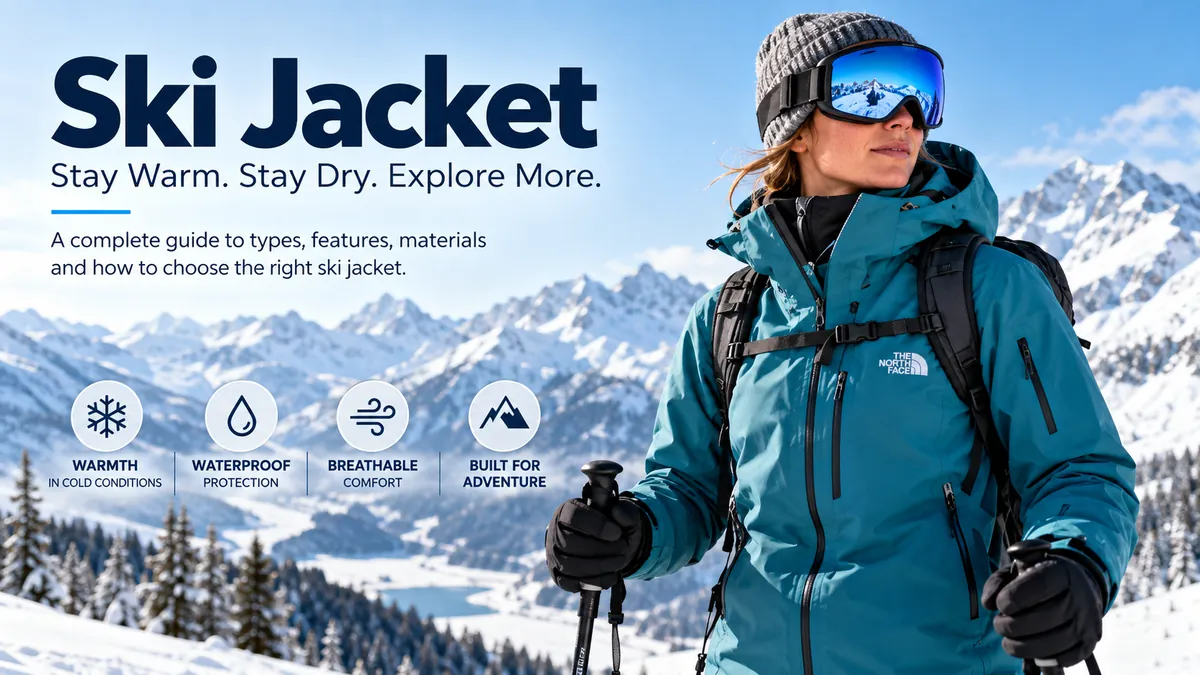
A ski jacket has a harder job than an ordinary winter coat. It needs to block wind-driven snow and moisture while allowing heat and sweat to escape as you move. At the same time, it has to fit comfortably over layers without restricting your arms, shoulders, or torso.
A ski jacket is a weather-protective outer layer designed for skiing and other snow sports. It typically combines a waterproof-breathable shell with ski-specific features such as a helmet-compatible hood, powder skirt, ventilation zips, sealed seams, adjustable cuffs, and pass pockets. Some models also contain insulation for additional warmth.
That definition sounds straightforward, but choosing the right jacket becomes more complicated once terms such as 2-layer, 3-layer, 20K waterproofing, Gore-Tex, synthetic insulation, DWR, and breathability enter the picture. Understanding what those features actually do makes the decision much easier.
What Makes a Ski Jacket Different From a Regular Winter Jacket?
A normal winter coat is primarily designed to keep you warm. A ski jacket has to balance several jobs simultaneously:
- Keep falling and wind-driven snow outside
- Resist water when you sit or fall on snow
- Block cold wind
- Release moisture generated by physical activity
- Allow unrestricted skiing movements
- Work comfortably with base and mid layers
- Fit around gloves, goggles, and a ski helmet
- Provide storage that remains accessible on the mountain
These requirements explain why a casual puffer jacket and a technical ski shell can feel completely different despite both being designed for cold weather.
Modern ski clothing commonly uses waterproof, windproof, and breathable fabrics. Ski-specific details often include ventilation zips, powder skirts, helmet-compatible hoods, and secure pass pockets.
Ski Jacket vs. Snow Jacket
The terms ski jacket and snow jacket are often used loosely. A snow jacket may simply refer to clothing intended for cold, snowy weather, whereas a dedicated ski jacket normally includes features specifically useful on the slopes.
Snowboard jackets share many of the same technologies. The main differences are often fit and styling rather than basic weather protection. Snowboard clothing may have a roomier or longer cut, while some alpine ski jackets use a more tailored, articulated shape.
Neither style is automatically better. Mobility, weather protection, and compatibility with your other equipment matter more than the label.
Types of Ski Jacket: Shell, Insulated and 3-in-1
The first major decision is whether you want insulation built into your jacket.
OutdoorGearLab separates many modern options into hardshell and shell-insulated designs and notes that the choice depends heavily on conditions, layering preferences, and whether you ski mainly at resorts or in the backcountry.
| Jacket type | Built-in insulation | Main advantage | Main limitation | Typical use |
|---|---|---|---|---|
| Hardshell | No | Maximum layering flexibility | Requires separate insulation | Variable weather, touring |
| Insulated | Yes | Convenient warmth | Less adaptable in warm weather | Cold resort skiing |
| 3-in-1 | Removable layer | Versatile system | Usually heavier and bulkier | Recreational skiing |
| Softshell | Little or none | Stretch and breathability | Lower storm protection | Mild, dry conditions |
Shell Ski Jackets
A shell jacket focuses primarily on protection from wind, rain, and snow. It contains little or no insulation.
You control warmth underneath using a layering system.
This is extremely useful when conditions change. On a cold January morning, you might wear a moisture-managing base layer, fleece or synthetic midlayer, and lightweight insulated jacket underneath the shell. During spring skiing, you may need only the base layer.
A hardshell can also work outside the ski season for activities such as alpine climbing or hiking, giving it more year-round versatility.
Shells are particularly useful for backcountry skiing because climbing generates substantially more body heat than sitting on a chairlift.
Insulated Ski Jackets
An insulated ski jacket combines weather protection and insulation in one garment.
This design works particularly well for resort skiers who spend significant time on exposed lifts between downhill runs. You get reliable warmth without needing to build a complicated layering system every morning.
Synthetic insulation is common because it can provide useful warmth without the extreme bulk associated with traditional winter coats. Technologies found across the category include PrimaLoft and Helly Hansen’s LIFALOFT.
For example, Helly Hansen has used LIFALOFT insulation by PrimaLoft alongside HELLY TECH Performance weather protection in its ski clothing.
The trade-off is adaptability. If an insulated jacket becomes too warm, you cannot remove its insulation.
3-in-1 Ski Jackets
A 3-in-1 system normally consists of a waterproof outer shell and removable insulated inner jacket.
You can wear:
- Both pieces together in cold weather.
- The shell alone in wet or mild conditions.
- The inner jacket separately in dry conditions.
The design is practical for occasional skiers who want one system for several situations. The downside is that 3-in-1 jackets can be heavier and less streamlined than purpose-built technical shells.
Ski Jacket Waterproofing Explained
Waterproofing deserves close attention because snow eventually melts.
A fabric’s waterproof rating is commonly expressed in millimeters, such as 10,000 mm (10K) or 20,000 mm (20K). The figure relates to hydrostatic-head testing: essentially, how much water pressure the material can resist before water penetrates it.
As a practical reference, 10,000 mm is commonly treated as a useful starting point for skiing, while approximately 20,000 mm provides stronger protection for demanding, prolonged exposure. Test methods differ, however, so ratings between manufacturers are not always perfectly comparable.
| Waterproof rating | General interpretation | Suitable conditions |
|---|---|---|
| Below 10K | Basic water resistance | Short outings, relatively dry snow |
| Around 10K | Useful everyday protection | Recreational resort skiing |
| 15K–20K | Strong protection | Frequent skiing, wetter storms |
| 20K+ | High weather resistance | Prolonged or demanding mountain exposure |
These figures should be treated as guides rather than guarantees.
Fabric construction, seam sealing, zipper design, garment condition, and exposure time all influence real-world performance.
Gore-Tex and Other Waterproof Membranes
Gore-Tex is one of the best-known waterproof-breathable membrane families used in outdoor clothing, but it is far from the only option.
Brands also develop proprietary systems. Patagonia, for example, uses H2No technology in some technical outerwear, while Helly Hansen uses HELLY TECH.
Modern Gore-Tex products also increasingly use an ePE membrane. The exact construction varies between products, so seeing a familiar membrane name should not replace checking the entire jacket specification.
The membrane is only one part of the system.
A technically impressive fabric can still perform poorly if water enters through untreated seams or openings.
Why Taped Seams Matter
Every stitch creates tiny holes in a waterproof fabric.
Manufacturers therefore apply waterproof seam tape behind vulnerable stitching. A fully seam-sealed jacket protects all relevant seams, whereas critically taped construction may protect only selected high-exposure areas.
Fully taped seams are preferable when reliable protection in prolonged snow and wet weather matters.
DWR Is Not the Same as Waterproofing
Durable water repellent, usually abbreviated DWR, is a treatment applied to the outer face fabric.
Its purpose is to make water bead and roll away instead of immediately soaking into the textile.
DWR should not be confused with the waterproof membrane itself. The membrane is responsible for the primary waterproof barrier; DWR helps the outer fabric avoid becoming saturated.
That distinction matters as a jacket ages. A jacket can begin looking wet on the outside even while its membrane remains functional.
Breathability Is Just as Important as Waterproofing
Keeping water outside solves only half the problem.
Skiing generates heat and moisture inside your clothing. If that moisture cannot escape, your base and mid layers become damp. Once activity decreases—particularly when you sit on a cold chairlift—that moisture can make you feel much colder.
Breathability describes a fabric’s ability to move water vapor away from your body.
Some manufacturers report MVTR, or moisture vapor transmission rate, in grams per square meter over 24 hours. Figures around 20,000 g/m²/24h are often associated with strong all-mountain breathability, although different laboratory test methods mean numbers from different brands cannot always be compared directly.
How Much Breathability Do You Need?
Your activity level matters more than simply chasing the largest specification.
A resort skier who spends much of the day riding lifts may prioritize warmth and weather resistance.
A backcountry skier climbing uphill can generate considerable heat and sweat. For that person, a breathable shell and effective mechanical ventilation become much more important.
This is one reason premium specifications do not automatically make a jacket suitable for everyone.
Pit Zips and Mechanical Ventilation
Even excellent breathable membranes have limits.
Underarm vents—often called pit zips—let hot, humid air escape directly. Opening them before you begin sweating heavily can be more effective than waiting until your inner layers are already damp.
Some insulated ski jackets also incorporate underarm ventilation specifically for this reason.
A useful habit is to regulate temperature early. If you feel slightly warm before a demanding section, open your vents rather than waiting until you are overheating.
2-Layer vs. 2.5-Layer vs. 3-Layer Construction
The “layers” in 2L and 3L do not refer to how many garments you wear.
They describe how the waterproof fabric is constructed.
2-Layer Construction
A 2-layer fabric bonds the outer face material to a waterproof membrane. A separate hanging liner commonly protects the membrane from your body.
This construction is widespread in resort clothing because it can feel comfortable and accommodates insulation easily.
2.5-Layer Construction
A 2.5-layer jacket uses a face fabric and membrane plus a printed or applied protective treatment on the inside instead of a complete third textile layer.
The result can be lighter and more packable.
It is more common in lightweight rainwear and some technical shells than in heavily featured resort jackets.
3-Layer Construction
In a 3-layer shell, the face fabric, waterproof membrane, and protective backing are laminated together.
Three-layer materials are common in higher-performance shells because they can combine excellent weather resistance with relatively low bulk. OutdoorGearLab generally recommends considering 3-layer construction when high levels of weather protection and ventilation are priorities.
Do not assume 3L automatically means warmer. A technical 3-layer hardshell may contain virtually no insulation.
How Warm Should a Ski Jacket Be?
There is no single correct amount of insulation.
Temperature is only one variable. Wind, humidity, precipitation, skiing intensity, chairlift exposure, altitude, metabolism, and your other clothing all affect how warm you feel.
This is why “warmest” and “best” are not interchangeable.
Synthetic Insulation
Synthetic insulation is extremely common in ski clothing.
Its advantages include consistent performance, relatively easy maintenance, and useful warmth in environments where snow and moisture are expected.
PrimaLoft is a familiar example. Some garments use different insulation weights in different areas of the body to balance warmth and mobility. Helly Hansen, for instance, lists PrimaLoft and LIFALOFT technologies in technical ski designs.
Down Insulation
Down offers an excellent warmth-to-weight ratio and compressibility.
Its limitations become more relevant around persistent moisture. Modern treatments and waterproof outer constructions can reduce those concerns, but down is generally most attractive when low weight and substantial warmth are priorities.
Why More Insulation Is Not Always Better
Overheating creates sweat.
Sweat creates moisture.
Moisture becomes a problem when you stop moving.
A slightly cooler setup that keeps you dry can therefore feel more comfortable across an entire ski day than an extremely warm jacket that causes constant overheating.
How to Layer Under a Ski Jacket
A good layering system divides responsibilities between garments instead of expecting one coat to do everything.
1. Base Layer
The base layer sits next to your skin.
Its main purpose is moisture management. Materials such as merino wool and performance synthetics are commonly used because they can move moisture away from the body more effectively than ordinary cotton.
Cotton is generally a poor choice for demanding winter activity because it can retain moisture and become uncomfortable when wet.
2. Midlayer
The midlayer supplies insulation.
Depending on conditions, this might be:
- Fleece
- Synthetic insulated jacket
- Lightweight down jacket
- Technical wool layer
You can change midlayer thickness as temperatures change.
3. Outer Shell
The shell protects the entire system against wind and precipitation.
This modular approach is particularly effective with a non-insulated ski jacket because you can modify warmth without replacing your outer weather barrier.
Quick Takeaway: If conditions vary significantly throughout your ski season, a shell plus adjustable layers provides greater temperature flexibility. If you mostly ski cold resorts and prefer simplicity, an insulated jacket can be easier to manage.
Essential Ski Jacket Features
Features should solve actual problems rather than simply make the specification sheet longer.
Current technical jackets commonly combine helmet-compatible hoods, powder skirts, ski-pass pockets, ventilation, articulated sleeves or elbows, and internal storage.
Helmet-Compatible Hood
A ski hood should fit comfortably over your helmet without restricting your ability to turn your head.
Adjustment points are valuable because a huge hood that cannot be tightened may flap around when worn without a helmet.
A high protective collar can also shield your chin and lower face during windy lift rides.
Powder Skirt
A powder skirt is an internal band around the lower torso that helps prevent snow from entering from underneath.
It becomes especially useful when skiing deep powder or after a fall.
Some powder skirts are removable. That can make the jacket more versatile when snow protection is unnecessary.
Ski Pass Pocket
Many ski areas use electronic lift passes.
A sleeve-mounted pass pocket lets the scanner read the pass without requiring you to unzip your jacket or remove your gloves.
It sounds like a minor feature until you repeatedly go through lift gates.
Goggle Pocket
Large internal drop pockets are useful for goggles, gloves, or other items you need to access quickly.
Keeping goggles inside your jacket can also help protect them when they are not being worn.
Adjustable Cuffs and Wrist Gaiters
Your jacket and gloves need to work together.
Adjustable cuffs help create a clean seal around or beneath gloves, reducing gaps where snow and cold air can enter. Stretch wrist gaiters and thumb loops provide another barrier on some designs.
Articulated Sleeves
Skiing involves frequent arm movement.
Articulated elbows and sleeves are shaped to follow the body’s skiing position rather than hanging like a simple straight tube. The result can be greater freedom of movement with less fabric pulling across the shoulders.
RECCO Reflector
Some technical ski jackets contain a RECCO reflector.
The reflector is a passive component designed to work with compatible RECCO detectors used by professional rescue organizations. Several ski garments, including Helly Hansen models, integrate RECCO reflectors.
It is an additional search technology—not a substitute for an avalanche transceiver, appropriate training, rescue equipment, or sound backcountry decision-making.
Useful Pockets
More pockets are not necessarily better.
Think about what you actually carry: phone, lift pass, goggles, snacks, wallet, keys, or a trail map.
Pocket placement also matters. A technically excellent pocket becomes useless if a backpack strap blocks it.
Some modern ski clothing includes fleece-lined hand pockets, chest pockets, internal stash pockets, goggle wipes, and specialized phone storage.
How Should a Ski Jacket Fit?
A ski jacket should provide enough space for your intended layers while maintaining full freedom of movement.
It should not fit like a tightly tailored street jacket.
At the same time, unnecessarily excessive fabric can add bulk and flap in strong wind.
OutdoorGearLab’s testing emphasizes that comfort and fit depend on body type and that a good jacket should permit a wide range of motion without unnecessary material.
Check the Shoulders
Wear the layers you expect to use while skiing.
Raise both arms overhead, reach forward, and imitate holding ski poles. The shoulders should move naturally without the hem climbing excessively or the jacket pulling tightly across your back.
Check Sleeve Length
Your sleeves should remain long enough when your elbows are bent.
This matters because skiing is performed with bent arms rather than standing perfectly straight.
Check the Hem
The hem should provide adequate coverage when bending, sitting on a lift, and falling.
Longer cuts can provide more protection, while shorter athletic cuts may feel less bulky.
Test It With a Helmet
If the jacket has a helmet-compatible hood, test the two together whenever possible.
Turn your head fully left and right.
You should be able to look around without the hood pulling your head backward or blocking peripheral vision.
Leave Room for Layers
A shell needs enough internal space for insulation.
An insulated jacket requires less extra room because much of its warmth is already built in.
This is why simply sizing up automatically is not the answer. The correct fit depends on the garment’s intended cut and your layering system.
Resort Skiing vs. Backcountry Skiing
Where you ski should influence the type of jacket you use.
Resort Skiing
Resort skiing usually alternates between relatively short periods of intense downhill movement and longer periods of lower activity on chairlifts.
That pattern often favors:
- Moderate or substantial insulation
- Strong wind protection
- Powder skirt
- Lift-pass pocket
- Comfortable collar
- Plenty of storage
An insulated jacket can work exceptionally well here because warmth during inactive periods matters.
Backcountry Skiing
Touring reverses the equation.
Climbing uphill for an extended period creates significant body heat, making breathability, ventilation, low weight, and layering flexibility more important.
A non-insulated hardshell is therefore often the more adaptable solution. Insulation can remain in a backpack during the ascent and be added during transitions, descents, or stops.
OutdoorGearLab similarly notes that shells offer greater flexibility for variable conditions and backcountry use, whereas insulated models are particularly convenient for resort skiing.
All-Mountain Use
If one jacket needs to cover both situations, prioritize adaptability.
A breathable waterproof shell with large vents, adequate pockets, a helmet-compatible hood, and enough room for a midlayer is a flexible starting point.
Ski Jacket Features That Matter Most by Conditions
Different climates expose weaknesses in different designs.
| Conditions | Prioritize |
|---|---|
| Cold, dry resort | Insulation, wind resistance, high collar |
| Wet snow | Strong waterproofing, fully taped seams, hood |
| Deep powder | Powder skirt, longer coverage, secure cuffs |
| Spring skiing | Ventilation, breathability, lighter insulation |
| Backcountry touring | Lightweight shell, breathability, pit zips |
| Variable conditions | Shell plus adaptable layering system |
| Frequent storms | High weather resistance, secure hood, sealed seams |
The most technical jacket on paper is not necessarily the one that will keep you most comfortable.
Common Ski Jacket Mistakes
Choosing Warmth Without Considering Sweat
People who get cold easily sometimes choose the heaviest insulated jacket available.
That can backfire during active skiing.
If you sweat heavily, damp layers may make you colder later in the day. A more breathable jacket combined with adjustable insulation can produce better temperature control.
Ignoring Seam Construction
A high waterproof rating catches attention, but seams and zippers are potential entry points for moisture.
Look at the entire garment rather than one headline number.
Buying Too Tight
Trying on a jacket over a T-shirt tells you very little about winter fit.
Test it with realistic base and mid layers.
Buying Too Large
Extra space is useful only until it begins interfering with movement.
A jacket should accommodate layers, not hang like an oversized blanket unless that is specifically the intended cut.
Treating DWR as Permanent
The face fabric’s water repellency can decline through dirt, abrasion, and repeated use.
That does not necessarily mean the waterproof membrane has failed.
Assuming Expensive Always Means Warmer
Premium jackets may cost more because of membrane technology, construction, weight, fit, durability, and refinement rather than simply having more insulation.
Testing by OutdoorGearLab has found that less expensive options can provide much of the core warmth and weather resistance of premium jackets, while higher-end models may distinguish themselves through fit, tailoring, comfort, and technical details.
How to Care for a Ski Jacket
Technical outerwear performs better when it is kept clean and maintained according to the manufacturer’s instructions.
Dirt, body oils, and residues can interfere with the performance of the face fabric and its water-repellent finish.
Read the Care Label First
Waterproof membranes, insulation, seam tape, and outer fabrics differ.
Follow the instructions supplied with your specific garment rather than assuming every technical jacket should be washed the same way.
Close Zippers and Fasteners
Some manufacturers specifically recommend closing zippers and hook-and-loop fasteners before washing.
Helly Hansen’s care instructions for technical ski garments also warn against fabric softener.
Avoid Ordinary Fabric Softener
Fabric softeners can leave residues that are undesirable on technical performance clothing.
Use cleaning products and methods appropriate for the garment.
Restore Water Repellency When Necessary
If clean outer fabric stops beading water, its DWR may need reactivation or renewal according to the manufacturer’s care instructions.
Some garments specifically recommend tumble drying as part of reactivating their water-repellent treatment.
Do not automatically apply extreme heat; always follow the care label.
Repair Damage Early
A small tear can become much larger when exposed to ski edges, backpacks, trees, and repeated movement.
Technical repair tape can provide a temporary or sometimes long-lasting solution for minor shell damage, while major membrane, seam, or zipper failures may justify professional repair.
What Specifications Actually Matter?
It is easy to get lost comparing technical numbers.
For most skiers, the practical hierarchy is simpler:
- Weather protection: Can it keep wind and snow out in the conditions you encounter?
- Fit: Can you move freely while wearing your real ski layers?
- Temperature control: Does insulation match your climate and activity level?
- Breathability: Can moisture escape when you work hard?
- Ventilation: Can you dump heat quickly?
- Construction: Are the important seams adequately sealed?
- Hood and cuffs: Do they integrate properly with your helmet and gloves?
- Ski features: Are the powder skirt and pockets useful for the way you ski?
- Durability: Can the fabric withstand your typical use?
- Weight and packability: Do these matter for your type of skiing?
Specifications such as 20K waterproofing or 3-layer construction are valuable only when they solve your actual requirements.
A recreational skier spending several cold days each winter at a resort may get more practical value from a comfortable insulated 2-layer jacket than from an ultralight technical 3-layer shell.
A touring skier could reach exactly the opposite conclusion.
Is a Ski Jacket Necessary for Skiing?
You do not need a garment carrying the words “ski jacket” on its label.
You do need suitable protection.
A technical waterproof shell designed for other mountain activities can work for skiing when it provides enough weather resistance, mobility, layering room, and compatibility with your equipment.
What you may lose are conveniences such as:
- Powder skirt
- Sleeve pass pocket
- Large goggle storage
- Ski-specific hood adjustment
- Wrist gaiters
- Integrated goggle wipe
For occasional use, those omissions may not matter. Frequent skiers tend to appreciate them much more.
Is a Ski Jacket Supposed to Be Waterproof?
For most skiing, meaningful water protection is highly desirable.
Even cold powder can melt when it lands on warm clothing, and contact with chairlifts, wet snow, or the ground exposes the garment to additional moisture.
Water resistance becomes particularly important in regions where snow is wetter or temperatures regularly hover around freezing.
A waterproof-breathable outer layer with well-protected seams is therefore a more reliable choice than an ordinary water-resistant winter coat for prolonged mountain use.
Can You Wear a Ski Jacket Every Day?
Yes.
There is nothing preventing a ski jacket from being used as an everyday winter coat, especially an insulated model.
The trade-offs are practical. Technical jackets may feel stiffer, noisier, or more complicated than casual clothing. Features such as a powder skirt and oversized helmet hood may provide little benefit during a commute.
Shell jackets may also feel surprisingly cold when worn casually because the shell itself was designed to be paired with insulating layers.
How Long Does a Ski Jacket Last?
There is no universal lifespan.
Longevity depends on:
- Frequency of use
- Fabric durability
- Abrasion from backpacks and equipment
- Washing and drying practices
- DWR maintenance
- Seam and zipper quality
- Storage conditions
- Damage from ski edges or trees
A well-maintained technical shell can remain useful for many seasons, but components do not necessarily age at the same rate. Face-fabric repellency may decline before the waterproof membrane fails, while zippers, seam tape, cuffs, and high-friction areas may experience their own wear.
Evaluate the jacket’s actual condition rather than replacing it simply because it has reached a certain age.
Choosing the Right Ski Jacket for Your Needs
The easiest way to make sense of all the technology is to start with how you ski.
If you spend most winter days at cold resorts and dislike complicated layering, an insulated jacket offers convenient warmth.
If your temperatures change dramatically, you ski in spring as well as winter, or you regularly tour uphill, a shell provides greater control over insulation.
For wet or stormy climates, prioritize reliable waterproof construction and fully protected seams. For highly active skiing, put breathability and ventilation higher on your list.
Then examine the smaller details: helmet-compatible hood, powder skirt, pass pocket, adjustable cuffs, articulated sleeves, goggle storage, and useful ventilation.
The central lesson is simple: a ski jacket should keep external weather out without trapping excessive heat and moisture inside. Waterproofing, breathability, insulation, fit, and layering need to work as one system.
Choose around your climate and activity rather than the biggest waterproof number or longest feature list. A properly fitted ski jacket paired with sensible layers gives you the flexibility to stay dry, regulate temperature, and move comfortably from the first lift to the final run.