
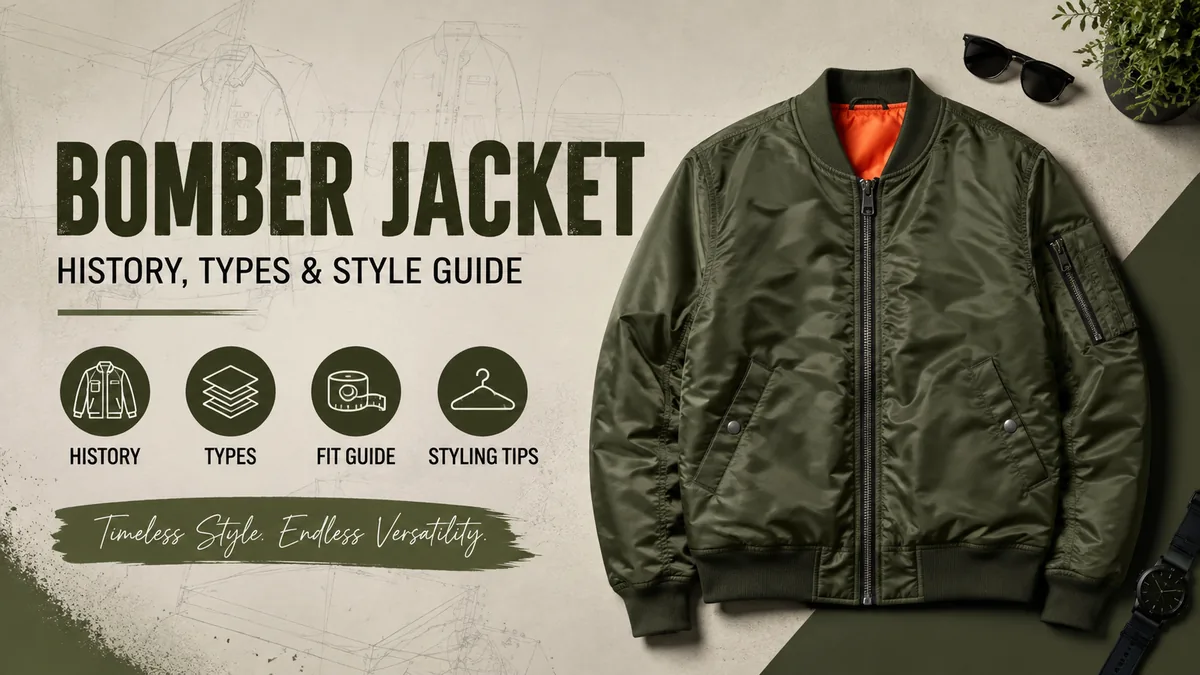
Few pieces of outerwear have made a journey quite like the bomber jacket. What began as practical clothing for military aviators eventually moved through surplus stores, youth subcultures, music scenes, streetwear, and luxury fashion—without losing its recognizable shape.
Today, bomber jackets can be made from nylon, leather, suede, cotton, polyester, wool, or technical fabrics. Some stay remarkably close to military flight jackets, while others use oversized proportions, cropped cuts, embroidery, or minimalist details.
A bomber jacket is a short outer jacket, generally ending around the waist or hips, with a zip front and a fitted or ribbed waistband. Classic versions also use rib-knit cuffs and collars. The familiar modern silhouette owes much to military flight jackets such as the B-15 and especially the MA-1, which became one of the most influential bomber designs.
What Is a Bomber Jacket?
The simplest way to recognize a bomber is by its shape.
Cambridge Dictionary describes a bomber jacket as a short, zip-fastened jacket that fits closely around the waist and is often made from leather.
Modern designs have expanded considerably beyond that basic definition, but several characteristics remain common:
- Waist- or hip-length body
- Front zipper
- Ribbed or elasticated hem
- Fitted cuffs
- Relatively simple, practical construction
- Room through the chest and arms
- Side or utility pockets
Traditional military-inspired models may also have a sleeve utility pocket, insulated lining, storm flap, or reversible construction.
The bomber’s slightly rounded upper body combined with a tighter waistband creates its distinctive silhouette. That shape separates it from longer field jackets, parkas, overcoats, and many motorcycle jackets.
Why Is It Called a Bomber Jacket?
The name comes from the jacket’s connection with military aviation.
Early pilots operated aircraft with open or poorly insulated cockpits. At altitude, cold temperatures and wind exposure made warm clothing essential rather than optional.
Heavy leather and fur-lined flight jackets helped solve that problem. Early versions were associated with aviators flying during the First World War era, when bomber and fighter aircraft became increasingly important military tools. Alpha Industries traces the origins of early bomber flight jackets to leather and fur garments worn by pilots in the cold open-air cockpits of World War I aircraft.
Strictly speaking, though, “bomber jacket” now describes a broad fashion category rather than one specific historical military garment.
Several different flight jackets contributed to what people recognize as a bomber today.
The History of the Bomber Jacket
Understanding the bomber becomes much easier when you follow the changes in aviation technology.
The jacket didn’t evolve simply because designers wanted a different look. Aircraft changed, so pilots’ clothing had to change with them.
Early Flight Jackets
Early military aircraft offered little protection from the weather.
Pilots therefore needed clothing that provided insulation while allowing enough freedom to operate an aircraft. Leather became particularly useful because it was durable and helped protect against wind, while fur and shearling supplied insulation.
These early aviation jackets established an important principle that remains part of bomber design: warmth without excessive length.
A shorter jacket made sense inside a cockpit, where a long coat could become cumbersome.
The A-2 Leather Flight Jacket
The A-2 became one of the best-known American leather flight jackets associated with the World War II era.
Its appearance differs from the later MA-1. Traditional A-2 designs generally feature a leather shell, shirt-style collar, knitted cuffs and waistband, and front pockets.
This is one reason “flight jacket” and “bomber jacket” should not always be treated as names for one identical garment.
The bomber family includes several generations of aviation outerwear.
The B-3 and Shearling Bomber
The B-3 represents another famous branch of flight-jacket history.
Instead of the relatively lightweight construction associated with later nylon bombers, B-3-style jackets use heavy shearling and leather to provide substantial insulation.
Modern “aviator jackets” with oversized shearling collars often take their visual cues from this tradition.
They offer a rugged vintage appearance but can be considerably heavier and warmer than an MA-1.
The B-15 Changes the Formula
The B-15 moved flight-jacket construction closer to the silhouette most people now associate with a modern bomber.
It became particularly important because it helped provide the blueprint for the MA-1.
Military aviation was advancing rapidly. As aircraft technology changed, clothing had to become lighter, less bulky, and more compatible with increasingly cramped and equipment-filled cockpits.
That transition set the stage for the MA-1.
The MA-1 Bomber Jacket Changed Everything
If one garment established the visual language of the modern bomber, it was the MA-1 flight jacket.
The MA-1 was developed during the early jet age. Compared with bulky earlier leather flight gear, nylon construction could provide a lighter, more practical solution for pilots working inside modern aircraft.
Its recognizable elements included:
- Nylon shell
- Ribbed collar
- Rib-knit cuffs
- Knitted waistband
- Front zipper
- Compact waist-length construction
- Utility-oriented pockets
The MA-1 was originally developed for military aviation during the 1950s. Alpha Industries later received U.S. Department of Defense contracts for the MA-1 in 1963.
That distinction matters because Alpha did not invent every element of the bomber jacket. The company became one of the historically important military manufacturers of the MA-1 and subsequently helped bring military-inspired outerwear into the civilian market.
Why Nylon Replaced Heavy Leather
Jet aircraft created different requirements.
Higher-altitude operations, compact cockpits, changing equipment, and the need for easier movement made bulky leather garments less suitable for some applications.
The MA-1 therefore used high-quality nylon with insulating materials rather than relying on the heavy leather construction associated with earlier flight jackets.
This change wasn’t simply cosmetic.
It made the jacket lighter and more practical while maintaining the protection pilots required.
What Was the Orange Lining For?
One of the most recognizable details associated with classic MA-1 jackets is the bright orange interior.
It wasn’t originally there to create a fashionable color contrast.
The reversible orange lining was intended to improve visibility in an emergency. A downed airman could reverse the jacket so that the bright lining made him easier for rescue personnel to locate.
That functional feature eventually became an iconic design detail copied by civilian bomber manufacturers.
From Military Uniform to Everyday Fashion
Military garments frequently influence civilian clothing because they’re designed around practical problems: weather protection, storage, movement, durability, and comfort.
The bomber followed this pattern.
As military clothing entered surplus markets, flight jackets became available to people who had never been inside a military aircraft.
Alpha Industries itself entered the commercial market around 1970, producing civilian garments alongside its military-contract work.
From there, bomber jackets moved far beyond aviation.
They became associated at different times with British youth subcultures, punk, music, hip-hop, workwear, streetwear, and mainstream fashion. Their meaning changed depending on who wore them and where.
That history also means some bomber styles have carried particular political or subcultural associations in certain countries and periods. Today, however, the silhouette is so widely used that a bomber jacket alone does not reliably communicate membership in any specific group.
Fashion ultimately separated the design from a single identity.
Main Types of Bomber Jackets
Calling every bomber the same thing hides how much variation exists within the category.
Here are the major styles worth knowing.
| Type | Typical Material | Character | Best Use |
|---|---|---|---|
| MA-1 | Nylon | Classic military | Everyday casual wear |
| Leather bomber | Leather | Rugged, polished | Casual and smart-casual |
| B-3/aviator | Leather and shearling | Vintage, substantial | Cold weather |
| Suede bomber | Suede | Soft, refined | Autumn and mild weather |
| Lightweight bomber | Nylon/polyester | Minimal, practical | Spring and layering |
| Padded bomber | Synthetic/insulated fabric | Warm, fuller | Winter |
| Varsity-inspired bomber | Wool/synthetic blends | Sporty | Casual outfits |
| Modern oversized bomber | Various | Contemporary | Streetwear |
MA-1 Bomber
The MA-1 remains the benchmark.
A traditional interpretation normally has a nylon exterior, ribbed trim and relatively clean military construction.
Olive or sage green is particularly recognizable, although black, navy, gray and other colors have become standard civilian options.
If someone says “classic bomber jacket,” this is often the silhouette they have in mind.
Leather Bomber Jacket
Leather predates nylon in aviation clothing and remains closely connected to bomber styling.
Modern leather bombers range from rugged aviation-inspired pieces to extremely clean, minimalist jackets.
Compared with nylon, leather generally feels heavier and more structured. Quality leather can also develop a patina as it ages, changing the jacket’s appearance rather than simply looking worn out.
The trade-off is maintenance.
Leather requires more careful storage and cleaning than most synthetic bombers.
Suede Bomber Jacket
Suede takes the familiar bomber silhouette in a softer direction.
Its textured surface works particularly well with knitwear, chinos, denim, wool trousers, and other autumn fabrics.
The drawback is sensitivity to moisture and staining. A suede bomber is usually less forgiving than nylon when weather conditions turn bad.
B-3 or Shearling Aviator
A B-3-inspired jacket sits at the heavier end of the spectrum.
Its leather exterior, thick shearling interior and large collar provide warmth and a distinctive vintage aviation appearance.
This isn’t the bomber you choose for a mild spring afternoon.
It makes more sense as serious cold-weather outerwear.
Lightweight Bomber
Modern lightweight bombers often remove much of the military detailing.
You might get a thin polyester or nylon shell, subtle pockets and minimal insulation.
That simplicity makes them useful during transitional weather, especially when you need more than a shirt but less than a coat.
Oversized Bomber
Contemporary fashion frequently plays with the proportions of the original design.
An oversized bomber may have dropped shoulders, wider sleeves, an exaggerated body and a lower hem. The silhouette is deliberately different from the close, functional military fit.
Neither fit is inherently “correct.” They simply produce different looks.
Bomber Jacket vs. Flight Jacket: Is There a Difference?
The terms overlap, but they’re not perfectly interchangeable.
A flight jacket originally refers to outerwear designed for aviation personnel. A bomber jacket has become a broader fashion term describing jackets inspired by those military garments.
So an authentic MA-1 is both a flight jacket and a bomber.
A modern fashion bomber made from satin with decorative embroidery, on the other hand, might never have been intended for aviation at all.
It’s a bomber because of its silhouette and design heritage.
Bomber Jacket vs. Varsity Jacket
These styles are also commonly confused.
A varsity or letterman jacket traditionally comes from American school and college sports culture. It often features a wool body, contrasting sleeves, snap-button closure, striped ribbing and embroidered letters or patches.
A classic bomber is rooted in military aviation and usually uses a zipper.
Modern designers frequently combine elements of both, which explains why the distinction can look blurry in stores.
Which Bomber Jacket Material Is Best?
There is no universally best fabric.
The right material depends on climate, budget, maintenance requirements and the look you want.
Nylon
Nylon has the strongest association with the MA-1.
It is relatively lightweight, durable and practical. Depending on construction and treatment, it can also offer useful resistance to wind and light moisture.
Choose nylon when you want the classic military or streetwear aesthetic.
Leather
Leather provides structure and durability.
It generally looks richer and can become more attractive as it develops natural character. However, good leather costs more, weighs more and requires proper maintenance.
Choose it when longevity and appearance matter more than minimum weight.
Suede
Suede offers a softer, more sophisticated texture.
It works beautifully for smart-casual clothing but requires more protection from rain, dirt and stains.
Polyester
Polyester is extremely common in modern fashion bombers.
It can be affordable, lightweight and easy to maintain. Quality varies substantially, so fabric composition alone doesn’t tell you whether a jacket is well made.
Cotton
Cotton bombers feel less overtly military than shiny flight nylon.
They can be comfortable and breathable, making them useful for mild temperatures. The downside is generally weaker water resistance unless the fabric has received a protective treatment.
Wool
Wool gives the silhouette a more tailored cold-weather character.
It’s less closely connected to traditional MA-1 construction but can work extremely well when a bomber is intended to bridge casual and smarter wardrobes.
How Should a Bomber Jacket Fit?
Fit changes the entire personality of a bomber.
For a classic fit, the jacket should feel close enough to retain its compact shape but loose enough for comfortable movement. Traditional fit guidance emphasizes mobility without having the elastic cuffs and hem stretched tightly against the body.
Pay attention to four areas.
1. Shoulders
With a traditional regular-fit bomber, the shoulder seam should normally sit close to the natural end of your shoulder.
If it falls significantly beyond that point, the jacket starts looking oversized.
That’s perfectly fine when intentional.
It’s a problem when you were trying to buy a classic fit.
2. Chest
Zip the jacket fully.
You should be able to move your arms naturally without the chest pulling dramatically or the zipper bowing outward.
Also think about what you’ll wear underneath. A bomber that fits perfectly over a T-shirt might become uncomfortable over a sweatshirt.
3. Length
Classic bombers are intentionally short.
The ribbed waistband typically finishes around the waist or upper hip rather than extending like a field jacket.
This cropped proportion is part of the design—not evidence that the jacket is automatically too small.
4. Sleeves
Sleeves should generally finish around the wrist, with ribbed cuffs sitting securely without squeezing.
Some traditional flight-jacket designs intentionally create a little fullness through the sleeve.
Don’t expect them to fit exactly like a slim blazer.
How to Wear a Bomber Jacket
One reason the bomber has survived for generations is that styling it doesn’t require much effort.
The jacket already has a strong silhouette, so simple combinations often work best.
Bomber Jacket With Jeans
Start with the obvious combination because it works.
Try:
Bomber + plain T-shirt + straight jeans + sneakers
A black, navy or olive nylon bomber makes the outfit casual without looking unfinished.
For a more rugged version, replace nylon with brown leather and sneakers with boots.
Bomber Jacket With Chinos
Chinos make the outfit slightly cleaner.
A suede or minimalist bomber works especially well here because its softer texture and restrained detailing don’t clash with the smarter trousers.
Keep the colors balanced.
Navy bomber, white shirt, beige chinos and simple sneakers are difficult to get wrong.
Bomber Jacket With a Hoodie
This is a streetwear staple, but proportions matter.
The bomber needs enough room through the shoulders and chest to accommodate the hoodie. Trying to force a thick sweatshirt underneath a slim bomber creates bunching around the arms and zipper.
A slightly relaxed bomber works better.
Bomber Jacket With Tailored Trousers
Yes, it can work.
Choose a clean bomber with minimal military detailing and pair it with straight or relaxed tailored trousers.
Suede, wool, matte nylon and simple leather styles generally integrate better into smart-casual outfits than heavily patched military reproductions.
Bomber Jacket With a Dress or Skirt
Bomber jackets aren’t restricted to menswear.
A cropped bomber can provide contrast against a longer skirt or dress, while oversized bombers can create a deliberately relaxed silhouette.
The principle is the same: balance volume.
If the jacket is large and dramatic, keeping the rest of the outfit visually cleaner often prevents competing proportions.
Choosing the Right Color
Color affects versatility almost as much as fabric.
Black is easy to combine and gives the bomber a sharper, more urban appearance.
Olive or sage green connects most clearly with MA-1 military heritage.
Navy is understated and works particularly well when you want something softer than black.
Brown is a natural choice for leather and suede, particularly with denim, cream, beige and earth tones.
Burgundy, red, silver and patterned designs make the jacket itself the focal point.
For a first bomber, neutral colors are generally easier to integrate into an existing wardrobe.
Can You Wear a Bomber Jacket Year-Round?
Potentially—but not the same bomber.
The category covers such a wide range of materials that seasonal suitability varies enormously.
For spring, choose lightweight nylon, cotton or polyester with minimal insulation.
For cool summer evenings, an unlined or very lightweight bomber can work.
For autumn, leather, suede, lined nylon and wool blends become useful.
For winter, look for insulated designs, quilted linings or shearling.
The military bomber family itself reflects this climate-specific approach. The L-2B was developed as a lighter option, while later CWU models addressed different flight conditions. Alpha Industries notes that the L-2B was intended for moderate temperatures, while the CWU-45/P and CWU-36/P represented later military flight-jacket developments.
Are Bomber Jackets Still in Style?
Yes, although the fashionable proportions change.
The more useful question is whether the core bomber silhouette has disappeared. It hasn’t.
Designers regularly reinterpret it through cropped lengths, oversized sleeves, leather, suede, technical materials and minimalist constructions. Recent fashion coverage continues to feature bomber silhouettes in contemporary styling and new collections, including leather versions.
The classic MA-1 shape also exists independently of seasonal trends.
That’s an important distinction.
An extremely oversized bomber might belong strongly to a particular fashion cycle, while a straightforward waist-length nylon or leather bomber functions more like established outerwear.
What to Look for When Choosing a Bomber Jacket
Don’t judge one only from the front.
Look closely at its construction.
Start with the zipper. It should operate smoothly without catching the lining.
Check whether the ribbing returns to shape after being stretched gently. Loose cuffs and waistbands can quickly ruin the characteristic bomber silhouette.
Inspect stitching around pockets, shoulders, armholes and the zipper because these areas receive regular stress.
For patterned fabrics or leather panels, look at alignment and consistency.
Then consider practical questions:
- Is there enough room for your normal layers?
- Are the pockets actually useful?
- Does the lining feel comfortable?
- Is the jacket appropriate for your climate?
- Can you realistically maintain the material?
- Does the hem sit where you want it?
- Can you raise your arms comfortably?
A beautiful bomber you avoid wearing because it feels restrictive isn’t a particularly good purchase.
Common Bomber Jacket Styling Mistakes
The most common problem is treating every bomber as interchangeable.
A bulky shearling B-3, shiny MA-1 and minimalist suede bomber may share aviation DNA, but they don’t serve the same wardrobe role.
Another mistake is accidental oversizing.
Oversized clothing can look excellent when the proportions are intentional. Buying a standard bomber two sizes too large usually doesn’t recreate that effect because the sleeves, shoulders, hem and body were not designed around an oversized pattern.
Layering can also go wrong.
If you plan to wear thick knitwear or hoodies underneath, test the jacket with similar clothing rather than sizing it over a thin T-shirt.
Finally, avoid overloading military-inspired jackets with unrelated military accessories unless that is deliberately the aesthetic you want.
A bomber already has enough visual history to carry an outfit by itself.
How to Care for a Bomber Jacket
Care depends primarily on the material, so always check the manufacturer’s label before cleaning.
Nylon and Polyester
Many synthetic bombers are relatively straightforward to maintain.
Small marks can often be spot-cleaned. If machine washing is permitted, close zippers and follow the specified temperature and drying instructions.
Avoid assuming every nylon bomber can simply go into a dryer. Insulation, coatings, patches and ribbed trims may have different care requirements.
Leather
Leather generally shouldn’t be treated like normal washable fabric.
Wipe minor surface dirt carefully and use leather-specific products when appropriate. For significant staining, professional cleaning is usually safer.
Store leather on a supportive hanger and avoid prolonged exposure to direct heat or sunlight.
Suede
Suede needs extra caution around water.
A proper suede brush can help maintain the nap, while appropriate protective treatments may reduce staining. Test any treatment in an inconspicuous area first.
Serious stains are better handled by a professional familiar with suede.
Shearling
Because genuine shearling combines leather and wool characteristics, aggressive home cleaning can cause damage.
Follow the garment’s specific instructions and use specialist cleaning when necessary.
Why the Bomber Jacket Has Lasted So Long
Fashion usually changes faster than the bomber jacket has.
Its longevity comes from the fact that the original design solved genuine practical problems.
The short body allowed movement. Ribbed cuffs and waist helped create a closer seal. Durable shells provided protection. Pockets offered utility. Later nylon construction reduced unnecessary bulk for changing aviation environments.
Once those functional elements were combined into one clean silhouette, civilian fashion had an unusually adaptable template.
It could become rugged in leather, military in olive nylon, luxurious in suede, athletic in varsity-inspired designs, or contemporary through oversized proportions.
Yet you can still recognize the underlying jacket.
That continuity is why the bomber jacket is more than a temporary fashion trend. From early aviation clothing and the B-15 to the influential MA-1 and today’s streetwear interpretations, it has repeatedly adapted without abandoning the practical shape that made it useful in the first place.
If you’re choosing one for everyday wear, focus less on whatever version happens to be trending and more on fit, material, climate and how it works with clothes you already own. Get those four things right, and the bomber remains one of the easiest pieces of outerwear to keep wearing year after year.