
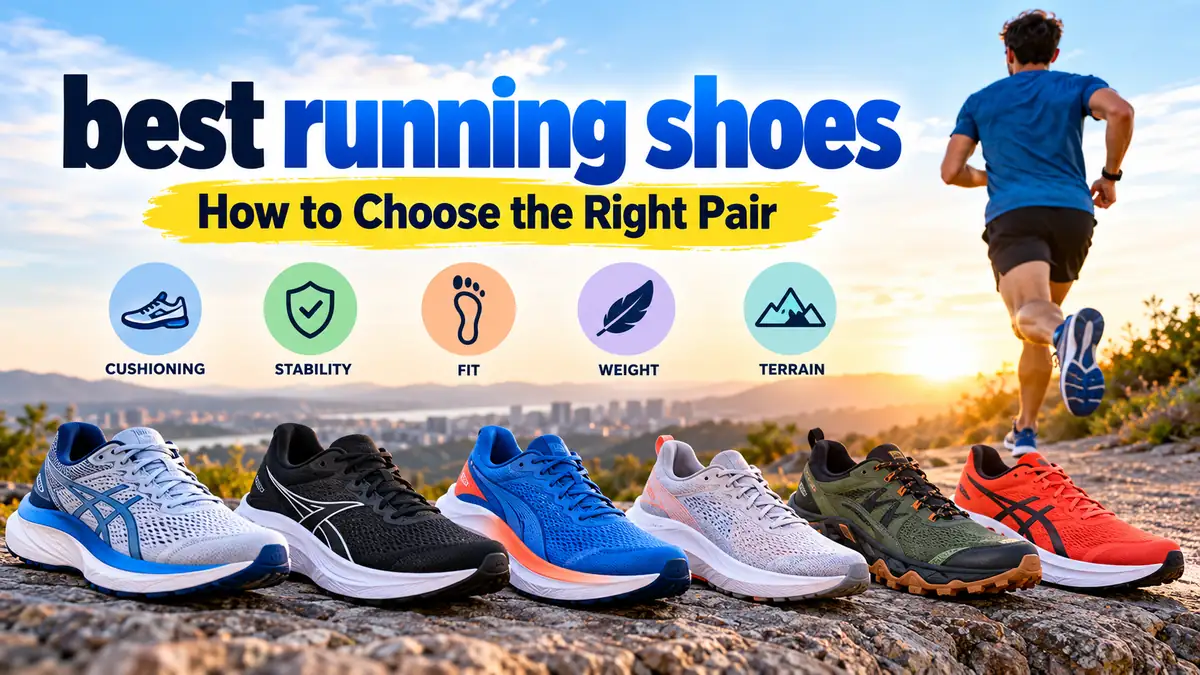
The best running shoes aren’t necessarily the most expensive, the lightest, or the ones worn by elite marathon runners. They’re the shoes that fit your feet comfortably, suit your running routine, and provide the right combination of cushioning, stability, and traction.
For beginners, everyday runners, and experienced athletes, choosing footwear can feel complicated. Running brands offer everything from plush daily trainers to carbon-plated racing shoes, often using technical terms that aren’t immediately clear.
The best running shoes combine a secure, comfortable fit with cushioning, grip, and flexibility suited to your running surface and goals. Most runners benefit from versatile daily trainers, while specialized shoes can help with trail running, racing, or particular comfort preferences. No single shoe works best for everyone.
H2: What Makes the Best Running Shoes?
A good running shoe should feel comfortable during your actual running motion, not merely while standing in a store.
Several features determine how a shoe performs.
H3: Cushioning and Shock Absorption
Running shoes use midsole materials to influence how the shoe feels when your foot contacts the ground.
Common materials include EVA (ethylene-vinyl acetate), TPU (thermoplastic polyurethane), and PEBA-based performance foams.
Soft cushioning can make long runs more comfortable, but softer doesn’t automatically mean better. Some runners prefer firmer midsoles for a more stable, responsive sensation.
Maximum-cushion shoes generally have taller midsoles. Minimalist shoes use less cushioning and may require gradual adaptation.
H3: Stability and Support
Stability describes how a shoe influences foot movement and provides a secure platform.
Modern stability shoes may use wider bases, sidewalls, guidance systems, or different foam geometries rather than traditional rigid medial posts.
Neutral shoes are designed without substantial corrective support. Stability models provide additional guidance for runners who find it comfortable or helpful.
Pronation—the natural inward movement of the foot during running—is normal. It does not automatically mean someone needs motion-control footwear.
H3: Fit and Toe Room
A running shoe should hold your heel securely without squeezing your toes.
As a general starting point, leave approximately a thumb’s width of space between your longest toe and the front of the shoe.
The midfoot should feel supported without uncomfortable pressure, while the toe box should allow natural movement.
Width matters as much as length. A shoe that’s too narrow can cause friction, numbness, or blisters even when its labeled size appears correct.
H3: Weight, Flexibility, and Breathability
Lighter shoes can feel easier to move in, particularly during faster efforts, but they may sacrifice some durability, protection, or cushioning.
Engineered mesh and knit uppers often improve ventilation. Reinforced uppers can provide extra protection on rough trails.
The best balance depends on how and where you run.
H2: Best Running Shoes by Running Style
Different running activities place different demands on footwear.
| Running style | Recommended shoe category | Main characteristics |
|---|---|---|
| Beginners | Daily trainers | Comfortable, versatile, durable |
| Daily road running | Neutral cushioned shoes | Balanced cushioning and flexibility |
| Long-distance running | High-cushion trainers | Comfort over extended mileage |
| Faster workouts | Lightweight tempo shoes | Responsive midsole and lower weight |
| Marathon racing | Performance racing shoes | Lightweight construction, often plated |
| Trail running | Trail-specific shoes | Lugged grip and protective uppers |
| Additional guidance | Stability trainers | Supportive geometry and secure platform |
| Walking and running | Versatile daily trainers | Comfortable fit and predictable ride |
H3: Best Running Shoes for Beginners
New runners usually benefit from a versatile daily trainer rather than a specialized racing shoe.
Daily trainers are designed for easy runs, moderate distances, and regular use. They often provide a balance of cushioning, durability, and comfort.
Examples of established daily-training families include the Brooks Ghost, ASICS GEL-Cumulus, Nike Pegasus, and Saucony Ride.
A beginner should prioritize fit and consistency rather than advanced technologies such as carbon-fiber plates.
H3: Best Running Shoes for Long-Distance Running
Long runs demand comfort that lasts beyond the first few kilometers.
Shoes with generous cushioning, a secure upper, and a smooth heel-to-toe transition can make extended training more enjoyable.
Popular high-cushion model families include the ASICS GEL-Nimbus, Brooks Glycerin, HOKA Bondi, and New Balance Fresh Foam X 1080.
These shoes differ in softness, weight, rocker geometry, and fit. The most cushioned model is not necessarily the most comfortable for every runner.
H3: Best Running Shoes for Speed Training
Tempo runs and interval workouts often benefit from shoes that feel responsive during faster strides.
Lightweight performance trainers may feature energetic foams, curved midsoles, or nylon-based plates.
Examples include the Saucony Endorphin Speed family and adidas Adizero performance trainers.
Unlike dedicated racing shoes, many speed trainers are designed to tolerate repeated workouts.
H3: Best Running Shoes for Trail Running
Trail footwear is designed for uneven ground, loose dirt, mud, and rocky surfaces.
Its most recognizable feature is a lugged outsole. Lug depth and rubber compound influence traction on different surfaces.
Trail shoes may also incorporate rock plates, reinforced toe caps, protective overlays, and more secure uppers.
Well-known trail-running families include the Salomon Speedcross, HOKA Speedgoat, Brooks Cascadia, and Altra Lone Peak.
A heavily lugged shoe designed for mud may feel less comfortable on pavement. Conversely, a smooth road-running outsole may provide insufficient traction on wet trails.
H2: Popular Running Shoe Brands and Their Differences
Major running shoe manufacturers offer multiple categories rather than a single type of footwear.
| Brand | Notable model families | Common design characteristics |
|---|---|---|
| ASICS | GEL-Nimbus, GEL-Kayano, GEL-Cumulus | Cushioning and stability options |
| Brooks | Ghost, Glycerin, Adrenaline GTS | Daily comfort and guidance systems |
| Nike | Pegasus, Vomero, Alphafly | Daily training and performance racing |
| HOKA | Clifton, Bondi, Speedgoat | Rocker-shaped midsoles and cushioning |
| New Balance | 1080, 880, 860 | Multiple fit widths and training categories |
| Saucony | Ride, Triumph, Endorphin Speed | Daily cushioning and responsive options |
| adidas | Supernova, Adizero | Training and race-focused technologies |
| On | Cloudmonster, Cloudrunner | Distinctive midsole geometries |
| Altra | Torin, Lone Peak | Foot-shaped toe boxes and low/zero-drop options |
| Mizuno | Wave Rider, Wave Inspire | Structured, responsive training designs |
Model specifications change between generations. A previous version and a newly released version of the same shoe may feel noticeably different.
H3: Are Expensive Running Shoes Better?
Higher-priced shoes sometimes include premium foams, lightweight materials, or advanced racing components.
However, price is not a reliable measurement of comfort or injury prevention.
A well-fitting midrange daily trainer can be more suitable for regular running than an expensive carbon-plated racing shoe.
Durability, fit, terrain, and intended use are more meaningful considerations than price alone.
H2: Best Running Shoes in 2026: Notable Models
Running shoe recommendations change as manufacturers update midsoles, uppers, and outsole designs. Recent independent testing offers a useful starting point, although no ranking can guarantee a particular shoe will suit your feet.
| Running shoe | Category | Notable advantage |
|---|---|---|
| ASICS Superblast 3 | Versatile premium trainer | High cushioning and broad training versatility |
| adidas Adizero Evo SL | Lightweight road trainer | Responsive feel for daily and faster running |
| ASICS Novablast 6 | Beginner-friendly trainer | Cushioned, energetic ride |
| Brooks Ghost 18 | Traditional daily trainer | Predictable, stable-feeling platform |
| New Balance 1080v15 | Cushioned trainer | Relaxed ride and everyday comfort |
| Brooks Adrenaline GTS 25 | Stability trainer | Additional guidance and support |
| Nike Structure Plus | Long-run stability trainer | Cushioning with supportive geometry |
| Nike Winflo 12 | Budget-oriented trainer | Accessible daily-running option |
These models appear in 2026 testing and recommendation coverage from RTINGS, Runner’s World, and Outside. Their rankings differ because testing methods and runner preferences vary.
RTINGS.com
+2
H3: What Do Independent Shoe Tests Actually Measure?
Laboratory and wear testing can assess factors such as shoe weight, midsole dimensions, cushioning behavior, stability, outsole wear, and fit.
RTINGS, for example, reports measurements for cushioning, energy return, stability, and sizing consistency. Runner’s World combines staff evaluations with feedback from a large group of wear testers.
RTINGS.com
+1
These measurements are useful, but laboratory performance is only part of the picture. A shoe that performs exceptionally in standardized tests may still feel uncomfortable because of its arch shape, heel counter, or toe-box dimensions.
The strongest approach combines independent evidence with personal fit testing.
H2: How to Choose the Best Running Shoes for Your Feet
Choosing footwear becomes easier when you focus on a few practical questions rather than comparing every technical specification.
H3: Step 1 — Identify Your Main Running Surface
Road runners generally need shoes designed for pavement, sidewalks, treadmills, or similarly firm surfaces.
Trail runners need traction appropriate to dirt, rocks, roots, or mud.
For runners who frequently alternate between pavement and light trails, road-to-trail hybrid shoes can provide a compromise.
H3: Step 2 — Understand Your Foot Shape
Foot shape influences comfort more directly than many marketing features.
Runners with wide forefeet may benefit from wider sizing or anatomically shaped toe boxes. Those with narrow heels may prefer uppers that lock the rearfoot securely.
Flat feet and high arches do not automatically require specific shoe categories.
A 2022 review of running footwear research found limited evidence supporting universal injury-prevention rules based on traditional shoe-selection theories. Comfort and individual needs remain important considerations.
PMC
H3: Step 3 — Consider Heel-to-Toe Drop
Heel-to-toe drop is the height difference between the shoe’s heel and forefoot.
For example, a shoe with a 36 mm heel stack and a 28 mm forefoot stack has an 8 mm drop.
| Heel-to-toe drop | General characteristics |
|---|---|
| 0–4 mm | Lower-drop design; may increase calf and Achilles loading |
| 5–8 mm | Moderate drop; common in versatile trainers |
| 9–12 mm | Higher drop; often feels familiar to traditional-shoe users |
These are broad categories, not medical prescriptions.
Moving suddenly from a higher-drop shoe to a zero-drop shoe can alter loading patterns. Gradual adaptation is especially sensible for runners unfamiliar with low-drop footwear.
H3: Step 4 — Match Cushioning to Your Preferences
Maximum cushioning is not automatically the best choice for long distances, heavier runners, or beginners.
A highly cushioned shoe may feel soft and protective but can also feel tall or less secure during sharp turns.
Moderately cushioned shoes may offer better ground awareness.
Try different cushioning levels and pay attention to comfort during actual running.
H3: Step 5 — Test the Fit Properly
Running shoes should be tested with the socks you normally wear.
- Try shoes later in the day, when feet may be slightly larger.
- Check the space in front of your longest toe.
- Walk and jog to identify heel movement or pressure points.
- Confirm that the midfoot feels secure without tightness.
- Test both shoes because feet can differ in size.
- Avoid assuming that an uncomfortable shoe will eventually become comfortable.
A shoe should feel reasonably comfortable from the beginning. Break-in periods may soften materials, but they cannot reliably correct an unsuitable shape.
H2: Best Running Shoes for Specific Foot Needs
Some runners need to consider additional factors beyond general cushioning and fit.
H3: Best Running Shoes for Flat Feet
Flat feet describe a foot shape with relatively low arches.
Some people with flat feet prefer stability shoes, while others run comfortably in neutral trainers.
Shoes such as the Brooks Adrenaline GTS and ASICS GEL-Kayano offer additional guidance, but they are not universally necessary for low arches.
Persistent discomfort is better evaluated individually rather than treated solely through footwear selection.
H3: Best Running Shoes for Wide Feet
Wide-footed runners should look for shoes offered in multiple width options.
New Balance and Brooks are among the manufacturers that offer width variations in selected running shoe models.
The shoe’s overall shape also matters. Two shoes labeled as the same width may fit differently around the toes, arch, and heel.
Do not compensate for a narrow shoe simply by choosing an excessively long size.
H3: Best Running Shoes for Heavy Runners
Body weight alone does not determine the correct running shoe.
Some runners prefer substantial cushioning and a broad platform, while others favor firmer, more responsive footwear.
Consider midsole compression, outsole durability, stability, and overall comfort.
A tall, extremely soft shoe can feel unstable for some runners, regardless of their weight.
H3: Best Running Shoes for Knee Pain
No particular running shoe can reliably prevent or cure knee pain.
Footwear can influence running mechanics and comfort, but pain may also relate to training volume, strength, recovery, or an existing injury.
If knee pain persists, worsens, or affects walking, seek an assessment from a qualified healthcare professional.
Avoid assuming that maximum cushioning or stability technology automatically solves the problem.
H2: Running Shoe Technology Explained
Modern footwear contains several technologies that influence how shoes feel and perform.
H3: Carbon-Fiber Plates
Carbon-plated running shoes typically combine a stiff plate with lightweight, responsive foam.
The plate and midsole work together to influence bending stiffness and running mechanics.
These designs are especially associated with road racing and marathon performance.
However, their benefits vary between runners, speeds, and shoe models. They are not essential for recreational running.
H3: Superfoams and Energy Return
High-performance foams, including PEBA-based materials, are designed to offer cushioning and rebound while keeping weight relatively low.
Energy return refers to how much mechanical energy a material returns after compression.
A higher laboratory energy-return measurement does not automatically translate into the same improvement in running efficiency for every person.
Shoe geometry, weight, fit, and running mechanics also matter.
H3: Rocker Geometry
Rocker-shaped soles have curved profiles intended to influence the transition from landing to toe-off.
Some runners appreciate the rolling sensation, particularly in shoes with thick midsoles.
Others prefer a flatter, more flexible forefoot.
Rocker geometry can affect movement, but its comfort and suitability are individual.
H3: Outsole Rubber and Traction
The outsole is the layer that contacts the ground.
Road shoes typically use rubber coverage designed for pavement durability and grip.
Trail shoes often use deeper lugs to improve traction on loose or uneven surfaces.
Rubber compound, lug arrangement, and surface conditions all influence grip. A shoe that performs well on dry pavement may behave differently on wet stone or muddy trails.
H2: How Long Do Running Shoes Last?
Many conventional running shoes are replaced after approximately 300–500 miles (480–800 kilometers), but this is a guideline rather than a fixed expiration point.
Durability depends on the shoe’s construction, runner mechanics, body weight, running surface, and frequency of use.
Some shoes remain comfortable beyond that range, while others show deterioration earlier.
H3: Signs Your Running Shoes Need Replacing
Look for several changes rather than relying on mileage alone:
- Significant outsole wear or uneven tread loss
- Midsole compression or noticeable loss of cushioning
- Torn uppers or damaged heel counters
- A shoe that feels substantially different from when it was new
- Persistent slipping caused by worn outsole rubber
New aches are worth investigating, but they do not necessarily prove that footwear is responsible.
H3: How to Make Running Shoes Last Longer
Allowing shoes to dry between wet runs can help preserve comfort and reduce odor.
Remove loose dirt with a soft brush, clean with mild soap when necessary, and air-dry away from direct heat.
Avoid machine drying unless the manufacturer explicitly permits it.
Runners who train frequently may benefit from rotating between two suitable pairs, particularly when one pair becomes wet.
H2: Common Mistakes When Choosing Running Shoes
One of the most common mistakes is choosing shoes based on appearance or popularity rather than fit.
A model favored by a professional athlete may be designed for a different pace, running style, or foot shape.
Another mistake is assuming that more cushioning always means greater protection. Comfort and stability can matter just as much as midsole thickness.
Runners also sometimes choose footwear based entirely on pronation labels. Although gait analysis can provide useful information, it should not be treated as a definitive method of preventing injuries.
Finally, switching abruptly to minimalist, zero-drop, or unusually stiff shoes may expose the body to unfamiliar loading patterns.
Quick takeaway: Select running shoes according to comfort, fit, surface, and intended use. Treat technical specifications as supporting information rather than absolute rules.
H2: Final Thoughts on the Best Running Shoes
The best running shoes are those that make running comfortable, suit your training needs, and fit securely without unnecessary pressure.
For most recreational runners, a versatile daily trainer is a sensible starting point. Long-distance runners may prefer additional cushioning, trail runners need appropriate traction, and competitive runners may benefit from specialized performance footwear.
Popular models such as the ASICS Superblast 3, adidas Adizero Evo SL, Brooks Ghost 18, and New Balance 1080v15 illustrate the variety available in modern running shoes.
Instead of searching for one universally perfect model, identify your foot shape, typical running surface, preferred cushioning, and weekly mileage. Then compare suitable categories and test how the shoes actually feel.
The right running shoe should support a comfortable, consistent running routine—not force you to change your natural movement to accommodate the shoe.