
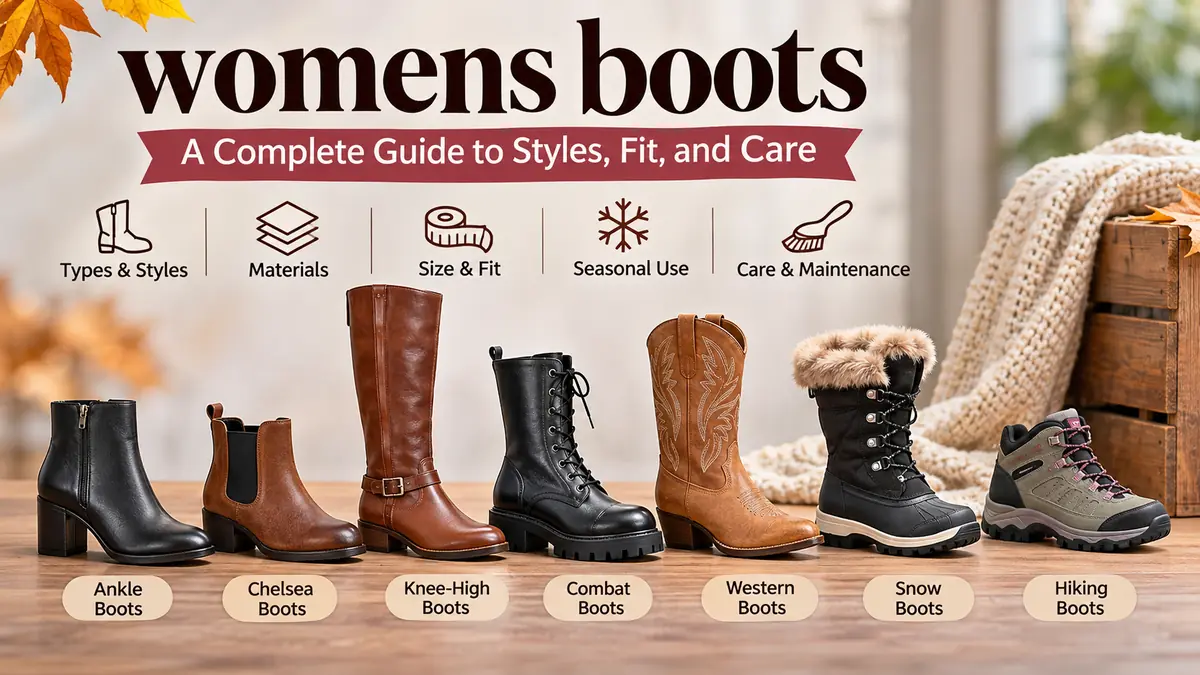
A pair of boots can look perfect on a shelf but feel uncomfortable after just an hour of walking. The difference often comes down to details that are easy to overlook: toe shape, shaft height, sole construction, material, and how the boot fits around your foot and calf.
Understanding womens boots makes it easier to distinguish fashionable designs from practical footwear and recognize which features matter for everyday comfort.
womens boots are footwear designed to cover the foot and extend above the ankle, with styles ranging from ankle boots and Chelsea boots to knee-high, combat, and winter boots. They differ in shaft height, materials, heel construction, insulation, and intended use. Choosing the right style depends on fit, weather conditions, walking needs, and personal preferences.
Understanding the Different Types of womens boots
Boots come in several recognizable styles, each with distinct design characteristics. Some originated as workwear or outdoor footwear before becoming fashion staples, while others were developed primarily for everyday or formal wear.
Ankle Boots
Chelsea Boot Stiefelette für Damen NANTJE Schwarz jetzt kaufen CRICKIT
Stivaletti e Stivali da Donna | Comodi e resistenti | Bata Italia
Women’s Reraye Block Heel Ankle Leather Booties – Black Leather | Nine West
13
Ankle boots, sometimes called booties, generally end at or slightly above the ankle bone. Their relatively short shaft makes them versatile for different outfits and seasons.
Common variations include flat ankle boots, heeled booties, pointed-toe designs, and side-zip styles. A low block heel can provide a more stable walking platform than a narrow stiletto heel, although comfort also depends on overall construction.
Ankle boots work with straight-leg jeans, trousers, skirts, and dresses. Their shorter profile also makes them easier to put on and store than taller boots.
Chelsea Boots
Chelsea boots are distinguished by their elastic side panels, close-fitting ankle shaft, and pull tabs. They typically have no laces or conventional fastening.
Their origins are associated with Victorian-era footwear, and the design later became prominent in British fashion.
Modern Chelsea boots appear in smooth leather, suede, synthetic materials, and chunky lug-sole versions.
The elastic panels make them convenient for everyday use, but the fit should remain secure around the heel. Excessive heel movement can cause rubbing, especially when walking longer distances.
Knee-High Boots
Stivale cavallerizzo marrone in pelle| Primadonna Collection
Knee-high boots extend to approximately the knee, covering much of the lower leg.
They are available in fitted, relaxed, stretch-panel, flat, and heeled designs. Some have full-length zippers, while others use pull-on constructions.
A well-fitting knee-high boot should accommodate the calf without excessive pressure. Shaft circumference is especially important because two boots with the same shoe size can fit very differently around the leg.
Knee-high styles are commonly worn with dresses, skirts, leggings, and slim trousers.
Over-the-Knee Boots
Over-the-knee boots extend above the knee and sometimes reach the middle of the thigh.
They often feature stretch fabrics, suede-like finishes, or flexible synthetic materials that allow movement around the knee.
Fit is particularly important. A shaft that is too loose may slide down, while one that is too tight can restrict comfortable bending and walking.
Flat versions are generally easier to manage for extended wear, while higher heels change the distribution of pressure across the foot.
Combat Boots
Shopee Brasil | Ofertas incríveis. Melhores preços do mercado
Combat boots take inspiration from military footwear. Their typical features include lace-up fronts, reinforced-looking construction, ankle support, and textured outsoles.
Fashion combat boots vary considerably from actual military boots. Some emphasize appearance over durability or weather protection.
The lacing system allows adjustment around the instep and ankle, which can be helpful for achieving a secure fit.
Chunky combat boots pair with casual trousers, denim, and dresses, but their suitability for long walks depends on cushioning, flexibility, and weight.
Western and Cowboy Boots
Western boots are recognizable by their shaped shafts, decorative stitching, angled heels, and often pointed or rounded toes.
Traditional cowboy boots developed around horseback riding, where their heel and shaft served practical purposes.
Fashion versions may have different heel heights, shaft shapes, and outsole materials.
A properly fitted pull-on Western boot may have slight heel movement when new, but it should not feel excessively loose or cause painful rubbing.
Riding Boots
Riding boots generally have a tall, relatively streamlined shaft and a low heel.
Traditional equestrian boots are designed for use with riding equipment. Fashion riding boots borrow the silhouette without necessarily meeting the performance requirements of horseback riding.
For actual riding, footwear should be selected according to the discipline, stirrup design, and relevant safety guidance.
Winter and Snow Boots
Winter boots prioritize protection from cold, moisture, snow, or slippery conditions.
Typical features include insulated linings, weather-resistant uppers, protective seams, and deeply patterned outsoles.
However, an insulated boot is not automatically waterproof, and a waterproof boot is not necessarily warm enough for freezing temperatures.
Winter footwear should be evaluated according to the specific conditions in which it will be used.
Hiking Boots
Hiking boots are intended for uneven terrain, outdoor walking, and varying trail conditions.
They may feature reinforced toe areas, supportive midsoles, durable outsoles, and water-resistant or waterproof membranes.
High-cut hiking boots can provide additional coverage, but ankle height alone does not guarantee protection from ankle injuries.
For recreational walking on maintained trails, lighter hiking shoes may be sufficient. More demanding terrain can make protective footwear and suitable traction more valuable.
Comparing womens boots by Style and Function
The following table summarizes the main characteristics of popular boot types.
| Boot type | Typical height | Main characteristic | Common use |
|---|---|---|---|
| Ankle | At or above ankle | Compact shaft | Everyday outfits |
| Chelsea | Ankle | Elastic side panels | Casual and smart-casual wear |
| Knee-high | Near knee | Extended leg coverage | Cooler weather and fashion |
| Over-the-knee | Above knee | Tall fitted shaft | Fashion styling |
| Combat | Ankle to mid-calf | Lace-up construction | Casual wear |
| Cowboy | Mid-calf or taller | Western silhouette | Fashion and Western wear |
| Riding | Below knee | Streamlined tall shaft | Equestrian-inspired outfits |
| Snow | Varies | Insulation and weather protection | Cold, snowy conditions |
| Hiking | Low to high cut | Trail-focused construction | Outdoor walking |
These categories can overlap. For example, a Chelsea boot can have a waterproof membrane, while an ankle boot can use a heavy lug sole suitable for wet urban conditions.
Materials Used in Women’s Boots
Material affects how boots feel, age, breathe, and respond to moisture. It also influences how much maintenance they require.
Genuine Leather
Leather is widely used in boots because it can provide durability, structure, and a distinctive appearance.
Common leather finishes include full-grain, top-grain, corrected-grain, and coated leather.
Full-grain leather retains the natural grain surface, while other finishes may involve sanding, coating, or additional processing.
Leather can gradually soften and conform to some aspects of the foot, but this does not mean an incorrectly sized boot will eventually become comfortable.
Leather also requires appropriate conditioning and cleaning to help prevent drying, staining, or deterioration.
Suede and Nubuck
Suede has a soft, textured surface produced from the underside or split of a hide. Nubuck is typically made by lightly sanding the outer surface of leather.
Both materials have a distinctive matte appearance.
Their textured surfaces can attract dirt and show water marks more readily than some smooth leather finishes.
A suitable protective spray may improve resistance to moisture and stains, but it does not make every suede boot waterproof.
Synthetic Leather
Synthetic leather is generally manufactured using polymer-based materials, often polyurethane (PU) or polyvinyl chloride (PVC), applied to a textile backing.
It can imitate the appearance of leather and may require less conditioning.
However, quality varies. Some synthetic uppers can crack, peel, or become less flexible over time.
Synthetic leather also does not automatically mean better breathability or environmental performance.
Textile and Knit Uppers
Textile boots may use nylon, polyester, canvas, mesh, or stretch-knit fabrics.
These materials are particularly common in lightweight boots, fashion footwear, and some outdoor designs.
Stretch panels can improve flexibility around the ankle or calf, while woven materials may reduce overall weight.
Water resistance depends on the fabric treatment, membrane, seam construction, and overall boot design.
Rubber and Waterproof Materials
Rubber boots, often called wellington boots or rain boots, are designed to resist water penetration through their main material.
Natural rubber and synthetic compounds are commonly used.
Waterproof construction is especially useful for rain, mud, and wet environments, although fully rubberized boots can feel less breathable than footwear designed for dry conditions.
How to Find the Correct Boot Size and Fit
A comfortable boot should hold the foot securely without squeezing the toes or creating concentrated pressure.
Sizing can differ between manufacturers, and even two styles from the same brand may fit differently.
Measure Both Feet
Foot dimensions can change with age, activity, swelling, and other factors.
For a basic measurement:
- Stand on a sheet of paper with your weight evenly distributed.
- Mark the back of your heel and the end of your longest toe.
- Measure the distance between the marks.
- Repeat the process for the other foot.
- Compare the larger measurement with the manufacturer’s sizing chart.
Measure foot width where possible, especially if footwear frequently feels tight around the forefoot.
Shoe size conversions between US, UK, and EU systems are approximate. Manufacturer-specific charts are more reliable than assuming every conversion is identical.
Check the Toe Box
The toe box is the front portion of the boot surrounding the toes.
It should allow natural toe positioning without compression. A pointed outer shape does not necessarily mean the internal toe area is equally narrow, but some pointed designs provide less usable space.
Your toes should not be pressed against the front when standing or walking downhill.
Evaluate Heel Fit
A secure heel fit helps reduce friction and instability.
A small amount of movement may occur in certain boot constructions, particularly some pull-on styles. However, repeated slipping, rubbing, or the feeling that the boot may come off suggests an unsuitable fit.
Understand Boot Width
Common footwear width labels include narrow, standard, wide, and extra-wide. Some brands use letter-based systems, such as B, D, or E, but these conventions are not universal.
Someone with a wide forefoot may need a different last shape rather than simply increasing shoe length.
A larger size can create excessive heel movement while failing to solve the original width problem.
Measure Calf Circumference for Tall Boots
Tall boots introduce an additional measurement: shaft circumference.
Measure around the widest part of your calf while standing. Compare this measurement with the boot’s published calf circumference, checking whether the measurement refers to a particular shoe size.
Stretch panels and adjustable buckles can provide additional flexibility.
For knee-high and over-the-knee designs, also consider shaft height, particularly if you are shorter or taller than the manufacturer’s typical fit model.
Try Boots With the Intended Socks
Sock thickness changes the available space inside footwear.
Thin everyday socks, cushioned hiking socks, and thermal winter socks can produce noticeably different fits.
Try boots with the type of socks you expect to wear most frequently.
Quick takeaway: Fit should be assessed while standing and walking, not only while sitting. Boots should feel secure and comfortable from the beginning, even if the material is expected to soften slightly with wear.
Heel Heights, Soles, and Walking Comfort
Heel design and sole construction affect stability, shock absorption, and walking mechanics.
Flat Boots
Flat boots have minimal heel elevation, although many still contain a small heel-to-toe difference.
They can be comfortable for everyday wear, but a completely flat design without adequate cushioning or support is not necessarily ideal for everyone.
Block-Heel Boots
Block heels have a wider base than narrow heels, often providing a more stable platform.
Low or moderate block heels are common on ankle boots, Chelsea boots, and knee-high styles.
Comfort depends on heel height, placement, foot shape, and how the shoe distributes pressure.
High-Heel Boots
Higher heels shift more body weight toward the forefoot and change ankle positioning.
Extended wear may contribute to discomfort, especially if the toe box is narrow or the boot lacks adequate support.
For long periods of standing or walking, a lower heel is often more practical.
Lug Soles
Lug soles have raised tread patterns intended to improve grip on suitable surfaces.
They are commonly found on combat, hiking, winter, and chunky fashion boots.
Deep tread can be useful in mud or loose terrain, but tread appearance alone does not establish performance on ice, polished floors, or wet tile.
Rubber Versus Leather Outsoles
Rubber outsoles are common in everyday and outdoor footwear because they can offer flexibility, wear resistance, and traction.
Leather outsoles are often associated with dressier footwear and traditional boot construction.
They may feel smooth and flexible after wear but can be slippery on certain wet surfaces.
Actual traction depends on the outsole compound, tread design, surface, and conditions.
Choosing womens boots for Different Seasons
Seasonal suitability depends on more than appearance.
Spring
Spring conditions often involve changing temperatures and occasional rain.
Ankle boots, Chelsea boots, and lightweight waterproof designs can provide useful coverage without the bulk of heavily insulated winter footwear.
Breathable linings and flexible soles may improve comfort during milder days.
Summer
Boots can be worn in warm weather, although ventilation becomes more important.
Lightweight ankle boots, perforated designs, and breathable textile styles may feel more comfortable than heavily lined leather or insulated boots.
In hot conditions, excessive heat and moisture inside footwear can contribute to discomfort and skin irritation.
Autumn
Autumn is a popular season for ankle boots, Chelsea boots, Western boots, and knee-high styles.
Moderate temperatures make it easier to wear leather and suede footwear without substantial insulation.
In rainy climates, water-resistant materials and slip-resistant outsoles become more relevant.
Winter
Winter footwear needs to match the expected temperature, precipitation, and ground conditions.
Insulation may be made from synthetic fibers, wool, shearling, or other thermal materials.
Manufacturers sometimes publish temperature ratings, but these are not standardized across all brands and may depend on activity level, socks, and individual cold tolerance.
For snowy environments, look for construction designed to keep moisture out, enough room for appropriate socks, and traction suited to the surface.
On smooth ice, ordinary winter boot soles may not provide adequate grip. Appropriate removable traction devices may be necessary.
Waterproof, Water-Resistant, and Weatherproof Boots
These terms are frequently confused.
Water-resistant boots are designed to resist limited moisture exposure, such as light rain or splashes.
Waterproof boots are constructed to prevent water entry under specified conditions, often through membranes, sealed seams, or impermeable materials.
Weatherproof boots is a broader marketing term and does not always identify a specific performance standard.
A boot may contain a waterproof membrane such as GORE-TEX while still allowing water to enter over the top of the shaft.
Similarly, waterproof leather uppers are not enough if the seams, tongue, or zipper allow water through.
How to Assess Water Protection
Consider the following details:
- Upper material and any protective treatment
- Waterproof membrane or lining
- Seam sealing and stitching
- Gusseted tongue construction
- Zipper placement and protection
- Shaft height relative to expected water exposure
Waterproof footwear can also trap perspiration, particularly in warm conditions.
For dry environments, a breathable non-waterproof boot may feel more comfortable.
How to Style Different Boot Silhouettes
Boot styling is influenced by shaft height, toe shape, color, and the proportions of surrounding clothing.
Boots With Jeans
Ankle boots work with straight-leg, slim, and cropped jeans.
A cropped hem can leave a small amount of space above the boot shaft, while longer straight-leg jeans may fall over the upper.
Chelsea boots are especially suited to simple casual outfits because of their clean silhouette.
Chunky combat boots create a more substantial visual profile and can balance wider-leg denim.
Boots With Dresses
Knee-high boots can be paired with midi dresses, while ankle boots work with shorter or longer hemlines.
The distance between the boot shaft and dress hem changes the visual proportions of the outfit.
For colder weather, tights and tall boots can provide additional coverage.
Boots With Skirts
Mini skirts, midi skirts, and longer skirts can all work with boots, although the overall effect depends on the combination.
A fitted knee-high boot creates a different silhouette from a loose Western boot or chunky combat style.
Boots With Workwear
In workplaces where dress codes allow them, smooth leather ankle boots or understated knee-high styles can complement tailored trousers and skirts.
Neutral shades such as black, dark brown, tan, and burgundy are commonly used because they coordinate with many clothing colors.
Formal workplace requirements vary, so footwear should match the environment rather than follow a universal rule.
Understanding Boot Construction and Durability
The way a boot is assembled influences repairability, flexibility, water resistance, and long-term wear.
Cemented Construction
Cemented boots use adhesives to attach the upper and sole.
This method is common in fashion footwear and can produce lightweight, flexible designs.
Repair options depend on the materials and construction. Many cemented boots are difficult to resole economically.
Goodyear Welt Construction
A Goodyear welt is a strip of material used to connect the upper and sole assembly through stitching.
This construction is associated with traditional leather boots and can allow resoling when the rest of the boot remains in suitable condition.
However, Goodyear-welted footwear is not automatically waterproof or more comfortable.
Blake Stitching
Blake-stitched boots use stitching that connects the upper and outsole through the interior.
This can produce a relatively flexible, streamlined construction.
Resolability depends on the design and availability of suitable repair equipment.
Direct-Attach and Molded Soles
Some work and outdoor boots use molded or directly attached soles.
These designs can offer durable connections between the upper and outsole, although repairability varies.
Signs of Quality Construction
When examining a boot, look at the consistency of stitching, how securely the sole is attached, the quality of the lining, and whether the heel feels stable.
Inspect zippers, elastic panels, eyelets, and pull tabs because these components experience repeated stress.
Price alone is not a reliable indicator of construction quality.
Boot Care and Maintenance
Proper care can help footwear retain its appearance and remain functional for longer.
Cleaning Leather Boots
Remove loose dirt with a soft brush or cloth.
Use a cleaner suitable for the leather finish, then allow the boots to dry naturally away from direct heat.
Apply an appropriate leather conditioner when needed, following the product instructions.
Overconditioning can soften certain leathers excessively or alter their appearance.
Cleaning Suede Boots
Use a suede brush to remove dry surface dirt.
A suitable suede eraser can help address some marks.
Avoid soaking suede or applying ordinary leather creams unless the product is specifically intended for that material.
Always test cleaning products on an inconspicuous area first.
Drying Wet Boots
Remove removable insoles and loosen the laces or fastenings to improve airflow.
Allow boots to dry at room temperature.
Direct heat from radiators, heaters, or hair dryers can damage adhesives, leather, and synthetic components.
Absorbent paper placed inside may help remove excess moisture, but it should be changed when damp.
Storing Boots Correctly
Store boots in a clean, dry, ventilated area.
Boot shapers can help tall shafts retain their form. For leather footwear, appropriate shoe trees may help manage moisture and creasing.
Avoid prolonged storage in damp or extremely hot environments.
Knowing When to Repair or Replace Boots
Consider repair when the upper remains sound but the heel, sole, or stitching needs attention.
A qualified cobbler may be able to replace worn heel lifts, repair zippers, or resole suitable constructions.
Replacement may be more appropriate when structural components have failed, the boot no longer fits securely, or its protective performance cannot be restored.
Common Mistakes When Choosing Boots
One frequent mistake is choosing boots solely by appearance without considering their intended use.
A stylish leather boot may not provide adequate traction for icy sidewalks, while a heavy snow boot may feel unnecessarily warm indoors.
Another mistake is assuming that tight footwear will stretch enough to become comfortable. Some leather can relax with wear, but significant pressure around the toes or instep should not be ignored.
Other common issues include overlooking calf measurements, relying on generic size conversions, wearing inappropriate socks, and confusing water resistance with waterproof protection.
A practical way to assess footwear is to consider where it will be worn most often, how far you expect to walk, and the conditions it must handle.
How Long Do Women’s Boots Last?
Boot lifespan varies significantly according to materials, frequency of use, walking surfaces, maintenance, and construction.
A pair worn occasionally for indoor events may remain serviceable much longer than boots used daily in wet or abrasive environments.
Signs of wear include:
- Uneven or severely worn outsole tread
- Cracked uppers or separating sole edges
- Damaged heel components
- Persistent water leakage
- Worn interior linings
- Reduced cushioning or stability
Regular cleaning and prompt repairs can help prevent minor damage from becoming more serious.
Rotating footwear between wears may also give materials time to dry and recover.
There is no universal replacement schedule that applies to every pair.
Sustainable Considerations for Women’s Boots
The environmental impact of footwear depends on multiple factors, including raw materials, manufacturing, transport, product lifespan, and disposal.
Leather production involves livestock agriculture and tanning processes, while synthetic materials often rely on petroleum-derived polymers.
Neither category is automatically environmentally preferable in every situation.
Durability, repairability, responsible material sourcing, and how long footwear remains in use all matter.
Some manufacturers provide information about recycled components, leather sourcing, or production standards.
For example, the Leather Working Group assesses certain aspects of leather manufacturing facilities, while the Global Recycled Standard addresses recycled content and related chain-of-custody requirements. Such certifications have specific scopes and should not be interpreted as proof that an entire boot has no environmental impact.
Maintaining existing footwear, repairing suitable boots, and avoiding unnecessary replacement can also reduce consumption.
Final Thoughts on womens boots
Understanding womens boots is about recognizing the relationship between design, fit, materials, and purpose.
Ankle boots and Chelsea boots offer versatile everyday silhouettes. Knee-high and over-the-knee styles provide additional leg coverage, while combat, hiking, rain, and winter boots emphasize different combinations of construction and function.
The most useful starting point is to identify the conditions in which the boots will be worn. From there, evaluate foot and calf measurements, outsole grip, weather protection, comfort, and maintenance requirements.
A boot that fits properly and suits its intended environment is more likely to remain comfortable, practical, and useful over time.