
The wrong running shoes can turn an enjoyable morning jog into an uncomfortable experience. Tight toes, slipping heels, insufficient support, and unsuitable cushioning can affect how your feet feel during and after a run.
Choosing running shoes for men involves more than finding an attractive design or a familiar brand. Your foot shape, running distance, preferred terrain, and comfort preferences all influence which shoes will work best.
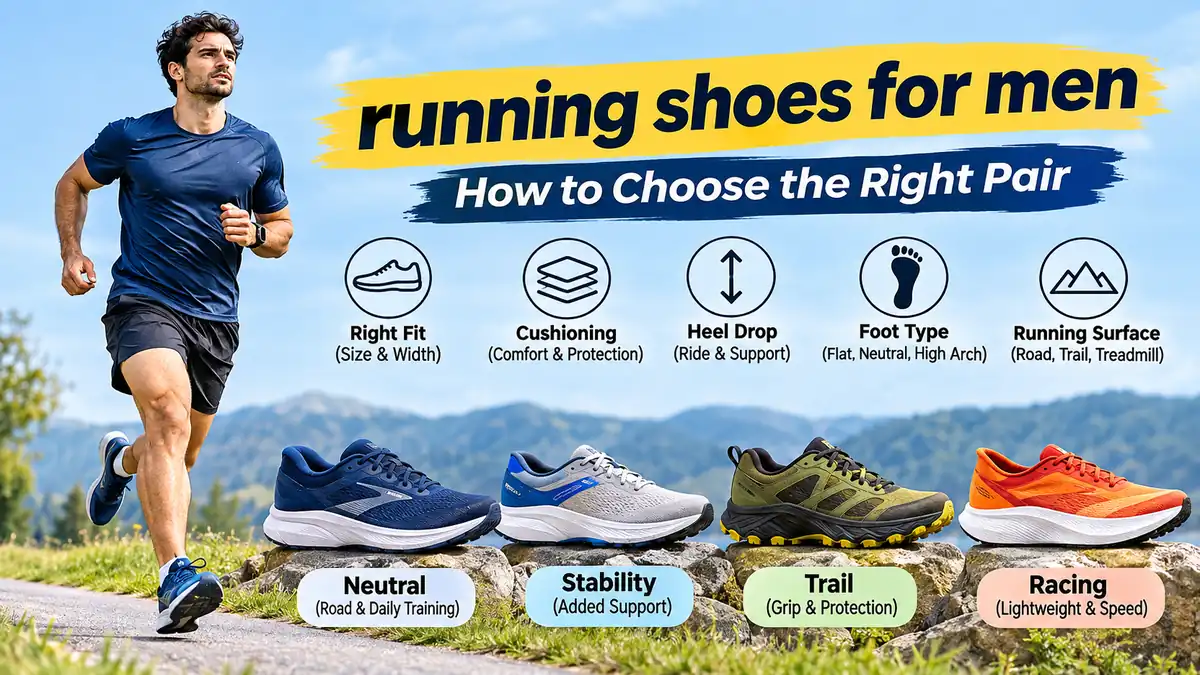
Running shoes for men should fit securely around the heel and midfoot, provide enough space for the toes, and offer cushioning suited to the runner’s needs. Road shoes, trail shoes, stability trainers, and lightweight racing shoes serve different purposes. The most suitable pair is one that feels comfortable while running and supports your usual training activities.
Understanding the main features of running footwear makes it easier to distinguish useful technology from marketing terminology.
What Makes running shoes for men Different?
Running shoes are designed to accommodate the repetitive movements and forces involved in running. Unlike ordinary casual sneakers, they typically combine specialized cushioning, flexible or rocker-shaped soles, breathable uppers, and durable outsole materials.
During running, each foot repeatedly contacts the ground, absorbs force, and helps propel the body forward. The shoe’s construction influences how those movements feel.
Most running shoes contain several important components.
| Component | Function |
|---|---|
| Upper | Holds the foot securely and allows ventilation |
| Toe box | Provides room for the toes to move |
| Midsole | Supplies cushioning and influences ride characteristics |
| Outsole | Provides traction and protects the midsole |
| Heel counter | Helps maintain a secure heel fit |
| Insole | Adds an interior layer of comfort |
| Tongue and laces | Adjust pressure and secure the shoe |
| Heel collar | Cushions the area surrounding the ankle |
Men’s running shoes are commonly offered in different length and width combinations. Standard men’s sizing is often based on a D-width last, although actual dimensions vary between manufacturers.
Women’s standard widths are commonly narrower, but this does not mean every man needs a wide shoe or that shoe selection must follow gender labels.
Foot shape and individual fit are more important than the category printed on the box.
Running Shoes vs. Regular Sneakers
Regular sneakers may provide adequate comfort for walking and casual activities, but they are not necessarily designed for repeated running sessions.
Running-specific footwear typically offers more specialized midsole materials, running-oriented geometry, and outsole construction.
However, a running shoe is not automatically suitable for every athletic activity.
For example, a tall, soft road-running shoe may feel unstable during lateral movements in basketball, tennis, or weight training.
The footwear should match the movement involved.
Types of running shoes for men
Running shoes are available in several categories because different activities place different demands on footwear.
Neutral Running Shoes
Designed for runners who do not require additional motion-guidance features. Commonly used for daily training, easy runs, and general fitness.
Stability Running Shoes
Incorporate features such as wider platforms, sidewalls, or firmer support structures to provide a more guided ride.
Feature more aggressive outsole traction and sometimes protective rock plates for dirt, rocks, mud, and uneven terrain.
Racing Running Shoes
Emphasize low weight, responsive foam, and efficient forward movement. Some use carbon-fiber plates and pronounced rocker geometry.
Daily Trainers
Daily trainers are versatile shoes intended for regular running.
They generally balance cushioning, durability, stability, and weight rather than maximizing a single performance characteristic.
For someone running three or four times weekly, a comfortable daily trainer may be sufficient for most sessions.
Popular daily-training families include the Nike Pegasus, Brooks Ghost, ASICS GEL-Cumulus, Saucony Ride, and New Balance Fresh Foam X 880.
Individual versions can differ significantly, so the model name alone does not guarantee a particular fit or ride.
Maximum-Cushion Running Shoes
Maximum-cushion shoes use relatively thick midsoles to create a highly cushioned experience.
Examples of product families associated with this category include the HOKA Bondi, Brooks Glycerin, ASICS GEL-Nimbus, and Nike Vomero.
These shoes may appeal to runners who prefer a plush sensation during easy or longer runs.
However, thicker cushioning does not automatically mean better impact protection or fewer injuries. Some runners find very soft midsoles less stable.
Minimalist and Zero-Drop Shoes
Minimalist footwear generally uses less cushioning, greater flexibility, and a design that allows more direct ground feedback.
Zero-drop shoes have approximately equal heel and forefoot stack heights.
Altra is known for zero-drop and low-drop designs, while Vivobarefoot and Xero Shoes are associated with minimalist footwear.
These characteristics are not interchangeable: a zero-drop shoe can still have substantial cushioning.
Switching suddenly from conventional footwear to minimalist or zero-drop designs may increase loading on the calves, Achilles tendon, and feet.
A gradual transition is particularly important for runners accustomed to higher heel-to-toe drops.
How to Choose the Correct Running Shoe Size
A running shoe that is technically appropriate for your gait can still be uncomfortable if it does not fit correctly.
Footwear fit should be evaluated in three dimensions: length, width, and internal volume.
Leave Enough Space in the Toe Box
A useful starting point is approximately a thumb’s width of space between the longest toe and the front of the shoe while standing.
Your longest toe is not necessarily your big toe.
This extra room helps accommodate forward foot movement and the swelling that may occur during exercise.
A shoe that is too short can contribute to:
- Blackened or bruised toenails
- Blisters around the toes
- Pressure on the forefoot
- Numbness or discomfort
- Toenail irritation during downhill running
However, excessive length can allow the foot to slide, making the shoe feel insecure.
Check the Heel and Midfoot
The heel should feel secure without excessive rubbing or lifting.
The midfoot should be comfortably held in place, not squeezed.
A common mistake is tightening the laces excessively to compensate for an incorrectly sized shoe.
If the heel moves significantly, alternative lacing techniques, including a runner’s loop or heel-lock lacing, may improve the fit.
But lacing cannot reliably fix a shoe that is fundamentally the wrong shape.
Understand Running Shoe Widths
Men’s footwear commonly uses the following width labels:
| Width designation | Common description |
|---|---|
| B | Narrow |
| D | Standard |
| 2E | Wide |
| 4E | Extra wide |
| 6E | Extra-extra wide, where available |
Width availability differs between brands and models.
A runner with wide forefeet may need more room in the toe box without requiring a loose heel.
Conversely, someone with narrow heels and broad toes may find certain anatomical or foot-shaped designs more comfortable.
Measure Both Feet
Feet are not always identical in size.
For the most reliable measurement:
- Measure both feet while standing.
- Wear your usual running socks.
- Measure later in the day when feet may be slightly larger.
- Check the manufacturer’s current sizing chart.
- Select a size that comfortably accommodates the larger foot.
- Test the shoes by walking and jogging.
US, UK, and EU shoe-size conversions are approximate because manufacturers use different lasts and sizing systems.
A US men’s size 10 from one brand may not fit exactly like a size 10 from another.
The best test is how the shoes feel in motion.
Cushioning, Heel Drop, and Running Shoe Technology
Modern running shoes use a variety of materials and design features that influence comfort, responsiveness, and stability.
Understanding these characteristics helps explain why two shoes with similar appearances may feel completely different.
How Much Cushioning Do You Need?
Running-shoe cushioning is commonly described as minimal, moderate, or maximum.
Typical cushioning characteristics
| Minimal | Greater ground feedback; less material underfoot |
|---|---|
| Moderate | Balance of cushioning, versatility, and ground feel |
| Maximum | Thicker midsoles; often a softer, more protective sensation |
Cushioning preference is personal.
A runner completing short, fast intervals may appreciate a responsive, lightweight shoe. Someone completing relaxed long-distance sessions may prefer more underfoot cushioning.
Body weight, running experience, and previous footwear can also influence what feels comfortable.
There is no universal cushioning level that prevents running injuries.
Understanding Stack Height
Stack height refers to the thickness of the shoe’s sole structure beneath the foot, generally measured at specified heel and forefoot locations.
Higher stack heights often allow manufacturers to incorporate more foam.
However, stack height and softness are not identical.
A thick midsole can feel firm, while a thinner one can feel relatively soft depending on foam composition and construction.
What Is Heel-to-Toe Drop?
Heel-to-toe drop is the difference between the heel stack height and forefoot stack height.
For example:
- Heel stack height: 36 mm
- Forefoot stack height: 28 mm
- Heel-to-toe drop: 8 mm
Running shoes may have zero drop, low drop, moderate drop, or relatively high drop.
Higher-drop designs can alter the distribution of loading between the ankle and other joints. Lower-drop shoes generally place different demands on the foot and calf complex.
Neither is automatically superior.
A 2026 Cleveland Clinic guide emphasizes making gradual transitions when changing heel-drop characteristics because abrupt changes can strain the Achilles tendon and calves.
EVA, TPU, PEBA, and Modern Running Foams
The midsole is one of the most technologically developed parts of a running shoe.
Common materials and material families include:
EVA (ethylene-vinyl acetate): A widely used foam that can be formulated to provide different levels of cushioning and firmness.
TPU (thermoplastic polyurethane): Used in certain expanded or bead-based midsoles, often valued for resilience and durability.
PEBA (polyether block amide): A lightweight, resilient material used in some high-performance running shoes.
Supercritical foams: A manufacturing category involving specialized foaming processes, rather than one specific chemical material.
Brands also use proprietary cushioning technologies.
Examples include Nike ZoomX, adidas Lightstrike Pro, ASICS FF BLAST, Brooks DNA technologies, Saucony PWRRUN, and New Balance Fresh Foam X.
These names represent different formulations and constructions. Performance cannot be reliably determined from a marketing label alone.
Carbon Plates and Rocker Geometry
Carbon-fiber plates are commonly associated with advanced racing footwear.
When combined with responsive foam and appropriate shoe geometry, a plate can contribute to a more efficient running experience for some athletes.
However, carbon plates are not guaranteed to improve every runner’s performance.
A rocker-shaped sole uses a curved profile to influence the transition from landing to toe-off.
Rockers can appear in daily trainers, maximum-cushion shoes, and racing footwear.
The overall shoe design matters more than any single feature.
Choosing running shoes for men Based on Foot Type
Foot structure influences how shoes fit, but foot shape alone cannot determine the ideal footwear category.
Three commonly discussed arch profiles are low, medium, and high arches.
Running Shoes for Flat Feet
Flat feet are characterized by relatively low arches.
Some runners with flat feet prefer stability shoes because they provide a broader platform or additional guidance.
Others are comfortable in neutral footwear.
Having flat feet does not automatically mean you overpronate excessively or need motion-control shoes.
The American College of Sports Medicine cautions against selecting shoes solely from arch height or the presence of pronation, which is a normal part of foot movement.
The practical priority is finding a shoe that fits comfortably and does not create unwanted pressure.
Running Shoes for High Arches
High arches can be associated with different patterns of foot loading, but they do not automatically require maximum cushioning.
A runner with high arches may appreciate a comfortable neutral shoe with adequate room and a cushioning feel that suits their stride.
If high arches are accompanied by recurring pain, instability, or unusual pressure, professional assessment may be useful.
Running Shoes for Overpronation
Pronation is the natural inward movement of the foot during walking and running.
Overpronation describes inward movement beyond what is considered typical, although its significance varies between individuals.
Stability shoes may use features such as:
- Wider midsole platforms
- Firmer medial foam
- Sidewall support
- Guidance rails
- Structured heel counters
These features influence movement and the sensation of support.
They do not guarantee injury prevention.
A runner who experiences discomfort in neutral shoes may benefit from testing stability designs, but visible pronation alone is not a sufficient reason to change footwear.
What About Supination?
Supination, sometimes called underpronation, describes relatively limited inward rolling or greater loading toward the outer side of the foot.
Neutral running shoes are often a reasonable starting point for these runners.
However, gait patterns should not be diagnosed solely by looking at worn outsole rubber.
Wear patterns can be influenced by terrain, shoe construction, walking habits, and running mechanics.
A qualified sports podiatrist or physical therapist can provide a more complete assessment when symptoms are present.
Choosing Shoes for Different Running Activities
The right running shoe depends partly on where, how far, and how quickly you run.
Running Shoes for Beginners
Beginners generally benefit from footwear that feels comfortable, stable, and versatile.
A daily trainer is often a practical starting point because it can handle easy jogging, walk-run intervals, and progressively longer sessions.
Look for a secure fit, a comfortable midsole, and sufficient traction for your usual surfaces.
You do not need carbon plates or highly specialized racing technology to begin running.
Running Shoes for Long Distances
Long-distance running places repeated demands on the feet over extended periods.
Shoes for half-marathon and marathon training should remain comfortable after the first few miles.
Consider the following characteristics:
- Sufficient toe room for foot swelling
- Reliable heel and midfoot security
- Cushioning that remains comfortable over time
- Outsole durability
- A familiar heel-to-toe drop
- No persistent rubbing or pressure points
Maximum cushioning is one option, but some runners prefer moderately cushioned shoes for long distances.
For marathon training, consistency and familiarity with the footwear are particularly valuable.
Avoid introducing an unfamiliar shoe on race day.
Running Shoes for Speed Training
Tempo runs, intervals, and track workouts may feel easier in lightweight, responsive footwear.
Some speed-oriented shoes use firmer foam, lower weight, and a more aggressive rocker.
Others use highly resilient foam and plated structures.
A lighter shoe is not automatically faster for every runner. Fit, running mechanics, and training conditions also influence performance.
Running Shoes for Treadmills
Treadmill running usually takes place on a predictable, relatively even surface.
A comfortable road-running shoe is generally suitable.
Aggressive trail lugs are unnecessary for most treadmills.
Choose a shoe that feels secure at your usual treadmill speed and does not become excessively warm during indoor sessions.
Running Shoes for Trails
Trail running introduces additional variables, including loose gravel, rocks, mud, roots, and steep slopes.
Trail shoes often use deeper outsole lugs to improve traction.
Some also incorporate:
- Rock plates for underfoot protection
- Reinforced toe bumpers
- Durable upper materials
- Drainage features
- More secure foothold systems
Wet rock, dry dirt, and deep mud require different traction characteristics.
A waterproof membrane may help in wet grass or shallow puddles, but it can also reduce breathability and slow drying if water enters from above.
Running Shoes for Walking and Standing
Many running shoes are also comfortable for walking.
However, footwear designed for running is not necessarily ideal for standing throughout an entire workday.
Very soft or tall midsoles may feel less stable during prolonged stationary use.
For walking and standing, prioritize comfortable fit, dependable traction, and a stable platform.
Neutral vs. Stability Running Shoes
Neutral and stability shoes are often presented as opposite categories, but modern designs increasingly overlap.
Some neutral trainers have wide, stable platforms, while some stability models provide relatively subtle guidance.
| Feature | Neutral shoes | Stability shoes |
|---|---|---|
| Primary design | Natural-feeling, unguided ride | Additional motion guidance |
| Support features | Usually fewer structured elements | May include rails, posts, or sidewalls |
| Typical users | Runners comfortable without added guidance | Runners who prefer more support |
| Weight | Varies widely | Varies widely |
| Cushioning | Minimal to maximum | Moderate to maximum |
| Injury prevention | No guaranteed advantage | No guaranteed advantage |
The most meaningful distinction is how the shoe feels while running.
If both categories feel comfortable, there is no reason to assume the more structured option is automatically healthier.
A specialty running store may offer treadmill gait assessments, but these should be treated as one source of information rather than a definitive medical diagnosis.
Popular Running Shoe Brands and Their Technologies
Several established manufacturers offer men’s running footwear across different training categories.
| Brand | Well-known running shoe families | Common design focus |
|---|---|---|
| Nike | Pegasus, Vomero, Structure, Vaporfly | Daily training, cushioning, racing |
| adidas | Supernova, Adizero | Everyday running and speed |
| ASICS | GEL-Nimbus, GEL-Kayano, GEL-Cumulus, Novablast | Cushioning, stability, daily training |
| Brooks | Ghost, Glycerin, Adrenaline GTS | Daily comfort and support |
| HOKA | Clifton, Bondi, Speedgoat, Mach | Cushioned road and trail footwear |
| New Balance | Fresh Foam X 1080, 880, FuelCell Rebel | Daily training and responsive running |
| Saucony | Ride, Triumph, Guide, Endorphin | Versatile training and performance |
| PUMA | Velocity NITRO, Deviate NITRO | Responsive cushioning and performance |
| On | Cloudrunner, Cloudmonster, Cloudsurfer | Distinctive cushioning geometry |
| Altra | Torin, Escalante, Lone Peak | Roomy toe boxes and low/zero-drop designs |
These are examples of established product families, not a ranking of the brands.
Individual shoe versions may change their cushioning, weight, upper construction, and geometry from one generation to the next.
For this reason, a runner who likes one version should still check the fit and specifications of its successor.
A 2026 Runner’s World guide similarly emphasizes that there is no universally best men’s running shoe; the appropriate choice depends on running goals and individual comfort.
Common Mistakes When Choosing Running Shoes
Many running-shoe problems begin with assumptions that seem reasonable but do not account for individual differences.
Choosing Shoes Based Only on Appearance
A shoe may look comfortable while having a narrow toe box, unsuitable heel shape, or cushioning that feels wrong for your stride.
Visual design should not replace a proper fit test.
Assuming More Cushioning Is Always Better
Maximum cushioning may feel excellent to one runner and excessively soft to another.
A very thick sole can also change ground feel and perceived stability.
Choose cushioning according to comfort and intended use rather than stack height alone.
Buying Shoes That Are Too Small
Running shoes should not require painful stretching before they become wearable.
A snug midfoot is different from compressed toes.
Persistent tingling, numbness, or toenail pressure suggests the fit should be reassessed.
Ignoring Shoe Width
Increasing shoe length to solve a width problem may create heel slippage and poor lockdown.
Where possible, compare the same shoe in multiple widths.
Switching Shoe Geometry Too Quickly
Moving abruptly from a conventional 10 mm drop to a zero-drop shoe can significantly change lower-leg loading.
The same caution applies when transitioning to minimalist footwear or unusually stiff racing shoes.
Introduce unfamiliar designs gradually, initially using them for shorter sessions.
Believing Expensive Shoes Prevent Injuries
Higher prices may reflect specialized foams, lightweight materials, or advanced racing construction.
They do not guarantee better fit, fewer injuries, or greater comfort.
Research-based guidance from the American College of Sports Medicine emphasizes appropriate fit and individual needs rather than a universal shoe design.
How to Test Running Shoes Before Using Them
A proper fit assessment takes only a few minutes and can reveal problems that are difficult to notice while standing still.
Use this practical checklist:
Running shoe fit checklist of checked
[Reset checklist]
During the jogging test, pay attention to whether the foot moves excessively inside the shoe.
A good running shoe should feel secure without forcing your foot into an uncomfortable position.
It should also feel comfortable immediately. Although new shoes may require a period of physical adaptation, persistent pain is not a normal break-in requirement.
How Long Do Running Shoes Last?
Many conventional running shoes last approximately 300–500 miles (480–800 kilometers), although actual durability varies considerably.
Shoe lifespan depends on several factors, including:
- Runner weight and biomechanics
- Running frequency and distance
- Road or trail conditions
- Midsole foam formulation
- Outsole rubber durability
- Exposure to heat and moisture
- How the shoes are stored and maintained
Mileage is a useful guideline, not an expiration date.
Some shoes remain comfortable beyond 500 miles, while others lose their preferred ride characteristics earlier.
Signs That Running Shoes Need Replacing
Look for changes in both the shoes and your running experience.
Common indicators include visible outsole wear, compressed or uneven midsoles, damaged uppers, reduced traction, and new discomfort during familiar runs.
A shoe that develops significant side-to-side instability may also need replacement.
However, the appearance of creases in foam does not automatically mean the cushioning has failed.
Running Shoe Mileage Calculator
Estimate how long your shoes may last based on your average weekly running distance.
Weekly running distance
- Miles
- Kilometers
Current selection unavailable.
Slider
Current value unavailable.
Minimum: 5
Step: 1
Estimated shoe lifespan
300 miles
400 miles
500 miles
Estimated time to reach mileage
weeks
Approximately months
Illustrative estimate only. Actual shoe lifespan depends on condition, wear, and comfort.
How to Make Running Shoes Last Longer
Allow shoes to dry between wet or sweaty sessions.
Remove mud and debris after trail runs, and clean uppers gently using a soft brush and mild soap when appropriate.
Avoid placing shoes directly against heaters or exposing them to excessive heat, which can damage adhesives and materials.
If you run frequently, rotating between two suitable pairs may allow each pair to dry between uses and distribute wear across both pairs.
Rotation does not guarantee that either pair will last longer in total mileage.
Can Running Shoes Help Prevent Foot and Knee Pain?
Footwear can influence comfort and the way forces are distributed during running, but no shoe can eliminate the risk of injury.
Common running-related conditions include plantar fasciitis, Achilles tendinopathy, shin splints, patellofemoral pain, and stress injuries.
Their causes are often multifactorial.
Training load, recovery, muscle strength, previous injuries, running mechanics, and individual health factors may all contribute.
Running Shoes for Plantar Fasciitis
People experiencing plantar heel pain may find certain cushioning or support characteristics more comfortable.
However, the best footwear depends on the underlying diagnosis and individual response.
Persistent heel pain should not be managed solely by repeatedly changing shoes.
A clinician can help identify appropriate exercises, activity adjustments, and other treatments.
Running Shoes for Knee Pain
Some runners feel more comfortable in shoes with different cushioning or stability characteristics.
However, there is insufficient basis for claiming that one shoe category universally prevents knee pain.
A gradual training progression, appropriate recovery, and strength work may be relevant alongside footwear selection.
Running Shoes for Achilles Discomfort
Heel-to-toe drop can influence Achilles tendon loading.
Suddenly adopting lower-drop footwear may aggravate symptoms in some runners.
If Achilles pain is already present, footwear changes should be considered alongside professional assessment and an appropriate rehabilitation plan.
Pain that persists, worsens, causes limping, or is associated with swelling deserves medical attention.
Practical Running Shoe Selection by Experience Level
Different runners often prioritize different characteristics.
| Runner profile | Useful starting point | Main consideration |
|---|---|---|
| New runner | Comfortable daily trainer | Fit and versatility |
| Recreational road runner | Neutral or supportive daily trainer | Consistent comfort |
| Long-distance runner | Cushioned daily or long-run shoe | Comfort over extended distances |
| Trail runner | Trail-specific footwear | Traction and protection |
| Speed-focused runner | Lightweight performance trainer | Responsiveness |
| Runner with wide feet | Wide-width or roomy-toe-box design | Forefoot comfort |
| Runner seeking guidance | Stability-oriented trainer | Comfortable support |
| Treadmill runner | Road-running shoe | Fit and ventilation |
These are starting points, not strict prescriptions.
A beginner may prefer a firmer shoe, and an experienced marathon runner may be most comfortable in a moderately cushioned daily trainer.
The right selection emerges from actual use rather than a fixed formula.
Final Thoughts on running shoes for men
Choosing the right running shoes for men begins with understanding your feet and your running habits.
Start by identifying where you run most frequently, how far you usually travel, and what type of cushioning feels comfortable. Then evaluate shoe length, width, heel security, stability, and overall fit.
Neutral trainers suit many runners, while stability shoes, trail shoes, minimalist designs, and racing footwear address different preferences or activities.
Do not assume that maximum cushioning, expensive materials, or advanced technology automatically make a shoe better.
The most reliable approach is to compare several suitable designs, test them while jogging, and pay attention to comfort over time.
A well-fitting running shoe should help you focus on running rather than on the footwear itself.