
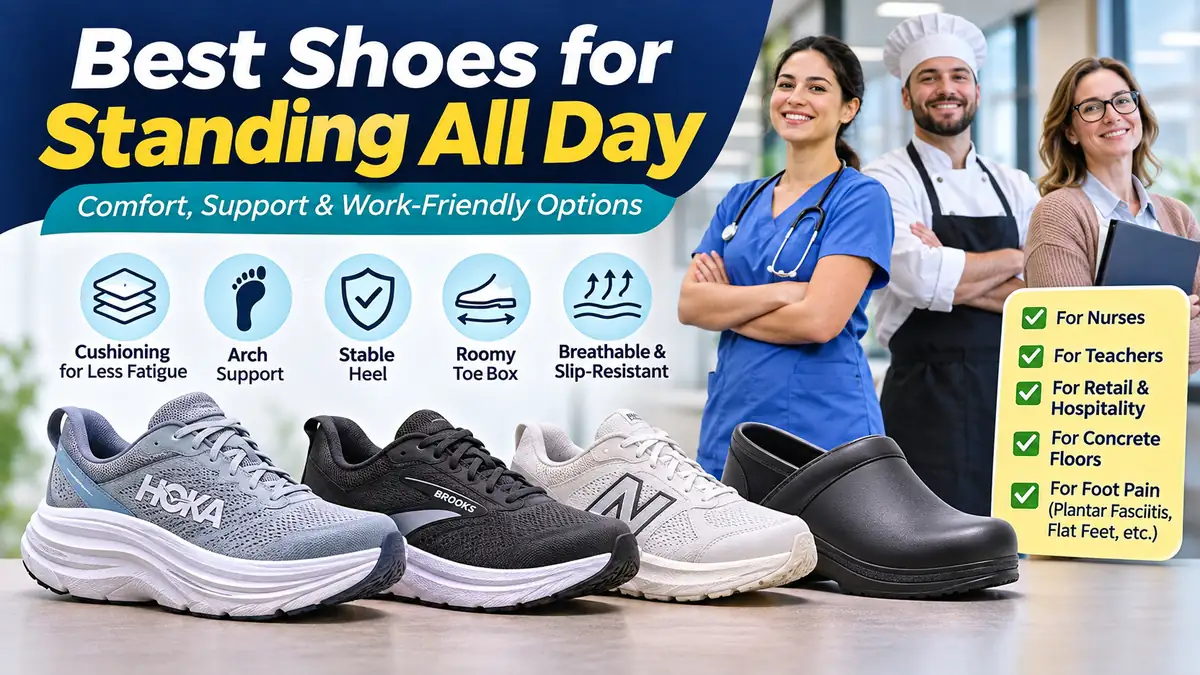
Spending eight, ten, or twelve hours on your feet can leave your heels aching, arches tired, and legs feeling heavy. Nurses, teachers, retail employees, restaurant workers, and warehouse staff know that comfortable footwear is more than a matter of style.
Finding the best shoes for standing all day means understanding how cushioning, arch support, stability, and proper fit work together. A shoe that feels wonderfully soft for five minutes may not provide the support you need throughout an entire shift.
The best shoes for standing all day combine responsive cushioning, appropriate arch support, a stable heel, a roomy toe box, and reliable traction. Supportive walking shoes, cushioned running shoes, and specialized work footwear are common options. The right choice depends on your foot shape, workplace flooring, activity level, and any existing foot discomfort.
What Makes the Best Shoes for Standing All Day?
Standing places sustained pressure on the heels, balls of the feet, and supporting muscles. Unlike walking, which repeatedly shifts weight between feet, prolonged stationary standing can concentrate pressure in the same areas.
According to foot-health specialists featured in recent footwear evaluations, cushioning, stability, adequate toe room, and supportive construction are central considerations for all-day comfort. Prevention+1
Cushioning That Absorbs Pressure
A well-cushioned midsole helps distribute pressure and soften the impact of walking on hard surfaces.
Common cushioning materials include:
- EVA foam: Lightweight cushioning commonly used in athletic footwear.
- Polyurethane: Often provides a firmer, durable underfoot feel.
- PEBA-based foams: Used in some performance footwear for lightweight resilience.
- Gel cushioning: Used in selected ASICS models to help manage impact.
- Memory foam: Can improve initial step-in comfort but does not automatically provide adequate structural support.
Extremely soft cushioning is not always ideal. If the midsole compresses excessively, some wearers may feel unstable or experience greater fatigue.
A balanced shoe should feel comfortable without allowing the foot to wobble excessively.
Arch Support That Matches Your Foot Shape
The arch helps distribute body weight and contributes to the foot’s natural movement.
People with different foot structures may benefit from different footwear characteristics.
- Flat feet may feel more comfortable in shoes with a stable platform and appropriate support.
- High arches often benefit from cushioning and pressure distribution.
- Neutral arches may work well with balanced, neutral footwear.
Arch support should feel natural rather than creating a painful pressure point beneath the middle of the foot.
A Stable Heel and Supportive Midsole
The heel counter is the structured section surrounding the back of the heel.
A supportive heel counter can help keep the rearfoot secure during walking and changing direction.
The midsole also matters. A wide, stable platform may feel more secure than a tall, narrow sole, even when both shoes contain similar amounts of cushioning.
A Roomy Toe Box
Feet can become swollen after hours of standing, especially in warm conditions.
Shoes with narrow toe boxes may create pressure around the toes and forefoot, aggravating discomfort associated with bunions, hammertoes, or general foot swelling.
Look for enough room to move your toes freely without allowing the entire foot to slide inside the shoe.
Breathability and Slip Resistance
Breathable mesh uppers can help manage heat during long shifts.
However, healthcare, restaurant, and industrial workplaces may require different materials.
Water-resistant or wipe-clean uppers can be useful where spills are common. Slip-resistant outsoles are particularly important on wet or greasy floors.
A comfortable running shoe is not automatically a suitable occupational safety shoe.
Best Shoes for Standing All Day: Supportive Models Compared
Several footwear models repeatedly appear in 2026 specialist guides and footwear evaluations. These examples illustrate different approaches to cushioning, stability, and workplace suitability rather than representing a single universally correct ranking.
| Shoe model | Main strength | Potential limitation |
|---|---|---|
| HOKA Bondi 9 | High cushioning and broad platform | Thick sole may feel bulky |
| Brooks Ghost Max 4 | Cushioned, smooth walking transitions | Rocker shape may not suit everyone |
| Brooks Glycerin GTS 23 | Cushioning with guidance support | Fit and support feel vary |
| ASICS GEL-KAYANO 33 | Structured stability | May feel too supportive for some |
| New Balance Fresh Foam X More v6 | Plush cushioning | Softness may not suit every foot |
| HOKA Bondi SR | Work-focused traction and protective upper | Less breathable than mesh sneakers |
| Dansko Professional | Structured clog design | Firm feel and distinctive fit |
| Skechers Arch Fit models | Contoured underfoot support | Fit and stability vary by model |
These models are discussed in contemporary footwear guides from Fleet Feet, Prevention, and specialist footwear reviewers. They have not been independently tested for this article. 2026 Buyer’s Guide+2
HOKA Bondi 9: Maximum Cushioning for Hard Floors
The HOKA Bondi 9 is a highly cushioned athletic shoe designed around a substantial midsole and smooth heel-to-toe transitions.
Its broad underfoot platform makes it an option worth considering for people who spend long periods walking or standing on firm surfaces.
Why it may work:
- Generous cushioning under the heel and forefoot.
- Rocker-shaped sole designed for smoother forward movement.
- Broad platform that may improve the feeling of stability.
- Athletic construction suitable for walking-intensive routines.
Potential drawbacks: Its thick sole can feel unfamiliar, and the rocker geometry may not suit every walking pattern.
People who prefer direct ground contact or a firmer underfoot sensation may prefer another design.
Brooks Ghost Max 4: Balanced Cushioning for Walking
The Brooks Ghost Max 4 is another option for people who alternate between standing and walking.
Its design emphasizes cushioning and smooth transitions.
This can be particularly relevant for teachers, retail workers, and other professionals who move frequently rather than remaining in one position.
The key consideration is whether the rocker shape and platform feel natural during actual walking.
Brooks Glycerin GTS 23: Cushioning With Guidance Support
The Brooks Glycerin GTS 23 combines soft cushioning with a guidance system intended to support the foot’s movement.
It may appeal to people who prefer a more structured feel than some neutral running shoes provide.
However, stability technology is not automatically necessary for everyone with flat feet or pronation.
A shoe should be evaluated by comfort, fit, and how naturally the wearer moves in it.
ASICS GEL-KAYANO 33: Structured Stability
The ASICS GEL-KAYANO 33 is a stability-oriented athletic shoe.
Its supportive construction may appeal to wearers who feel more comfortable with guided movement and a secure platform.
People with neutral foot mechanics may find some stability shoes unnecessarily structured, so personal comfort remains essential.
New Balance Fresh Foam X More v6: Plush Underfoot Comfort
The New Balance Fresh Foam X More v6 emphasizes generous foam cushioning.
It can be a useful example of a softer, highly cushioned approach to footwear.
The important question is whether that softness remains stable and comfortable during extended wear.
A plush shoe that feels excellent during a short walk may not be the best choice for someone who prefers a firmer standing platform.
HOKA Bondi SR: Work-Focused Footwear
The HOKA Bondi SR differs from ordinary mesh running shoes because it is designed with occupational environments in mind.
Its slip-resistant outsole and protective upper make it particularly relevant for healthcare and food-service settings.
The trade-off is that work-focused uppers may feel warmer and less breathable than lightweight athletic mesh.
Workers should still confirm that the specific model meets their employer’s footwear requirements.
Dansko Professional: A Structured Clog Alternative
The Dansko Professional is a recognizable option in healthcare and other standing-intensive occupations.
Its firm construction, rocker-style sole, and roomy forefoot provide a different experience from soft running sneakers.
Some people appreciate the structured platform. Others find the firmer feel or clog-style heel movement uncomfortable.
Proper fitting is especially important because clogs are not intended to fit exactly like lace-up athletic shoes.
Skechers Arch Fit: Contoured Support
Skechers offers several Arch Fit footwear styles with contoured footbeds.
These may appeal to people who want noticeable support beneath the arch.
However, Arch Fit is a product family rather than a single shoe with identical construction across every model.
Compare the outsole, heel stability, upper materials, and fit of the specific version rather than relying on the name alone.
Best Shoes for Standing All Day at Work
Different occupations create different demands on footwear. The most comfortable shoe for a teacher may not be appropriate for a restaurant kitchen or industrial warehouse.
Best Shoes for Nurses and Healthcare Workers
Nurses and healthcare professionals often alternate between prolonged standing, rapid walking, and frequent changes in direction.
Hospital flooring can also become slippery, and footwear may come into contact with liquids.
Important features include:
- Cushioning that remains comfortable during long shifts.
- Secure heel support.
- Easy-to-clean materials where required.
- Appropriate slip resistance.
- Enough room for foot swelling.
- A stable sole for turning and moving quickly.
The HOKA Bondi SR, selected occupational clogs, and purpose-designed healthcare shoes such as the Commbi Atlas Clog illustrate different approaches.
Some nurses prefer athletic sneakers because they feel flexible and familiar. Others prefer clogs because they are easier to clean.
The safest choice depends on the workplace’s footwear policy and the wearer’s individual needs.
Best Shoes for Teachers
Teachers often stand for extended periods while moving between desks, classrooms, and hallways.
For this type of work, a cushioned walking or running shoe with a stable platform may provide a useful balance of comfort and mobility.
Models such as the Brooks Ghost Max and HOKA Bondi demonstrate the types of features worth examining.
Teachers who must wear professional or business-casual clothing may prefer supportive leather sneakers or dress-style walking shoes.
A supportive shoe that fits the dress code is generally more practical than a fashionable shoe that causes discomfort halfway through the day.
Best Shoes for Retail and Hospitality Workers
Retail employees frequently stand on tile, concrete, or other hard flooring.
They may also walk considerable distances during a shift.
A suitable shoe should offer:
- Consistent underfoot cushioning.
- Good forefoot flexibility or comfortable rocker geometry.
- Secure fastening.
- Adequate traction.
- Lightweight construction where practical.
For customer-facing positions, black walking shoes or understated athletic sneakers may be easier to match with uniforms.
The key is to avoid sacrificing fit for appearance.
Best Shoes for Restaurant Workers
Restaurant and kitchen employees need to prioritize traction.
Water, grease, and food spills can create hazardous walking surfaces.
Occupational footwear from brands such as Shoes for Crews, HOKA’s SR range, and suitable Birkenstock work clogs may be worth examining.
However, not every shoe from these manufacturers has the same slip-resistance characteristics.
Check the exact model and any applicable workplace standards before choosing footwear.
Best Shoes for Warehouse and Factory Workers
Warehouse and factory workers often stand on concrete for long periods while lifting, carrying, or moving equipment.
In some environments, ordinary athletic shoes are unsuitable because safety footwear is mandatory.
Depending on the hazards, appropriate footwear may require:
- Protective toe caps.
- Puncture-resistant midsoles.
- Slip-resistant outsoles.
- Electrical hazard protection.
- Suitable ankle support.
- Cushioning for prolonged standing.
Manufacturers such as KEEN Utility, Timberland PRO, Red Wing, and Thorogood offer occupational footwear categories.
The correct safety classification takes priority over cushioning preferences.
Best Shoes for Standing All Day on Concrete Floors
Concrete is a particularly demanding surface because it offers little cushioning.
People who stand on concrete for extended periods may experience pressure beneath the heels and forefeet, particularly when wearing thin or unsupportive footwear.
Why Concrete Floors Cause Discomfort
Concrete does not deform appreciably under body weight.
As a result, much of the pressure management depends on the shoe, the foot’s natural tissues, and movement throughout the day.
Prolonged stationary standing can also contribute to muscle fatigue and lower-limb discomfort.
Cushioning may improve comfort, but it cannot completely eliminate the physical effects of standing for hours.
Features to Prioritize on Concrete
| Feature | Why it matters |
|---|---|
| Resilient midsole | Helps manage repeated pressure |
| Broad outsole | Provides a stable standing platform |
| Supportive heel counter | Helps secure the rearfoot |
| Roomy forefoot | Reduces unnecessary toe compression |
| Durable outsole | Handles abrasive flooring |
| Removable insole | Allows compatible orthotic adjustments |
For people who spend most of their time standing still, a stable, supportive platform may be preferable to an extremely soft shoe.
For those who walk frequently, cushioning combined with a smooth rolling transition may feel more comfortable.
Can Running Shoes Be Used for Standing All Day?
Yes. Many running shoes can also function as comfortable everyday walking and standing shoes.
Their midsoles are designed to manage repeated loading, and many include supportive heel structures and breathable uppers.
However, running footwear is not necessarily designed for prolonged stationary standing.
Some performance running shoes have unusually soft foams, narrow platforms, or aggressive rocker designs that may feel less stable when standing.
Specialized racing shoes with rigid plates are generally unnecessary for ordinary workplace use.
Best Shoes for Standing All Day With Foot Pain
Foot discomfort can arise from several causes, including poor shoe fit, excessive pressure, repetitive loading, and underlying medical conditions.
Footwear can help manage certain mechanical stresses, but it should not be treated as a guaranteed cure.
Best Shoes for Plantar Fasciitis
Plantar fasciitis, often described clinically as plantar heel pain, commonly causes discomfort beneath the heel.
Pain may be particularly noticeable during the first steps after waking or following a period of rest.
People with plantar heel pain may benefit from footwear featuring:
- Comfortable heel cushioning.
- Appropriate arch support.
- A secure heel counter.
- A stable midsole.
- A comfortable heel-to-toe transition.
Some people find rocker-soled shoes helpful because the sole geometry changes how the foot moves during walking.
Others prefer a conventional supportive shoe.
A clinician may recommend stretching, activity modification, or orthoses depending on the individual assessment.
Best Shoes for Flat Feet
Flat feet, also called pes planus, describe a foot structure with a relatively low medial longitudinal arch.
Flat feet do not automatically cause pain or require corrective footwear.
However, someone with symptomatic flat feet may prefer a stable shoe with comfortable arch contact.
Stability-oriented models, such as the ASICS GEL-KAYANO or Brooks Glycerin GTS, illustrate footwear designed to provide additional movement guidance.
The best choice depends on symptoms, fit, and personal comfort rather than arch height alone.
Best Shoes for High Arches
High arches, sometimes called pes cavus, can concentrate pressure under particular parts of the foot.
People with high arches may appreciate cushioning that distributes pressure more comfortably.
Features worth examining include a well-cushioned heel and forefoot, adequate insole contact, and a comfortable upper.
Not everyone with high arches needs an aggressive arch-support insert.
An overly prominent insole may create discomfort rather than relieve it.
Best Shoes for Wide Feet and Bunions
Wide feet require adequate width throughout the shoe, not simply additional length.
Bunions, also known as hallux valgus, can make narrow footwear especially uncomfortable around the big-toe joint.
Look for a toe box that follows the natural shape of the forefoot, with minimal pressure against prominent joints.
Brands such as New Balance, Brooks, Altra, and Topo Athletic offer footwear options with varying width and forefoot shapes.
Remember that a wide toe box and a wide shoe are not necessarily the same thing.
A shoe can provide generous toe space while remaining relatively narrow through the midfoot or heel.
Best Shoes for Heel and Lower Back Discomfort
Heel pain and lower back discomfort may sometimes occur together during prolonged standing, but the relationship is not always straightforward.
Shoes that provide a stable base and comfortable pressure distribution may help reduce some mechanical discomfort.
However, back pain can also involve posture, muscle fatigue, spinal conditions, and workplace ergonomics.
If discomfort continues despite appropriate footwear, professional assessment is more useful than repeatedly changing shoe brands.
How to Choose the Best Shoes for Standing All Day
Choosing footwear requires more than comparing cushioning thickness or reading product descriptions.
A practical fitting process can reveal problems that are easy to overlook.
1. Measure Both Feet
Foot dimensions can change with age, activity, swelling, and other factors.
Measure both feet while standing and use the larger foot when determining the appropriate size.
Do not assume your size is identical across manufacturers.
2. Try Shoes Later in the Day
Feet may become slightly larger after hours of activity.
Trying shoes later in the day can help reveal whether the forefoot has enough space.
Wear the same type of socks you normally use at work.
3. Check Toe Clearance
There should be comfortable space beyond the longest toe, commonly around a thumb’s width, depending on the shoe design and foot shape.
Your toes should move freely without rubbing against the upper.
Avoid buying shoes that are painfully tight in the hope that they will eventually stretch enough.
4. Test Heel Security
Walk around and pay attention to the back of the shoe.
Your heel should feel secure without excessive slipping or uncomfortable rubbing.
A small amount of heel movement may be normal in certain clog designs, but lace-up shoes should generally hold the heel securely.
5. Evaluate Stability
Stand on both feet, shift your weight gently, and walk at your normal pace.
Notice whether the sole feels stable.
Excessive side-to-side movement may indicate that the shoe’s platform or cushioning is unsuitable for you.
6. Match the Outsole to Your Workplace
A shoe intended for dry indoor floors may not provide adequate traction in a commercial kitchen.
Likewise, a cushioned athletic sneaker does not replace certified protective footwear in a hazardous industrial environment.
7. Wear the Shoes Indoors Before a Full Shift
A short trial at home can help identify pressure points, rubbing, or unexpected discomfort.
Do not rely on a lengthy break-in period to correct a fundamentally poor fit.
Quick takeaway: The right shoe should feel comfortable and stable during the fitting process, with enough room for natural foot movement. Brand reputation and cushioning technology matter less than whether the shoe fits your feet and your work environment.
Common Mistakes When Choosing All-Day Standing Shoes
Choosing the Softest Shoe Available
Soft cushioning can feel pleasant initially, but it is not always associated with better long-term comfort.
Some wearers prefer a firmer platform because it feels more stable.
The ideal cushioning level is individual.
Wearing Shoes That Are Too Narrow
Narrow footwear can create friction, toe compression, and pressure around the forefoot.
Going up a full size may not solve the problem because the heel and midfoot can then become too loose.
A properly fitted wide version may be more appropriate.
Ignoring Worn-Out Midsoles
A shoe may look acceptable externally even when the cushioning has compressed or lost resilience.
Signs of deterioration include uneven wear, permanent creasing, loss of support, and new discomfort in previously comfortable shoes.
There is no universal replacement schedule.
Durability depends on body weight, working hours, walking distance, materials, and floor surfaces.
Assuming Expensive Shoes Are Always Better
Price does not guarantee comfort or appropriate support.
A moderately priced shoe that fits well may be more suitable than a premium model with an uncomfortable shape.
Evaluate construction and fit before considering brand prestige.
Using the Wrong Footwear for Workplace Hazards
An ordinary cushioned sneaker may lack the traction, protective toe, or puncture resistance required for a particular job.
Workplace safety requirements should always guide footwear selection.
Do Insoles and Orthotics Help When Standing All Day?
Insoles can modify pressure distribution and the feeling of support inside a shoe.
They may be useful when the original footbed is uncomfortable or when a healthcare professional recommends additional support.
There are several common categories.
| Insole type | Typical purpose |
|---|---|
| Cushioned insole | Adds underfoot softness |
| Contoured arch-support insole | Changes arch contact and pressure distribution |
| Heel cup | Provides localized heel cushioning and positioning |
| Prefabricated orthotic | Offers a standardized supportive shape |
| Custom orthotic | Addresses individually assessed needs |
Custom orthotics are not automatically superior for every person or every condition.
A well-fitting shoe with an appropriate standard insole may be sufficient.
When using orthotics, check whether the original insole can be removed. Stacking a thick insert on top of an existing footbed can reduce available space and create pressure.
If an insert causes new pain, numbness, or rubbing, stop using it until the fit can be assessed.
How to Reduce Foot Fatigue During Long Standing Shifts
Even the best shoes for standing all day cannot completely prevent fatigue when someone remains upright for many hours.
Workplace habits and environmental conditions also matter.
Change Position Regularly
Standing motionless can be more uncomfortable than alternating between standing and gentle movement.
When possible, shift your weight, take short walks, and avoid remaining in exactly the same position for extended periods.
Use an Anti-Fatigue Mat
Anti-fatigue mats may improve comfort at fixed workstations.
They are particularly relevant for cashiers, assembly-line employees, and other workers who remain in one area.
Choose mats designed for the environment, with edges and surfaces that do not create tripping or slipping hazards.
Take Short Movement Breaks
Brief periods of walking or sitting can reduce continuous loading.
Gentle ankle movements and calf raises may also help relieve stiffness during breaks.
The Australian Chiropractors Association’s 2026 standing-at-work guidance recommends varying weight distribution, avoiding locked knees, and using appropriate footwear. ACA
Consider Appropriate Socks
Socks affect moisture management, friction, and overall shoe fit.
Moisture-wicking materials can help keep feet more comfortable during long shifts.
Some workers with leg swelling may benefit from graduated compression socks, but compression is not suitable for everyone.
People with circulatory conditions should seek professional advice before using medical-grade compression garments.
Maintain Foot and Calf Mobility
Gentle calf stretches, ankle movements, and foot exercises can be useful parts of a general mobility routine.
Avoid forcing painful movements.
If an exercise aggravates symptoms, modify or discontinue it.
Pay Attention to Persistent Pain
Occasional tiredness after a demanding shift is different from persistent or worsening pain.
Seek medical evaluation if you experience ongoing heel pain, numbness, burning sensations, significant swelling, or difficulty bearing weight.
Sudden severe pain, injury-related inability to walk, or a hot, swollen foot requires prompt assessment.
How Long Should Shoes Last When Standing All Day?
The lifespan of footwear depends on how it is used.
Someone who walks many miles on concrete each day may wear out shoes faster than someone who spends most of the shift standing on a resilient indoor surface.
Rather than relying exclusively on a fixed number of months, inspect the shoes regularly.
Important warning signs include:
- Uneven outsole wear.
- A noticeably compressed or tilted midsole.
- Reduced cushioning compared with when the shoes were new.
- A damaged heel counter.
- Loose or damaged uppers.
- Persistent discomfort that improves when wearing a different pair.
Rotating between two suitable pairs may allow each pair to dry between uses and can provide a different underfoot feel.
However, rotation does not eliminate the need to replace worn footwear.
Are Expensive Shoes Worth It for Standing All Day?
Premium shoes may use specialized foam compounds, complex support systems, or more durable materials.
These features can be beneficial, but their value depends on the wearer.
A person with a straightforward foot shape and relatively short shifts may be comfortable in an affordable supportive walking shoe.
Someone who works twelve-hour shifts on hard flooring may place greater value on cushioning durability, width options, and occupational features.
Consider the following comparison:
| Factor | Affordable footwear | Premium footwear |
|---|---|---|
| Cushioning | Often adequate for everyday use | May offer more specialized foam |
| Stability | Varies by design | Varies by design |
| Width choices | Model-dependent | Model-dependent |
| Durability | Depends on materials and usage | Not automatically longer-lasting |
| Comfort | Highly individual | Highly individual |
| Workplace protection | Must be verified | Must be verified |
The American Podiatric Medical Association’s Seal of Acceptance can be one useful reference when evaluating footwear designed to promote foot health.
However, the seal does not guarantee that a shoe will fit every person or resolve a particular medical condition.
How to Know Whether Your Shoes Are Right for You
A suitable pair should remain comfortable beyond the first few minutes.
During a normal workday, consider whether your toes have enough space, your heel remains secure, and the cushioning feels stable.
You should not need to repeatedly loosen your shoes to relieve painful pressure.
Minor tiredness after long periods of activity may still occur, even in appropriate footwear.
However, consistent rubbing, increasing pain, or numbness suggests that something needs attention.
It can be helpful to keep a simple record of when discomfort appears. For example, heel pain that begins immediately may suggest a different problem from forefoot pressure that develops after several hours.
These observations can help a footwear specialist or healthcare professional identify potential causes.
Final Thoughts on the Best Shoes for Standing All Day
The best shoes for standing all day are those that provide an appropriate balance of cushioning, stability, arch comfort, toe space, and workplace protection.
Highly cushioned shoes such as the HOKA Bondi 9 and Brooks Ghost Max 4 illustrate options for general walking and standing. Stability-oriented footwear, including the ASICS GEL-KAYANO 33 and Brooks Glycerin GTS 23, offers a different support approach. Occupational models such as the HOKA Bondi SR and structured work clogs address additional workplace needs.
No single model is ideal for every foot shape, occupation, or medical condition.
Start by identifying your workplace requirements and the areas where your feet experience discomfort. Then prioritize proper fitting, stable construction, and sufficient room for natural movement.
Supportive footwear, combined with regular movement and sensible workplace habits, can make long days on your feet more manageable.