
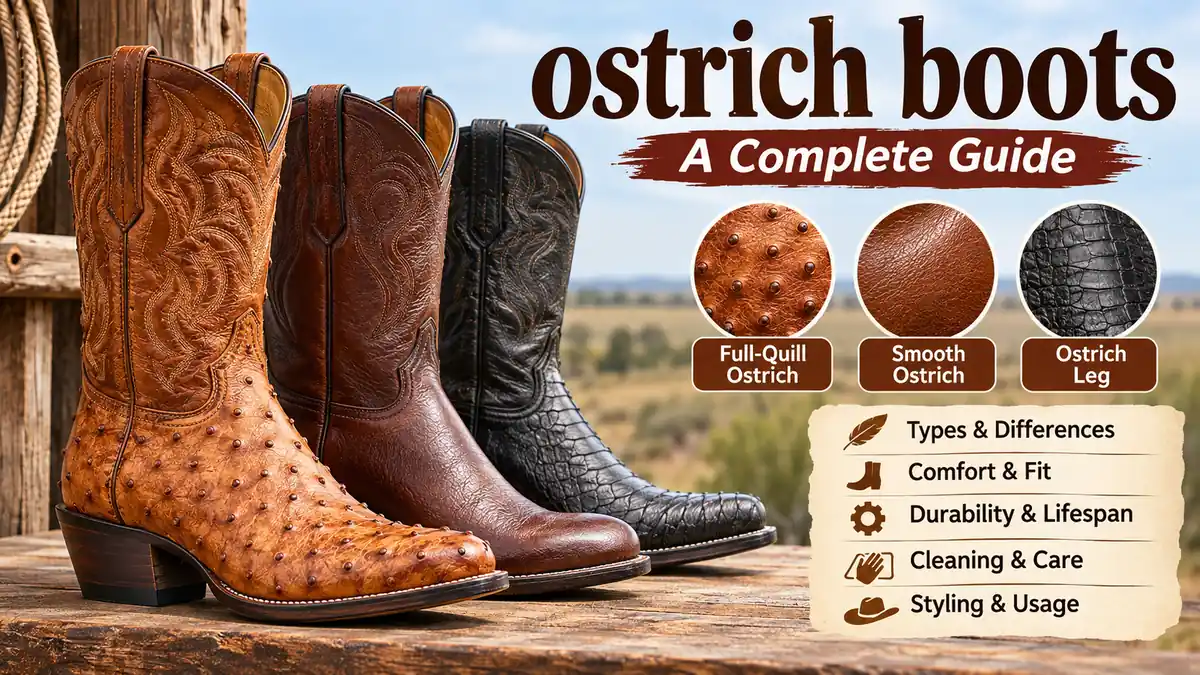
Not all cowboy boots feel the same, and the leather often makes the biggest difference. Some materials are stiff and take weeks to soften, while others offer flexibility almost immediately. Ostrich leather stands out for its distinctive texture, supple feel, and ability to combine traditional western style with everyday comfort.
ostrich boots are western-style footwear made using leather from ostrich hides. They are recognized for their softness, flexibility, durability, and natural grain patterns. The three main varieties are full-quill ostrich, smooth ostrich, and ostrich leg leather, each offering a different appearance and texture. With proper fitting and maintenance, these boots can provide years of comfortable wear.
Understanding the differences between these leathers is useful because the appearance of a boot does not always reveal how it will feel, fit, or age.
What Are ostrich boots?
Ostrich boots are footwear constructed partly or entirely from processed ostrich leather, most commonly in traditional cowboy boot designs.
Ostrich leather comes from the hide of the ostrich (Struthio camelus), a large flightless bird raised commercially for meat, feathers, and leather.
The material is especially recognizable because of the small raised bumps called quill follicles, which mark the locations where feathers originally grew.
Unlike decorative embossing, these markings occur naturally in the skin.
The leather is valued for several characteristics:
- Natural softness: It generally feels more pliable than many firm cowhide leathers.
- Distinctive grain: Feather follicles create an irregular, three-dimensional pattern.
- Flexibility: Properly tanned ostrich leather bends comfortably with foot movement.
- Durability: Quality leather can withstand regular wear when maintained correctly.
- Natural oils: The hide contains oils that contribute to its supple character.
- Individual appearance: Every hide has slightly different grain patterns and markings.
The Food and Agriculture Organization (FAO) describes ostrich leather as a material with two distinct body-hide textures: quill-marked areas and smoother areas with fine striations. FAOHome
Although ostrich leather is associated with luxury western footwear, the material itself does not guarantee superior comfort or craftsmanship. The construction of the entire boot matters just as much.
Types of ostrich boots and Their Differences
Three major types of ostrich leather are used in western bootmaking. They differ in texture, appearance, and the part of the bird from which the hide originates.
Damilano 13″ Full Quill Ostrich | Tony Lama
Full-Quill Ostrich
Prominent raised follicles create the classic textured pattern. Often used on the vamp, it is the most recognizable variety.
Wyatt Smooth Ostrich Boots | Stetson
Smooth Ostrich
Fine-grained, supple leather with few visible quill bumps. Its appearance is more understated.
Collin Ostrich Leg Classic Western Boot – Brown – Gavel Boots
Ostrich Leg
A narrow section of leather with naturally elongated, scale-like markings rather than rounded quills.
Full-Quill Ostrich Leather
Full-quill ostrich leather comes from the area of the body hide with prominent feather follicles, often called the crown.
The raised markings create the classic textured appearance associated with exotic ostrich cowboy boots.
Because the quill pattern varies naturally, two boots made from genuine leather may display slightly different markings.
Full-quill leather is particularly appreciated for its visual depth. The raised follicles catch light differently from the surrounding smooth leather.
However, full-quill does not mean the entire boot is made from ostrich. Some designs use full-quill leather on the foot and conventional leather on the shaft.
Smooth Ostrich Leather
Smooth ostrich comes from body-hide sections with fewer prominent quill follicles.
It retains the flexible character of ostrich leather but has a cleaner, more uniform-looking surface.
Smooth ostrich is sometimes called plain ostrich, although terminology varies among manufacturers.
It can resemble calfskin or other smooth leathers at first glance. Its fine grain, softness, and natural variation help distinguish it.
This variety works particularly well in understated western boot designs because the leather texture does not dominate the overall appearance.
Ostrich Leg Leather
Ostrich leg leather has a striking scale-like pattern.
Unlike the rounded bumps on full-quill body leather, the leg displays elongated, irregular markings.
The narrow dimensions of the leg hide also affect boot construction. Makers may use several leather panels to create the foot of a boot.
Ostrich leg leather should not be confused with reptile leather. Although the appearance can resemble lizard or snakeskin, it comes from a bird and has different structural characteristics.
Comparison of Ostrich Leather Types
| Feature | Full-Quill | Smooth | Ostrich Leg |
|---|---|---|---|
| Texture | Raised follicles | Fine, relatively even grain | Scale-like pattern |
| Appearance | Bold and distinctive | Subtle and refined | Highly textured |
| Flexibility | Generally supple | Generally supple | Varies by cut and finish |
| Visual markings | Rounded quills | Few prominent quills | Elongated scales |
| Typical use | Vamp and decorative panels | Foot and other panels | Vamp, overlays, trim |
| Maintenance | Gentle cleaning around quills | Gentle surface cleaning | Care around textured grain |
These distinctions are important because the three materials are not simply different finishes applied to identical leather. Western Boot World+1
Why Is Ostrich Leather Popular for Cowboy Boots?
The popularity of ostrich leather comes from the combination of flexibility, visual character, and traditional western craftsmanship.
Softness and Natural Flexibility
Many conventional leather boots feel firm when new, especially if the leather has been heavily finished or the boot contains substantial structural reinforcement.
Ostrich leather often feels softer from the beginning.
Its natural oils and fiber structure contribute to a flexible surface that can move with the foot.
This does not mean ostrich boots require no break-in period. Insoles, heel counters, toe boxes, and outsoles may still need time to adapt to normal walking.
Strength and Durability
Ostrich leather is known for combining suppleness with useful strength.
However, durability should not be confused with resistance to every kind of damage.
The leather can still experience:
- Scratches from rough surfaces
- Discoloration from oils and moisture
- Wear along flex points
- Damage from excessive heat
- Surface changes caused by unsuitable cleaning products
A well-constructed ostrich boot can remain wearable for many years, but lifespan depends on use, leather quality, sole construction, and maintenance.
Distinctive Natural Texture
The raised follicle pattern is one of the material’s defining characteristics.
Unlike a repeated artificial print, genuine full-quill leather normally has irregular spacing, varied follicle sizes, and subtle changes in grain.
These differences make the leather visually interesting without requiring additional decorative elements.
Versatility in Western Footwear
Ostrich leather can be incorporated into different boot shapes, including traditional cowboy boots, roper boots, dress western boots, and modern square-toe designs.
The final appearance depends on the toe shape, heel, shaft, stitching, leather color, and finish.
Are ostrich boots Comfortable for Everyday Wear?
Ostrich boots can be comfortable for everyday wear when their shape and construction match the wearer’s feet.
The leather’s softness is an advantage, but comfort is determined by more than the outer material.
How Ostrich Leather Feels on the Foot
Ostrich leather generally bends easily across the forefoot.
This flexibility can reduce the sensation of stiffness associated with some new western boots.
However, softness does not automatically provide arch support or cushioning.
Those qualities depend primarily on the insole, footbed, shank, and overall boot construction.
Do Ostrich Boots Stretch?
Genuine ostrich leather can stretch and conform somewhat with regular wear.
The amount of stretching depends on the hide, tanning process, finish, and construction.
A boot that is slightly snug across the instep may become more accommodating over time.
A boot that compresses the toes, causes numbness, or creates persistent pain is not properly fitted.
Do not rely on stretching to correct a significantly incorrect boot size.
Do Ostrich Boots Need Breaking In?
Yes, although the leather itself may feel comfortable sooner than some firmer materials.
A typical break-in process involves wearing the boots for shorter periods before increasing wear time.
The leather upper may gradually conform to the foot, while the insole and other structural components adapt to movement.
If discomfort continues or becomes worse, the issue may be the boot’s shape rather than the break-in period.
Are They Suitable for Long Hours of Standing?
They can be, but only when the complete boot provides appropriate support.
For prolonged standing, consider:
- Adequate arch support
- Cushioning beneath the heel and forefoot
- A stable heel
- Proper width across the ball of the foot
- An outsole suited to the walking surface
A soft leather upper cannot compensate for an uncomfortable footbed or poor fit.
How to Identify Genuine Ostrich Leather Boots
Identifying genuine ostrich leather is easier when examining several characteristics together.
Examine the Quill Pattern
Full-quill ostrich leather has naturally irregular follicle markings.
The bumps vary in size and spacing, and the surrounding grain is not perfectly uniform.
Artificially embossed leather may display repeated patterns that look unusually consistent.
However, modern embossing can be convincing, so appearance alone is not definitive proof.
Feel the Leather Texture
Genuine ostrich leather is typically supple.
Full-quill follicles have a raised, three-dimensional quality, while smooth ostrich has a fine natural grain.
Leather thickness, finish, and lining can change how a boot feels, so softness is only one clue.
Look for Natural Variation
Natural hides often contain subtle differences in texture, grain, and coloration.
These variations do not automatically indicate defects.
Conversely, uniform-looking leather is not necessarily fake, particularly when examining smooth ostrich or heavily finished material.
Check Material Descriptions
Terms such as genuine ostrich, full-quill ostrich, smooth ostrich, and ostrich leg describe particular materials.
By contrast, descriptions such as ostrich print or ostrich embossed may indicate another leather or synthetic material designed to imitate ostrich grain.
A reliable material specification is more meaningful than an appearance-based claim.
Understand the Limits of Visual Inspection
Even experienced observers may struggle to authenticate heavily finished leather from photographs alone.
When authenticity matters, examine construction details, material documentation, and the manufacturer’s description rather than relying exclusively on quill patterns.
Ostrich Boots vs. Cowhide and Other Exotic Leathers
Different leathers offer different combinations of texture, flexibility, durability, and maintenance needs.
| Leather | Typical texture | Main characteristics | Care considerations |
|---|---|---|---|
| Ostrich | Quill-marked or smooth | Supple, flexible, distinctive | Sensitive to oils and unsuitable products |
| Cowhide | Smooth, pebbled, or textured | Versatile; firmness varies | Routine cleaning and conditioning |
| Calfskin | Fine, smooth grain | Soft, refined appearance | Protect from scratches and moisture |
| Lizard | Fine scales | Distinctive reptile texture | Requires careful conditioning |
| Python | Overlapping scales | Flexible, patterned surface | Protect scale edges from damage |
| Crocodilian leather | Raised scale pattern | Structured exotic appearance | Specialized conditioning and cleaning |
These are general material characteristics rather than universal performance rankings.
Ostrich vs. Cowhide Boots
Cowhide is widely used in western footwear because it is versatile and available in many thicknesses and finishes.
Some cowhide boots are firm and rugged, while others use very soft leather.
Ostrich often offers a distinctive combination of flexibility and natural texture.
The better material depends on the intended use and the boot’s construction.
Ostrich vs. Lizard Boots
Lizard leather has a fine, closely patterned scaled surface.
Ostrich body leather is visually different because of its rounded quill follicles.
Ostrich leg leather may look more similar to lizard, although its scale pattern is typically larger and more irregular.
The two materials also have different care requirements.
Ostrich vs. Python Boots
Python leather has overlapping scales that create a recognizable pattern.
Its care often requires particular attention to scale direction and dryness.
Ostrich body leather does not have overlapping reptile scales, making the surface structure fundamentally different.
Neither leather is automatically more durable in every setting. Finish, construction, and exposure conditions affect wear.
How to Choose the Right Fit and Boot Shape
Fit is one of the most important factors in the comfort and longevity of western footwear.
A correctly fitted boot should hold the foot securely without excessive pressure.
Understanding Western Boot Sizing
Western boots are commonly sold using standard length sizes and width designations.
Men’s widths may include D for a standard width and EE for a wider fit, although sizing systems vary by manufacturer.
Women’s western boots often use different width conventions.
Size labels should therefore be treated as a starting point rather than a guarantee of fit.
How Should Ostrich Boots Fit?
A properly fitted western boot should generally provide:
- A snug but comfortable fit across the instep
- Enough room for the toes to move naturally
- A secure feel around the ball of the foot
- Some initial heel movement in traditional pull-on designs
- No persistent pinching or sharp pressure
A small amount of heel slip can be normal in new pull-on cowboy boots and may decrease as the sole flexes.
Excessive heel movement, however, may indicate an unsuitable fit.
Square Toe, Round Toe, and Snip Toe
Access to this page has been denied.
Square toe
Brown Ostrich Boots R Toe | Los Altos Boots
Round toe
RANCHO SEMENTAL EXOTIC LEATHER Ostrich Black Cowboy Boots Snip toe – Rancho Semental
Snip toe
Square-toe ostrich boots have a broad, angular toe profile. Some designs provide generous room at the front, although internal fit varies.
Round-toe ostrich boots feature a traditional curved shape that can work with casual and dress western clothing.
Snip-toe ostrich boots have a narrower, tapered appearance often associated with dress western styles.
Toe shape alone does not determine comfort. The internal last, which is the form used to shape the boot, is equally important.
Heel Height and Sole Construction
Western boots may feature walking heels, roper heels, or taller riding-inspired heels.
A lower heel may feel more familiar to people accustomed to everyday shoes.
Outsoles also affect traction and comfort.
Leather soles provide a traditional appearance and can feel flexible, while rubber soles may offer better traction on many smooth or damp surfaces.
Neither sole material guarantees slip resistance under all conditions.
Why Boot Construction Matters
The quality of the upper leather is only one component of a finished boot.
Other important elements include the lining, insole, shank, heel counter, stitching, outsole attachment, and welt construction where applicable.
Goodyear-welted and certain traditional stitched constructions may allow resoling, depending on the design and condition.
Some boots use cemented construction, which can be more difficult to repair.
A durable upper is most useful when supported by equally dependable construction.
How to Clean and Care for ostrich boots
Proper maintenance helps preserve the flexibility, texture, and appearance of ostrich leather.
The material contains natural oils, but this does not eliminate the need for appropriate cleaning and conditioning.
Manufacturers including Lucchese and Justin Boots recommend gentle cleaning and conditioners intended for exotic leather. Lucchese+1
Step 1: Remove Dust and Loose Dirt
Use a clean, soft cloth or gentle brush to remove surface dirt.
For full-quill leather, work carefully around the raised follicles.
Avoid stiff brushes that may abrade the finish.
Step 2: Wipe the Leather Gently
Use a soft cloth lightly dampened with water.
Do not saturate the leather or immerse the boots in water.
For stubborn stains, follow the manufacturer’s guidance and use a cleaner compatible with the specific finish.
Step 3: Apply a Suitable Conditioner
Choose a conditioner specifically recommended for ostrich or exotic leather.
Test a small amount on a hidden area first.
Apply a thin, even layer according to the product instructions.
Avoid heavy application because excessive conditioner may alter the color, leave residue, or affect the finish.
Step 4: Allow Natural Drying
Let the boots dry at room temperature.
Do not place them beside heaters, fireplaces, radiators, or other direct heat sources.
High temperatures can remove moisture from leather and contribute to stiffness or cracking.
Step 5: Buff and Protect
Once the conditioner has absorbed and the leather is dry, gently buff with a clean cloth if appropriate for the finish.
Some manufacturers recommend compatible cream polish or a non-silicone protective treatment.
Always follow the instructions for the specific leather and finish rather than assuming every exotic leather accepts the same products.
How Often Should Ostrich Leather Be Conditioned?
There is no universal conditioning schedule.
Frequency depends on climate, wear, storage conditions, and the leather’s finish.
Boots exposed to dry environments or frequent wear may need attention more often than those worn occasionally.
Condition when appropriate under the manufacturer’s guidance, rather than applying products automatically every few weeks.
What Should You Avoid Using?
Avoid household oils, harsh detergents, strong solvents, excessive wax, and products not recommended for exotic leather.
Ostrich leather can be sensitive to oil-related discoloration.
advises applying exotic leather conditioner lightly and buffing the boots after drying. Tony Lama Boots
Can Ostrich Leather Boots Get Wet?
Ostrich leather can tolerate incidental moisture, but prolonged exposure to water is undesirable.
Water may affect the finish, cause temporary darkening, or leave marks after drying.
The amount of damage depends on the leather treatment and exposure.
What to Do If Your Boots Get Wet
- Gently blot surface moisture with a clean, absorbent cloth.
- Remove excess dirt without rubbing aggressively.
- Allow the boots to air-dry naturally in a ventilated area.
- Use suitable boot trees if recommended to maintain their shape.
- Once completely dry, assess whether conditioning is needed.
Do not use a hair dryer or place the boots in direct sunlight to accelerate drying.
Are Ostrich Boots Waterproof?
Standard ostrich leather cowboy boots should not be assumed to be waterproof.
Water resistance depends on the finish, seams, sole construction, and any protective treatment.
A water-resistant surface treatment does not necessarily make the complete boot waterproof.
For frequent wet conditions, footwear specifically designed and tested for water protection is more appropriate.
How Long Do Ostrich Boots Last?
High-quality ostrich boots can last for many years with proper use and care.
However, there is no reliable universal lifespan because wear patterns vary considerably.
A pair worn occasionally for formal events may remain in good condition much longer than one worn daily in abrasive environments.
Factors That Affect Longevity
Leather quality: Proper tanning and finishing influence flexibility, appearance, and resistance to deterioration.
Boot construction: Strong stitching, stable heel attachment, and repairable soles can extend useful life.
Frequency of wear: Daily use generally produces more wear than occasional use.
Environmental exposure: Heat, moisture, dirt, and abrasive surfaces can accelerate deterioration.
Maintenance: Appropriate cleaning and conditioning help prevent avoidable damage.
Can Ostrich Boots Be Resoled?
Many traditional western boots can be resoled, but repairability depends on their construction.
A qualified boot repair specialist can inspect the welt, outsole, heel, and upper before recommending repairs.
Resolving sole wear early may help preserve the rest of the boot.
Do Ostrich Boots Develop a Patina?
Yes. Ostrich leather can gradually develop changes in color, sheen, and surface character.
This aging process is often described as patina.
Its appearance depends on the original dye, finish, exposure to light, natural oils, and care products.
Patina should not be confused with damage. Deep cracks, severe dryness, and structural deterioration are signs of wear that may require professional attention.
Common Problems With Ostrich Boots and How to Prevent Them
Even well-made leather footwear can develop problems.
Understanding the causes helps prevent unnecessary damage.
Dryness and Cracking
Leather may become dry when exposed to excessive heat, unsuitable cleaners, or poor storage conditions.
Prevention involves keeping the boots away from heat and using compatible conditioning products when needed.
Existing deep cracks cannot always be reversed through conditioning.
Uneven Color or Dark Spots
Ostrich leather may react to skin oils, grease, water, or certain care products.
The result can be localized darkening or uneven coloration.
Avoid applying untested products to visible areas.
For significant stains, a professional experienced with exotic leather is often the safest option.
Creasing Across the Vamp
Creases naturally develop where the foot bends.
Some creasing is expected and does not necessarily indicate poor quality.
Proper fit, appropriate storage, and avoiding repeated saturation can help limit excessive distortion.
Flattened or Damaged Quill Markings
Full-quill leather can lose some of its raised appearance through abrasion, pressure, or inappropriate treatment.
Avoid crushing the vamp during storage and do not scrub aggressively around follicles.
Unpleasant Odors
Odors usually originate from moisture and perspiration inside the boot rather than the outer ostrich leather.
Allow the interior to dry between uses.
Cedar boot trees may help absorb some moisture and maintain shape, although they are not a substitute for cleaning or adequate ventilation.
How to Store Ostrich Leather Boots Properly
Good storage practices are particularly useful for boots worn only occasionally.
Store them in a cool, dry, ventilated location away from direct sunlight.
Boot trees can help maintain the shape of the foot, while shaft supports can prevent tall boot shafts from folding excessively.
Avoid tightly packed storage that places pressure on the leather.
For longer periods, use breathable storage materials rather than sealing damp boots in plastic.
Inspect stored boots occasionally for moisture, mold, and changes in the leather’s condition.
How to Style Ostrich Cowboy Boots
Ostrich leather is strongly associated with western fashion, but its appearance can work across several clothing styles.
The most effective combinations usually balance the boot’s texture with simpler garments.
With Jeans
Straight-leg and bootcut jeans are traditional companions to western boots.
These cuts generally provide enough room for the boot shaft without excessive bunching.
Dark denim can create a more polished appearance, while faded jeans emphasize a casual western look.
With Dress Trousers
Smooth ostrich and darker full-quill finishes can work with tailored trousers in settings where western dress is appropriate.
A clean boot profile, restrained stitching, and coordinated colors help maintain a refined appearance.
With Western Shirts and Jackets
A western shirt, denim jacket, or simple leather jacket can complement the traditional silhouette.
When the boots have a bold quill pattern, keeping other textures understated helps avoid visual competition.
Choosing Colors
Black ostrich boots create a formal, versatile appearance.
Brown and chocolate shades emphasize the natural leather character and pair easily with denim.
Tan and lighter finishes can make the quill pattern more visible, but may also show stains or discoloration more readily.
Exotic leather finishes vary, so two boots described using the same color may look different under natural light.
Where Does Ostrich Boot Leather Come From?
Commercial ostrich leather is obtained from ostriches raised in farming systems.
Southern Africa, particularly South Africa, has a long history of commercial ostrich production.
Ostrich farming supplies multiple products, including meat, feathers, and hides.
After processing, the hides are prepared for tanning, dyeing, finishing, and manufacturing.
How Ostrich Leather Is Processed
The general production process involves:
- Preparing and preserving the raw hide.
- Removing unwanted tissue and fat.
- Tanning the hide to stabilize the material.
- Dyeing and finishing the leather.
- Cutting the material into footwear components.
- Assembling the finished boot.
Ostrich hide processing requires particular care because the skin contains substantial fat deposits and deeply rooted feather follicles.
These characteristics make tanning more specialized than simply processing a conventional smooth hide. FAOHome
Is Ostrich Leather an Exotic Leather?
Yes. In the footwear industry, ostrich is generally classified as an exotic leather.
The term describes the material category rather than a single quality grade.
Exotic leather products can differ widely in craftsmanship, sourcing, finishing, and durability.
Ethical and Environmental Considerations
Ostrich leather is an animal-derived material, so its production raises questions about animal welfare, farming conditions, tanning practices, and traceability.
The fact that ostriches are farmed for multiple products does not automatically establish that every leather product is ethically sourced or environmentally sustainable.
Responsible sourcing claims should be evaluated using verifiable information about production practices and supply chains.
Common Misconceptions About Ostrich Boots
Several assumptions about ostrich leather can lead to unrealistic expectations.
All Ostrich Boots Have Raised Bumps
False. Full-quill leather has prominent follicles, while smooth ostrich may have few visible bumps. Ostrich leg leather has a different scaled pattern.
Ostrich Leather Never Cracks
False. Although ostrich leather is naturally supple, it can deteriorate when exposed to heat, dryness, chemicals, or poor maintenance.
Full-Quill Means the Entire Boot Is Ostrich
Not necessarily. Full-quill may describe only the leather used on the vamp or another visible panel.
The shaft, lining, and other components may use different materials.
Expensive Leather Guarantees a Comfortable Boot
False. Fit, last shape, insole support, heel design, and construction are essential to comfort.
Ostrich Boots Require Constant Conditioning
False. Excessive conditioning may damage the finish or change the color.
Appropriate care is more effective than frequent, unnecessary treatment.
Every Raised Quill Pattern Is Genuine
False. Embossed leather can imitate the appearance of full-quill ostrich.
Material documentation and careful inspection are more dependable than texture alone.
Final Thoughts on ostrich boots
Ostrich boots combine traditional western footwear design with a leather known for its natural softness, flexibility, and distinctive grain.
Full-quill ostrich provides the recognizable raised follicle pattern, smooth ostrich offers a more restrained appearance, and ostrich leg leather introduces a completely different scale-like texture.
Each variety has its own character, but comfort and durability depend on the entire boot rather than the leather alone.
Understanding material differences, proper fit, construction, and maintenance makes it easier to appreciate how these boots are made and why they behave differently from conventional leather footwear.
The most useful next step is to identify the leather type and construction of any pair you own, then follow the manufacturer’s specific care instructions. With suitable maintenance, ostrich leather can retain its distinctive appearance and flexible character through years of wear.