
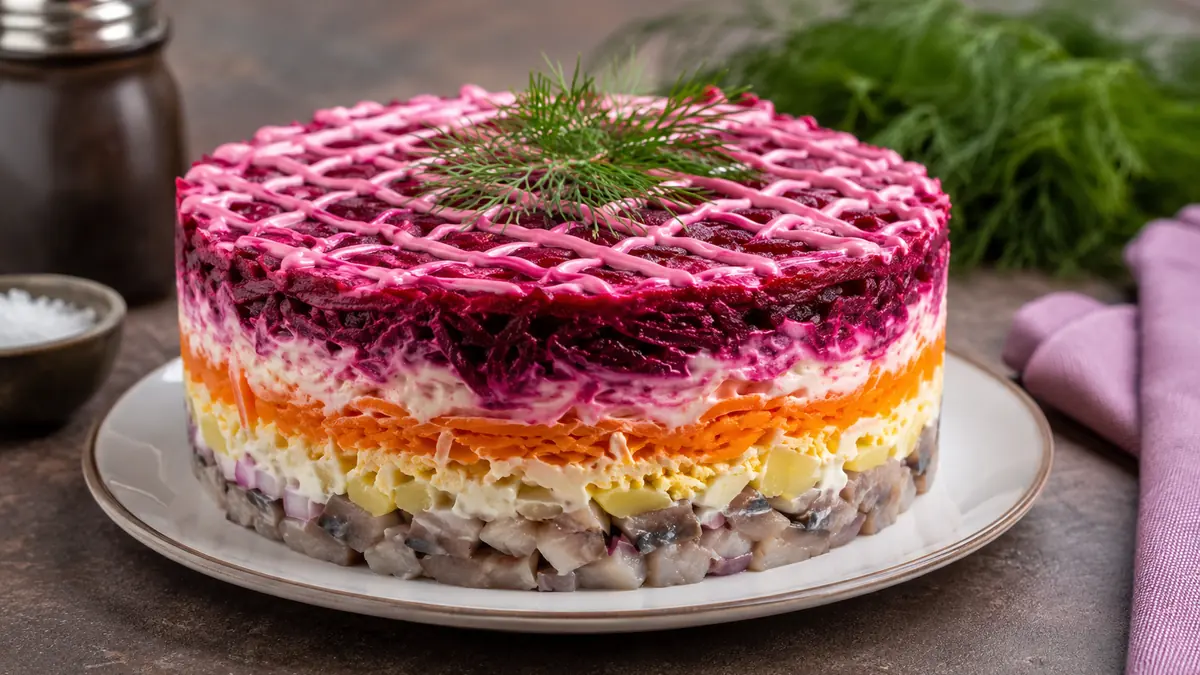
Searching for herring under fur coat near me can be surprisingly tricky. The dish is famous across Russian, Ukrainian, Belarusian, and other Eastern European food traditions, yet many restaurants and delis list it under a completely different name: Shuba salad.
That naming difference matters. A search for “herring salad” may bring up dozens of unrelated dishes, while searching for “Shuba,” “dressed herring,” or the Russian name “селёдка под шубой” can reveal restaurants, Eastern European grocery stores, delis, and prepared-food counters that you might otherwise miss.
Herring under a fur coat is a chilled layered salad built around salted or pickled herring, potatoes, carrots, beetroot, onions, mayonnaise, and often hard-boiled eggs. The bright beet layer gives it its distinctive pink-purple appearance, while the combination of salty fish, earthy vegetables, and creamy mayonnaise creates its characteristic flavor.
If you want to find an authentic version nearby, search beyond the English name. Look for Shuba salad, dressed herring, Russian herring salad, Ukrainian herring salad, or селёдка под шубой, and check Russian, Ukrainian, Eastern European, Baltic, and international grocery stores as well as restaurants.
What Is Herring Under a Fur Coat?
Herring under a fur coat is a cold layered salad commonly known as Shuba. It combines preserved herring with cooked vegetables and mayonnaise, usually arranging the ingredients in separate colorful layers.
A typical version contains:
- Salted, cured, or pickled herring
- Boiled or roasted potatoes
- Cooked carrots
- Beetroot
- Onion
- Mayonnaise
- Hard-boiled eggs
- Dill or other herbs for garnish
Recipes vary considerably between households and restaurants. Some versions add apple, pickled onion, sour cream, cucumber, or extra eggs, while simpler recipes may leave one or more of these ingredients out.
The “fur coat” is not an ingredient. It describes the layers of vegetables and dressing that cover the herring. The beetroot near the top creates the salad’s recognizable deep pink or purple color.
Why Is It Also Called Shuba Salad?
One of the easiest ways to improve a herring under fur coat near me search is to know its alternative names.
The dish is commonly called:
| Name | What It Usually Refers To |
|---|---|
| Herring Under a Fur Coat | Common English name |
| Shuba | Short traditional name |
| Shuba Salad | Common restaurant and recipe name |
| Dressed Herring | Another English name |
| Herring Under Fur Coat | Shortened search variation |
| Селёдка под шубой | Russian name |
“Shuba” means “fur coat” in Russian, referring to the vegetable layers covering the fish.
Recipes From Europe describes the dish as Shuba and notes its association with Russia, Belarus, and Ukraine, while other sources also use “dressed herring” as an English alternative.
This is useful when searching online because a restaurant might serve exactly what you want without ever using “herring under a fur coat” on its menu.
How to Find Herring Under Fur Coat Near Me
Finding Shuba is less about performing one search and more about knowing where the dish is likely to appear.
1. Search for “Shuba Salad Near Me”
Start with the alternative name.
Try searches such as:
- Shuba salad near me
- Russian Shuba salad near me
- dressed herring near me
- Russian herring salad near me
- Ukrainian herring salad near me
- Eastern European deli near me
- Russian grocery store near me
- Ukrainian grocery store near me
Restaurant menus sometimes use only “Shuba,” while prepared-food shops may use “Herring Under Fur Coat.”
Using several variations gives you a better chance of finding the same dish under different names.
2. Check Russian and Ukrainian Restaurants
Russian and Ukrainian restaurants are among the most logical places to look because Shuba is strongly associated with the cuisines of the former Soviet region.
It often appears in the salad, cold appetizer, or zakuski section rather than among main courses.
For example, restaurant menus currently indexed online show Herring Under a Fur Coat being served as a cold salad made with herring, potatoes, carrots, beetroot, mayonnaise, and eggs.
So when checking a menu, don’t stop after scanning the entrées.
3. Search Eastern European Grocery Stores
A restaurant isn’t your only option.
Eastern European supermarkets, Russian food stores, Ukrainian groceries, and international delis may sell Shuba from a refrigerated prepared-food counter.
This can actually be more convenient if you want to take the salad home rather than eat at a restaurant.
Prepared versions can also be sold by weight or in containers suitable for sharing. Online delivery listings, for example, show prepared 500-gram portions marketed specifically as “Shuba Salad (Herring Under Fur Coat).”
4. Search the Menu, Not Just the Restaurant Name
Suppose you find an Eastern European restaurant nearby.
Open its menu and search the page for:
herring, shuba, beet, or fur coat.
The dish may be buried among cold appetizers and traditional salads.
Some menus explicitly describe it as layers of herring, roasted carrots, beetroot, potatoes, mayonnaise, and hard-boiled egg.
5. Call Before Making a Special Trip
Shuba isn’t necessarily prepared every day.
Because it benefits from chilling and resting before serving, some smaller restaurants and delis may make it for particular days, holidays, catering orders, or special menus.
If you’re traveling specifically to buy it, confirming availability first can save you a wasted trip.
What Does Authentic Herring Under a Fur Coat Look Like?
Authentic Shuba is easy to recognize once you’ve seen it.
The most noticeable feature is its beetroot-colored upper layer. Depending on how much mayonnaise is mixed with the beets, this can range from dark burgundy to bright pink.
When sliced from the side, you should be able to see several distinct layers.
A traditional-looking portion may include:
- Herring
- Onion
- Potato
- Carrot
- Egg
- Mayonnaise
- Beetroot
There isn’t one universally mandatory order. Recipes from different families arrange the ingredients differently, and some repeat layers. Food Network, for example, uses onions, potatoes, herring, egg whites, carrots, mayonnaise, beets, additional mayonnaise, and egg yolks.
So a different layer order doesn’t automatically make a restaurant’s version inauthentic.
What Does Shuba Salad Taste Like?
Shuba has a much more balanced flavor than its unusual English name might suggest.
The herring supplies salty, savory richness. Potatoes soften the intensity of the fish, carrots provide mild sweetness, and beetroot contributes earthy sweetness and color.
Onion adds sharpness.
Mayonnaise ties those contrasting ingredients together and creates the creamy texture associated with the dish.
The result is simultaneously:
- Salty
- Creamy
- Earthy
- Slightly sweet
- Savory
- Rich
If you’ve never eaten preserved herring before, the fish can be the strongest flavor initially. But properly balanced Shuba shouldn’t taste like nothing but herring.
The vegetables and mayonnaise are there for a reason.
Salted Herring vs. Pickled Herring
The type of herring can noticeably change the final result.
Some recipes use salted or lightly salted herring preserved in oil. Others use pickled herring.
Food Network specifically recommends herring preserved in oil for its version and warns that strongly vinegar-cured fish can make the salad excessively sharp.
Other traditional-style recipes successfully use pickled herring.
Neither choice automatically makes a version wrong. What matters is balance.
If you’re ordering from a restaurant and prefer a milder salad, asking what type of herring they use can tell you a lot about the flavor you should expect.
Is Herring Under a Fur Coat Russian or Ukrainian?
You’ll frequently see Shuba described as Russian, Ukrainian, Soviet, or Eastern European food.
The most useful way to understand the dish is not to force it into a single modern national category.
It became deeply associated with Soviet-era food culture and remains familiar across several countries and communities. Contemporary recipe sources connect the salad with Russia and Ukraine, while broader descriptions also associate dressed herring with Belarus and neighboring parts of Eastern Europe and the Baltic region.
That explains why recipes differ.
A Ukrainian family’s Shuba may not look exactly like the version served at a Russian restaurant in another country. Family traditions, ingredient availability, and personal preferences all influence the final dish.
Why Is Shuba Popular During Holidays?
Herring under a fur coat is strongly associated with celebrations, particularly New Year’s gatherings in Russian and other post-Soviet food traditions.
Recipes frequently describe it as a holiday staple or traditional New Year’s appetizer.
Its popularity at gatherings makes sense.
The salad can be prepared ahead of time, served cold, and presented in a large dish for several people. Its colorful beet layer also gives it a more festive appearance than an ordinary potato salad.
It is often served alongside other familiar dishes such as Olivier salad, pickled vegetables, breads, cold appetizers, and other foods intended for sharing.
Why Shuba Often Tastes Better After Chilling
If you’ve found herring under fur coat near me and the deli tells you it was prepared earlier, that isn’t necessarily a disadvantage.
Resting is an important part of many Shuba recipes.
Food Network recommends refrigerating its version for eight hours or overnight, while Saveur instructs readers to chill the assembled salad for at least six hours.
During that time, moisture and flavor move between the layers. The potatoes absorb some of the herring’s savory character, while mayonnaise brings the vegetables together.
That is why freshly assembled Shuba can taste less integrated than one that has rested properly.
How to Judge a Good Restaurant or Deli Version
Not every prepared Shuba will taste the same.
When trying a new place, focus on balance rather than expecting one rigid recipe.
The herring shouldn’t overpower everything
You should taste the fish, but the salad shouldn’t be aggressively salty.
The vegetables should remain identifiable
Potatoes, carrots, and beetroot should contribute distinct flavors and textures rather than becoming one indistinguishable paste.
The beetroot should taste fresh
Beetroot provides sweetness and earthiness. A dull or watery beet layer can flatten the entire salad.
Mayonnaise should bind, not drown
Shuba is undeniably a mayonnaise-based salad, but excessive dressing can hide the vegetables and herring.
The layers should have had time to settle
A chilled, rested salad generally holds together better and develops a more unified flavor.
Is Herring Under a Fur Coat Served as a Main Dish?
Usually, Shuba is treated as a salad, appetizer, or cold starter rather than a conventional main course.
Saveur describes it as a zakuska, or appetizer, and restaurant menus frequently place it under salads or cold zakuski.
However, it is substantial.
Potatoes, eggs, mayonnaise, vegetables, and herring make even a modest serving fairly filling. A larger portion with bread can easily become a light meal.
At celebrations, people generally eat smaller portions alongside several other dishes.
What Can You Eat With Shuba?
Herring under a fur coat already contains several rich ingredients, so simple accompaniments tend to work well.
Consider serving it with:
- Dark rye bread
- Fresh dill
- Pickled vegetables
- Cucumber salad
- Other cold appetizers
- Olivier salad
- Vinaigrette salad
- Light vegetable dishes
Rye bread is particularly useful because its slightly sour, earthy character complements preserved fish and beetroot.
If you’re trying Shuba for the first time, keep the rest of the plate relatively simple so you can appreciate the layers.
What If No Restaurant Near Me Serves It?
If searches for herring under fur coat near me don’t produce useful results, don’t assume the dish is unavailable.
First, broaden the terminology.
Search for Shuba, dressed herring, Russian beet and herring salad, and Eastern European prepared foods. Check grocery stores as well as restaurants.
If that still doesn’t work, Shuba is practical to make at home because its core ingredients are relatively straightforward.
A basic home version requires cooked potatoes, carrots and beets, prepared herring, onion, mayonnaise, and optional hard-boiled eggs.
The difficult part isn’t advanced cooking technique. It’s getting the ingredient proportions, saltiness, layering, and resting time right.
Can You Make Herring Under a Fur Coat at Home?
Yes.
The basic process is:
- Cook the potatoes, carrots, and beets until tender.
- Allow the vegetables to cool completely.
- Prepare the herring and remove any unwanted bones.
- Finely chop the onion.
- Grate or finely chop the cooked vegetables.
- Arrange the ingredients in layers.
- Spread mayonnaise between selected layers.
- Finish with beetroot and mayonnaise.
- Refrigerate before serving.
Recipes differ on whether vegetables should be boiled or roasted and on exactly where the mayonnaise goes.
For a cleaner presentation, a springform pan or culinary ring can help keep the layers neat. Food Network uses a springform pan, while other preparations suggest culinary rings for individual portions.
How Long Should Shuba Rest Before Serving?
There isn’t one universal resting period.
Published recipes range from a few hours to overnight. Food Network recommends approximately eight hours or overnight, Saveur suggests at least six hours, and another traditional preparation recommends several hours.
For home preparation, making the salad several hours before you plan to eat it is a practical approach.
Just remember that it contains fish, eggs, and mayonnaise, so proper refrigeration is essential.
Finding the Best Herring Under Fur Coat Near Me
The biggest obstacle when searching for herring under fur coat near me is often not availability—it’s terminology.
This distinctive layered salad may appear on a menu as Shuba, Shuba salad, dressed herring, Russian herring salad, or селёдка под шубой. Search those names individually and pay particular attention to Russian, Ukrainian, and Eastern European restaurants, grocery stores, delis, and prepared-food counters.
Once you find it, look for the classic combination of herring, potatoes, carrots, beetroot, onion, mayonnaise, and often eggs. Expect a chilled, colorful salad where salty fish is balanced by sweet beetroot, mild vegetables, and creamy dressing.
And if nothing nearby turns up, the traditional ingredients are accessible enough to recreate the experience at home. The secret isn’t complicated technique. Good herring, balanced layers, and enough chilling time do most of the work.