
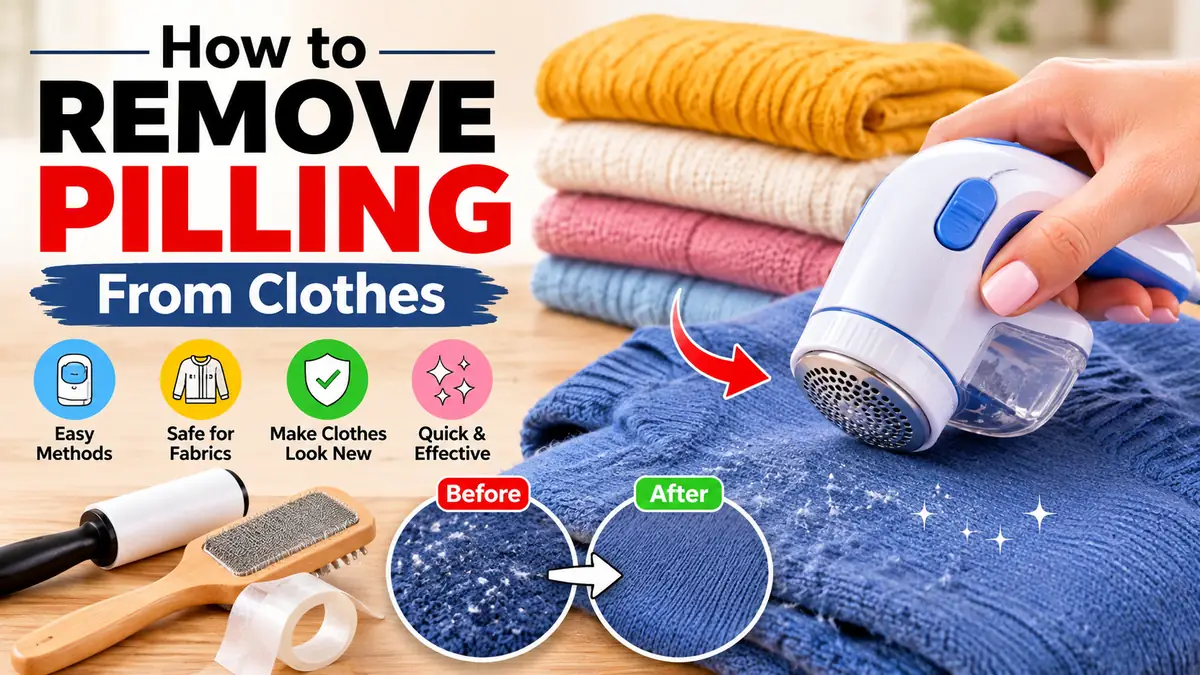
You pull out a favorite sweater, T-shirt, or pair of leggings and notice dozens of tiny fuzzy balls across the surface. The garment may still fit perfectly, but suddenly it looks older than it really is.
Learning how to remove pilling from clothes can restore a smoother appearance without replacing an otherwise good garment. Pilling is usually caused by friction that loosens surface fibers, which then tangle together into small balls called pills.
Quick answer: The safest way to remove pilling from most clothes is to lay the garment flat, pull the fabric gently taut, and pass a fabric shaver lightly over the affected areas. For delicate knitwear, a sweater or fabric comb offers more control. Light fuzz may come away with sticky tape or a lint roller.
What Is Pilling on Clothes?
Pilling is the formation of small, tangled balls of fiber on the surface of fabric. You may also hear these called fuzz balls, lint balls, bobbles, or simply pills.
They develop when fibers are loosened by rubbing. Instead of falling away, some broken fibers remain attached to the fabric and become tangled with other loose fibers.
That explains why pilling frequently appears in high-friction areas such as:
- Under the arms
- Around elbows
- Along sleeves
- On the sides of sweaters
- Around the waist
- Where backpacks or handbags rub
- Where seat belts repeatedly contact clothing
Woolmark notes that rubbing during normal wear is a major cause of pilling, particularly in areas where parts of a garment repeatedly touch one another.
Washing and tumble drying can add more friction. Clothing rubs against other garments, buttons, zippers, and the machine itself, giving loose fibers more opportunities to tangle.
Does Pilling Mean Your Clothes Are Ruined?
Usually, no.
Pilling is primarily a surface-level appearance issue. A sweater covered with pills may look worn even though the underlying garment still has plenty of usable life.
Removing those pills can therefore make an older garment look noticeably cleaner and smoother.
There is one important distinction: pilling shouldn’t be confused with serious fabric thinning, pulled yarns, holes, or damaged seams. Depilling improves the surface; it cannot repair structural damage.
Why Do Some Clothes Pill More Than Others?
Almost any textile can develop pills, but construction, fiber type, fiber length, and everyday friction all influence how quickly it happens.
Knitted fabrics often experience more pilling than tightly woven materials. Wool, cotton, polyester, acrylic, and various synthetic or blended fabrics can all pill.
Fiber blends can be particularly noticeable. In a cotton-polyester blend, for example, weaker fibers may break while stronger synthetic fibers keep the resulting pills attached to the garment instead of allowing them to fall away naturally.
Longer, tightly spun fibers generally have fewer loose ends available to form pills. Fabric construction matters too: a dense, smooth textile typically resists abrasion better than a loose, fuzzy surface.
This is also why pilling does not automatically mean a garment is poor quality. Even high-quality wool or cashmere can pill where repeated friction occurs.
How to Remove Pilling from Clothes: Best Methods Compared
There isn’t one perfect tool for every textile.
A thick fleece jacket and a fine cashmere sweater shouldn’t necessarily receive the same treatment. Start with the least aggressive method that can handle the amount of pilling you have.
| Method | Best For | Speed | Damage Risk |
|---|---|---|---|
| Fabric shaver | Moderate or heavy pilling | Fast | Low to moderate |
| Sweater/fabric comb | Wool and knitwear | Medium | Low when used correctly |
| Lint roller/tape | Loose fuzz and very light pills | Fast | Low |
| Sweater stone | Sturdier knits | Medium | Moderate |
| Safety/disposable razor | Emergency use on suitable fabrics | Medium | Higher |
| Small scissors | A few isolated pills | Slow | Moderate |
Always check the garment’s care instructions and the depilling tool’s directions before beginning.
When you’re uncertain, test the method on a hidden section first.
1. Use a Fabric Shaver for Fast Pilling Removal
For widespread pilling, a fabric shaver is usually the most convenient option.
These handheld devices—also called lint shavers, sweater shavers, fuzz removers, or de-pillers—use small blades protected behind a screen to trim protruding pills from the fabric surface.
Maytag and Whirlpool both identify fabric shavers as one of the fastest ways to deal with pilling.
How to Use a Fabric Shaver
- Make sure the garment is clean and completely dry.
- Place it on a firm, flat surface.
- Smooth out wrinkles.
- Hold the material gently taut.
- Turn on the fabric shaver.
- Move it lightly across the pilled area.
- Use slow passes rather than pressing downward.
- Stop regularly to inspect the fabric.
- Empty the shaver’s lint compartment when necessary.
- Finish by removing loose fibers from the garment.
The key word is lightly.
Pressing an electric shaver harder does not necessarily produce a better finish. Excessive pressure can remove more material than intended, particularly on thin knits.
Where Fabric Shavers Work Well
Depending on the tool and garment, they can work effectively on:
- Sweaters
- Sweatshirts
- Cotton knits
- Fleece
- Leggings
- T-shirts
- Coats
- Blankets
Be more cautious around seams, embroidery, decorative stitching, buttons, loose threads, and very thin material.
2. Remove Pills with a Sweater or Fabric Comb
A sweater comb provides more manual control than an electric shaver.
The comb catches raised pills as you move it across the textile. Because you control every stroke, it can be particularly useful when you don’t want powered blades moving over a favorite knit.
Patagonia recommends fabric combs as an option for soft knits such as merino wool and cashmere, while Woolmark also recommends careful combing for removing pills from wool garments.
How to Use a Sweater Comb
Lay the garment flat and hold one section taut.
Move the comb gently across the surface using short, controlled strokes. Don’t aggressively scrub backward and forward.
Remove accumulated fuzz from the comb as you work.
If the comb begins catching loops or pulling yarn, stop immediately.
Quick Takeaway: A fabric shaver wins on speed, while a sweater comb wins on control. For expensive or delicate knitwear, control is often more valuable than speed.
3. Try Sticky Tape or a Lint Roller for Light Fuzz
A lint roller is useful when the surface has loose fuzz or only very light pilling.
Roll it gently over the material, or press a piece of sticky tape onto the affected area and lift it away.
This technique has an obvious limitation: sticky surfaces can collect loose fibers, but tightly attached pills may need to be cut or combed away instead. Maytag specifically recommends lint rollers or tape for looser pills and fuzz.
A lint roller is also useful after using a fabric shaver or sweater comb because it can collect the fibers left behind.
4. Use a Sweater Stone Carefully
Sweater stones are abrasive blocks often made from pumice-like material.
As the stone passes over a textile, its textured surface catches loose fibers and pills.
They can be effective, but abrasion is precisely what makes them work. That means pressure matters.
Use gentle strokes and reserve stronger abrasive methods for fabrics that can tolerate them. Always check whether the particular stone is recommended for your garment.
Avoid aggressively rubbing fine or fragile textiles.
5. Can You Remove Pilling with a Razor?
Yes, a safety or disposable razor can remove pills from some clothes, but it carries considerably more risk than a purpose-built depilling tool.
Maytag recommends keeping the fabric taut and shaving gently if this method is used, while warning that the razor can cut the garment.
If a razor is your only option:
- Put the garment on a flat surface.
- Smooth the material completely.
- Hold the fabric taut without overstretching it.
- Use very light, short strokes.
- Never dig the blade into the textile.
- Remove collected fuzz frequently.
- Stop immediately if the razor catches a thread.
Avoid this method on very loose knits, lace, embroidery, extremely thin fabrics, or expensive garments where a small mistake could create permanent damage.
A dedicated fabric shaver is generally the safer choice.
6. Use Small Scissors for Individual Pills
If you only have three or four noticeable pills, treating the entire garment with a shaver may be unnecessary.
Small sharp scissors can trim isolated pills.
Pull the pill slightly away from the surface and carefully snip the fuzzy ball without cutting the underlying fibers.
Never pull stubborn pills off forcefully. Pulling can stretch attached fibers and potentially worsen the affected area.
How to Remove Pilling from Sweaters
Sweaters deserve extra care because knitted structures can snag.
First determine how delicate the knit is.
For sturdy sweaters with extensive pilling, a fabric shaver can save considerable time. For fine wool, merino, or cashmere, consider starting with a suitable sweater comb and gentle pressure.
A simple sweater routine is:
- Lay the sweater flat.
- Remove loose lint.
- Test your depilling tool in a hidden spot.
- Hold the section you’re treating taut.
- Work slowly in small areas.
- Collect loose fuzz afterward.
- Fold the sweater for storage rather than immediately subjecting it to more friction.
For wool specifically, Woolmark recommends gentle hand removal when only a few pills are present, careful combing, or a battery-operated de-pilling device.
How to Remove Pilling from Clothes Without a Fabric Shaver
You don’t necessarily need an electric device.
If you’re dealing with light or moderate pilling, try a sweater comb first. Sticky tape can collect loose fuzz, while individual pills can be carefully trimmed.
A razor should be treated as a backup rather than your default DIY solution because an exposed blade can nick the underlying material.
For delicate or valuable garments, patience beats improvisation. Saving a few minutes isn’t worth putting a hole in a sweater.
What Is the Fastest Way to Remove Pilling?
For a large area covered with pills, an electric fabric shaver is generally the fastest practical method.
It cuts many pills at once and requires less manual effort than combing an entire sweater.
However, “fastest” doesn’t always mean “best.”
If you’re working with fine cashmere, loose knitting, embroidery, or an irreplaceable garment, slower and gentler treatment may be more appropriate.
Can You Remove Pilling in the Washing Machine?
Washing alone isn’t a substitute for physically removing established, tightly attached pills.
Some detergents contain the enzyme cellulase, which can help loosen pills on certain cellulose-based fabrics during washing. Whirlpool notes that cellulase-containing detergent combined with a gentle, cold-water cycle may help with pilling.
But don’t expect a heavily pilled sweater to emerge perfectly smooth simply because you changed detergent.
For established pilling, mechanical removal with an appropriate shaver or comb remains more predictable.
How to Prevent Clothes from Pilling Again
Removing pills solves the visible problem. Reducing friction helps slow their return.
Turn Clothes Inside Out Before Washing
This exposes the inside surface to more washing-machine friction while protecting the visible exterior.
It’s a particularly useful habit for sweaters, sweatshirts, leggings, T-shirts, and other garments prone to surface fuzz.
Separate Heavy and Delicate Fabrics
Don’t automatically wash delicate knitwear with rough jeans, heavy towels, or garments covered with hardware.
Different weights and textures rubbing together increase abrasion.
Fasten zippers, hooks, and buttons where appropriate so hardware doesn’t repeatedly scrape other fabrics. Whirlpool specifically recommends sorting by fabric type and securing fasteners to reduce damage from rubbing.
Choose a Gentle Wash Cycle
Aggressive agitation means more fabric-to-fabric contact.
For garments susceptible to pilling, follow the care label and use a gentle or delicate cycle when appropriate.
A mesh laundry bag can provide another layer of protection for delicate pieces by limiting direct contact with rougher garments.
Use Cooler Water When Appropriate
Always follow the care label first, but cooler washing is often suitable for pilling-prone clothing.
Hot water isn’t necessarily the direct cause of pills, but repeated exposure can accelerate fiber wear in some textiles, making them more vulnerable.
Avoid Overloading the Washer
Stuffing the drum tightly isn’t good fabric care.
Clothes need enough room to move. An overloaded machine can increase rubbing and prevent garments from moving freely during the cycle.
Reduce Tumble-Dryer Friction
The dryer is another place where garments continuously rub against one another.
Whirlpool notes that friction during tumble drying can contribute to pilling and suggests laying susceptible garments flat to air-dry when appropriate.
Again, follow the garment’s care label. For knitwear, flat drying can also help maintain shape.
Watch Everyday Friction
Laundry isn’t the only culprit.
Repeated rubbing from a backpack, shoulder bag, seat belt, desk edge, chair arm, or even another section of the garment can create concentrated pilling.
If one specific area constantly develops fuzz while the rest of the garment stays smooth, everyday abrasion is probably contributing.
Which Fabrics Are Most Likely to Pill?
There isn’t a simple “natural fibers good, synthetic fibers bad” rule.
Fiber length, yarn construction, fabric structure, blending, and friction all matter.
| Fabric Type | Pilling Considerations |
|---|---|
| Wool | Can pill noticeably, especially in high-friction areas |
| Cashmere | Soft and delicate; pills should be removed gently |
| Cotton | Can pill, particularly with shorter fibers or softer knits |
| Polyester | Strong fibers can keep pills attached to the surface |
| Acrylic | Often susceptible to visible pilling |
| Cotton-polyester blends | Broken fibers may remain anchored by stronger fibers |
| Tightly woven fabrics | Generally less vulnerable than loose, fuzzy structures |
This explains why simply checking the fiber name on a clothing label doesn’t tell you everything about its future pilling behavior.
Common Pilling-Removal Mistakes to Avoid
Removing pills is simple, but overly aggressive treatment can turn a cosmetic problem into actual fabric damage.
Don’t press a fabric shaver down hard. Let the device trim raised fibers rather than forcing its blades against the base material.
Don’t pull pills aggressively. They may still be attached to the yarn.
Don’t scrape delicate fabric repeatedly. More passes aren’t always better.
Don’t use the same technique on every garment. A fleece sweatshirt and cashmere sweater require different levels of care.
Don’t work over wrinkled material. A blade can catch raised folds.
Don’t ignore loose threads. Never run a shaver or razor directly over a pulled yarn.
Don’t skip the test patch. Try unfamiliar tools on a hidden section before working across the visible front of a garment.
Does Dry Cleaning Remove Pilling?
Not automatically.
Dry cleaning cleans suitable garments, but the process itself isn’t designed to shave existing pills from their surfaces. Some professional cleaners may offer separate depilling or garment-repair services.
If the garment is expensive, highly delicate, or difficult to replace, asking a professional cleaner whether they provide fabric restoration can be safer than experimenting with a razor at home.
Can Pilling Be Permanently Removed?
Existing pills can often be removed, but no method can guarantee that new ones will never develop.
As long as fabric experiences friction, new loose fibers may eventually work their way to the surface.
The better goal is maintenance: remove pills carefully when they appear and reduce unnecessary friction during wearing, washing, drying, and storage.
That approach keeps garments looking better without repeatedly removing excessive amounts of fiber.
The Safest Approach for Different Situations
If you aren’t sure where to begin, match the method to the problem.
For light fuzz, start with a lint roller or sticky tape.
For a few isolated pills, careful hand removal or small scissors may be sufficient.
For moderate sweater pilling, use an appropriate sweater comb.
For large areas of established pilling, a fabric shaver is usually the quickest option.
For fine wool, merino, or cashmere, prioritize gentle methods, light pressure, and a test patch.
For valuable or extremely delicate clothing, professional garment care may be worth the cost.
Final Thoughts on How to Remove Pilling from Clothes
Knowing how to remove pilling from clothes can give sweaters, shirts, leggings, coats, and other garments a much cleaner appearance without replacing them.
A fabric shaver is usually the quickest solution for widespread pilling, while a sweater comb gives you greater control on delicate knitwear. Tape and lint rollers work well for loose fuzz, and scissors can handle an occasional isolated pill.
Whatever method you choose, work on a flat surface, keep the material smooth, use minimal pressure, and test delicate fabrics first.
Afterward, focus on prevention. Washing garments inside out, separating rough and delicate fabrics, choosing gentler wash settings, avoiding unnecessary heat and tumble-dryer friction, and paying attention to everyday abrasion can all help slow the return of those annoying little fuzz balls.