
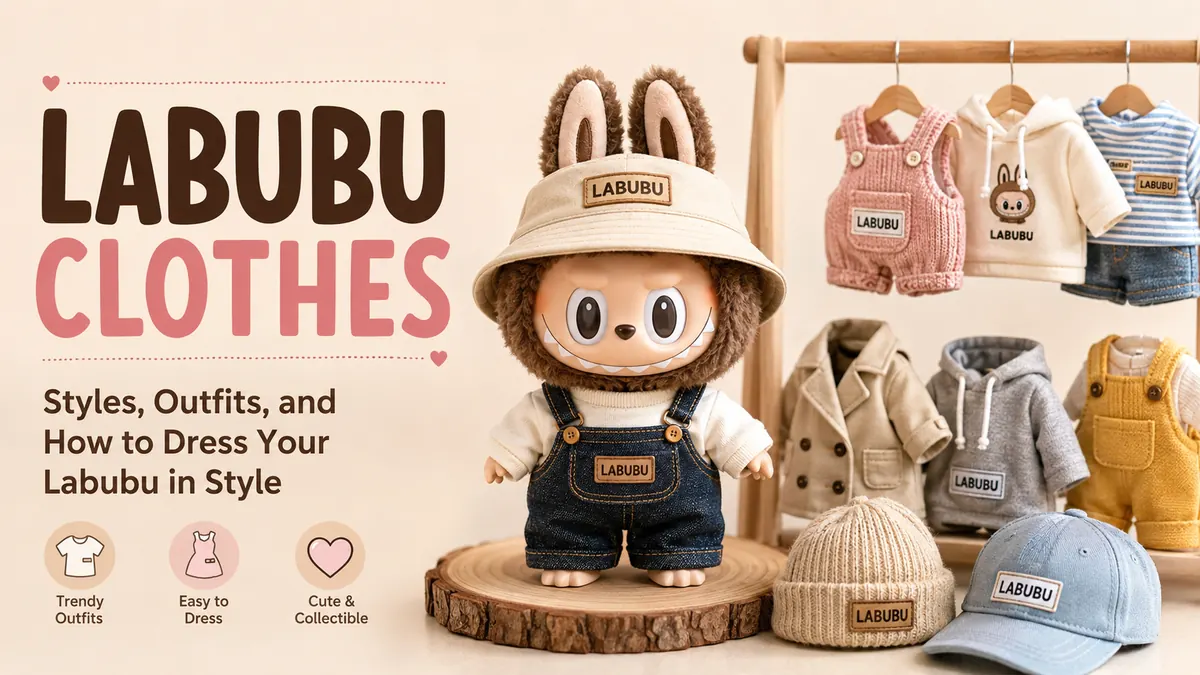
A tiny hoodie, knitted overalls, a miniature dress, or even a pair of doll-sized sunglasses can completely change the personality of a Labubu. That customization is a big reason dressing these collectibles has developed into its own hobby.
labubu clothes are miniature garments and accessories designed to fit Labubu vinyl-plush collectibles from POP MART’s THE MONSTERS universe. Common choices include sweaters, dresses, overalls, hoodies, costumes, hats, shoes, and handmade crochet pieces. The key to a good fit is matching the outfit to the exact Labubu version rather than relying on height alone.
What Are labubu clothes?
Labubu is the pointed-eared, toothy character associated with artist Kasing Lung’s THE MONSTERS universe and POP MART. The character appears across figures, vinyl-plush pendants, larger plush dolls, blind boxes, and special collaborations.
As vinyl-plush versions became popular as bag charms and collectibles, owners began treating them almost like miniature fashion models. That led to a large ecosystem of removable clothing made specifically—or approximately—to fit them.
Typical Labubu doll clothes include:
- Hoodies and sweatshirts
- T-shirts and shirts
- Dresses and skirts
- Overalls and jumpsuits
- Knitted sweaters
- Pajamas
- Jackets
- Character costumes
- School-uniform-inspired sets
- Seasonal outfits
- Crochet clothing
- Hats and headbands
- Shoes and boots
- Scarves, bags, glasses, and other miniature accessories
Current specialist collections illustrate just how broad the category has become, with outfits ranging from casual hoodies and overalls to dresses, costumes, themed uniforms, rainwear, and coordinated multi-piece sets.
There is one important distinction, however: these clothes are usually accessories for an existing collectible. Unless a listing explicitly says otherwise, an outfit listing may contain only the clothing, not the Labubu itself.
Quick Takeaway: When looking at an outfit, check three things before anything else: the intended doll size, which pieces are included, and whether the collectible shown in the photos is actually part of the package.
What Size Clothes Fit Labubu?
Sizing causes more problems than almost anything else.
There is no single universal “Labubu clothing size” because POP MART has released THE MONSTERS collectibles in different formats and dimensions. Even products with similar overall heights may have different body proportions.
For example, official POP MART regional product information lists the Let’s Checkmate and Fall in Wild vinyl-plush pendants at approximately 17 cm tall. Meanwhile, Have a Seat has been listed at roughly 15 cm excluding the hanging loop and about 20 cm including it.
That difference matters.
Labubu clothing size guide
| Collectible type | Approximate reference size | Clothing consideration |
|---|---|---|
| Small vinyl-plush pendant | Around 15 cm body height on some releases | Look for outfits specifically made for that body type |
| Common larger pendant format | Around 17 cm on several releases | Many third-party outfits target this general size |
| Larger vinyl-plush doll | Varies substantially by release | Standard pendant clothes usually will not fit |
| MEGA or oversized editions | Much larger scale | Requires scale-specific clothing |
These measurements are references rather than a universal sizing standard.
Current clothing listings frequently use terms such as “17cm Labubu” because that is a common outfit category. Dedicated clothing stores list 17 cm hoodies, dresses, jumpsuits, costumes, and overalls, while marketplaces also distinguish between clothing marketed for approximately 15 cm and 17 cm collectibles.
Measure the doll instead of trusting the label
The safest method is simple: measure your own collectible.
Take these measurements:
- Body height — Ignore the hanging loop unless the seller specifically includes it in the measurement.
- Chest circumference — Measure around the widest part of the torso.
- Waist circumference — Useful for trousers, skirts, and overalls.
- Shoulder width — Particularly important for jackets and shirts.
- Torso length — Measure from the neck area to the waist or crotch.
- Leg length — Essential for trousers and jumpsuits.
- Head and ear dimensions — Needed for hats, hoods, and headbands.
Compare those numbers with the garment measurements whenever the maker provides them.
This is more reliable than assuming that an outfit labelled “17 cm doll clothes” will automatically fit every 17 cm collectible.
Why Two Similar-Size Labubus May Need Different Clothes
Height is only one dimension.
Two plush collectibles can be close in height but differ in torso width, head size, limb position, fur thickness, or vinyl construction. An outfit that technically reaches from shoulder to waist can still be too tight around the body.
This becomes especially noticeable with fitted pieces such as:
- Denim shorts
- Buttoned shirts
- Tailored jackets
- Overalls
- Non-stretch dresses
- Shoes
- Close-fitting hats
Stretchy knitwear and crochet pieces are generally more forgiving.
A loose sweater may accommodate a few millimeters of difference without looking wrong, while a fitted cotton shirt may not close at all.
Check the opening size
Labubu’s distinctive head and pointed ears can make dressing more complicated than dressing an ordinary small doll.
A shirt might fit the torso perfectly but have a neck opening that cannot comfortably pass over the head.
Useful construction features include:
- Back openings
- Velcro-style closures
- Snaps
- Buttons
- Stretch necklines
- Side openings
- Tie closures
Garments that open fully are usually easier to put on and remove than tiny pullovers.
Popular Types of labubu clothes
There is no single “correct” Labubu aesthetic. Owners style these collectibles in everything from simple casual clothing to elaborate character costumes.
Hoodies and casual outfits
Hoodies are among the easiest styles to understand visually because the oversized proportions suit Labubu’s large head and compact body.
A casual outfit might combine:
- Hoodie
- T-shirt
- Shorts
- Miniature sneakers
- Cap
- Crossbody bag
Loose silhouettes are also relatively forgiving when the fit is not absolutely precise.
Dresses and skirts
Miniature dresses range from simple cotton designs to layered lace, gingham, tutu, and Lolita-inspired outfits. Current clothing collections include everything from basic colored dresses to frilled maid-style designs and coordinated dress-and-headpiece sets.
When evaluating a dress, pay attention to the arm openings and back closure. A beautifully detailed dress is not particularly useful if dressing the figure requires excessive pulling.
Overalls and jumpsuits
Overalls work especially well with the proportions of a vinyl-plush pendant.
They can also be easier to adjust than fitted trousers because shoulder straps provide some flexibility. Handmade versions often use buttons or adjustable straps.
A published Labubu crochet pattern, for example, uses adjustable overall straps and recommends changing the starting chain when the waist is too tight or loose.
Knitwear and crochet outfits
Crochet has become a natural match for Labubu customization.
Common handmade pieces include:
- Sweaters
- Cardigans
- Bonnets
- Hood hats
- Overalls
- Dresses
- Earmuffs
- Scarves
- Bags
- Headbands
The appeal is practical as well as aesthetic. Handmade yarn garments can be resized more easily than mass-produced woven clothing.
Published crochet tutorials commonly use lightweight yarn and small hooks. One beginner-oriented sunflower outfit tutorial uses 4-ply milk cotton with a 3 mm hook, while another pattern recommends DK/light-worsted cotton or cotton-blend yarn with a 3.0–3.5 mm hook.
Character costumes
Costumes turn Labubu into another animal, fantasy creature, or themed character.
Examples across current clothing catalogs include frog and bunny outfits, devil-style costumes, pumpkin-themed sets, sailor clothing, cowboy looks, and other novelty designs.
Costumes can be particularly forgiving because they are intentionally bulky.
Seasonal clothing
Owners also change outfits according to seasons or holidays.
Common themes include:
- Halloween
- Christmas
- Lunar New Year
- Winter
- Summer
- Valentine’s Day
- Birthday displays
Seasonal styling is useful for collectors who photograph their figures because one collectible can be reused across completely different displays.
Labubu Accessories That Complete an Outfit
Clothing is only part of the styling process.
Miniature accessories can change the look without requiring a complete wardrobe.
Hats and headwear
Beanies, bonnets, caps, bows, headbands, and decorative hoods are common options.
Labubu’s tall pointed ears make ordinary doll hats difficult to use, however. The best designs either sit between the ears or include openings that allow the ears to pass through.
Crochet patterns specifically incorporating ear holes demonstrate why this detail matters.
Glasses
Tiny glasses provide an immediate visual change and require no dressing of the body.
The main concern is pressure. Frames that are too narrow can press against the face or fur, so they should rest comfortably rather than being forced into position.
Mini bags
Backpacks, satchels, handbags, and crossbody bags pair particularly well with casual outfits.
Keep the strap loose enough that it does not continuously rub against the vinyl face or pull heavily on the plush body.
Shoes
Shoes can be one of the hardest accessories to fit.
A shoe must accommodate both the length and width of the foot. Flexible shoes or open-backed styles are therefore more forgiving than rigid molded footwear.
Never force a tight shoe onto the figure.
Choosing Materials for Labubu Doll Clothes
Fabric affects both appearance and usability.
| Material | Advantages | Potential drawback |
| Cotton | Lightweight, easy to sew, many prints | Little stretch |
| Jersey knit | Flexible and comfortable to fit | Tiny edges can be difficult to finish |
| Crochet cotton | Handmade appearance, adjustable | Bulky yarn can overwhelm the figure |
| Fine knit | Soft, stretchy, realistic | Can snag |
| Denim | Structured casual appearance | Thick seams become bulky at miniature scale |
| Felt | Easy for DIY costumes | Less realistic drape |
| Lace | Detailed decorative finish | Can catch on ears or accessories |
| Fleece | Good for costumes and winter looks | Adds substantial bulk |
For tiny clothing, scale matters as much as material.
A fabric that looks thin on a human garment can appear extremely thick when reduced to doll size. Heavy denim seams, large buttons, and thick elastic can make miniature clothes look stiff.
Fine cotton, lightweight knits, thin yarn, and small closures generally produce more proportional results.
How to Tell Whether an Outfit Will Fit
Photos can make almost any miniature outfit look convincing. A few practical checks provide much better information.
1. Identify your exact Labubu
Start with the series or product name whenever possible.
For example, THE MONSTERS collection includes multiple vinyl-plush pendants and larger dolls rather than one standardized body.
2. Find the manufacturer’s dimensions
Use official dimensions as a starting reference.
POP MART’s official and regional listings provide measurements for numerous releases. Several vinyl-plush pendants are approximately 17 cm tall, but that does not mean every Labubu product shares identical dimensions.
3. Compare actual garment measurements
Look for:
- Chest width
- Waist width
- Garment length
- Sleeve length
- Neck opening
- Leg opening
- Hat circumference
Measurements are more useful than vague labels such as “small doll outfit.”
4. Examine the closure
A full back opening is easier to use than a tight neck opening.
For overalls, adjustable straps are especially helpful.
5. Look at the same outfit on the same body style
Product photos are most useful when they show the garment being worn by a Labubu from the same series as yours.
Photos using an unidentified doll provide less certainty.
Quick Takeaway: “Fits 17 cm Labubu” should be treated as a starting point, not a guarantee. Series, body proportions, fabric stretch, openings, and garment measurements all affect the final fit.
Can Baby Doll Clothes Fit Labubu?
Sometimes—but not reliably.
Collectors occasionally experiment with clothing made for other small dolls or plush toys. A loose sweater or elastic garment may happen to work if the dimensions are similar.
The problem is proportion.
Labubu has a distinctive head, ears, torso, and limb arrangement. Clothing designed around a conventional human-shaped doll may have:
- Shoulders that are too narrow
- Sleeves that are too long
- A neckline that is too small
- Incorrect trouser proportions
- Excess fabric around the waist
If experimenting with clothing for another doll brand, compare measurements rather than relying on the advertised doll height.
How to Make DIY labubu clothes
You do not need advanced sewing skills to make a basic outfit.
Crochet is particularly popular because the garment can be test-fitted while it is being constructed. Existing patterns cover pieces such as hood hats, earmuffs, overalls, dresses, and themed outfits.
Simple DIY workflow
- Measure the collectible.
- Choose a lightweight material.
- Make a paper or scrap-fabric prototype.
- Leave extra room for seams or crochet tension.
- Add a back or side opening.
- Test the garment before finishing.
- Adjust tight areas.
- Add decorative details only after the basic fit works.
This approach avoids wasting detailed fabric or several hours of crochet work on something that does not fit.
Crochet sizing matters
Crochet tension can substantially alter miniature garments.
A pattern may give a hook size and stitch count, but two people following the same instructions can produce different dimensions.
That is why experienced pattern designers emphasize test-fitting. One free pattern recommends checking the hood after the ear-hole section, testing the waistband before joining it, and adding or removing chains to adjust the waist and straps.
For miniature crochet, frequently trying the piece on the collectible is more reliable than blindly completing every row.
How to Dress Labubu Without Damaging It
A collectible should never have to be forced into an outfit.
Remove detachable accessories first
If your figure already has an accessory that can safely be removed according to its design, taking it off can make dressing easier.
Never pull apart components that are not intended to detach.
Open the garment fully
Undo every snap, button, tie, or closure before putting the outfit on.
Trying to squeeze the doll through a partially closed garment creates unnecessary pressure.
Guide the ears carefully
The ears are one of Labubu’s defining features and one of the main obstacles when putting on tops or hats.
Stretch the opening gently around them rather than pulling directly on the ears.
Avoid excessive friction on the vinyl face
Repeatedly dragging rough fabric, metal accessories, or tight elastic over vinyl surfaces is unnecessary.
A garment with a back opening largely avoids this problem.
Do not leave tight elastic in one place indefinitely
Very tight bands can compress plush fibers and may leave temporary impressions.
For long-term displays, slightly looser garments are preferable.
Preventing Color Transfer and Fabric Problems
This is an area that outfit guides often overlook.
Dark or strongly dyed miniature fabrics can potentially transfer color when they remain pressed against a light surface, particularly in warm or humid conditions.
A cautious collector can reduce the risk by:
- Washing or testing handmade fabric before use
- Avoiding damp garments
- Checking dark clothing periodically
- Using a light-colored underlayer beneath strongly dyed pieces
- Removing an outfit if any discoloration appears
- Keeping the collectible away from excessive heat and moisture
Also inspect unfinished metal accessories.
Tiny chains, buckles, snaps, and decorative pieces can scratch surfaces if they have sharp edges.
The safest outfit is not necessarily the most expensive one; it is the one that fits without pressure, rubbing, staining, or forcing.
How to Clean Labubu Clothes
Treat the outfit separately from the collectible whenever possible.
For ordinary miniature cotton or crochet garments:
- Remove the clothing carefully.
- Check for beads, glue, printed decorations, or metal parts.
- Use cool or lukewarm water if the material can be washed.
- Hand-wash gently with a small amount of mild detergent.
- Avoid aggressive twisting or wringing.
- Reshape the garment.
- Let it air-dry completely before putting it back on the collectible.
Handmade crochet pieces deserve particular care because stretching can permanently change their dimensions.
Clothes with glued embellishments, faux leather, printed graphics, or delicate decorative elements may need spot cleaning instead.
How to Store a Labubu Wardrobe
Once a collection grows beyond two or three outfits, miniature clothing becomes surprisingly easy to lose.
A practical storage system can include:
- Small labeled zip pouches
- Compartment organizers
- Miniature hangers
- Acid-free tissue between delicate pieces
- Separate containers for shoes and glasses
- Individual bags for complete outfit sets
Store clean garments in a dry area away from prolonged direct sunlight.
Keep tiny accessories together with the outfit they belong to. A labeled pouch containing the shirt, trousers, hat, bag, and shoes saves far more time than searching through a box of miniature pieces later.
Common Mistakes When Choosing labubu clothes
The biggest mistakes are usually simple ones.
Buying by height alone
“17 cm” does not describe every relevant body measurement.
Check the series and proportions.
Assuming the doll is included
Some listings show a fully dressed Labubu even though only the clothes are included. Marketplace results explicitly use wording such as “only cloth” for certain items, illustrating why the description matters.
Ignoring head and ear clearance
A perfectly sized torso does not help if the shirt cannot pass over the head.
Look for generous openings or removable closures.
Choosing fabric that is too thick
Miniature fashion works best when the fabric is proportional to the figure.
Bulky seams can make sleeves and trousers almost immovable.
Forcing tight shoes or clothing
If significant pressure is required, stop.
A slightly oversized outfit usually looks better than a tiny garment stretched unnaturally around the figure.
Leaving dark clothing unchecked
Long-term display in strongly dyed clothing deserves occasional inspection, particularly on lighter collectibles.
Building a Small Labubu Wardrobe
You do not need dozens of outfits to create different looks.
A versatile miniature wardrobe can start with:
- One neutral T-shirt
- One hoodie or sweater
- One pair of overalls
- One dress or statement outfit
- One seasonal costume
- One hat
- One pair of glasses
- One miniature bag
From there, mix accessories rather than replacing the complete outfit each time.
A simple sweater can look completely different with a beanie and satchel than it does with glasses and a miniature camera.
This is one reason Labubu styling has so much creative range: the collectible remains the same, but its personality changes with a few tiny details.
Are Labubu Outfits Official POP MART Products?
Do not assume that clothing advertised as being “for Labubu” is official POP MART merchandise.
POP MART is the company behind the official THE MONSTERS product ecosystem, while much of the separate miniature clothing market consists of third-party or handmade accessories. The official POP MART catalog contains extensive Labubu and THE MONSTERS merchandise, but independent clothing stores and craft creators also produce large numbers of compatible outfits.
This distinction matters for collectors.
Terms such as:
- “Labubu compatible”
- “Fits Labubu”
- “For 17cm Labubu”
- “Labubu outfit”
describe intended compatibility; they do not by themselves establish an official collaboration or licensing relationship.
When authenticity matters, check the manufacturer and official product information rather than relying on the listing title.
What Makes Good Labubu Clothing?
The best miniature outfit is not simply the most detailed.
A genuinely good piece balances appearance with fit and usability.
Look for:
Correct proportions. Sleeves, trouser legs, and torso length should suit the specific collectible.
Easy closures. Buttons, snaps, ties, or openings make dressing much safer.
Fine-scale materials. Lightweight fabrics and yarns generally sit more naturally.
Clean seams. Bulky internal seams can dramatically reduce usable space.
Ear-friendly construction. Hats and hoods should accommodate Labubu’s pointed ears.
Adjustability. Stretch, ties, elastic used carefully, and adjustable straps make an outfit compatible with minor dimensional differences.
Safe details. Metal pieces should be smooth, and fabrics should not shed dye easily.
Removability. Collectible clothing should be easy to take off without stressing the figure.
Those characteristics matter more than a fashionable product photo.
Final Thoughts on labubu clothes
labubu clothes turn a collectible into something that can be restyled repeatedly. Hoodies create a casual look, dresses and coordinated sets create more elaborate displays, costumes add seasonal personality, and crochet offers almost unlimited room for customization.
The most important lesson is sizing. POP MART’s Labubu and THE MONSTERS releases do not all share one body size, even when several popular vinyl-plush pendants sit around the 15–17 cm range.
Measure the actual collectible, check the exact series, compare garment dimensions, and favor clothes that open easily rather than forcing a tight fit. If making your own outfit, test-fit repeatedly as you sew or crochet.
Once those basics are right, dressing Labubu becomes less about finding a supposedly universal size and more about what makes miniature fashion enjoyable in the first place: creating a different personality from the same mischievous little character.