
The right footwear can make a noticeable difference when you step onto a tennis court. Tennis involves quick sprints, sudden stops, lateral movements, and frequent changes of direction. Ordinary athletic sneakers may feel comfortable, but they aren’t always designed to handle those demands.
Tennis shoes are athletic shoes designed to provide lateral stability, traction, cushioning, and durability during tennis. Unlike running shoes, which primarily support forward movement, tennis-specific footwear helps players move sideways, stop quickly, and change direction on hard, clay, or grass courts. Choosing the right pair depends on court surface, foot shape, playing style, and fit.
Understanding these differences can help beginners, recreational players, and competitive athletes make better footwear decisions.
What Are tennis shoes?
Tennis shoes are specialized athletic footwear engineered for the movements and playing surfaces associated with tennis.
In everyday American English, the term “tennis shoes” is also commonly used to describe casual sneakers or athletic footwear in general. However, footwear specifically designed for playing tennis has features that distinguish it from ordinary sneakers.
Key Features of Tennis Footwear
Lateral stability
Tennis players frequently shuffle sideways, recover toward the center of the court, and change direction rapidly. Supportive uppers and stable midsoles help keep the foot secure during these movements.
Durable outsoles
Repeated stopping, pivoting, and dragging can wear down ordinary footwear. Court-specific rubber compounds and reinforced high-wear areas help tennis footwear withstand abrasion.
Controlled traction
The outsole must provide enough grip to support quick movement without creating excessive resistance during pivots.
Impact cushioning
Cushioning helps absorb impact from running, jumping, and landing. The ideal amount varies according to court surface, player preference, and shoe construction.
Reinforced toe protection
Some players drag their toes during serves, slides, and recovery steps. Reinforced toe caps and abrasion-resistant overlays can reduce premature wear.
Why Tennis Players Need Specialized Shoes
A typical tennis rally involves more than running toward the ball.
Players may accelerate forward, stop abruptly, shuffle laterally, backpedal, and pivot repeatedly. These movements place demands on the shoe’s upper, outsole, and midsole.
Tennis-specific footwear is designed around this combination of movement patterns rather than continuous forward running.
Different Types of tennis shoes
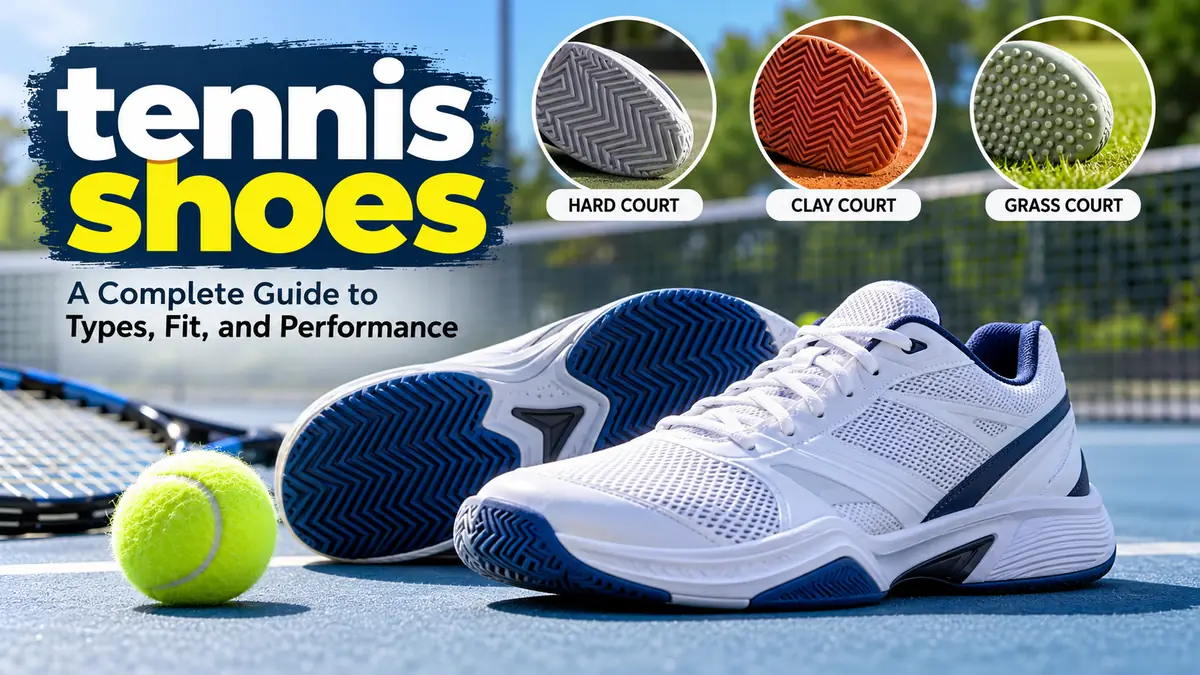
Tennis footwear is commonly categorized according to court surface. Each type uses a different outsole design to manage traction, movement, and wear.
Hard Court Tennis Shoes
Designed for abrasive acrylic surfaces, with durable rubber outsoles, cushioning, and reinforced areas to resist wear from frequent stops and slides.
Clay Court Tennis Shoes
Typically feature a full herringbone tread pattern that provides grip on loose clay while helping release trapped material.
Grass Court Tennis Shoes
Often feature small rubber pimples or specialized tread patterns designed for traction on natural grass without excessively damaging the surface.
All-Court Tennis Shoes
All-court shoes aim to balance traction, durability, and versatility across multiple playing surfaces.
They are particularly practical for recreational players who use more than one type of court.
However, all-court designs may not match the specialized traction of dedicated clay or grass footwear.
Comparing Tennis Shoe Types
Shoe type Outsole characteristics Main advantage
Hard court Durable, abrasion-resistant rubber Long-lasting traction
Clay court Full herringbone tread Controlled movement on clay
Grass court Small pimples or specialized tread Grip on grass
All-court Versatile tread pattern Multi-surface convenience
The playing surface should be one of the first considerations when evaluating court footwear.
tennis shoes vs Running Shoes: What’s the Difference?
Tennis and running shoes may appear similar, but their designs serve different movement patterns.
Running footwear generally emphasizes forward propulsion, cushioning, and smooth heel-to-toe transitions.
Tennis footwear prioritizes lateral support, secure foot containment, and stability during rapid changes of direction.
Feature Tennis shoes Running shoes
Primary movement Multidirectional Primarily forward
Lateral stability Generally higher Varies by model
Outsole Court-specific traction Road or trail traction
Upper Often reinforced Often lightweight and flexible
Cushioning Balanced with stability Often optimized for repetitive forward impact
Durability focus Sidewalls, toe, outsole Repetitive running wear
Best activity Tennis and court movement Running and jogging
Can You Play Tennis in Running Shoes?
Running shoes may be adequate for light, low-intensity practice, but they are generally not ideal for regular competitive tennis.
Many running shoes have taller, softer midsoles and less lateral containment than tennis-specific designs. These characteristics can make abrupt side-to-side movements feel less secure.
For regular tennis, a court-specific shoe is usually the more appropriate choice.
Can You Use Tennis Shoes for Running?
Tennis footwear can handle short runs, warm-ups, and occasional jogging.
However, dedicated running shoes are generally more suitable for longer-distance running because their geometry, weight, and cushioning are designed around repeated forward strides.
The best footwear depends on the primary activity rather than whether a shoe is labeled athletic.
How to Choose the Right tennis shoes
Finding suitable tennis footwear involves more than selecting a familiar brand or attractive design. The most important factors are court compatibility, foot shape, stability, cushioning, and fit.
Step 1: Identify Your Court Surface
Start by identifying where you play most frequently.
For hard courts, prioritize durable outsoles, reliable traction, and sufficient impact cushioning. Hard courts can be particularly demanding on footwear because their surfaces are abrasive.
For clay courts, look for herringbone-patterned outsoles that allow controlled sliding and help prevent excessive clay buildup.
For grass courts, choose footwear specifically approved for the surface. Some grass-court designs use small rubber pimples, but tournament regulations may require flatter soles or prohibit certain tread patterns.
The International Tennis Federation (ITF) emphasizes that the interaction between the shoe and court surface affects both performance and injury risk.
ITF Tennis
+1
Step 2: Understand Your Foot Shape
Foot shape influences comfort, support, and how securely a shoe holds your foot.
Wide feet: Look for models with a naturally wider forefoot or dedicated wide-width options. Avoid assuming a longer shoe will provide the correct width.
Narrow feet: Choose a secure upper and heel construction that minimizes unwanted movement inside the shoe.
Flat feet: Consider shoes that provide comfortable arch support and a stable platform. Flat arches alone do not automatically mean you need maximum motion control.
High arches: Cushioning and appropriate insole support may improve comfort, particularly on hard surfaces.
Neutral feet: A balanced design offering support, flexibility, and cushioning may work well.
Foot shape does not determine the perfect shoe by itself. Two people with similar arches may prefer different levels of support.
Step 3: Match the Shoe to Your Playing Style
Your movement patterns influence which shoe characteristics matter most.
Playing style Useful footwear characteristics
Baseline player Lateral support, durable outsole, reinforced upper
Serve-and-volley player Responsive forefoot, secure fit, quick directional changes
Aggressive mover Strong toe protection, stable platform, abrasion resistance
Recreational player Balanced cushioning, comfort, all-court versatility
Competitive player Court-specific traction, secure lockdown, predictable movement
A player who frequently slides on hard courts may wear through the toe and medial forefoot faster than someone who moves primarily with small adjustment steps.
Step 4: Evaluate Cushioning and Stability
Cushioning and stability are related but separate characteristics.
A soft midsole may feel comfortable when walking around a store, yet excessive compression during lateral movement can make a shoe feel unstable.
A firmer, lower-profile shoe may provide better court awareness but feel less forgiving during long sessions.
Look for a balance between:
- Shock absorption during landings
- Stable contact with the court
- Responsive movement during acceleration
- Comfortable support during extended rallies
- Secure foot positioning during lateral cuts
Players who prioritize comfort may prefer more cushioning, while those seeking a close-to-court sensation may prefer firmer midsoles.
Step 5: Check the Outsole and Upper
The outsole determines how the shoe interacts with the playing surface.
Herringbone tread patterns are particularly common in tennis footwear because they can provide multidirectional traction.
The upper helps maintain foot positioning during rapid movement. Mesh can improve breathability, while synthetic overlays and reinforced panels add structure and abrasion resistance.
A well-designed tennis shoe balances these characteristics instead of maximizing one at the expense of another.
How Should tennis shoes Fit?
Proper fit is essential for comfort, predictable movement, and avoiding unnecessary pressure on the feet.
A tennis shoe should feel secure around the heel and midfoot while allowing the toes to move naturally.
How Much Room Should Be in the Toe Box?
A common starting point is approximately a thumb’s width of space between the longest toe and the front of the shoe, although the ideal clearance varies with foot shape and shoe design.
Too little room can cause pressure during abrupt stops. Too much space may allow the foot to slide forward.
The toe box should also provide adequate width so the toes are not compressed together.
Should Tennis Shoes Feel Tight?
Tennis footwear should feel snug, not painfully tight.
A secure fit helps prevent unwanted movement inside the shoe, particularly when changing direction.
However, excessive pressure around the forefoot, arch, or heel can cause discomfort.
Signs of an unsuitable fit include persistent numbness, pinching, heel slipping, and toes repeatedly striking the front of the shoe.
How to Test the Fit Before Playing
- Wear the athletic socks you normally use for tennis.
- Check the space around your toes while standing.
- Walk and perform a few short forward movements.
- Shuffle sideways in both directions.
- Make controlled stops and direction changes.
- Check whether your heel remains secure.
- Confirm that no part of the upper creates uncomfortable pressure.
Try footwear later in the day when possible, since feet can become slightly larger after normal daily activity.
Do not rely on a painful break-in period. Minor stiffness may soften with use, but a shoe that is fundamentally too narrow or too short is unlikely to become suitable.
Important Tennis Shoe Technologies and Materials
Modern tennis footwear uses combinations of foam, rubber, synthetic fabrics, and structural components to balance performance and comfort.
Understanding these materials can help explain why different shoes feel noticeably different on court.
Midsole Cushioning
The midsole sits between the foot and outsole and influences impact absorption, stability, and responsiveness.
Common cushioning materials include EVA-based foams and proprietary foam compounds.
Brands such as ASICS use technologies including GEL cushioning in certain tennis models.
Nike uses technologies such as Zoom Air in selected tennis footwear.
Other manufacturers use different foam formulations and mechanical structures to manage cushioning and responsiveness.
No single technology guarantees the best performance. The overall shoe construction and individual fit matter more than the marketing name of a cushioning system.
Outsole Rubber and Traction Patterns
Tennis outsoles commonly use durable rubber compounds designed to withstand friction against court surfaces.
A modified herringbone pattern can balance grip and controlled movement on hard courts, while a full herringbone pattern is often preferred for clay.
The tread’s depth, spacing, flexibility, and rubber composition all influence how the shoe behaves.
Traction should be appropriate rather than simply maximized. Excessive grip may interfere with natural pivoting, while insufficient grip can make movement unpredictable.
Heel Counters and Midfoot Support
The heel counter is a structural component surrounding the rear of the foot.
Its purpose is to help maintain heel positioning during movement.
Some shoes also use midfoot shanks, torsional support systems, or reinforced sidewalls to influence how the sole twists and bends.
These structures can improve the sensation of stability, but their effectiveness depends on the complete shoe design and the player’s movement patterns.
Toe Guards and Drag Protection
Toe guards protect areas exposed to frequent abrasion.
They are particularly useful for players who drag a foot during serves or slide into shots.
Some models extend durable rubber upward around the front and inner sides of the shoe.
This construction may increase weight slightly, but it can also improve durability for aggressive movers.
Breathability and Upper Construction
Mesh panels improve airflow, while synthetic leather, woven materials, and supportive overlays help control movement.
A highly breathable shoe may feel cooler but can offer less abrasion resistance if its upper lacks reinforcement.
Conversely, a heavily reinforced shoe may be durable but warmer.
The best balance depends on playing conditions, personal comfort, and how aggressively the player moves.
Popular Tennis Shoe Brands and Their Design Approaches
Several established athletic footwear manufacturers produce tennis-specific shoes.
Their product lines often include different models for stability, speed, cushioning, and durability.
Brand Examples of tennis footwear families Common design emphasis
ASICS GEL-RESOLUTION, SOLUTION SPEED Stability and responsive movement
Nike NikeCourt, GP Challenge Court movement and cushioning
Adidas Barricade, Ubersonic Support and agility
New Balance 996, CT-Rally Fit options and court performance
K-Swiss Hypercourt, Ultrashot Court support and durability
Babolat Jet, Propulse Agility and stability
Wilson Rush Pro, Kaos Lateral support and movement
HEAD Sprint Pro, Revolt Pro Speed and stability
These are established model families rather than a ranking of the best shoes. Availability, model names, and construction details can change between generations.
Are Expensive Tennis Shoes Always Better?
Higher-priced footwear may include specialized cushioning, reinforced materials, or more elaborate stability systems.
However, price does not guarantee better comfort or suitability.
A moderately priced shoe that fits correctly and matches the court surface may perform better for an individual player than an expensive model with an unsuitable shape.
Fit, traction, and support should take priority over brand reputation alone.
How Long Do tennis shoes Last?
The lifespan of tennis footwear depends on playing frequency, court surface, movement patterns, body weight, and shoe construction.
Hard courts generally cause faster outsole abrasion than softer surfaces.
Players who frequently drag their feet or slide aggressively may also experience concentrated wear around the toe and forefoot.
Signs That Your Tennis Shoes Need Replacing
Worn outsole tread
The rubber pattern becomes smooth, especially around the forefoot or heel.
Reduced cushioning
The midsole feels noticeably less comfortable or supportive than before.
Damaged upper
Tears, stretched sidewalls, or separated materials reduce foot containment.
Unreliable traction
The shoes begin slipping during movements that previously felt secure.
Changes in comfort
New pressure points or persistent discomfort appear without another obvious explanation.
How Often Should You Replace Tennis Footwear?
Some recreational players may use the same pair for six to twelve months, while frequent hard-court players may wear out their shoes much sooner.
There is no universal replacement schedule.
The condition of the outsole, cushioning, and upper provides a more useful indication than age alone.
Inspect shoes regularly, especially when playing several times per week.
How to Clean and Maintain tennis shoes
Proper maintenance can help preserve the appearance and functional condition of tennis footwear.
Cleaning Tennis Shoes After Playing
- Remove loose dirt with a soft brush.
- Wipe the upper using a damp cloth.
- Use mild soap and water for stubborn marks when compatible with the materials.
- Clean debris from the outsole grooves.
- Remove insoles when appropriate to help them dry.
- Allow the shoes to air-dry in a ventilated area.
Avoid exposing footwear to intense heat, such as a radiator or hot tumble dryer, because excessive temperatures can damage adhesives, foam, and synthetic materials.
Machine washing should only be considered when the manufacturer explicitly permits it.
Maintaining Clay Court Shoes
Clay can accumulate inside outsole grooves and around the upper.
After playing, remove loose clay and gently clean the tread pattern.
This helps maintain traction and reduces the amount of debris transferred into bags or indoor spaces.
How to Store Tennis Footwear
Store shoes in a cool, dry, ventilated location.
Avoid leaving them in a hot vehicle for extended periods.
If footwear becomes wet, allow it to dry thoroughly before storing it in an enclosed bag.
Rotating between two pairs may provide additional drying time for players who practice frequently, although it does not guarantee a longer total lifespan.
Common Mistakes When Choosing tennis shoes
Several common footwear mistakes can affect comfort and court performance.
Choosing Shoes Based Only on Appearance
A stylish sneaker may not provide the lateral support or outsole traction required for tennis.
Check whether the model is designed for court play rather than assuming every athletic shoe is suitable.
Ignoring Court Surface
A shoe that performs well on hard courts may behave differently on loose clay or natural grass.
Surface-specific tread patterns exist because traction requirements change with playing conditions.
Selecting the Wrong Size
Shoes that are too small may compress the toes, while oversized footwear can allow excessive internal movement.
Width, heel fit, and forefoot space all matter.
Assuming More Cushioning Is Always Better
Extra cushioning can improve comfort, but it may also alter the shoe’s stability and court feel.
The appropriate balance depends on the player’s preferences and the design of the shoe.
Continuing to Use Severely Worn Shoes
Outsoles that have lost their tread may provide inconsistent traction.
Damaged uppers can also reduce support during lateral movements.
Replacing footwear when functional wear becomes significant is more sensible than waiting until it is completely unusable.
Can tennis shoes Be Used for Everyday Activities?
Tennis shoes are not limited to competitive play.
Many people wear court-inspired sneakers for walking, commuting, casual exercise, and everyday activities.
However, the suitability depends on whether the footwear is a performance tennis shoe or a lifestyle sneaker.
Are Tennis Shoes Good for Walking?
Tennis footwear can be comfortable for everyday walking, especially when it fits well and provides suitable cushioning.
However, some performance tennis shoes are relatively firm and heavy compared with dedicated walking footwear.
For long-distance walking, shoes designed around repetitive forward strides may feel more comfortable.
Can You Wear Tennis Shoes to the Gym?
Tennis shoes may be suitable for general gym activities involving lateral movement and moderate exercise.
Their relatively stable construction can also feel supportive during certain strength exercises.
However, they are not necessarily ideal for every activity. Long treadmill runs, specialized weightlifting, and high-impact training may benefit from different footwear designs.
Are Tennis Shoes the Same as Sneakers?
Not exactly.
In casual conversation, the words are often used interchangeably.
Technically, sneakers describe a broad category of casual or athletic footwear, while performance tennis shoes are designed specifically for tennis.
A lifestyle sneaker inspired by classic court footwear may not provide the same support and traction as a modern performance tennis model.
Do tennis shoes Help Prevent Injuries?
Appropriate tennis footwear can contribute to stable, predictable movement, but no shoe can eliminate the risk of injury.
Tennis involves repeated acceleration, braking, pivoting, and lateral movement. These actions place substantial demands on the feet, ankles, knees, and lower limbs.
The ITF explains that shoe-surface friction requires a balance: too little grip can cause slipping, while excessive friction can interfere with movement.
ITF Tennis
+1
Foot and Ankle Support
A secure upper, stable heel, and appropriate outsole can help players feel more controlled during directional changes.
However, high collars or heavily reinforced shoes do not automatically prevent ankle sprains.
Strength, balance, technique, fatigue, and previous injuries also influence risk.
Cushioning and Impact Management
Cushioning changes how impact forces are experienced during movement.
Players who spend significant time on hard courts may appreciate footwear with sufficient underfoot protection.
Nevertheless, greater cushioning does not automatically translate into lower injury rates.
Comfort, movement mechanics, and appropriate training loads remain important.
When to Seek Professional Advice
Persistent foot pain, recurring ankle instability, or discomfort that worsens during play should not be ignored.
A qualified healthcare professional, sports physiotherapist, or podiatrist can help evaluate symptoms and determine whether footwear, movement patterns, or another issue may be contributing.
Final Thoughts on tennis shoes
Choosing suitable tennis shoes starts with understanding the demands of the sport.
Court-specific footwear differs from ordinary running shoes because tennis requires multidirectional traction, lateral stability, secure foot containment, and durable construction.
Hard-court shoes emphasize abrasion resistance, clay-court models commonly use herringbone outsoles, and grass-court designs address the traction requirements of natural grass.
The most appropriate pair is not necessarily the most expensive or technologically complex. It is the one that fits securely, matches the playing surface, provides comfortable support, and remains reliable during movement.
Before your next session, check your current footwear’s fit, outsole condition, and lateral stability. Those three observations offer a practical starting point for deciding whether your shoes are suitable for regular tennis.
