
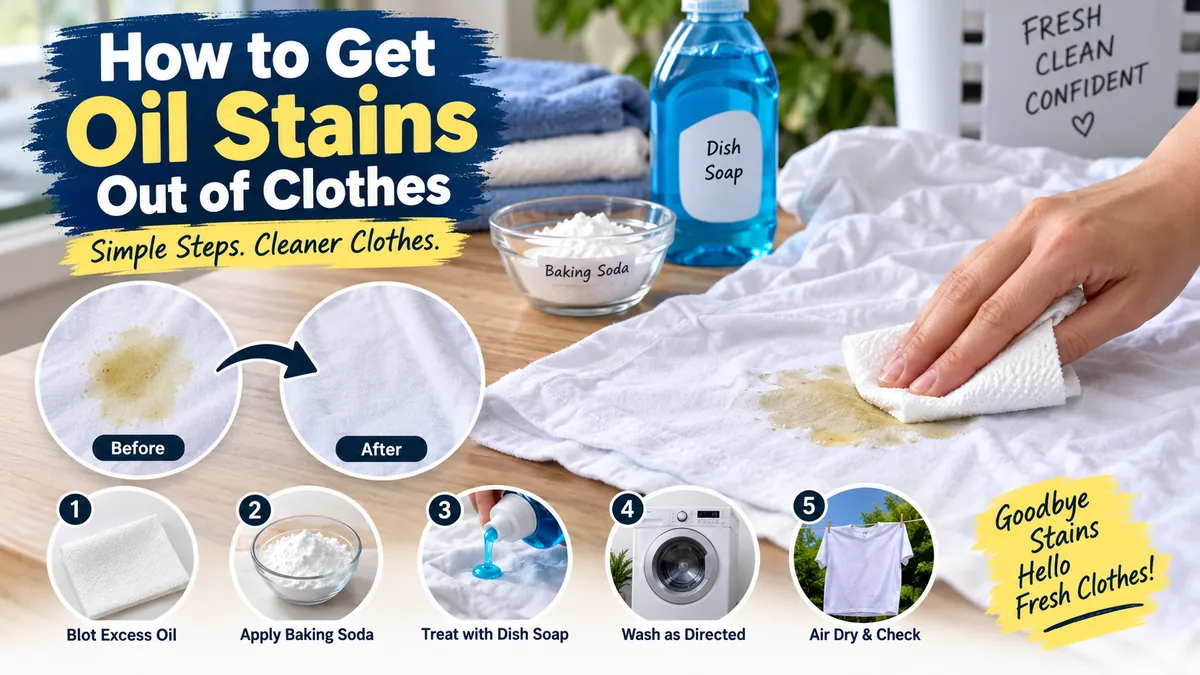
One splash of cooking oil can leave a dark mark that seems to survive an ordinary wash. Oil stains behave differently from many food and drink stains because oil does not readily mix with water, so simply rinsing the garment is rarely enough.
If you’re wondering how to get oil stains out of clothes, start with the fabric dry, blot away excess oil, absorb what remains with baking soda or cornstarch, then pretreat the spot with liquid dish soap or heavy-duty laundry detergent. Wash according to the care label and air-dry until you’re certain the stain has disappeared.
The biggest advantage you can give yourself is speed. A fresh cooking-oil stain is generally easier to treat than one that has already gone through the washer and dryer.
How to Get Oil Stains Out of Clothes Step by Step
For washable everyday fabrics such as cotton T-shirts, jeans, work clothes, and many cotton-polyester blends, a simple pretreatment is often enough.
You’ll need:
- Paper towels or a clean white cloth
- A spoon or dull-edged utensil for excess grease
- Baking soda or cornstarch
- Grease-cutting liquid dish soap or liquid laundry detergent
- A soft toothbrush or laundry brush
- Your normal laundry detergent
Before starting, read the garment’s care label. Water temperature and cleaning methods that are safe for cotton may not be suitable for wool, silk, leather, suede, or other delicate materials.
1. Remove excess oil without spreading it
If there is food, butter, grease, salad dressing, or another thick substance sitting on the fabric, carefully lift it away with a spoon or dull edge.
Next, blot liquid oil with a paper towel or clean cloth.
Don’t scrub aggressively. Rubbing a fresh spill can spread the oil beyond the original stain and work it farther into the fibers.
2. Apply an absorbent powder
Cover the affected area with baking soda or cornstarch. These dry powders can absorb some of the surface oil before you introduce detergent.
For a small fresh stain, leave the powder for around 15–30 minutes. If it quickly becomes oily or clumpy, brush it away and apply another layer.
This step is especially useful when a substantial amount of oil has spilled onto the garment. It isn’t necessarily a complete stain treatment by itself; detergent still has an important job to do.
3. Brush away the powder
Gently shake or brush away the baking soda or cornstarch.
Check the back of the fabric as well. A large oil spill may have penetrated completely through the material, so both sides can require attention.
4. Pretreat with dish soap or liquid detergent
Apply a small amount of grease-cutting liquid dishwashing detergent directly over the remaining mark.
Dishwashing detergent contains surfactants designed to help loosen greasy soils. Gently massage it over the stain with your fingers or a soft toothbrush rather than aggressively scrubbing the fibers.
Allow it to work for about 5–10 minutes. Clorox’s stain-removal guidance similarly recommends applying liquid dish detergent to dry fabric and allowing several minutes of contact time before rinsing and washing.
If you’re concerned about colorfastness, test any cleaning product on an inconspicuous part of the garment first.
5. Rinse thoroughly
Rinse out the dish soap, especially before putting the garment into a washing machine.
This matters because hand dishwashing liquid can produce much more foam than detergent formulated specifically for washing machines.
Maytag recommends thoroughly rinsing dish soap from a garment before machine washing.
6. Wash according to the care label
Wash the garment using laundry detergent and the warmest water temperature permitted by its care instructions.
Don’t automatically choose very hot water. Some fabrics, dyes, prints, elastics, and finishes can be damaged by excessive heat. The garment label takes priority over generic stain-removal advice.
7. Air-dry and inspect
This is one of the most important steps when learning how to get oil stains out of clothes.
Don’t immediately transfer the garment to a tumble dryer.
Instead, air-dry it and inspect the stained area in good light. Oil marks can be difficult to judge while fabric is wet. If a dark or translucent patch remains after drying, repeat the pretreatment.
Dryer heat can make a remaining greasy stain considerably more difficult to remove.
Quick Takeaway: Blot, absorb, pretreat, wash and inspect. Don’t use the dryer until you’re satisfied that the oil is gone.
Why Oil Stains Are So Hard to Remove
Oil-based stains include more than vegetable oil. Butter, mayonnaise, salad dressing, bacon grease, cosmetics, skin oils, automotive grease and similar substances can all leave greasy marks.
The central problem is that oil is hydrophobic—it does not readily dissolve in water.
A normal rinse therefore cannot remove grease in the same way it can flush away many water-soluble substances. Detergents help because their surfactants interact with both oily soils and water, allowing grease to be dispersed and carried away during cleaning.
Oil also works its way between fabric fibers. As a stain ages, especially after exposure to heat, it can become progressively harder to remove. This explains why a spot that was barely noticeable before washing may still appear as a darker patch after the garment dries.
How to Get Oil Stains Out of Clothes With Baking Soda
Baking soda is particularly useful as an absorbent during the early stages of treating fresh oil.
Place the garment on a flat surface and cover the oily area generously. Leave the powder undisturbed for approximately 15–30 minutes, then brush it off.
If the baking soda has absorbed enough oil to become visibly clumped or discolored, another application can help remove additional surface grease.
Afterward, treat the remaining mark with liquid detergent or dish soap before laundering.
Cornstarch can serve a similar purpose. Both materials are most useful for absorbing oil rather than replacing the detergent and washing stages. Clorox describes baking soda and cornstarch as household options for absorbing surface oil, with more limited usefulness once grease is deeply set.
Does baking soda remove old oil stains?
It may help, but an old stain usually needs more than an absorbent powder.
Once oil has penetrated deeply into fibers or the garment has been washed and dried, a strong detergent pretreatment becomes more important. Multiple treatment cycles may also be necessary.
For that reason, don’t discard a garment just because the first treatment leaves a faint shadow.
How to Remove Old or Set-In Oil Stains
Finding an oil mark after laundry day doesn’t necessarily mean the garment is ruined.
For an old stain:
- Start with the dry garment and place a towel behind the affected area.
- Apply heavy-duty liquid laundry detergent or a suitable stain pretreatment.
- Gently work the product into the stained fibers.
- Allow the pretreatment to work according to its instructions.
- For washable fabrics, soaking may help with stubborn residue.
- Wash at the warmest temperature permitted by the care label.
- Air-dry and inspect.
- Repeat if a greasy shadow remains.
Maytag recommends pretreating old oil stains, soaking where appropriate, washing at a fabric-safe temperature and line drying rather than applying dryer heat.
Patience matters more here than aggressive scrubbing. Excessive brushing can damage the surface of a fabric while leaving the underlying grease behind.
What if the clothes have already been washed and dried?
Re-treat them.
Apply liquid laundry detergent or an appropriate stain remover to the dry mark and work it gently into the fibers. After the recommended contact time, wash the garment again.
A stain that has already encountered dryer heat can be more stubborn, so two or more rounds may be necessary. Current stain-care guidance consistently recommends checking for residual oil before applying further heat.
A faint mark after the first attempt is therefore a reason to repeat the process—not immediately assume the stain is permanent.
Dish Soap vs. Laundry Detergent vs. Baking Soda
Several household products appear in oil-stain advice, but they don’t all perform the same role.
| Treatment | Main role | Best use |
|---|---|---|
| Paper towel | Removes excess liquid | Fresh spills |
| Baking soda | Absorbs surface oil | Fresh oily stains |
| Cornstarch | Absorbs surface grease | Fresh stains |
| Dish soap | Breaks up greasy soil | Pretreating washable fabrics |
| Liquid laundry detergent | Pretreats and cleans oily soil | Fresh and older stains |
| Laundry stain remover | Targets stubborn residue | Set-in or persistent stains |
| Oxygen-based stain remover | Additional stain treatment where fabric-safe | Persistent washable stains |
The simplest approach is usually the safest starting point: remove excess grease, use an absorbent if needed, pretreat with detergent, and wash according to the garment label.
You don’t need to combine every household cleaning ingredient you can find. More products do not automatically mean better stain removal.
How to Remove Cooking Oil and Grease From Clothes
Cooking oils such as olive, canola, sunflower and vegetable oil can leave a translucent dark patch. Butter and animal fats behave similarly because the stain contains lipids that ordinary water does not readily remove.
For a fresh cooking-oil spill, blot first. Apply baking soda or cornstarch if there is substantial oil, then brush away the absorbent and pretreat the remaining spot.
Greasy sauces can be more complicated because the stain may contain several components. Tomato sauce mixed with oil, for example, can leave both pigment and grease behind. Treating the oily portion may remove the dark greasy halo while leaving some colored residue requiring a fabric-safe stain remover.
The same principle applies to salad dressing, mayonnaise and oily cosmetics: remove the excess material before working on what has penetrated the fibers.
How to Get Oil Stains Out of Jeans
Denim is generally easier to treat than delicate fabrics, but its dye can still fade with harsh products or excessive scrubbing.
Blot the stain, apply a small amount of liquid dish detergent, let it work for several minutes and rinse. You can then apply a suitable laundry stain treatment and wash according to the jeans’ care label.
Clorox recommends a similar sequence for jeans: blotting, dish-detergent pretreatment, rinsing, laundering and air drying.
For dark denim, test unfamiliar stain removers in a hidden area first. A perfectly clean patch that is noticeably lighter than the surrounding jeans isn’t much of an improvement.
What About Polyester and Synthetic Fabrics?
Polyester can hold onto oily soils particularly well, so pretreatment matters.
Blot excess grease rather than rubbing it across the synthetic fibers. Apply a small amount of liquid detergent suitable for the fabric, gently work it over the stain, and allow adequate contact time before washing.
Follow the care label’s water-temperature limit rather than assuming hotter is always better.
Avoid repeated high-heat drying while checking your progress. Air-drying makes it possible to inspect the mark and treat it again without unnecessarily exposing the remaining oil to dryer heat.
How to Handle Delicate and Dry-Clean-Only Clothes
Silk, wool, suede, leather and structured garments deserve a more cautious approach.
First, read the care label. If it says dry clean only, don’t treat the garment as if it were a washable cotton T-shirt.
For valuable or delicate clothing, gently blot excess oil and take the garment to a professional cleaner. Tell the cleaner what caused the stain if you know; knowing whether the spot came from cooking oil, butter, cosmetics or another substance can help determine the treatment.
Clorox specifically warns against using chlorine bleach on materials such as silk, suede and leather, while other fabric-care guidance recommends professional treatment for unusual or delicate fabrics when ordinary laundering isn’t appropriate.
Can White Vinegar Remove Oil Stains?
White vinegar frequently appears in household cleaning advice, but it shouldn’t be treated as a universal replacement for a grease-cutting detergent.
For oily clothing stains, dishwashing liquid or a suitable laundry detergent is usually a more direct first-line pretreatment because surfactants are specifically useful for dispersing grease.
Vinegar may have roles in other laundry situations, but throwing vinegar, baking soda, detergent and multiple stain removers onto one stain can create unnecessary complications.
Use one controlled treatment method at a time, rinse when required, and follow product labels.
Should You Use WD-40 on an Old Grease Stain?
You may encounter advice recommending WD-40 for extremely stubborn, set-in grease. Some laundry guidance does mention water-displacement lubricant as an option for reactivating old grease, but this method comes with an important safety concern.
Maytag advises that garments treated with such lubricants should be hand washed and line dried only, because residue from flammable products may remain. The garment should be repeatedly cleaned until no grease odor remains.
For most household stains, start with ordinary laundry pretreatment methods instead. If a valuable garment has a stubborn set-in stain, professional cleaning is a safer alternative to experimenting with solvents or flammable products.
Mistakes That Make Oil Stains Harder to Remove
A good stain-removal technique is partly about knowing what not to do.
Rubbing a fresh spill
Scrubbing can spread liquid grease and force it farther into the fabric. Blot instead.
Relying on water alone
Because oil and water don’t readily mix, rinsing alone is unlikely to remove a greasy stain effectively. Pretreatment is the crucial step.
Ignoring the care label
Very hot water, bleach or vigorous brushing can damage a garment even if they remove the stain. Fabric safety comes first.
Putting stained clothes straight in the dryer
This is the mistake worth avoiding most. If any oily mark remains, air-dry and treat it again. Whirlpool and Maytag both caution against machine drying during stain removal because heat can make remaining stains much harder to eliminate.
Using too many remedies at once
Combining multiple cleaners makes the process harder to control and can expose fabric to unnecessary chemicals. Start with the least aggressive effective method and escalate only when needed.
Giving up after one wash
Set-in grease can require repeated pretreatment. Inspect the fabric only after it has air-dried, then repeat the process if necessary.
Are Oil Stains Permanent?
Not necessarily.
Fresh oil stains often respond well when excess oil is removed quickly and the garment is properly pretreated. Even an older stain may improve after repeated treatment.
Success depends on several factors: the type of oil, how long it has been present, the fabric and dye, previous washing and drying, and the cleaning products used. Whirlpool notes that oil stains can become permanent but aren’t automatically permanent, particularly when they are treated promptly.
If a dark spot remains after the first wash, don’t apply dryer heat. Air-dry, inspect and repeat the pretreatment.
The Safest Routine for Removing Oil Stains
Once you understand how to get oil stains out of clothes, the process is fairly straightforward: remove excess oil, use an absorbent powder when helpful, pretreat the remaining grease with dish soap or liquid laundry detergent, and wash according to the garment’s care label.
The final check matters just as much as the cleaning itself. Let the garment air-dry and look closely for a remaining oily shadow. If you still see one, repeat the treatment before exposing the fabric to dryer heat.
For delicate, valuable or dry-clean-only clothing, skip aggressive home remedies and use a professional cleaner. For ordinary washable clothes, acting quickly and using a grease-focused pretreatment gives you the best chance of getting the fabric clean again.