
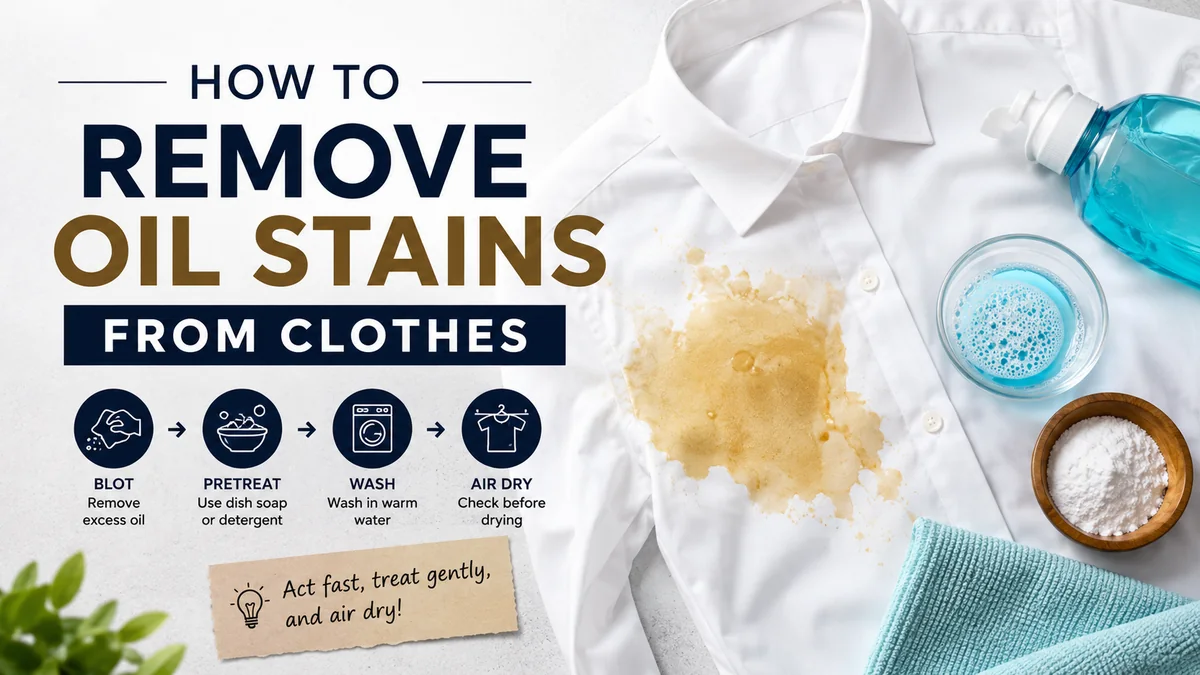
An oil splash can turn a clean shirt into a frustrating laundry problem in seconds. Cooking oil, butter, salad dressing, automotive grease, and even oily cosmetics can leave dark marks that ordinary washing does not always remove.
The good news is that learning how to remove oil stains from clothes does not require complicated equipment. The key is to absorb as much oil as possible, use a grease-cutting cleaner, wash according to the garment’s care label, and keep the clothing away from the dryer until the stain has disappeared.
Quick answer: To remove an oil stain, blot away excess oil without rubbing, cover a fresh stain with baking soda or cornstarch if needed, then pretreat it with liquid dish soap or laundry detergent. Wash the garment in the warmest water permitted by its care label and air-dry it. Repeat the treatment if any oily mark remains.
Why Oil Stains Are Difficult to Remove From Clothes
Oil behaves differently from many everyday stains. If you spill juice or another water-based liquid, water can often rinse away a significant portion of the mess. Oil does not dissolve readily in water.
That is why simply putting an oily shirt under the tap often produces disappointing results.
Dish soap and laundry detergent contain surfactants. These compounds help loosen grease from a surface and keep it suspended in water so it can be rinsed away. This is one reason grease-cutting dishwashing liquid is commonly recommended for treating washable clothing.
Oil stains also become harder to deal with as they age. A fresh cooking-oil splash may still contain removable surface oil, while an older stain has had more time to penetrate the fibers.
Heat creates another problem. Putting a garment in a tumble dryer before confirming that the stain is gone can make the remaining mark considerably harder to remove.
So three rules matter from the beginning:
- Treat the stain as soon as practical.
- Do not aggressively rub fresh oil into the fibers.
- Do not tumble-dry the garment until you have checked the stain.
How to Remove Oil Stains From Clothes Step by Step
For washable everyday fabrics, you usually need only a few basic supplies.
Gather paper towels or a clean white cloth, liquid dishwashing detergent, regular laundry detergent, and a soft-bristled toothbrush or similar brush if the fabric can tolerate gentle agitation. Baking soda or cornstarch can also be useful for absorbing excess oil.
Then follow this process.
1. Remove Excess Oil
Start while the fabric is dry.
If there is liquid oil sitting on the surface, press a clean paper towel or cloth against it. Blot gently rather than wiping from side to side.
For thicker grease or food residue, carefully lift the excess with a spoon or dull-edged utensil.
Avoid vigorous rubbing. It can spread the stain across a larger area and work the grease further into the fibers.
Placing a piece of cardboard or an old clean towel behind the stained area can also prevent oil and cleaning products from transferring to another part of the garment.
2. Use an Absorbent Powder for Fresh Oil
If a noticeable amount of oil remains, cover the affected area with an absorbent powder such as baking soda or cornstarch.
These materials can absorb surface oil before you begin the detergent treatment.
Allow the powder to sit for roughly 15–30 minutes. A particularly oily stain may need more time. Then gently brush or shake away the powder.
Persil, for example, recommends cornstarch as an absorbent treatment for oil on delicate fabrics before following the garment’s care instructions.
This step is useful, but it is not always essential. If you only have dish soap available, you can still treat many washable oil stains effectively.
3. Pretreat With Liquid Dish Soap
Apply a small amount of grease-cutting liquid dish soap directly to the stained area.
Spread it across the entire mark with your fingertip. On sturdy fabrics such as cotton or denim, you can gently work it into the fibers with a soft toothbrush.
Do not scrub aggressively, especially on thin, knitted, printed, or delicate materials.
Allow the dish soap to remain on the stain for around 5–10 minutes. Both Whirlpool and Clorox recommend giving dish detergent several minutes to work before continuing the cleaning process.
4. Rinse the Dish Soap Thoroughly
Rinse the treated section well.
This is especially important before putting the garment into a washing machine because hand dishwashing liquid can create much more foam than machine laundry detergent.
The water temperature should always respect the garment’s care label.
A common mistake is assuming hotter is automatically better. While warm water can help with grease, fabrics differ dramatically in how much heat they tolerate.
5. Pretreat Again if Necessary
Once the dish soap has been rinsed away, inspect the stain.
For a stubborn mark, you can apply liquid laundry detergent or a fabric-compatible stain remover before washing.
Give the pretreatment enough contact time to work, but follow the product directions rather than leaving a stain remover on indefinitely.
Older grease stains may require more than one treatment cycle.
6. Wash According to the Care Label
Wash the garment using regular laundry detergent and the warmest water temperature considered safe for that particular fabric.
This detail matters.
Cotton work clothes may tolerate a warmer wash than delicate garments or certain synthetic fabrics. The care label should take priority over generic stain-removal advice. Whirlpool, Maytag, Persil, and Clorox all emphasize following fabric-care instructions when selecting the wash temperature.
7. Check the Stain Before Drying
When the wash cycle ends, resist the temptation to throw the garment directly into the dryer.
Look closely at the stained area while the clothing is still damp, then allow it to air-dry if you are uncertain.
Once dry, inspect it again under good lighting.
If you can still see a greasy shadow, repeat the pretreatment and washing process.
This simple inspection is one of the most important parts of removing oil stains successfully because dryer heat can make residual staining much more difficult to address.
How to Remove Fresh Oil Stains From Clothes
Fresh oil gives you the best opportunity to remove the stain because you can absorb some of it before it penetrates deeply into the fabric.
For a fresh spill:
- Blot away excess oil with a paper towel.
- Avoid rubbing or immediately soaking the stain with plain water.
- Sprinkle baking soda or cornstarch over an oily spot.
- Leave the powder for approximately 15–30 minutes.
- Brush away the powder.
- Apply a small amount of liquid dish soap.
- Let it work for several minutes.
- Rinse thoroughly.
- Wash according to the care label.
- Air-dry and inspect.
The principle is simple: absorb first, degrease second, wash third.
The faster you start, the less time the oil has to settle into the fabric.
Should You Rub a Fresh Oil Stain?
No. Blotting is usually safer.
Rubbing a fresh spill can push oil outward and deeper into the weave. Press a paper towel against the surface instead and let it absorb the excess.
Once most of the free oil has been removed, you can gently work a suitable detergent into sturdy washable fabric.
How to Remove Old or Set-In Oil Stains From Clothes
Discovering an oil mark after laundry day does not necessarily mean the garment is ruined.
Set-in stains simply require more patience.
Start by laying the clothing flat and examining the stain. If there is dried material on the surface, remove it carefully without damaging the fibers.
Next, apply liquid dish soap or liquid laundry detergent directly to the stain.
Allow the cleaner to penetrate the fabric for about 10 minutes. Gently massage it in with your fingers or a soft brush if the material is durable enough.
For stubborn washable items, soaking after pretreatment can help. Maytag recommends soaking oil-stained clothing in warm or hot water—when permitted by the care label—for at least 30 minutes before washing.
Then wash the garment and air-dry it.
If the stain remains, repeat the process.
Can You Remove an Oil Stain After the Clothes Have Been Washed?
Often, yes.
A normal wash does not necessarily make an oil stain permanent. If the garment has been washed but not tumble-dried, pretreating and rewashing may still remove it.
Apply dish soap or liquid laundry detergent to the remaining mark, let it work, rinse if required, and wash again according to the care label.
Do not move to machine drying just because the garment has already completed one wash cycle.
How to Remove Oil Stains After Clothes Have Been Dried
A dryer makes the job harder, but a visible stain can still be worth treating.
Start with a grease-cutting pretreatment. Apply liquid dish soap to the dry stained area and let it sit for several minutes.
On sturdy fabrics, gently work it in using a soft-bristled toothbrush.
Rinse thoroughly, apply laundry detergent or an appropriate stain remover, and wash again at a fabric-safe temperature.
Then air-dry.
A dried stain may need several rounds. Stop aggressive treatment if you notice fading, pilling, stretching, or other fabric damage.
For valuable or delicate garments, professional cleaning may be safer than repeatedly treating the fibers at home.
How Dish Soap Helps Remove Oil From Clothes
Dishwashing liquid is one of the most useful household products for grease stains because it is formulated to deal with oils.
Think about a greasy dinner plate. Plain water leaves much of the oily film behind, while dish detergent helps lift and disperse it.
A similar principle applies to washable fabric.
However, use liquid hand-dishwashing detergent, not automatic dishwasher detergent. Dishwasher products are formulated differently and may contain ingredients unsuitable for treating clothing.
You also need only a small amount. More soap does not automatically mean better stain removal and can make rinsing unnecessarily difficult.
How to Remove Oil Stains With Baking Soda
Baking soda is most useful as an absorbent, especially when a spill is fresh.
Try this method:
- Blot away as much liquid oil as possible.
- Cover the stain with baking soda.
- Let it sit for 15–30 minutes.
- Brush away the powder.
- Apply liquid dish soap.
- Gently work it into washable, sturdy fabric.
- Rinse and launder according to the care label.
- Air-dry before checking the result.
Baking soda should not be viewed as a replacement for detergent in every situation. Absorbing loose oil and actually removing greasy residue from fibers are different jobs. Dish soap or laundry detergent supplies the surfactants needed for the latter.
Baking Soda vs. Cornstarch for Oil Stains
Both can help absorb fresh oil.
| Method | Best Use | Main Role |
|---|---|---|
| Baking soda | Fresh oily marks on many washable fabrics | Absorbs surface oil |
| Cornstarch | Fresh stains, including some delicate fabrics | Draws up excess oil |
| Dish soap | Fresh and older washable stains | Breaks up greasy residue |
| Liquid laundry detergent | Pretreating and washing | Lifts and suspends soil |
| Fabric stain remover | Persistent washable stains | Additional pretreatment |
Cornstarch is particularly useful when you want a dry absorbent treatment before cleaning a delicate garment.
Regardless of which powder you choose, always check the care label first.
How to Remove Cooking Oil Stains From Clothes
Cooking oil stains are among the most common forms of grease damage.
Olive oil, vegetable oil, frying oil, butter, sauces, mayonnaise, and oily salad dressings can all leave translucent spots that become more obvious as the fabric dries.
For fresh cooking oil:
Blot → absorb → dish soap → rinse → wash → air-dry.
Do not wait for laundry day if you can treat the mark sooner.
A tiny oil splatter can be deceptive. It may look almost invisible while the fabric is wet but become a darker circle after drying.
That is why checking clothing under bright light before machine drying is worthwhile.
How to Remove Grease Stains From Clothes
Oil and grease stains are closely related, so their treatment is similar.
Grease may be thicker or semi-solid, meaning you may first need to carefully lift excess material from the garment.
Use a spoon, dull knife, or similar blunt edge rather than grinding the grease into the fabric.
Then blot, pretreat with dish soap or liquid laundry detergent, wash according to the care label, and air-dry.
Automotive grease and industrial lubricants can be considerably heavier than cooking oils. If a garment is heavily contaminated with a flammable substance, follow the product’s safety guidance rather than treating it as an ordinary food stain.
Removing Oil Stains From Different Fabrics
The basic stain-removal process works for many clothes, but the fabric determines how aggressively you can treat the mark.
Cotton
Cotton is generally one of the easier fabrics to treat.
Blot excess oil, use dish soap as a pretreatment, rinse thoroughly, and wash at the temperature allowed on the label.
For durable white or colorfast cotton, a compatible laundry stain remover may provide additional help.
Denim
Denim can usually tolerate gentle agitation better than delicate fabrics.
After blotting excess grease, massage a little dish soap into the spot and allow it to work for several minutes. Rinse, wash, and air-dry.
Clorox specifically recommends a dish-detergent pretreatment for oil and grease on jeans before washing.
Polyester and Synthetic Fabrics
Synthetic fibers can hold oily soil stubbornly.
Pretreat the stain carefully with dish soap or liquid detergent, but do not assume that extremely hot water is appropriate. Check the care label and use a safe wash temperature.
Repeat treatment rather than increasing heat beyond the manufacturer’s instructions.
Wool
Wool requires a gentler approach.
After blotting excess oil, an absorbent powder such as cornstarch can be placed over the mark and left for approximately 30 minutes. Brush it away gently and clean the garment according to its care instructions.
Avoid vigorous scrubbing, which can distort or damage wool fibers.
Silk and Other Delicates
Silk deserves particular caution.
Do not aggressively scrub it with a toothbrush or automatically use the same treatment you would use on a cotton T-shirt.
Check the care label first. If the item is marked dry clean only, or if it is expensive, vintage, embellished, or especially delicate, professional cleaning is usually the safer choice.
When using any cleaning product on a delicate or strongly colored fabric, test an inconspicuous area first.
What Water Temperature Removes Oil Stains Best?
There is no single correct temperature for every garment.
Warm water can help loosen greasy residue, and several laundry-care guides recommend using the warmest water allowed by the garment’s care label.
That last part is crucial.
Do not damage a garment by choosing hot water simply because you are dealing with oil. Heat can shrink, fade, distort, or otherwise harm certain materials.
Read the label first, then choose the safest effective temperature.
Common Mistakes When Removing Oil Stains
Oil stains often become harder to remove because of what happens after the spill rather than because of the original spill itself.
Rubbing Instead of Blotting
Scrubbing a puddle of fresh oil spreads it.
Blot first. Save gentle agitation for later, after you have removed as much loose oil as possible and applied a suitable cleaner.
Using Only Water
Water alone is poorly suited to dissolving grease.
Use a surfactant-containing cleaning product, such as an appropriate dish soap or laundry detergent, to help separate oily residue from washable fibers.
Ignoring the Care Label
A method that works beautifully on a cotton T-shirt might damage wool or silk.
Always check washing instructions before choosing water temperature, stain removers, bleach products, or agitation methods.
Scrubbing Too Hard
More force does not necessarily produce a cleaner garment.
Aggressive scrubbing can roughen fibers, stretch knits, fade color, and damage printed designs. Gentle repeated treatment is usually preferable.
Using the Dryer Too Soon
This is one of the biggest mistakes.
Do not machine-dry a treated garment while a visible oily stain remains. Air-dry it and inspect the area first.
Mixing Random Household Cleaners
More ingredients do not automatically produce a stronger stain remover.
A straightforward treatment using an absorbent powder when useful, followed by dish soap or laundry detergent, is often enough.
Avoid experimenting with mixtures of household chemicals. Follow the instructions on commercial cleaning products and never combine cleaners unless their labels specifically indicate that doing so is safe.
Are Oil Stains Permanent?
Not necessarily.
Fresh stains are generally easier to remove, but even older oil marks can sometimes respond to repeated pretreatment and washing.
Success depends on several factors:
- The type and amount of oil
- How long the stain has been present
- Whether it has been exposed to dryer heat
- The fabric type
- Previous cleaning attempts
- The stain remover or detergent used
Whirlpool notes that oil stains can become permanent, but treating them promptly improves the chance of successful removal.
So do not discard a favorite shirt after one unsuccessful wash.
Treat it again and inspect it after air-drying.
When Should You Take Oil-Stained Clothing to a Dry Cleaner?
Home treatment makes sense for ordinary washable cotton, polyester, and denim.
Professional cleaning is worth considering when the garment is:
- Marked dry clean only
- Made from delicate silk, wool, suede, or leather
- Vintage or especially valuable
- Heavily embellished
- Structurally tailored
- Heavily contaminated with unusual industrial oil or grease
Tell the cleaner what caused the stain if you know. Identifying the substance can help them select an appropriate treatment.
The Best Routine for Removing Oil Stains
When you are standing in the kitchen looking at a fresh grease spot, you do not need an elaborate collection of cleaning hacks.
Remember this sequence:
Blot → absorb → pretreat → wash → inspect → air-dry.
Blot away loose oil rather than rubbing it around. Use baking soda or cornstarch when you need to absorb a fresh spill. Apply grease-cutting dish soap or liquid laundry detergent to break up the residue. Wash at the warmest temperature the care label safely permits.
Most importantly, inspect the garment before exposing it to dryer heat.
That simple routine is the foundation of how to remove oil stains from clothes, whether you are dealing with cooking oil on cotton, grease on denim, or an older mark that needs a second round of treatment.