
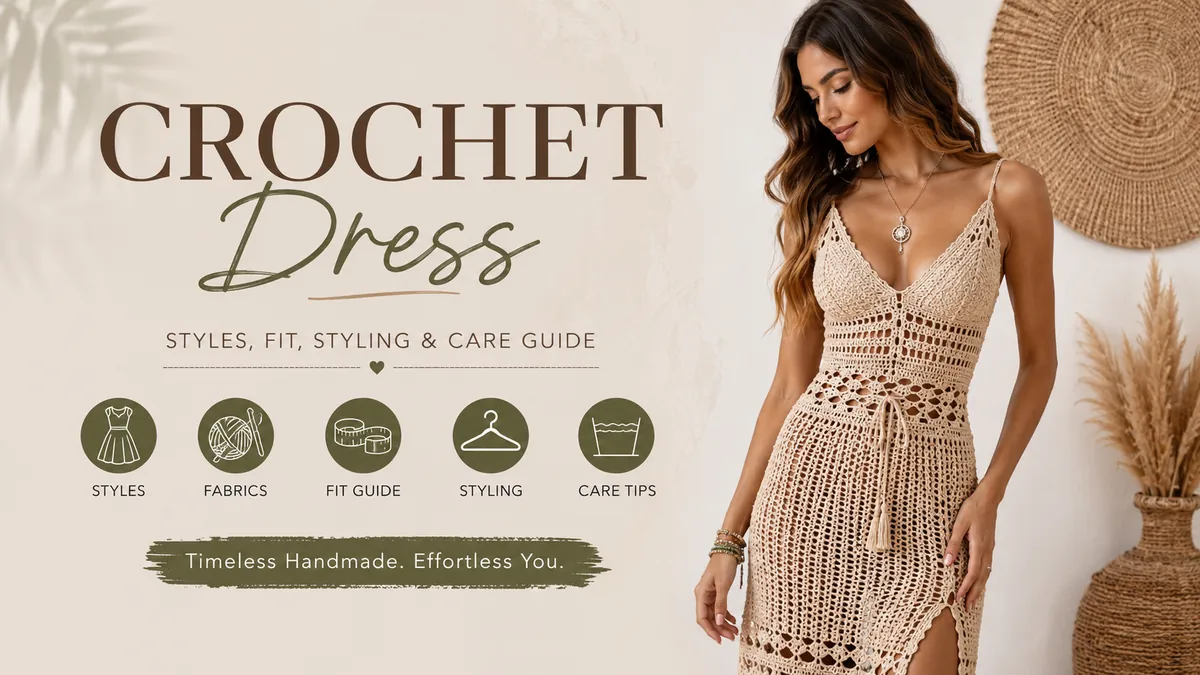
A crochet dress has something most ordinary dresses cannot easily reproduce: visible texture. Instead of relying mainly on print or fabric construction for character, crochet builds the visual interest directly into the garment through loops, stitches, motifs and open spaces.
That handcrafted quality has deep roots, but it feels particularly relevant now. Crochet appeared prominently in Spring 2026 fashion coverage, with designers using it for everything from relaxed vacation pieces to sophisticated city looks. It has also attracted renewed attention in bridal fashion, where openwork and handcrafted details are being used in contemporary gowns.
A crochet dress is a dress made wholly or partly from fabric created by working yarn or thread with a crochet hook. Depending on the stitch pattern, yarn, gauge and construction, it can be dense and structured or light and open. Styles range from beach cover-ups and mini dresses to fitted midis, flowing maxis and formal designs.
The interesting part is that “crochet dress” describes a construction technique rather than one particular aesthetic. Understanding the stitches, fibers, fit and transparency makes it much easier to know how these dresses work and how to wear or make one successfully.
What Is a Crochet Dress?
Crochet is produced by forming interconnected loops of yarn with a hook. That distinguishes it from knitting, which typically keeps multiple live stitches on needles.
The technique can create remarkably different surfaces. Tight single crochet can produce relatively dense fabric, while chains, double crochet, treble crochet, shells and lace arrangements can create increasingly open patterns.
This flexibility explains why two crochet dresses can look completely unrelated.
One might be a fitted neutral midi with small, closely worked stitches. Another could be a colorful granny square maxi. A third might resemble lace and function mainly as a swimsuit cover-up.
The handcrafted connection is also genuine. The ASU FIDM Museum notes that crochet has not been mechanized in the same way as knitting, meaning true crocheted garments are created by hand. Its museum collection includes a cotton crochet mini dress dated 1966–69, illustrating crochet’s established place in modern fashion history.
Why Crochet Has a Distinctive Appearance
Several elements determine how crochet fabric looks and behaves:
- Stitch type: Controls density, texture and openness.
- Yarn weight: Fine yarn creates delicate fabric; thicker yarn creates greater visual weight.
- Fiber: Cotton, linen, bamboo, wool and synthetic fibers behave differently.
- Hook size: Affects the size and openness of stitches.
- Gauge: Determines the dimensions and overall fabric density.
- Motif: Granny squares, floral motifs and geometric units create visible patterns.
- Construction: Dresses may be made in panels, rounds, joined motifs or seamless sections.
The combination matters more than any single feature.
A fine cotton yarn worked in lace stitches may produce a breathable summer garment. The same general silhouette made from heavier wool with dense stitches can function more like a sweater dress.
Why the Crochet Dress Keeps Returning to Fashion
Crochet is sometimes described as a “comeback” trend, but it never completely disappears.
Its modern fashion significance became particularly visible during the late 1960s. According to the ASU FIDM Museum, interest in natural fibers and traditional processes grew partly in reaction to the highly synthetic fashion of the mid-1960s. Patchwork, knitting and crochet fitted naturally into that shift toward clothing where the method of making was visibly apparent.
That connection with craft still gives crochet much of its appeal.
Yet modern crochet is not limited to the stereotypical 1970s bohemian outfit. Current styling ranges from minimal monochrome dresses to elaborate evening pieces. Vogue’s 2026 coverage highlighted crochet designs from fashion houses and designers including Gabriela Hearst, Diotima, Rabanne and Maria McManus, demonstrating how far the technique has moved beyond conventional beachwear.
What Makes Crochet Different From Ordinary Fabric?
The texture is the obvious difference, but there are others.
Crochet fabric may have:
- deliberate gaps between stitches;
- three-dimensional surface texture;
- visible handmade irregularity;
- considerable stretch depending on construction;
- noticeable weight in longer garments;
- decorative edges built directly into the fabric.
These qualities create both advantages and challenges.
Openwork can feel wonderfully airy in warm weather, for example, but may require a slip or lining. A long crochet maxi can have beautiful movement, yet the weight of the yarn may pull the garment downward.
That is why construction and fiber choice matter so much.
Popular Types of Crochet Dress
There is no single standard silhouette. Current pattern collections include mini, maxi, fitted, flared, beach, lace, granny-motif and layering designs. Hobbii, for example, currently organizes crochet dress and skirt patterns across different skill levels and silhouettes, while AllFreeCrochet separates lighter summer dresses from styles suited to layering.
Crochet Mini Dress
A mini dress usually finishes above the knee and works particularly well when the crochet itself is the focal point.
Common designs include:
- fitted sleeveless minis;
- bell-sleeve retro dresses;
- granny square dresses;
- openwork beach styles;
- simple shift silhouettes.
Shorter length can also make a handmade dress more manageable because less yarn means less finished weight.
Crochet Midi Dress
The midi usually falls somewhere between the knee and ankle.
It is one of the easiest crochet lengths to adapt beyond vacation wear because it can look polished without losing the texture that makes crochet distinctive.
A fitted neutral midi with a simple slip underneath, for example, has a completely different character from a multicolored granny square dress.
Crochet Maxi Dress
A crochet maxi creates maximum visual impact.
Long vertical lines, lace panels and repeating motifs work particularly well over a full-length silhouette. Maxi designs are common for summer, resorts, festivals and beach settings.
Weight needs consideration, however. Yarn adds up quickly in a floor-length garment. A fiber and stitch combination that feels fine in a swatch may become considerably heavier when multiplied across an entire dress.
Crochet Beach Dress
The beach dress is probably the version most people immediately recognize.
It usually features:
- open stitches;
- lightweight yarn;
- relaxed shaping;
- side slits;
- sleeveless or halter construction;
- enough transparency to reveal swimwear underneath.
Contemporary patterns frequently combine these characteristics with granny squares and maxi silhouettes. One recently updated beach-dress pattern, for example, uses granny-square construction for a lightweight bohemian maxi design.
The key distinction is purpose. A highly open beach cover-up does not need the opacity expected from an everyday dress.
Granny Square Crochet Dress
Few crochet techniques are as instantly recognizable as the granny square.
Small motifs are worked separately and then joined to form the garment. Squares may be monochrome, tonal or intensely colorful.
This construction provides enormous design flexibility because changing the colors, arrangement or size of individual motifs changes the entire appearance.
The practical challenge is joining them cleanly and planning their placement around the bust, waist and hips.
Crochet Lace Dress
Crochet lace uses open stitch combinations to create a delicate patterned surface.
Depending on the yarn and motif, it can feel romantic, vintage, minimal or formal. Fine thread produces especially intricate results.
Lace also introduces the obvious question: What do you wear underneath a crochet dress?
For everyday use, a slip dress is usually the simplest solution. A fitted bodysuit can work under shorter pieces, while swimwear makes sense under a beach cover-up. The right choice depends on how open the stitches are and where the dress will be worn.
Crochet Sweater Dress
Not every crochet garment belongs to summer.
Dense stitches and warmer fibers can create sweater dresses suited to cooler temperatures. Pattern collections commonly include thicker designs intended for layering through autumn and winter as well as lighter summer pieces.
This is where fiber choice becomes especially important. A wool blend behaves very differently from a lightweight cotton or linen yarn.
Crochet Wedding Dress
Crochet can also move into formalwear.
Vogue reported crochet as a notable feature in 2026 and 2027 bridal collections, where designers have used handcrafted openwork and crochet-inspired detailing to create romantic contemporary gowns.
A bridal crochet dress may use extremely fine thread, intricate lace motifs, strategic lining and carefully engineered shaping.
The result is far removed from a casual beach cover-up, even though both belong to the same broad technique.
Which Yarn Works Best for a Crochet Dress?
A beautiful stitch pattern cannot compensate for unsuitable yarn.
For garments, you have to think about what happens when several hundred grams of fiber become a full dress.
Cotton
Cotton is a natural choice for warm-weather crochet.
It offers good stitch definition and works particularly well for lace, granny motifs and summer designs. It also tends to feel more substantial than extremely lightweight synthetic fibers.
Its limitation is elasticity. Some cotton yarns have relatively little bounce, and a heavy cotton maxi may stretch under its own weight.
Linen
Linen can create excellent drape and breathability.
It often becomes softer with wear and washing, making it appealing for summer clothing. Its initial feel can be firmer than some people expect, though, and the fabric behaves differently from elastic wool.
Bamboo and Bamboo Blends
Bamboo-based yarns are often selected when softness and fluid drape are priorities.
Current garment-pattern collections commonly recommend cotton, bamboo or linen blends for breathable warm-weather pieces.
The fluidity can look beautiful in long dresses, but very slippery or stretchy yarn requires careful gauge control.
Wool and Wool Blends
For colder weather, wool becomes more practical.
It provides warmth and elasticity and can be particularly suitable for a crochet sweater dress. The exact feel depends heavily on the yarn construction and wool type.
Acrylic and Synthetic Blends
Synthetic fibers can offer durability, color variety and accessible pricing.
Their behavior varies widely, so judging the actual yarn is more useful than assuming all acrylics will perform the same way.
For any fiber, ask four questions:
- Does it have enough drape?
- Will it feel comfortable against skin?
- How much will the finished garment weigh?
- Will it hold its intended shape?
Those answers are more useful than simply choosing the prettiest skein.
Fit Matters More With Crochet Than You Might Expect
A crochet dress can look spectacular on a hanger and still fit poorly.
The reason is simple: crocheted fabric has its own stretch, weight and drape. A garment that begins at the correct dimensions can lengthen once gravity starts acting on it.
Accurate body measurements are therefore essential.
The Craft Yarn Council recommends checking the full sizing information supplied with a pattern and comparing relevant body and finished-garment measurements. Its standard sizing guidance includes bust or chest, waist, hip, back length, armhole depth and other garment measurements.
Measure the Body First
For most dresses, pay particular attention to:
- bust;
- natural waist;
- fullest hip;
- shoulder-to-waist length;
- desired total length.
Do not automatically choose the clothing size you normally buy.
Pattern sizing is based on measurements, and those measurements are what matter.
Understand Ease
Ease is the difference between body measurements and finished garment measurements.
Positive ease makes the garment larger than the body and creates a relaxed fit. Negative ease makes it slightly smaller and relies on stretch for a close fit.
Neither is automatically better.
A loose beach dress needs different ease from a fitted bodycon crochet dress.
Read the Schematic
A good garment pattern often includes a schematic showing finished dimensions.
The Craft Yarn Council describes schematics as visual representations that help crocheters understand the size and shape of a piece, evaluate fit and determine where modifications may be needed. Comparing the schematic with a well-fitting garment you already own is particularly useful.
That small step can prevent a very large fitting problem later.
Gauge Is Critical When Making a Crochet Dress
A scarf can survive imperfect gauge.
A fitted dress usually cannot.
Gauge tells you how many stitches and rows occupy a given measurement. If your stitches are substantially larger than the designer’s, the entire garment can become too wide or long. If they are smaller, the dress may be tight.
Make a proper swatch using:
- the actual yarn;
- the planned hook;
- the main stitch pattern.
Then treat it the way you will treat the finished dress.
For lace patterns in particular, measure after blocking because open stitches can change considerably once relaxed and shaped.
The Craft Yarn Council maintains standardized guidance covering yarn weights, hook sizes, body measurements, crochet abbreviations and related pattern conventions, which can help when interpreting garment instructions.
Quick takeaway: Swatching may feel like delaying the project, but remaking a small square takes far less time than remaking a dress.
How Crochet Dresses Are Constructed
Understanding construction helps explain why some dresses fit more naturally than others.
Separate Panels
The front and back are crocheted individually and seamed.
This traditional method makes shaping straightforward and gives you clear pieces to measure.
Top-Down Construction
The garment begins near the neckline or shoulders and grows downward.
One major advantage is the ability to try the dress on during construction. Waist placement and overall length can therefore be adjusted more easily.
Bottom-Up Construction
The dress begins at the hem and progresses toward the upper body.
This works well when the lower section contains a strong border or repeating motif.
Joined Motifs
Granny squares, flowers or geometric pieces are crocheted separately before being connected.
The planning stage is crucial. Motifs need to fit together while still accommodating the body’s curves.
Worked in the Round
Some dresses are crocheted as tubes or mostly seamless shapes.
This reduces seaming and can create clean continuous stitch patterns, although shaping still has to be incorporated through increases and decreases.
What Should You Wear Under a Crochet Dress?
The answer depends almost entirely on stitch openness.
A tightly crocheted garment may need nothing beyond normal undergarments. Open lace requires more planning.
Slip Dress
A simple slip is the most versatile option.
Choose one that follows the silhouette without bunching underneath. A color close to the crochet creates a more unified appearance; a contrasting slip makes the stitch pattern stand out.
Bodysuit
A bodysuit works especially well under mini dresses and highly open designs.
It provides coverage while allowing the crochet pattern to remain visible.
Camisole and Shorts
This combination can work for relaxed summer pieces when you want more coverage without using a full slip.
Swimwear
For a true crochet beach dress, swimwear is the natural base layer.
In that context, transparency is part of the design rather than a problem to solve.
The useful rule is simple: the more open the crochet, the more intentional the underlayer should be.
How to Style a Crochet Dress Without Making It Look Like a Costume
Crochet already provides strong texture, so the rest of an outfit often works best when it has a clear supporting role.
Current fashion coverage demonstrates that crochet is no longer restricted to beach styling. Recent runway and editorial looks pair crochet with refined accessories, trousers, minimalist shoes and city-ready layers as well as traditional resort pieces.
For a Casual Summer Outfit
Try a cotton midi or mini with:
- flat leather sandals;
- simple jewelry;
- a small shoulder bag;
- sunglasses.
You do not need to add several other bohemian elements simply because the dress is crocheted.
For the Beach
Let the openwork do its job.
Wear the dress over swimwear with sandals, a sun hat and a practical tote. Open stitches that may feel too revealing elsewhere make perfect sense here.
For an Evening Look
Choose a more refined silhouette and reduce the number of competing textures.
A lined black, cream or rich-colored midi can work with understated heels and a structured bag.
For Cooler Weather
Layering changes the character completely.
Depending on the dress, try:
- a fitted long-sleeve top underneath;
- a tailored jacket;
- a denim jacket;
- ankle boots;
- a coat over a dense sweater dress.
Crochet can therefore extend beyond summer when the stitch density, fiber and layers support the season.
Are Crochet Dresses Always See-Through?
No.
This misconception comes from the popularity of openwork beach dresses.
Crochet can be extremely open or comparatively dense. Transparency depends on stitch size, yarn thickness, hook size and the spacing built into the pattern.
Dense stitches such as single crochet leave relatively little open space. Mesh, chain spaces and lace motifs intentionally create more.
Even a slightly transparent design can become practical everyday clothing with a removable slip.
That flexibility is useful because one crochet outer layer can create different effects simply by changing what sits underneath.
Common Crochet Dress Problems and How to Avoid Them
A successful garment is about more than making accurate stitches.
The Dress Becomes Too Heavy
This happens most often with long designs and dense yarn.
Consider lighter yarn, more open stitches or a shorter silhouette before committing to a heavy maxi.
It Stretches After Wearing
Gravity affects crocheted fabric, particularly when the yarn itself is heavy.
A generous swatch can help you understand the fabric before making the full garment. Wash and dry the swatch according to the intended care method, then check whether its dimensions changed.
The Armholes Gap
This usually points to fit or shaping issues.
Check bust measurements, upper-body construction and pattern size rather than simply tightening the edge afterward.
The Waist Falls in the Wrong Place
Body length varies even among people with similar bust measurements.
This is one reason top-down construction and detailed schematics are so useful: they make vertical adjustments easier to identify.
The Dress Looks Too Sheer
Do not abandon the garment immediately.
Try it over different slips before deciding. Matching, contrasting and skin-tone underlayers can produce dramatically different results.
The Hem Loses Its Shape
A heavy or decorative border can pull downward.
The border’s weight should be considered as part of the garment rather than as an afterthought.
How to Care for a Crochet Dress
Care begins with the yarn label.
Different fibers tolerate water, heat and agitation differently, so one universal washing method cannot safely apply to every crochet garment.
The Craft Yarn Council includes standardized care symbols among its yarn-industry guidelines, reinforcing the importance of following fiber-specific instructions.
For delicate handmade pieces, gentle treatment is generally the safest approach when compatible with the yarn instructions.
Washing
Check the fiber label first.
If hand washing is recommended, use cool or lukewarm water and an appropriate mild detergent. Avoid aggressive scrubbing or twisting.
Removing Water
Do not wring a wet crochet dress.
Support the garment as you lift it because wet fibers can be considerably heavier. Gently press out water and use a towel to absorb excess moisture.
Drying
Flat drying is often preferable for delicate crochet because hanging a wet dress can allow its own weight to stretch the garment.
Reshape it to the intended measurements while damp.
Storage
Heavy crochet garments are generally better folded than hung for long periods.
A hanger concentrates the garment’s weight at the shoulders, potentially causing distortion.
Blocking a Crochet Dress
Blocking means shaping finished crochet so the stitches settle and the garment reaches its intended dimensions.
It is particularly valuable for:
- lace;
- granny squares;
- uneven edges;
- motif joins;
- garments where finished measurements matter.
The exact blocking method depends on the fiber.
Some fibers tolerate wet blocking well, while others require different handling. Always check yarn-care instructions before applying water, steam or heat.
Blocking cannot magically fix a badly sized garment, but it can transform slightly uneven handmade fabric into a much more polished piece.
Is a Crochet Dress Suitable for Beginners?
It can be, but pattern choice matters.
A dress is a larger commitment than a scarf or basic square because the finished piece has to fit a three-dimensional body.
Current pattern libraries include both accessible and intermediate dress projects, while more advanced collections emphasize shaping, lace work and garment-grade finishing.
A beginner should look for:
- simple repeated stitches;
- minimal shaping;
- clear measurements;
- straightforward construction;
- detailed instructions;
- a schematic;
- a yarn that is easy to see and handle.
A simple loose summer dress may be a realistic early garment project.
A fitted lace maxi made from fine thread is another matter.
Skills Worth Learning First
Before starting, it helps to be comfortable with:
- chain stitches;
- slip stitches;
- single crochet;
- half double crochet;
- double crochet;
- increasing and decreasing;
- counting stitches;
- reading basic pattern abbreviations;
- making and measuring a gauge swatch.
You do not need to master every decorative stitch. Consistent tension and accurate measurement matter more.
How Long Does It Take to Crochet a Dress?
There is no useful universal number.
Time depends on:
- dress length;
- garment size;
- yarn thickness;
- hook size;
- stitch complexity;
- number of motifs;
- shaping;
- crocheter speed;
- finishing and seaming.
A loose mini in thicker yarn may progress relatively quickly. A floor-length lace dress made from fine thread can require vastly more work.
That time investment is part of what distinguishes genuine crochet clothing from ordinary mass-produced fabric.
If you are making one yourself, measuring progress in completed sections rather than hours is often less frustrating.
How to Choose the Right Crochet Dress
Start with function rather than trend.
Ask where you expect to wear it.
For the beach, openness and airflow may be desirable. For daily city wear, coverage and ease of movement become more important. For cold weather, density and warmth matter. For an event, lining, structure and finishing deserve extra attention.
Then evaluate four areas.
| Factor | What to Check |
|---|---|
| Fiber | Comfort, breathability, warmth and care requirements |
| Stitches | Opacity, texture and stretch |
| Fit | Bust, waist, hips, length and ease |
| Construction | Seams, motif joins, lining and finished weight |
If those four work together, the dress is far more likely to feel good rather than merely photograph well.
Why Crochet Dress Design Has Lasting Appeal
The enduring appeal of the crochet dress comes from contrast.
It can feel nostalgic and contemporary at the same time. The technique has a strong association with handmade fashion and the craft-driven styles of the late 1960s and 1970s, yet designers continue to reinterpret it for modern runways, everyday clothing and bridalwear.
It is also unusually adaptable.
Change the yarn and you change the season. Change the stitch and you change the transparency. Change the motif and you change the visual language. Change the lining and the same openwork can move from beachwear toward everyday clothing.
Most importantly, a crochet dress makes its construction visible. The loops, joins, motifs and textures are not hidden behind the design; they are the design.
For anyone choosing or making one, focus first on fiber, stitch density, fit, finished weight and intended use. Get those fundamentals right, and crochet can produce far more than a passing summer trend—it can create a distinctive garment that remains wearable season after season.