
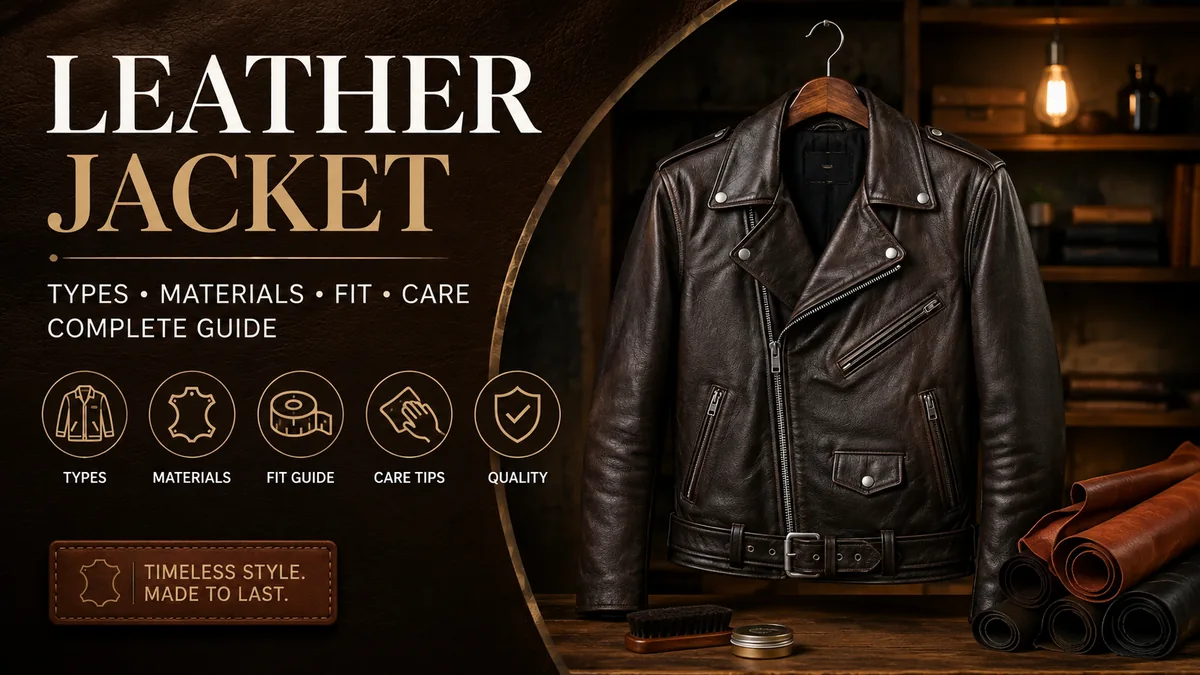
Few pieces of clothing have moved so easily between practical workwear, military equipment, motorcycle culture, music, and everyday fashion as the leather jacket. Its appeal is not based on one trend. A good jacket combines a distinctive appearance with wind resistance, durability, and a surface that can develop character through years of wear.
Yet the words “leather jacket” describe a surprisingly broad category. A soft lambskin bomber behaves very differently from a thick cowhide biker jacket. Full-grain and heavily corrected leather may look similar in a product photograph but age differently. Even familiar terms such as genuine leather can tell you less about quality than you might expect.
A leather jacket is an outerwear garment made primarily from tanned animal hide, commonly cowhide, sheepskin, goatskin, or horsehide. Its comfort, durability, weight, texture, and aging characteristics depend on the hide, tanning process, finish, construction, and jacket design. Major styles include biker, bomber, café racer, flight, trucker, and leather blazer.
Understanding those differences makes it much easier to judge a jacket on its actual merits rather than its label.
What Is a Leather Jacket?
A leather jacket is a short-to-medium-length outer garment constructed mainly from leather. Leather itself is produced by treating animal hides or skins so that the material becomes stable and resistant to decomposition. Modern production involves preparation of the hide, tanning, dyeing, finishing, cutting, stitching, and assembly.
Unlike woven fabrics, natural leather has variations in grain, thickness, pores, and texture. These variations are part of its character rather than necessarily being defects.
Jackets have been produced from several animal hides, including:
- Cowhide
- Sheepskin
- Lambskin
- Goatskin
- Horsehide
- Buckskin
The choice affects far more than appearance. It changes how heavy the jacket feels, how quickly it breaks in, how much abrasion it can tolerate, and how it develops with age.
Leather jackets can also serve very different purposes. A motorcycle jacket may prioritize abrasion resistance and secure closures, while a fashion jacket may prioritize softness, drape, and a lightweight feel.
The History of the Leather Jacket
Leather garments existed centuries before the modern jacket. The Smithsonian’s collection, for example, includes a tanned buckskin cuera associated with protective garments used on the northern frontiers of Mexico and surrounding territories during several centuries.
The leather jacket familiar today, however, was heavily shaped by the twentieth century.
From Practical Outerwear to Motorcycle Icon
One major turning point came in 1928.
Irving Schott of Schott NYC introduced the Perfecto motorcycle jacket. Schott’s history describes it as the first leather motorcycle jacket and says it originally retailed for $5.50 through a Long Island Harley-Davidson distributor.
The design wasn’t simply decorative. Features associated with motorcycle jackets—secure zippers, substantial leather, fitted cuffs, and protective coverage—had practical purposes for riders dealing with wind and the road.
Military clothing also influenced leather outerwear. Flight and bomber jackets were designed around the needs of aviation, where warmth and functional construction mattered.
After World War II, leather jackets increasingly escaped their purely practical origins.
Cinema, motorcycle culture, rock music, punk, and youth subcultures transformed them into symbols of independence and rebellion. The Perfecto silhouette became especially influential, while later generations adopted leather jackets without necessarily having any connection to motorcycles.
That history explains why modern leather jackets can simultaneously look utilitarian, rebellious, luxurious, or minimalist.
Types of Leather Used in Jackets
Choosing the right leather matters as much as choosing the jacket style.
Two factors need to be separated: the animal source and how the hide has been processed and finished.
Cowhide
Cowhide is widely associated with rugged leather outerwear.
It tends to feel substantial and can provide excellent durability. A new heavy cowhide jacket may initially feel stiff, but repeated wear allows the material to conform more naturally to the wearer.
Cowhide works particularly well when toughness is more important than an ultra-light feel.
Common applications include:
- Motorcycle jackets
- Biker jackets
- Work-inspired outerwear
- Heavy casual jackets
Its downside is straightforward: weight. Someone looking for a soft jacket for comfortable everyday indoor-outdoor wear may prefer a lighter skin.
Lambskin
Lambskin sits toward the opposite end of the spectrum.
It is prized for its smooth hand, softness, and relatively lightweight feel. It often drapes beautifully, which is why it appears frequently in fashion-focused jackets.
The trade-off is that very soft leather generally requires more considerate treatment than thick, rugged hides.
Lambskin makes sense when you prioritize:
- Softness
- Low weight
- Refined appearance
- Comfortable drape
It is less compelling when maximum toughness is the main requirement.
Sheepskin
Sheepskin can produce soft, flexible leather and is closely associated with certain flight and shearling-style jackets.
When the wool remains attached to the hide, it creates the distinctive insulated construction seen in shearling outerwear.
That combination can provide substantial warmth without requiring a separate synthetic insulation layer.
Goatskin
Goatskin offers an appealing balance between toughness and flexibility.
Its recognizable grain gives it visual character, while its durability has made it useful for practical outerwear as well as everyday jackets.
Someone who finds heavy cowhide excessive but wants something more robust than very delicate lambskin should consider goatskin.
Horsehide
Horsehide has a long association with heritage and motorcycle jackets.
It can feel firm and dense when new and often requires patience during break-in. That same characteristic is part of the attraction for enthusiasts who want a substantial jacket that changes noticeably through years of wear.
It is not automatically “better” than cowhide or goatskin. It simply provides a different wearing experience.
Which Leather Is Best?
There is no universally best hide.
| Leather | Typical Feel | Durability | Weight | Good For |
|---|---|---|---|---|
| Cowhide | Firm, substantial | High | Medium-heavy | Biker and rugged jackets |
| Lambskin | Very soft | Moderate | Light | Fashion and everyday wear |
| Sheepskin | Soft, flexible | Moderate | Light-medium | Casual and insulated styles |
| Goatskin | Flexible, textured | High | Medium | Versatile everyday jackets |
| Horsehide | Dense, firm | High | Medium-heavy | Heritage and motorcycle styles |
The better question is: Which leather best matches how you intend to wear the jacket?
Full-Grain, Top-Grain, and Other Leather Terms
This is where leather terminology becomes confusing.
Consumers often see terms such as full-grain, top-grain, genuine, aniline, and bonded presented as if they belonged to one simple quality ladder. They don’t always describe the same characteristic.
Full-Grain Leather
Full-grain leather retains the natural grain surface rather than having it aggressively sanded to remove imperfections.
That means natural markings and texture can remain visible.
Quality full-grain leather is valued because the intact surface can be durable and can develop a distinctive patina over time.
It does not mean every full-grain jacket is automatically excellent. Poor construction can still ruin good material.
Top-Grain Leather
Top-grain leather comes from the upper portion of the hide, but its surface may be processed or corrected to create a more uniform appearance.
Depending on the finishing process, it can be smooth, attractive, durable, and easier to keep visually consistent.
A well-made top-grain jacket can therefore be an excellent choice.
“Genuine Leather”
This term creates plenty of confusion.
“Genuine” primarily communicates that a product contains real leather; by itself, it does not give you enough information to judge the hide’s quality, surface treatment, thickness, or construction.
Rather than assuming genuine leather equals either good or bad, ask for more specific information.
Aniline and Semi-Aniline
These terms concern finishing.
Leather Working Group defines aniline leather as natural-grain leather with either no surface coating or a very thin non-pigmented coating. Semi-aniline leather uses a finish containing a small amount of pigment while allowing the natural grain to remain visible.
Less heavily pigmented finishes can showcase the natural hide beautifully, although they may also make variations and wear more visible.
How Leather Is Tanned
Raw hide does not become durable jacket leather simply by drying it.
It must be tanned.
Tanning stabilizes the hide’s collagen structure, transforming a perishable biological material into usable leather.
Chrome Tanning
Chrome tanning uses chromium salts and is widely used in modern leather manufacturing.
Leather Working Group states that roughly three-quarters of leather today is chrome tanned. The process can create supple, consistent leather suitable for products that need flexibility and durability.
For jackets, those characteristics are useful because the material needs to move comfortably with the body.
Vegetable Tanning
Vegetable tanning uses tannins derived from plant sources such as wood, bark, nuts, trees, and shrubs.
It is an older and generally slower tanning method. Leather Working Group notes that vegetable-tanned leather is known for a distinctive feel and its ability to age attractively.
Vegetable-tanned leather can feel firmer, depending on how it has been produced and finished.
Chrome-Free Tanning
Chrome-free leather covers tanning systems that do not rely on chromium salts. One common approach uses aldehyde-based chemistry.
The phrase chrome-free should not automatically be interpreted as meaning environmentally harmless. Different tanning systems involve different chemical inputs, water requirements, wastewater challenges, and manufacturing controls.
When environmental impact matters, transparent sourcing and tannery practices are more useful indicators than a single marketing phrase.
Major Leather Jacket Styles
The silhouette often tells you more about a jacket’s personality than its color.
Biker Jacket
The classic biker or double-rider jacket is immediately recognizable.
Typical details include:
- Asymmetrical front zipper
- Wide lapels
- Zippered cuffs
- Multiple front pockets
- Shorter body
- Sometimes a waist belt and epaulettes
The design traces much of its modern identity to Irving Schott’s 1928 Perfecto.
It remains one of the most visually assertive leather jacket styles.
Bomber Jacket
A leather bomber usually has a cleaner, rounder shape.
Common features include ribbed or elasticized cuffs and hem, a front zipper, and a relatively simple body.
The silhouette has roots in military flight clothing but now works easily as casual everyday outerwear.
Because it has fewer aggressive hardware details than a double-rider, a bomber can be easier to combine with ordinary wardrobes.
Café Racer Jacket
The café racer is the minimalist member of the motorcycle-jacket family.
It commonly uses:
- Straight central zipper
- Low stand or band collar
- Streamlined body
- Minimal decoration
- Simple zip pockets
Its uncluttered appearance makes it one of the easiest leather jacket styles to wear outside motorcycle-inspired outfits.
Flight and Aviator Jackets
Flight jackets grew from military aviation requirements.
Depending on the model, they can include substantial collars, shearling, ribbed hems, and warm linings. Historical flight-inspired jackets are generally roomier than slim café racers.
Their main visual strength is volume and ruggedness rather than sleek minimalism.
Leather Trucker Jacket
The leather trucker borrows its basic shape from denim jackets.
Expect a point collar, chest pockets, and a straight casual silhouette. Leather transforms the familiar workwear shape into something heavier and more polished.
Leather Blazer
A leather blazer uses tailoring conventions rather than motorcycle or military details.
Lapel collars, button closures, and longer proportions give it a more refined appearance.
It works particularly well when someone likes leather but does not want the strong biker aesthetic.
Leather Jacket vs. Faux Leather Jacket
Not every leather-looking jacket is animal leather.
Faux leather can be made from synthetic materials such as polyurethane (PU) or vinyl. Leather Working Group notes that vegan leather is a marketing term applied to various non-animal materials, including PU, plastics, vinyl, and some materials marketed as plant-based alternatives.
The distinction matters because these materials age differently.
| Natural Leather | Faux Leather |
|---|---|
| Made from animal hide | Made from non-animal materials |
| Natural grain variation | Often highly uniform |
| Can develop patina | Usually does not develop leather-like patina |
| Can last many years with care | Lifespan varies greatly by material |
| Usually more expensive | Often less expensive |
| Requires leather-specific care | Care depends on synthetic composition |
Neither label alone answers every sustainability question. Longevity, manufacturing method, material composition, repairability, sourcing, and how long the garment remains in use all matter.
If material origin is important, check the composition label rather than relying on names such as vegan, eco, or leather-like.
How Should a Leather Jacket Fit?
Fit has an unusually large effect on how a leather jacket looks.
Unlike a soft sweatshirt, leather has enough structure to exaggerate poor proportions.
Check the Shoulders First
Shoulder seams should generally sit close to the natural edge of your shoulders.
If they extend noticeably beyond it on a fitted biker or café racer, the jacket may look oversized. If they sit too far inward, arm movement can become uncomfortable.
Oversized fashion cuts are an intentional exception.
Test the Chest
Zip the jacket fully.
It should feel secure without making normal breathing uncomfortable or creating extreme pulling across the chest.
Some firmness in a new substantial leather jacket is normal. Severe restriction isn’t.
Check Sleeve Length
For many classic styles, sleeves should reach around the wrist when your arms hang naturally.
Motorcycle-oriented designs can use slightly longer sleeves because riding posture pushes the arms forward.
Consider What Goes Underneath
Fit the jacket around real use.
If you plan to wear only a T-shirt, excessive room can make a slim jacket look sloppy. If sweaters or hoodies are part of the plan, a skin-tight fitting-room fit will become frustrating quickly.
Quick Takeaway: Fit the shoulders first, confirm that the jacket closes comfortably, test your arm movement, and leave enough room for the layers you genuinely expect to wear.
How to Identify a Well-Made Leather Jacket
Price is not a reliable quality test on its own.
Look at the entire garment.
Examine the Leather
Natural leather often shows subtle differences in grain and texture.
That does not mean every irregularity indicates premium material, but an unnaturally identical embossed pattern across every panel can indicate a heavily corrected surface.
Feel also matters. The leather should suit the jacket’s purpose rather than meet an arbitrary softness test.
A heavy biker jacket is supposed to feel different from lambskin fashion outerwear.
Inspect the Stitching
Look closely around:
- Pocket openings
- Zipper ends
- Cuffs
- Collar
- Shoulders
- Armholes
- Hem
Stitching should appear controlled and consistent, without obvious loose threads or badly misaligned seams.
Test the Hardware
Open and close the main zipper several times.
A jacket that feels wonderful but uses unreliable hardware will quickly become annoying.
Check snaps, buckles, pocket zippers, and adjustment hardware as well.
Check the Lining
The lining is easy to ignore because it is hidden.
Yet it affects comfort every time you put the jacket on.
Look for clean stitching, adequate room through the sleeves, and fabric that does not appear to be pulling away at stress points.
Look Beyond the Label
Instead of judging quality from one phrase such as genuine, ask:
- What animal hide is used?
- What finish does it have?
- How thick and heavy is it?
- Where was it tanned?
- How is the jacket constructed?
- What hardware and lining are used?
Specific answers tell you far more than luxury-sounding terminology.
How to Break In a Leather Jacket
A thick new leather jacket can feel surprisingly rigid.
That doesn’t mean something is wrong.
The safest break-in method is also the least exciting: wear it normally.
Body heat, movement, bending at the elbows, and repeated use gradually help the jacket adapt to your shape.
Avoid internet shortcuts that involve soaking the jacket, applying excessive heat, or aggressively crushing it.
Those methods can produce unpredictable results.
Instead:
- Wear the jacket regularly.
- Move naturally while wearing it.
- Allow creases to form on their own.
- Hang it correctly after use.
- Condition only when the leather actually needs it.
Patina and break-in are gradual processes. Trying to manufacture ten years of wear in a weekend can damage a jacket that might otherwise have lasted for decades.
How to Care for a Leather Jacket
Leather is durable, but neglect can shorten its useful life.
Keep It Reasonably Dry
A few raindrops are not automatically a disaster.
If the jacket becomes wet, gently remove excess surface moisture and let it dry naturally at room temperature.
Keep it away from:
- Radiators
- Hair dryers
- Direct heaters
- High-temperature drying
Rapid heat can remove moisture too aggressively and affect the leather.
Use a Proper Hanger
A substantial leather jacket deserves a broad, supportive hanger.
Thin wire hangers can concentrate weight in small areas and distort the shoulder shape.
Give the jacket some space rather than crushing it between tightly packed garments.
Clean Carefully
Minor surface dirt can often be removed with a soft, slightly damp cloth if the manufacturer’s care guidance allows it.
For stains, specialty finishes, suede, nubuck, or valuable vintage jackets, professional leather cleaning may be safer than experimenting with household cleaners.
Condition When Necessary
Leather can lose oils over time, particularly in dry conditions.
A suitable leather conditioner can help when the material genuinely feels dry, but more is not always better. Excessive product can darken some finishes or leave residue.
Test any product on an inconspicuous area first.
Store It Properly
For long-term storage:
- Make sure the jacket is clean and dry.
- Use a wide hanger.
- Keep it in a cool, ventilated place.
- Avoid prolonged direct sunlight.
- Do not seal damp leather in plastic.
- Give the garment enough room to retain its shape.
Good storage is far easier than repairing mold, discoloration, or distorted shoulders.
Can a Leather Jacket Get Wet?
Yes, leather can get wet. The real issue is what happens afterward.
Natural leather contains and depends on a particular moisture-and-oil balance. Repeated saturation followed by careless drying can leave some leathers stiff, dry, stained, or distorted.
If your jacket gets caught in rain, don’t panic.
Blot excess moisture gently, reshape the garment if necessary, hang it on a supportive hanger, and let it dry slowly away from direct heat.
Always follow the manufacturer’s care instructions when available because suede, aniline leather, heavily pigmented leather, and other finishes react differently to moisture.
Can You Wash a Leather Jacket in a Washing Machine?
Usually, this is a bad idea unless the care label specifically states otherwise.
A conventional wash cycle exposes the leather to large amounts of water, detergent, agitation, and sometimes heat. It can also affect the lining, adhesives, finish, hardware, and shape.
Spot cleaning or specialist leather cleaning is generally more appropriate.
The care label should take priority over generic advice.
How Long Can a Leather Jacket Last?
There is no honest universal lifespan.
A well-constructed jacket made from suitable leather can remain usable for many years and sometimes decades. A poorly constructed jacket may fail much sooner even if the leather itself still looks acceptable.
Longevity depends on:
- Leather type and thickness
- Tanning and finishing
- Stitching quality
- Hardware
- Frequency of use
- Exposure to moisture and sunlight
- Cleaning methods
- Storage
- Maintenance and repairs
Repairability also matters.
A worn lining or broken zipper does not necessarily mean the entire jacket has reached the end of its useful life. On a quality garment, replacing those components may make far more sense than replacing the jacket.
How to Choose the Right Leather Jacket
Start with your lifestyle rather than the photograph that looks coolest.
1. Decide How You Will Use It
For regular casual wear, comfort and versatility usually matter most.
For actual motorcycle riding, fashion should not substitute for purpose-built protective equipment. Look for motorcycle apparel designed and rated for riding requirements rather than assuming any thick-looking leather jacket provides adequate protection.
2. Choose Your Preferred Silhouette
For a bold appearance, consider a double-rider or biker jacket.
For something understated, look at café racers.
For relaxed everyday styling, bombers and trucker jackets are easy choices.
For a more tailored appearance, consider a leather blazer.
3. Choose the Hide
Pick the material based on the experience you want.
Want soft and lightweight? Lambskin may make sense.
Want rugged and substantial? Cowhide or horsehide may be more appealing.
Want a balance of flexibility and durability? Goatskin deserves consideration.
4. Inspect Construction
Good leather cannot compensate for poor stitching, weak hardware, or a badly designed pattern.
Evaluate the complete garment.
5. Prioritize Fit
A modestly priced jacket that fits your proportions well will often look better than an expensive jacket with poor shoulder placement or incorrect sleeve length.
6. Think in Years, Not Weeks
Leather is particularly rewarding when you enjoy how a garment changes through repeated use.
Consider whether the style still makes sense for you after the excitement of buying something new disappears.
Common Leather Jacket Mistakes
The same problems appear repeatedly.
Buying too small because “leather stretches.” Leather can relax and conform, but a fundamentally incorrect size will not magically become perfect.
Assuming thicker always means better. Thickness is useful for certain purposes, but lightweight leather can be exactly right for a fashion or warm-weather jacket.
Using random household products. Cooking oil, harsh detergent, alcohol, and aggressive cleaning products can alter finishes permanently.
Over-conditioning. Leather does not need to be saturated with conditioner every few weeks.
Ignoring the lining and hardware. These components often determine how enjoyable a jacket is to use.
Drying wet leather with heat. Slow natural drying is safer.
Buying by terminology alone. Full-grain, genuine, handmade, premium, and vintage-inspired are not substitutes for examining materials and construction.
Why the Leather Jacket Has Lasted
Fashion normally rewards novelty.
The leather jacket has survived by doing almost the opposite.
Its strongest designs remain recognizable decades after they were introduced. The Perfecto’s motorcycle heritage dates to 1928, while flight-inspired jackets still reflect their military origins. Modern café racers continue to use the same basic philosophy of a clean, streamlined riding jacket.
Materials help explain that longevity too.
Natural leather does not necessarily look best only when new. Depending on the finish, repeated wear can create creases, tonal changes, softened areas, and patina that make an individual jacket increasingly distinctive.
That is a fundamentally different relationship from disposable fashion.
Final Thoughts on Choosing a Leather Jacket
A leather jacket is best understood as a combination of material, construction, fit, function, and design—not simply as a black or brown fashion item.
Learn what hide you are buying. Understand whether you prefer the ruggedness of cowhide, softness of lambskin, versatility of goatskin, or substantial character of horsehide. Look closely at stitching, hardware, lining, and fit rather than relying on vague quality labels.
Then take care of it without overthinking the process: keep it away from unnecessary heat, clean it carefully, condition it only when needed, and store it properly.
The best leather jacket is ultimately the one whose material and design suit your actual life—and that you still want to reach for years after buying it.