
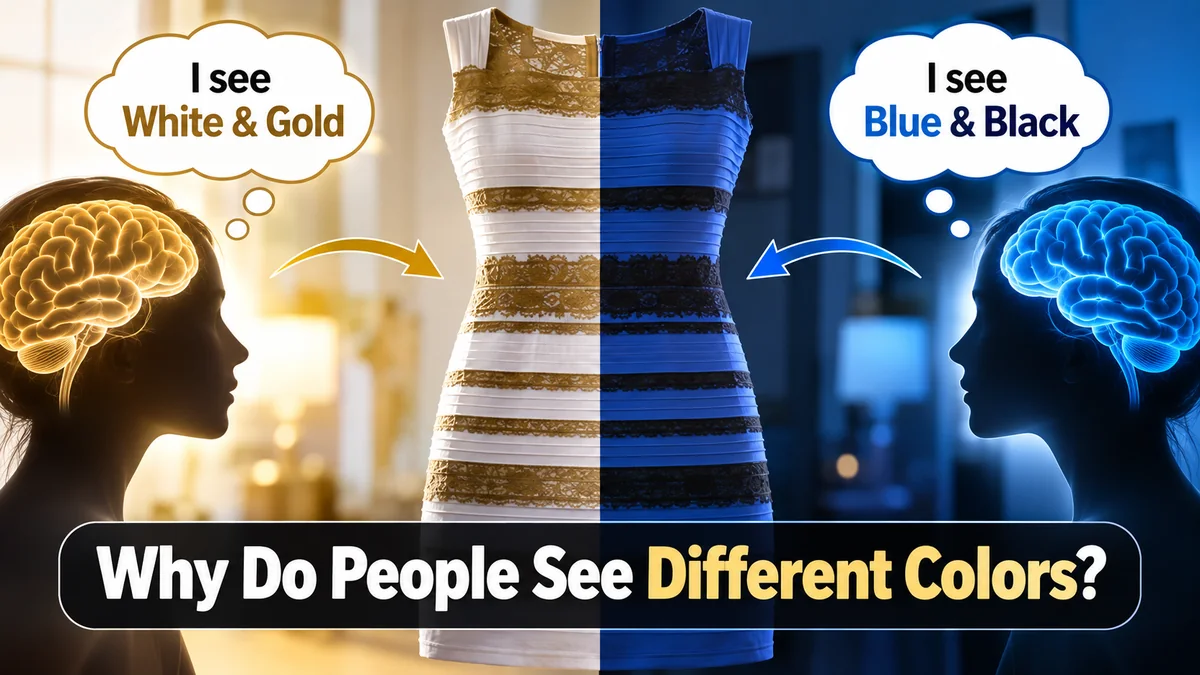
Few internet images have caused as much genuine disagreement as the black and blue dress. One person looks at the photograph and sees an obviously blue dress with black lace. Another looks at the exact same pixels and confidently sees white and gold.
The viral image, widely known as #TheDress, became famous in February 2015 because the disagreement was not simply an online joke. The physical garment really was blue and black, yet the ambiguous photograph caused many viewers to experience dramatically different colors. Scientific research has since linked the effect mainly to how the visual system estimates illumination and maintains color constancy. PubMed Central (PMC)
Quick answer: The black and blue dress looks white and gold to some people because the original photograph provides unusually weak information about its lighting. Your brain tries to compensate for the assumed light source. Discounting bluish illumination favors a white-and-gold interpretation, while discounting warmer illumination favors blue and black. ScienceDirect
What Was the Black and Blue Dress?
The phenomenon began with a photograph of a striped dress that spread across social media in February 2015. Viewers quickly separated into two main groups: those who perceived blue and black and those who perceived white and gold. Some people reported intermediate combinations as well. PubMed Central (PMC)
There are really two different questions hidden inside the debate:
| Question | Answer |
|---|---|
| What color was the physical dress? | Blue and black |
| What colors can the viral photograph appear to contain? | Blue/black, white/gold, and intermediate combinations |
| Why do perceptions differ? | The brain makes different assumptions about illumination |
| Is the photograph itself ambiguous? | Yes |
| Is this simply color blindness? | No |
That distinction is crucial. Saying the dress was physically blue and black does not mean somebody who experienced white and gold was pretending or failing to identify ordinary colors.
The ambiguity comes from the photograph.
What Is the Real Color of the Black and Blue Dress?
The actual garment was blue and black. Research papers examining the phenomenon explicitly distinguish the physical colors of the dress from the colors people perceive in the viral photograph. PLOS
So why doesn’t everyone simply see those colors?
Because your eyes do not function like a color-picker tool.
When you look at an object, the light reaching your eyes depends both on the object’s reflective properties and the illumination falling on it. Your visual system therefore has to estimate which part of the incoming light represents the object and which part comes from its surroundings.
Most of the time, this process works so smoothly that you never notice it.
The unusual photograph disrupted that process.
Why Does the Black and Blue Dress Look White and Gold?
The strongest explanation involves a visual mechanism called color constancy.
Color constancy allows your brain to perceive an object’s color as relatively stable even when illumination changes. A white sheet of paper, for example, still appears white outdoors, under warm indoor lighting, or in shade despite the wavelengths reaching your eyes changing considerably.
With the dress photograph, however, the lighting information is unusually ambiguous.
The visual system therefore has to make an assumption about what kind of illumination is affecting the scene. Different assumptions can produce dramatically different interpretations of the same image. Research involving roughly 13,000 observers found a strong relationship between people’s assumptions about illumination and their reported perception of the dress. PubMed
If Your Brain Assumes Bluish Illumination
Imagine that your visual system interprets the dress as being in a cool, bluish shadow.
It attempts to discount that blue illumination.
After mentally compensating for the assumed blue cast, the lighter portions can appear closer to white, while the darker portions can appear gold.
You therefore experience a white-and-gold dress.
If Your Brain Assumes Warm Illumination
Now imagine your visual system interprets the scene as being affected by warmer light.
It compensates differently.
The resulting interpretation makes the lighter material look blue and the dark lace look black.
That produces the blue-and-black perception corresponding to the physical garment.
The important point is that neither observer consciously chooses an interpretation. These adjustments happen automatically during visual processing. The Guardian
What Is Color Constancy?
Color constancy is your visual system’s ability to estimate stable surface colors despite changes in illumination.
Suppose you own a red coffee mug.
You take it outside at noon, bring it into a room illuminated by a warm lamp, and later place it near a window at dusk. The wavelengths reflected from the mug change in each environment, but you normally continue perceiving roughly the same red mug.
Your brain effectively separates two variables:
surface reflectance + illumination
That calculation is enormously useful because illumination constantly changes in everyday life.
The black and blue dress became extraordinary because the photograph removed many of the contextual clues that usually help the brain determine the illumination correctly. Researchers have therefore used #TheDress as a particularly striking example for studying individual differences in color perception and color constancy. PubMed Central (PMC)
Why Blue Is Especially Interesting
Research published in Current Biology identified an asymmetry in blue-yellow color perception that may help explain why this particular photograph became so ambiguous.
People appear especially willing to interpret bluish coloration as coming from illumination rather than from an object’s surface. This makes sense in natural environments because shadows and indirect skylight frequently contain a bluish cast. ScienceDirect
That characteristic makes the dress photograph almost perfectly positioned to create disagreement.
Why Can Two People See Different Colors on the Same Screen?
This is one of the most fascinating aspects of the illusion.
It would be easy to explain the controversy if one person’s phone simply displayed different colors. But observers can look at the same image on the same display under similar conditions and still disagree dramatically.
That tells us the phenomenon cannot be explained solely by monitor calibration.
The image reaching the eyes may be similar, but the brain still needs to interpret what produced those signals.
One person may unconsciously interpret the photograph as an object sitting in cool shadow. Another may infer a brightly illuminated or warm environment.
The physical stimulus can therefore remain the same while the perceptual interpretation changes. Scientific literature describes this striking difference between observers as one of the characteristics that made #TheDress particularly valuable for color-vision research. PubMed Central (PMC)
Does Screen Brightness Change What You See?
It can influence the appearance, but it does not fully explain the phenomenon.
A digital image is affected by factors such as:
- screen brightness;
- display color temperature;
- white balance;
- contrast;
- surrounding room illumination;
- image exposure;
- viewing angle and display technology.
Exposure and color balance were among the factors vision researchers considered when the image first became viral. Science Friday
Changing brightness or viewing conditions can sometimes make a person’s perception shift. Cropping the photograph or changing the surrounding visual context may also influence how the brain interprets its illumination.
But display settings alone cannot account for the famous disagreement because people can perceive different colors under effectively identical viewing conditions.
Why Was the Original Photograph So Ambiguous?
Ordinary photographs contain numerous clues about illumination.
You might see someone’s skin, a white wall, a shadow, a lamp or another familiar object. Those references help your visual system estimate what kind of light is illuminating the scene.
The dress photograph lacked sufficiently reliable contextual information.
Its exposure also produced colors that could plausibly support competing interpretations.
Your brain essentially had an underdetermined problem:
Is this a dark blue-and-black object receiving bright/warm illumination, or a light white-and-gold object under bluish illumination?
Both interpretations could make perceptual sense.
That ambiguity is why simply telling somebody the physical dress is blue and black does not necessarily cause their perception to change.
Knowing and seeing are not exactly the same process.
Are Your Eyes or Your Brain Responsible?
Both participate in color vision, but research suggests the dress phenomenon cannot be reduced to a single simple difference in the eye.
The retina contains photoreceptors that respond to different ranges of wavelengths. Those signals are subsequently processed through the visual system and brain, where context and illumination become important to the resulting color experience.
One 2016 study investigated whether early optical, retinal and neural factors contributed to the difference. Researchers reported differences involving macular pigment optical density and visual-evoked-potential latency between groups, while also emphasizing illumination assumptions as the prevailing explanation. PLOS
Other research has reinforced the importance of illumination priors—the expectations the visual system brings when trying to determine the lighting of an ambiguous scene. PubMed Central (PMC)
There is therefore no need to frame the phenomenon as “your eyes versus your brain.” Color perception emerges from a visual system in which retinal signals and subsequent neural processing work together.
Does Seeing White and Gold Mean You Are Color-Blind?
No.
Seeing the dress as white and gold is not, by itself, evidence of color vision deficiency.
Traditional color-vision deficiencies involve differences in how particular wavelengths are discriminated, often associated with cone photoreceptor function. #TheDress is primarily interesting because an ambiguous illumination context allows people with otherwise ordinary color vision to arrive at different perceptual interpretations.
Someone can have normal color vision and still see white and gold.
Likewise, seeing blue and black does not mean that person has “better” eyesight.
The phenomenon demonstrates how perception involves interpretation rather than providing a direct, pixel-for-pixel representation of the physical world.
Why Do Some People See the Dress Change Color?
Some viewers initially see white and gold and later suddenly perceive blue and black—or experience the reverse.
That is possible because the image sits near an ambiguous perceptual boundary.
Changing the surrounding context, lighting, screen settings or even how someone interprets the scene can alter which solution the visual system settles on.
Once the brain adopts another interpretation of the illumination, the colors may appear surprisingly different even though the image itself has not changed.
Experiments and demonstrations involving #TheDress have shown that spatial context, chromatic illumination and interactions between materials and light can influence color appearance. Researchers have even demonstrated related effects with the real garment under different lighting arrangements. PubMed Central (PMC)
Can You Force Yourself to See the Other Colors?
Not reliably.
You can experiment with the conditions that influence perception:
- Change your screen brightness.
- Look at the photograph in a brighter or darker room.
- Crop away some of the background.
- View it briefly and then look away.
- Compare the viral photograph with a correctly exposed photograph of the actual garment.
Some people experience an immediate switch. Others continue seeing the same colors.
That difference itself illustrates the point: visual perception is not entirely under conscious control.
Did Age, Gender, or Sleep Patterns Affect the Dress?
Researchers have investigated individual characteristics to determine why people fall into different perceptual groups.
A large study by Pascal Wallisch surveyed approximately 13,000 observers. Illumination assumptions had a strong relationship with how participants interpreted the dress, while demographic variables such as age and gender had comparatively smaller influences. The research also examined circadian type and prior exposure to different kinds of illumination. PubMed
The idea is sometimes simplified online into claims such as “morning people see white and gold” and “night owls see blue and black.”
Reality is less absolute.
Subsequent research examining illumination priors found only moderate relationships involving chronotype in its sample and emphasized that several factors contribute to individual differences. PubMed Central (PMC)
So your perception of the dress cannot reliably reveal your personality, intelligence or sleep habits.
Is the Black and Blue Dress an Optical Illusion?
Calling it an optical illusion is reasonable in everyday conversation, although perceptual ambiguity is more informative scientifically.
Many classic illusions cause almost everyone to experience a similar misleading effect.
The dress is unusual because different observers can settle on dramatically different interpretations of the same stimulus.
That makes it especially interesting to vision scientists.
The image exposes something normally hidden from awareness: the brain is constantly estimating environmental conditions before producing the colors that you consciously experience.
The Photograph Versus the Physical Object
Another useful distinction is between the photograph and the garment.
The physical dress has surface properties that produce its blue-and-black appearance under ordinary viewing conditions.
The viral photograph is a digital representation captured under unusual exposure and lighting circumstances.
When somebody says, “The pixels aren’t black and blue,” they are discussing image values.
When somebody says, “The dress is blue and black,” they are discussing the physical garment.
Those statements address different things and therefore do not necessarily contradict each other.
What Does the Dress Teach Us About Human Vision?
The most important lesson has little to do with clothing.
It shows that seeing is an active process.
Your eyes receive light, but the visual system must interpret that information. It estimates illumination, compares surrounding colors, uses context and draws on regularities learned from the environment.
Usually those calculations produce remarkably stable perceptions.
You walk from sunlight into a building without feeling as though every object’s color has suddenly transformed.
The dress created an unusual situation in which the available visual evidence supported more than one plausible interpretation.
Researchers have consequently used the phenomenon to study subjects including:
- color constancy;
- illumination estimation;
- individual differences in perception;
- blue-yellow color processing;
- spatial context;
- chromatic illumination;
- material-light interactions;
- color naming.
Studies published after the viral event confirmed that #TheDress was much more than an amusing social-media argument. It provided researchers with an unusual natural experiment in how different brains interpret an ambiguous visual stimulus. ScienceDirect
Why the Black and Blue Dress Still Matters
The black and blue dress became famous because it revealed a basic truth about perception in an unusually dramatic way: two people can receive nearly identical visual information and still consciously experience different colors.
The physical garment was blue and black. The white-and-gold perception arises because the viral photograph leaves its illumination ambiguous, forcing the visual system to estimate which wavelengths belong to the light source and which belong to the dress. Different assumptions can produce different perceived colors. PubMed Central (PMC)
That is what makes #TheDress more than an old internet mystery. It is a memorable demonstration that color is not simply copied from the outside world into your mind. Your visual system continuously interprets light, context and surroundings to construct the stable world you normally see—and every once in a while, an image like the black and blue dress lets you catch that process in action.