
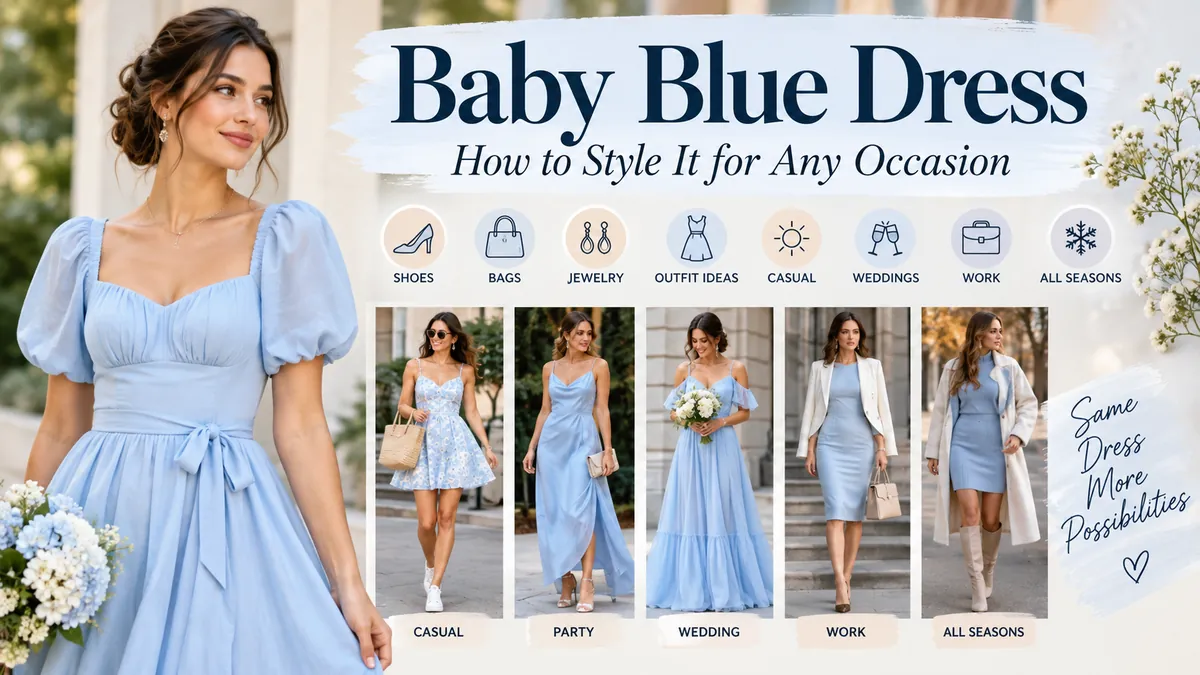
A baby blue dress has an unusual advantage: it can look romantic and delicate without being difficult to style. The same pale-blue shade can work for a summer lunch, wedding, graduation, cocktail event, date night, or even a polished daytime outfit simply by changing the shoes, fabric, jewelry, and accessories.
A baby blue dress is a pale, soft-blue garment that pairs especially well with white, ivory, nude, beige, silver, gold, blush pink, gray, and other pastel tones. For the most balanced outfit, match the dress’s fabric and silhouette to the occasion, then use shoes, jewelry, and a bag to control how casual or formal the finished look feels.
That sounds simple, but there is more room to experiment than you might expect. Baby blue works with neutrals, metallics, pastels and even carefully chosen high-contrast colors.
Why a Baby Blue Dress Is So Versatile
Baby blue sits within the broader family of light and pastel blues. Depending on the fabric and undertone, it may appear close to sky blue, powder blue, icy blue or a very soft periwinkle.
The color itself usually creates a light visual impression, so it works particularly naturally with spring and summer wardrobes. Yet there is no rule that restricts pale blue to warm weather. Velvet, heavier crepe, knitwear and structured outerwear can carry the color into autumn and winter.
Fabric makes an enormous difference.
A baby blue linen mini dress and a floor-length satin gown may share a color, but they communicate completely different levels of formality.
Common fabrics include:
- Linen and cotton for relaxed daytime outfits
- Jersey and knit fabrics for everyday wear
- Chiffon and georgette for flowing occasion dresses
- Satin and silk for evening and formal dressing
- Lace for romantic or traditional looks
- Tulle and organza for volume and special occasions
- Crepe for cleaner, more structured silhouettes
- Velvet for cooler-weather evening outfits
This distinction matters because accessories should respond to both the color and texture of the dress.
A silver crystal clutch might complement pale-blue satin beautifully while looking unnecessarily formal beside a simple cotton sundress.
Quick Takeaway: Start with the occasion and fabric before choosing accessories. Color coordination comes second.
What Colors Go With a Baby Blue Dress?
The easiest colors to combine with baby blue are white, ivory, cream, beige, nude, tan, soft gray and metallics. These shades support the lightness of blue rather than fighting against it.
Pastels such as blush pink, lavender and mint can create a softer tonal palette. Darker colors such as navy, charcoal or black provide greater contrast and therefore need more deliberate styling. Current fashion coverage also shows designers combining baby blue with more expressive colors such as yellow and lavender, demonstrating that pale blue does not have to be treated exclusively as a delicate neutral.
| Color | Effect with Baby Blue | Good For |
|---|---|---|
| White | Fresh, clean | Summer, daytime |
| Ivory/Cream | Soft, refined | Weddings, formal events |
| Nude/Beige | Understated | Almost any occasion |
| Silver | Cool, polished | Cocktail and evening wear |
| Gold | Warm contrast | Parties and formal events |
| Blush Pink | Romantic | Spring events |
| Lavender | Soft tonal contrast | Daytime and weddings |
| Mint | Fresh pastel combination | Spring/summer |
| Tan/Camel | Warm and relaxed | Casual outfits |
| Gray | Modern and subtle | Work and transitional weather |
| Navy | Tonal but grounded | Smart daytime outfits |
| Red | Strong contrast | Statement styling |
| Black | Sharp, dramatic | Evening or structured looks |
The important principle is visual weight.
Baby blue is visually light. If every accessory is black and chunky, the accessories can dominate the outfit. A thin black sandal or small black bag creates a much more controlled contrast than heavy black boots, a large black handbag and dark jewelry worn simultaneously.
What Shoes Go With a Baby Blue Dress?
Shoe choice is one of the most common styling questions surrounding light-blue dresses. Across current styling guides, white, nude, beige, metallic and other soft neutrals repeatedly appear as versatile options.
Nude and Beige Shoes
Nude and beige are among the easiest choices when you want the dress to remain the focal point.
Because these colors are visually quiet, they work especially well with:
- Cocktail dresses
- Midi dresses
- Wedding guest outfits
- Bridesmaid dresses
- Formal gowns
- Business-appropriate dresses
“Nude” is not one universal beige. A shoe closer to the wearer’s skin tone creates a more continuous visual line, while tan or camel footwear creates a more noticeable warm contrast.
White and Ivory Shoes
White creates a crisp combination with pale blue and is particularly effective in spring and summer.
Try white sneakers with a casual cotton dress, white sandals with a sundress, or sleek white heels with a contemporary midi.
Ivory is slightly softer. It can therefore feel particularly natural alongside chiffon, lace, satin and other romantic fabrics.
Current styling guidance also treats white footwear as more versatile than simply a casual option; the silhouette and material of the shoe largely determine its formality.
Silver Shoes
Silver naturally complements the cool undertones found in many baby-blue fabrics.
It works especially well for:
- Evening events
- Cocktail parties
- Weddings
- Formal dinners
- Prom
- Satin or embellished dresses
A brushed or muted silver creates a softer result, while mirrored metallic heels make a stronger statement.
Gold and Champagne Shoes
Gold introduces warmth.
Instead of matching the cool character of blue, it creates subtle temperature contrast. Champagne metallics provide an even softer alternative and can be particularly elegant with muted or dusty baby blue.
Keep other metallic details reasonably consistent. Gold earrings, champagne heels and a warm metallic clutch create more cohesion than several competing metal finishes.
Blush Pink Shoes
Blush and pastel pink create a romantic palette without producing dramatic contrast.
The combination works particularly well for garden weddings, spring celebrations and feminine daytime outfits.
If the dress already has bows, lace, ruffles or other decorative details, however, simple footwear usually prevents the overall look from becoming overly sweet.
Navy Shoes
Navy offers tonal dressing with more depth.
A navy pump or loafer can ground a pale-blue dress while maintaining a relationship between the colors. This can be useful for professional settings where metallic or pastel footwear might feel too decorative.
Can You Wear Black Shoes With a Baby Blue Dress?
Yes, but proportion matters.
Black produces one of the strongest contrasts against pale blue. Several styling sources caution that it can feel visually heavy, particularly with an airy dress, while noting that slimmer silhouettes such as strappy sandals or pointed pumps make the combination easier to balance.
If you choose black shoes, repeating black once elsewhere—a narrow belt, small clutch or subtle hair accessory—can make the contrast appear intentional.
How to Accessorize a Baby Blue Dress
The most successful accessories usually do one of two things: quietly support the dress or provide one controlled focal point.
Problems tend to appear when shoes, earrings, necklace, handbag and hair accessories are all trying to become that focal point simultaneously.
Silver Jewelry
Silver, white gold and platinum-toned jewelry complement the cool character of light blue particularly well.
Try:
- Small silver hoops
- Fine chain necklaces
- Crystal drop earrings
- Minimal bracelets
- Delicate pendant necklaces
This is an easy direction for icy or cool-toned versions of baby blue.
Gold Jewelry
Gold creates a warmer contrast.
It can be especially effective when the outfit already contains cream, champagne, beige or tan. Instead of making everything cool-toned, gold introduces warmth around the face.
For a minimalist dress, a slightly stronger gold earring can become the outfit’s main detail.
Pearls and Soft Gemstones
Pearls are a natural match for formal pale-blue clothing because their soft sheen doesn’t compete aggressively with the color.
Mother-of-pearl, crystals and opalescent details can achieve a similar effect. Contemporary blue-dress styling guides frequently recommend pearls, silver, rose gold, crystals and opal-like accents for baby and sky-blue outfits.
What Color Bag Goes With a Baby Blue Dress?
For maximum versatility, start with:
Daytime: white, ivory, tan, camel, beige or raffia.
Formal events: silver, champagne, pearl, cream or metallic clutches.
Pastel outfits: blush pink, lavender, mint or soft gray.
Statement looks: coral or red.
Your shoes and bag do not need to be exactly the same color. They simply need to make sense within the same palette.
For example, nude heels with an ivory clutch look cohesive without appearing overly matched.
Baby Blue Dress for a Wedding
Baby blue is frequently associated with wedding guest and bridesmaid dressing because the shade translates well into chiffon, satin, lace, tulle and other occasion fabrics. Wedding styling references commonly pair it with beige, tan and metallic accessories while also using warmer accent colors for contrast.
A reliable wedding guest combination is:
- Choose a midi or maxi dress appropriate to the dress code.
- Add nude, champagne, silver or refined ivory footwear.
- Choose delicate metallic or pearl jewelry.
- Carry a small structured bag or clutch.
- Keep the remaining accessories restrained.
The wedding’s stated dress code remains more important than the color itself.
A floaty baby blue sundress may be perfectly suitable for a relaxed outdoor celebration but underdressed for black tie. Conversely, a heavily embellished floor-length gown could feel excessive at a casual daytime ceremony.
For a Spring or Summer Wedding
Chiffon, silk, satin, organza and lightweight crepe work naturally.
Try:
Baby blue midi + nude sandals + pearl earrings + ivory clutch
or:
Baby blue maxi + silver heels + crystal earrings + silver clutch
For an outdoor garden event, block heels or wedges may also be more practical than narrow stilettos.
Baby Blue Dress for a Formal Event
Formal dressing depends heavily on material and construction.
Satin, silk, structured crepe, taffeta, chiffon and embellished fabrics immediately make baby blue feel more sophisticated.
For cocktail attire, consider a fitted or flowing midi with metallic sandals.
For a black-tie setting, a floor-length gown with restrained jewelry generally works better than trying to create formality through accessories alone.
A useful rule is:
The more detail the dress has, the less jewelry it needs.
An embellished neckline may require only earrings. A minimalist column gown leaves more space for a statement necklace or dramatic earrings.
Baby Blue Dress for Casual Outfits
The same color becomes much more relaxed in cotton, linen, jersey or denim-inspired fabrics.
A casual baby blue dress works with:
- Clean white sneakers
- Flat leather sandals
- Espadrilles
- Ballet flats
- Loafers
- Neutral ankle boots in cooler weather
White sneakers are especially useful with shirt dresses, T-shirt dresses and simple minis.
For a warmer, slightly rustic combination, pair pale blue with tan leather or woven accessories. Raffia bags and espadrilles also complement the airy character of the color.
The mistake to avoid is treating a casual dress as though it needs formal styling simply because the color looks delicate.
Sometimes white sneakers and a small crossbody bag are enough.
Baby Blue Dress for Work
Baby blue can also function in a professional wardrobe when the dress itself has sufficient structure and coverage.
A knee-length or midi silhouette in crepe, suiting fabric or a substantial knit works more naturally than sheer chiffon or heavily embellished satin.
Pair it with:
- Navy pumps
- Nude pointed flats
- Beige loafers
- Soft-gray footwear
- Structured neutral handbag
- Minimal jewelry
A navy blazer can create an effective tonal combination because it repeats blue at a much deeper value.
Gray is another useful partner. It provides definition without the severity that black sometimes creates against pale blue.
How to Style Different Baby Blue Dress Lengths
Length changes the proportions of an outfit, so the same accessories cannot automatically be transferred from a mini to a maxi.
Baby Blue Mini Dress
A mini already exposes more leg and often feels youthful or casual.
For daytime, try sneakers, flats or simple sandals. For evening, slim heels can sharpen the silhouette without overwhelming it.
If the dress is short and highly embellished, keep the accessories especially restrained.
Baby Blue Midi Dress
The midi is arguably the most adaptable length.
It can work for:
- Weddings
- Work events
- Graduations
- Lunches
- Christenings
- Cocktail parties
- Date nights
Pointed pumps create structure, while strappy sandals make the same dress feel lighter.
Baby Blue Maxi Dress
A flowing maxi naturally creates visual impact.
Flat sandals or espadrilles work for casual versions. Metallic or nude heels are better suited to formal styles.
With a floor-length dress, consider what will actually remain visible. Elaborate shoes may disappear beneath the hem, so earrings, hair and the neckline can become more important styling areas.
Matching the Accessories to the Fabric
This is where many outfits either come together or become visually confused.
Think of fabric texture as part of the color palette.
| Dress Fabric | Accessories That Work Well |
|---|---|
| Satin | Metallic heels, crystal jewelry, clutch |
| Silk | Fine jewelry, minimal sandals |
| Chiffon | Delicate heels, pearls, soft metallics |
| Linen | Leather sandals, raffia, woven bag |
| Cotton | Sneakers, flats, simple crossbody |
| Lace | Pearls, nude heels, minimal bag |
| Organza | Delicate metallic accessories |
| Velvet | Structured bag, deeper metallics |
| Crepe | Pumps, architectural jewelry |
| Knit | Loafers, boots, understated jewelry |
A satin baby blue dress reflects light, meaning highly reflective jewelry and shoes can quickly create too much shine.
A matte linen dress behaves differently. It can accommodate textured accessories such as woven leather, straw and raffia without feeling overloaded.
Quick Takeaway: Match the finish as carefully as the color. Matte fabrics tolerate texture; glossy fabrics often need simpler accessories.
Baby Blue Dress Outfit Ideas by Occasion
Rather than memorizing dozens of rules, build the outfit around the environment.
Summer Day
Pair a lightweight baby blue sundress with white sandals or sneakers, a woven bag and minimal jewelry.
This keeps the palette fresh without making an ordinary daytime outfit feel overly styled.
Garden Party
Try a floral-detail or flowing midi with nude block heels, a cream bag and pearl earrings.
Blush accessories can add another pastel without overpowering the blue.
Date Night
A fitted satin or crepe midi can be paired with silver strappy heels, a compact clutch and delicate earrings.
For stronger contrast, use one red accent rather than several competing colors.
Graduation
A simple midi or structured mini with nude, white or beige footwear photographs cleanly and works underneath graduation robes.
Avoid accessories that repeatedly catch on the gown or hood.
Cocktail Party
A satin baby blue dress with silver heels and crystal earrings creates a coherent evening palette.
If the dress itself has sequins or rhinestones, remove one other sparkling element.
Beach or Destination Event
Choose breathable linen, chiffon or lightweight cotton.
Neutral sandals, espadrilles, raffia and natural textures prevent the pale blue from feeling excessively formal.
What Makeup Goes With a Baby Blue Dress?
Makeup does not need to match the dress literally.
Instead, think about temperature.
Cooler makeup—soft pink blush, taupe or gray-brown eyeshadow and rosy lip colors—can maintain the cool palette.
Warmer nude, peach or coral tones introduce contrast and can stop a pastel outfit from becoming overly monochromatic.
For evening, a defined eye with a neutral lip usually lets the dress remain prominent. Alternatively, a red lip can act as the single high-contrast element in an otherwise minimal outfit.
Avoid automatically choosing bright blue eyeshadow simply because the dress is blue. Matching makeup and clothing too precisely can make the outfit feel more costume-like than coordinated.
What Nail Colors Work With Baby Blue?
Nails provide another opportunity to control the mood.
For a subtle finish, consider:
- Milky white
- Sheer nude
- Pale pink
- French manicure
- Soft gray
For evening, silver or chrome details can repeat metallic accessories.
For a playful pastel palette, lavender, peach or mint can work. A red manicure introduces deliberate contrast without requiring a large red accessory.
The nail color does not need to match the dress exactly.
Can You Wear Baby Blue in Fall and Winter?
Absolutely.
The seasonal shift comes primarily from fabric, layering and accessory weight, not from abandoning the color.
For autumn, combine a baby blue knit or heavier dress with taupe, camel, chocolate brown or gray.
In winter, consider:
- Charcoal coat
- Cream wool coat
- Gray boots
- Taupe boots
- Silver jewelry
- Structured leather bag
A pale blue velvet dress can also work beautifully for winter evening events.
This illustrates why rigid seasonal color rules are less useful than looking at the complete outfit.
How to Choose the Right Shade of Baby Blue
Not every pale-blue dress has the same undertone.
Place the garment in natural daylight and compare it with white. You may notice that the blue leans toward:
Gray: muted and sophisticated.
Green: closer to aqua or robin’s-egg territory.
Purple: approaching periwinkle.
White: icy and extremely pale.
These undertones affect accessory choices.
An icy blue naturally harmonizes with silver and cool gray. A slightly greenish blue can work beautifully with warm beige or gold. A periwinkle-leaning version coordinates easily with lavender.
This is one reason copying an outfit from a photograph does not always produce the same result—the two dresses labeled “baby blue” may actually be quite different colors.
Common Baby Blue Dress Styling Mistakes
The biggest mistake isn’t choosing a supposedly “wrong” color. It is creating several competing focal points.
Using Too Many Pastels
Baby blue, lavender, mint, blush and pale yellow can coexist, but using all of them in one outfit may dilute the visual hierarchy.
Choose one or two supporting colors.
Making Every Accessory Metallic
Silver shoes, a glitter clutch, crystal necklace, oversized earrings and metallic hair accessories can turn a refined evening look into visual clutter.
Choose where you want the shine.
Ignoring Fabric
Accessories that suit linen may not suit satin.
Treat material, sheen and texture as styling decisions rather than focusing exclusively on color.
Making Black Too Heavy
Black isn’t forbidden.
The issue is scale. A delicate black sandal can create elegant contrast; multiple heavy black accessories may overpower an extremely pale, floaty dress.
Matching Everything Exactly
Your shoes, bag, jewelry and hair accessories do not need to be identical.
A coordinated palette usually looks more natural than perfect matching.
A Simple Formula for Styling a Baby Blue Dress
When you’re standing in front of the wardrobe unsure what to add, use this sequence:
- Identify the occasion. Casual, professional, cocktail or formal?
- Look at the fabric. Matte, textured, flowing, structured or glossy?
- Choose one footwear direction. Neutral, metallic, tonal or contrasting.
- Repeat one element. Echo the shoe’s warmth or metal in your jewelry or bag.
- Choose one focal point. Let the dress, jewelry, shoes or bag lead—not all four.
- Check visual weight. Make sure dark or chunky accessories aren’t overwhelming a delicate dress.
This approach is more reliable than memorizing arbitrary rules about which colors supposedly “go” with blue.
Final Thoughts on Styling a Baby Blue Dress
A baby blue dress is versatile because its soft color can move easily between casual, romantic, professional and formal styling. White and ivory keep it fresh; nude and beige stay understated; silver emphasizes its cool tones; gold adds warmth; blush and lavender create pastel harmony; while navy, red or black introduce stronger contrast.
The most polished outfits consider more than color. Look at the dress’s fabric, silhouette, length, undertone and occasion, then choose accessories that reinforce that mood.
If you’re uncertain, start with the simplest formula: baby blue, neutral shoes, one coordinating bag and restrained jewelry. Once that foundation feels balanced, add contrast or color deliberately rather than adding accessories simply because they individually look attractive.