
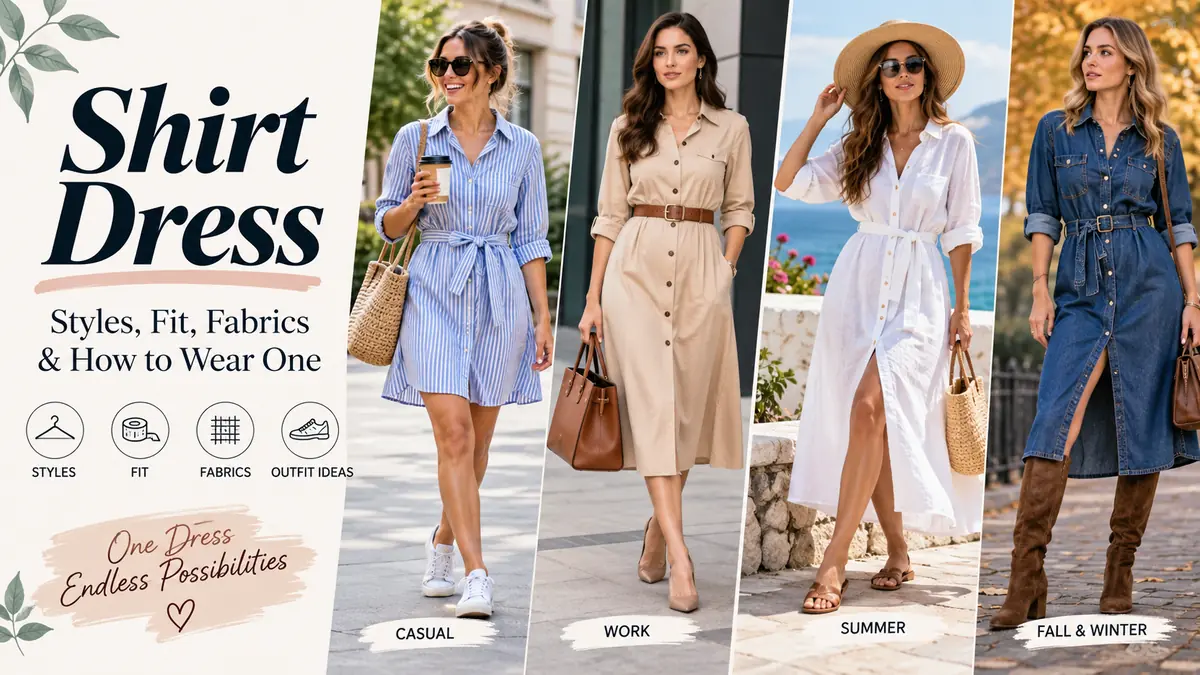
A shirt dress solves a surprisingly common wardrobe problem: you want the polish of a button-down shirt without having to coordinate separate pieces. Its structured collar and button placket make it look considered, while the longer dress silhouette keeps it comfortable and easy to wear.
A shirt dress is a dress inspired by a traditional button-down shirt, typically featuring a collar, front buttons, sleeves or cuffs, and a straight or shaped silhouette. It may be worn loose or belted at the waist and comes in mini, midi and maxi lengths, using fabrics ranging from cotton poplin and linen to denim, silk and viscose.
The design has lasted because it is adaptable rather than tied to one trend. A crisp cotton version can look appropriate for work, linen works beautifully in warm weather, denim makes the shape more casual, and a fluid midi version can move comfortably into evening wear.
What Is a Shirt Dress?
At its simplest, a shirt dress takes recognizable elements of a shirt and extends them into a garment long enough to function as a dress.
Traditional versions commonly include:
- A pointed or spread collar
- A button-down or button-through front
- Cuffed or rollable sleeves
- A defined shoulder
- A straight, A-line or fit-and-flare skirt
- A removable belt, self-tie sash or shaped waist
- Shirt-inspired details such as chest pockets or a curved hem
Not every design includes every feature. Modern interpretations can be sleeveless, oversized, collarless or partially buttoned while still retaining the recognizable shirt-inspired structure.
This flexibility is one reason the style crosses so many dress codes. The collar and placket provide structure, while fabric, hem length and waist treatment determine whether the finished outfit feels relaxed or polished.
Is a shirt dress the same as an oversized shirt?
No.
An oversized button-down is fundamentally a shirt made with extra volume. A shirt dress is constructed to work as a dress, so its length, side seams, hem, proportions and often its waist shaping are designed with full-body wear in mind.
That distinction matters when checking fit. An ordinary shirt sized up dramatically may become too wide at the shoulders before it becomes long enough to provide comfortable coverage.
Shirt dress vs. T-shirt dress
These names also describe different garments.
A classic shirt dress takes its design language from a collared button-down shirt. A T-shirt dress generally resembles an elongated T-shirt, with a knit construction and little or no tailoring.
The latter became a recognized variation in the 1960s.
Where Did the Shirt Dress Come From?
The modern design has roots in the shirtwaist dress, which combined a shirt-like upper section with a skirt. Shirt-inspired women’s clothing appeared well before the contemporary version became a wardrobe staple.
Practicality was part of its early appeal. White collared dresses were used for nursing uniforms in the early 20th century, while shirt dresses also appeared as sports dresses during the 1920s.
The silhouette became especially influential around the middle of the century.
Christian Dior’s 1947 New Look helped popularize a more defined waist and fuller skirt, and shirt dresses became widely established in women’s wardrobes during the 1950s. Designer Anne Fogarty was among those associated with versions of the style during that period.
That history helps explain why today’s versions vary so much. Some preserve a vintage fitted waist and full skirt, while others borrow the straighter proportions of modern menswear.
Quick takeaway: The shirt dress did not begin as a fleeting trend. It developed from practical shirtwaist clothing into a mid-century fashion staple and has continued evolving through oversized, minimalist, utility and contemporary interpretations.
Types of Shirt Dress and How They Differ
The basic formula may be simple, but changing the fabric, hem or waist creates a noticeably different garment.
| Style | Typical Characteristics | Overall Effect |
|---|---|---|
| Classic poplin | Crisp cotton, collar, cuffs, buttons | Clean and structured |
| Belted | Self-tie or separate belt | Defined waist |
| Oversized | Loose body, dropped shoulder | Relaxed and modern |
| Utility | Pockets, stitching, workwear details | Casual and structured |
| Denim | Heavier woven construction | Everyday and durable |
| Midi | Mid-calf hem | Versatile and balanced |
| Maxi | Ankle or floor-skimming hem | Long and dramatic |
| Linen | Breathable, naturally textured fabric | Relaxed warm-weather look |
| Silk/viscose | Fluid drape and softer surface | Refined and dressier |
These categories can overlap. A single design might be a belted linen midi shirt dress, for example.
Classic cotton poplin
Cotton poplin gives the silhouette its familiar crispness. The fabric holds a collar and cuff particularly well and creates clean lines around the shoulders.
A structured poplin version works when you want the appearance of tailoring without wearing a suit or separates.
The trade-off is creasing. Pure cotton can wrinkle during a long day, although the exact amount depends on the weave and finishing.
Belted shirt dress
Adding a belt changes the visual proportions quickly.
A self-tie sash can create a softer waist, while a leather belt produces sharper definition. The belt does not necessarily need to sit exactly where the garment’s original tie was positioned; placing it at your natural waist can sometimes create better proportions.
If the material bunches heavily beneath the belt, however, the dress may simply contain too much volume for the effect you want.
Oversized shirt dress
An oversized silhouette intentionally leaves space around the waist and body.
The key word is intentionally.
A well-designed oversized garment still needs appropriate shoulder placement, sleeve proportions and length. Simply buying a conventional style several sizes larger can create awkward proportions rather than the relaxed drape you were aiming for.
Leave it loose for a minimalist silhouette or add a belt when you want more definition.
Denim shirt dress
Denim adds structure and visual weight.
Traditional denim creates a firmer silhouette, while chambray and lyocell-based denim-like fabrics can produce a softer drape. This distinction becomes especially noticeable in warm conditions.
Boots, sneakers and simple leather accessories complement denim naturally, which makes this one of the easier casual versions to style.
Utility shirt dress
Utility designs borrow from workwear and safari clothing. Look for patch or flap pockets, epaulettes, visible stitching, metal hardware and sturdier fabrics such as cotton twill.
Because these details already create visual interest, complicated accessories usually aren’t necessary.
Midi shirt dress
A midi hem typically falls below the knee and toward the mid-calf region.
It is arguably the most adaptable length because it provides substantial coverage without the fabric volume of a maxi. Structured midi versions work well for professional settings, while loose linen versions feel much more casual.
Maxi shirt dress
Maxi versions extend toward the ankle or floor.
Buttons and side slits become especially useful at this length because they provide movement and allow you to control how much leg is visible.
With long styles, proportion matters. A defined waist, open neckline or carefully chosen footwear can keep substantial amounts of fabric from overwhelming the frame.
How Should a Shirt Dress Fit?
A good fit starts at the shoulders, not the belt.
The shoulder seam should sit appropriately for the intended cut, and the chest should close without buttons pulling apart. The fabric should then skim rather than strain across the hips unless the design is intentionally fitted.
A useful fit check is to stand, sit, walk and raise your arms.
Watch what happens to the buttons.
If the placket opens across the bust when you move normally, the garment needs more room or a different cut. Some contemporary designs use additional concealed or anti-gap buttons to reduce this problem.
Choosing by body shape
There is no body type that is inherently “wrong” for this style. What changes is the silhouette you may prefer.
| Shape or Fit Goal | Style Worth Trying | Why It Works |
|---|---|---|
| Defined waist | Belted or fit-and-flare | Emphasizes waistline |
| More room through midsection | Straight or relaxed cut | Allows fabric to skim |
| Balance fuller hips | A-line | Adds space through skirt |
| Add shape to straight frame | Belted, gathered or pleated | Creates definition |
| Petite proportions | Mini/knee-length or controlled midi | Reduces excess volume |
| Tall frame | Midi, maxi or oversized | Uses length effectively |
Treat this as a starting point, not a rulebook.
Someone with an hourglass figure may prefer an oversized silhouette precisely because they don’t want waist emphasis. Someone petite may love a full-length maxi. Personal preference matters more than conventional “body type rules.”
How long should it be?
Choose length based on both proportion and purpose.
A shorter version feels casual and exposes more leg, while knee and midi lengths generally offer easier coverage for workplaces. Maxi designs create more drama but require enough movement through the skirt for comfortable walking.
For button-through designs, experiment with the lowest buttons. Leaving one or two undone can provide extra movement without changing the basic silhouette.
Quick takeaway: Check shoulders, bust, button placement and movement before worrying about the waist. A belt can reshape excess volume, but it cannot correct a garment that pulls across the chest or restricts movement.
Best Fabrics for a Shirt Dress
Fabric can change the character of the exact same pattern more than almost any accessory.
Cotton poplin produces structure. Linen relaxes it. Denim adds weight. Silk and viscose introduce movement.
That is why fabric should be considered alongside color and length rather than as an afterthought.
Cotton and cotton poplin
Cotton is breathable and familiar, while poplin’s tight plain weave produces a relatively smooth, crisp surface.
Choose it when you want:
- Defined collars and cuffs
- Clean lines
- Breathability
- A classic button-down appearance
It works across seasons with appropriate layering.
Linen
Linen is particularly useful in hot weather because of its breathable nature and relaxed texture. Contemporary styling guides frequently recommend cotton and linen for warm conditions.
Expect wrinkles. They are part of linen’s natural appearance rather than necessarily a sign that something has gone wrong.
A linen blend may be preferable when you like the texture but want somewhat easier maintenance.
Lyocell and Tencel
Lyocell tends to feel smoother and drape more fluidly than crisp cotton. Tencel is a brand name used for certain lyocell fibers.
It is particularly useful when you want a denim-like or casual appearance without the stiffness associated with traditional heavy denim.
Denim and chambray
These materials may look related, but they behave differently.
Denim is generally heavier and more structured. Chambray is lighter and often feels closer to an everyday cotton shirt.
For summer, lighter chambray or soft lyocell-based denim can be easier to wear than rigid denim.
Viscose, rayon and silk
These materials create more fluid movement.
Silk can give the design a refined surface and elegant drape. Viscose and rayon can offer similar visual softness at different price points and with different care requirements.
They work particularly well when a crisp, office-style appearance isn’t the goal.
Polyester blends
Polyester blends can provide wrinkle resistance, durability and easier care, although breathability varies significantly depending on the construction and fiber mixture.
Don’t judge a garment from the fiber name alone. Fabric weight, weave, lining and fit all influence how comfortable it feels.
How to Style a Shirt Dress
The easiest approach is to make three decisions: waist, shoes and layer.
First decide whether the waist should remain loose or defined. Then choose footwear according to the setting. Finally, add a jacket, coat, knit or other layer only when the outfit needs it.
This avoids over-accessorizing an already structured garment.
1. Keep it casual with sneakers
Leave a cotton or linen design loose and add clean sneakers.
Roll the sleeves slightly and use a crossbody or simple shoulder bag. This combination works because the tailored collar provides enough structure to balance relaxed footwear.
2. Add a belt for definition
A belt is the quickest way to transform a boxy silhouette.
Try a self-fabric tie for a subtle effect or leather for contrast. Current styling guidance consistently uses waist definition as one of the core ways to alter the silhouette.
Avoid pulling the belt excessively tight. You want controlled folds, not large bunches of fabric around the waist.
3. Wear it with loafers for work
For a professional outfit, start with a structured midi style in cotton poplin, chambray or another fabric that holds its shape.
Add loafers, pointed flats or a modest heel.
A blazer can increase formality, but consider the collar interaction. If both garments are highly structured around the neckline, the combination can feel crowded.
4. Pair it with boots
Ankle and knee-high boots are natural partners for this silhouette.
Knee-high boots work particularly well beneath midi hems during cooler months, while ankle boots complement denim and utility versions.
Recent styling coverage also highlights tall boots, including rain and western-inspired boots, as useful combinations.
5. Wear it open as a layer
A fully button-through shirt dress can do something many conventional dresses cannot: become outerwear.
Unbutton it and wear it over a fitted top with jeans, trousers, shorts or another simple base layer.
Lightweight cotton and linen work especially well for this approach because they behave almost like a long overshirt.
6. Dress it up for evening
Choose a fabric with fluid movement or a more refined surface.
Define the waist if appropriate, open the neckline slightly and add heeled sandals, pumps or sleek boots. Jewelry and a structured bag can finish the outfit.
The goal isn’t to add everything at once. One or two stronger accessories are usually more effective than several competing elements.
Shirt Dress Outfit Ideas for Different Occasions
Versatility doesn’t mean every version works everywhere.
Fabric and construction determine dress code as much as the shirt-inspired shape itself.
For everyday wear
Try:
Cotton shirt dress + sneakers + crossbody bag
or
Denim shirt dress + ankle boots + simple shoulder bag
These combinations retain the garment’s structure while keeping the rest of the outfit relaxed.
For the office
Try:
Midi poplin shirt dress + slim belt + loafers + structured tote
A collar, controlled hem and defined waist generally read more formal than an oversized mini silhouette.
Office dress codes differ, so adjust length, neckline and sleeve coverage to the environment.
For warm weather
A loose linen version with flat leather sandals is difficult to beat for simplicity.
Roll the sleeves, leave the collar slightly open and avoid unnecessary layers. Cotton and linen are repeatedly favored for their breathability in warm-weather styling.
For travel
Look for a relaxed midi style that allows unrestricted movement.
Practical features include pockets, adjustable sleeves and a button front that lets you change ventilation. Fabrics that recover reasonably well after sitting are useful for long travel days.
For dinner or an event
A silk, viscose or fluid maxi version creates a noticeably different impression from everyday poplin.
Use elegant footwear and a defined bag. A bold earring or bracelet can provide enough visual interest without obscuring the clean neckline.
A polished shirt dress can also work for certain birthdays, showers and garden weddings when the fabric, color, print and dress code are appropriate.
How to Wear a Shirt Dress Through Different Seasons
This design is often associated with spring and summer, but thoughtful layering can make it useful throughout much of the year.
Spring
Use breathable cotton with loafers, sneakers or ankle boots.
A trench coat fits naturally over the collared silhouette and provides enough protection for variable temperatures without adding heavy bulk. Denim jackets are another straightforward option.
Summer
Prioritize lightweight cotton, linen, chambray or lyocell.
Flat sandals, sneakers and minimal accessories keep the outfit practical. Looser cuts also allow better air circulation than heavily fitted silhouettes.
Fall
This is where layering becomes particularly effective.
Add knee-high boots, a trench, suede jacket, denim jacket or lightweight knit. Western-inspired combinations using denim, suede and cowboy boots have also appeared prominently in recent styling coverage.
Winter
Start with a heavier cotton, denim or wool-blend version.
Depending on the climate, add tights, thermal layers, tall boots and a long coat. A thin turtleneck can sometimes be worn underneath a relaxed shirt dress, provided there is enough room through the shoulders and sleeves.
What Shoes Go With a Shirt Dress?
There isn’t one correct shoe because footwear controls the mood of the outfit.
| Shoes | Effect | Works Especially Well With |
|---|---|---|
| White sneakers | Casual | Cotton, denim, mini or midi |
| Loafers | Smart casual | Poplin and workwear styles |
| Pointed flats | Polished | Midi and belted styles |
| Flat sandals | Relaxed | Linen and summer styles |
| Heeled sandals | Dressier | Fluid midi/maxi styles |
| Ankle boots | Casual to polished | Denim and utility styles |
| Knee-high boots | Strong seasonal look | Midi dresses |
| Cowboy boots | Western-inspired | Denim and relaxed cotton |
Shoes can also correct proportion.
If a long, voluminous dress feels visually heavy, streamlined footwear may create balance. With a minimal straight-cut style, a stronger shoe can become the outfit’s focal point.
Glamour’s recent styling guidance similarly emphasizes beginning with footwear because shoes strongly influence how the entire garment reads.
Should You Wear a Shirt Dress With or Without a Belt?
Both approaches work; they simply communicate different silhouettes.
Wear it without a belt when you want:
- A relaxed shape
- More movement
- A minimalist aesthetic
- Better airflow in warm weather
- An intentionally oversized appearance
Wear it with a belt when you want:
- Clear waist definition
- More traditional proportions
- A polished finish
- Less visual volume
- A transition from daytime to dressier styling
A common mistake is assuming every loose style must be belted. Some garments are designed specifically around volume, and forcing the waist inward can distort their intended shape.
Try the outfit both ways in a full-length mirror before deciding.
Common Shirt Dress Styling Mistakes
Because the garment seems simple, small fit problems become surprisingly visible.
Ignoring button gaping
Pulling between buttons is a fit issue, particularly around the bust.
Try another size or cut rather than relying on the belt to disguise it. Designs with concealed buttons or anti-gap construction can also help.
Buying oversized instead of buying an oversized cut
These are not the same thing.
Purpose-designed oversized clothing accounts for shoulder width, sleeves and hem proportions. Arbitrarily sizing up can make all three areas too large.
Choosing fabric without considering climate
Heavy denim on a hot, humid afternoon may look great and feel miserable.
Likewise, very lightweight linen may not provide the structure you expect from formal workwear. Match material to weather and purpose.
Adding too many accessories
The collar, buttons, cuffs and belt already create multiple visual lines.
When the garment has a print, utility pockets or statement sleeves as well, simplify the jewelry and bag.
Forgetting about underwear and transparency
Light-colored cotton, linen and viscose can become more transparent in direct sunlight than they appear indoors.
Check the dress in strong natural light. Seamless underwear, a slip or appropriate lining may be necessary.
Ignoring the side view
A dress can look perfectly fitted from the front but pull across the bust, hips or buttons from another angle.
Always move around when assessing fit rather than judging from one static pose.
Why the Shirt Dress Remains a Wardrobe Staple
Fashion cycles change, but certain garments survive because their basic construction is useful.
The shirt dress is one of them.
It combines the familiar architecture of a button-down—collar, placket, cuffs and clean vertical lines—with the simplicity of a one-piece outfit. Contemporary fashion coverage continues to describe it as a versatile staple that moves between casual dressing, work and more polished occasions.
Its adaptability also comes from the number of variables available. Change cotton poplin to linen and the same basic silhouette becomes more relaxed. Change linen to silk and it becomes more refined. Add a belt and the waist appears structured; remove it and the silhouette becomes loose. Swap sneakers for knee-high boots and the seasonal character changes immediately.
That makes a shirt dress less of a single look than a framework. Start by choosing the right fabric and fit, make sure the shoulders and buttons sit comfortably, and then use the belt, footwear and layers to control how polished or relaxed it feels. The best next step is simple: style the garment around the occasion and your preferred silhouette rather than trying to follow a rigid set of body-type or fashion rules.