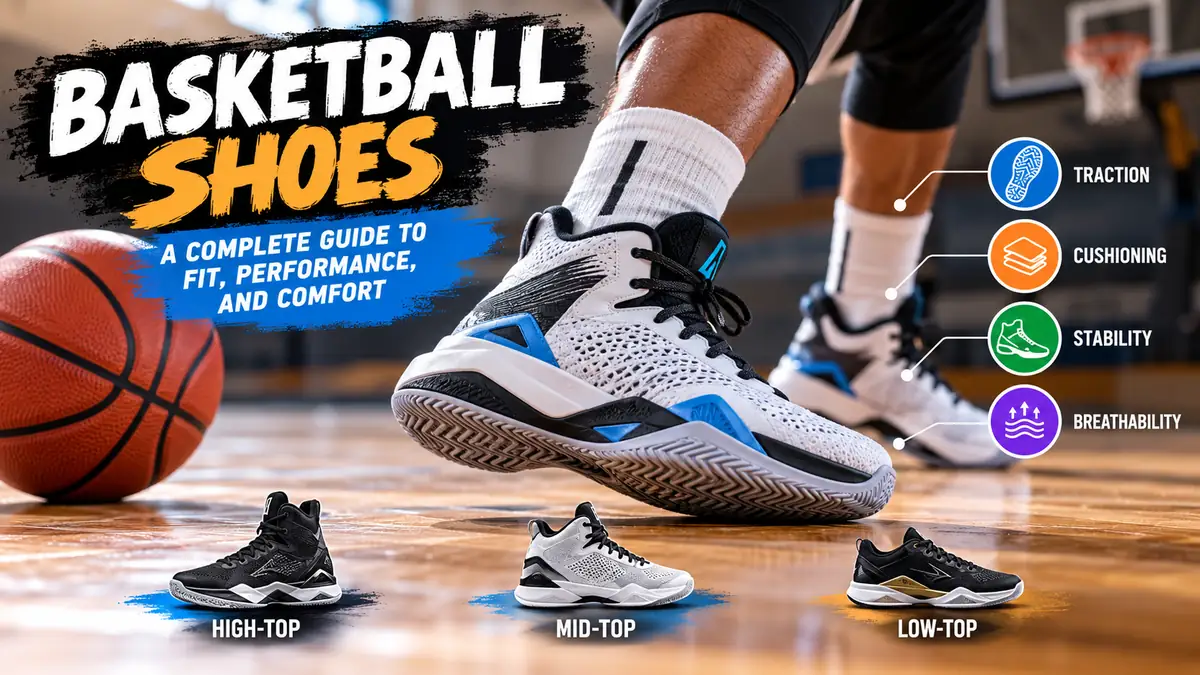
The right basketball shoes can make a noticeable difference in how comfortably you move on the court. Basketball involves sudden stops, explosive jumps, lateral cuts, pivots, and repeated landings. Ordinary athletic footwear may not provide the combination of grip, stability, and cushioning these movements demand.
Basketball shoes are athletic footwear designed for the movements of basketball, including running, jumping, cutting, and quick changes of direction. Their main features include traction-focused rubber outsoles, impact-absorbing midsoles, supportive uppers, and secure heel construction. The most suitable pair depends on foot shape, playing surface, movement style, and personal comfort.
Understanding these features helps players evaluate footwear beyond appearance, brand reputation, or professional athlete endorsements.
What Are Basketball Shoes and How Do They Work?
Basketball shoes are specialized sports shoes built to support multidirectional movement on hardwood, synthetic courts, and outdoor playing surfaces.
Unlike conventional running shoes, which primarily accommodate forward motion, basketball footwear must also handle sideways movement, abrupt deceleration, and rapid changes in direction.
Most designs contain four main components:
- Outsole: The bottom rubber layer that provides traction against the court.
- Midsole: The cushioning structure that absorbs and distributes forces during movement.
- Upper: The material surrounding the foot, helping maintain a secure fit.
- Heel counter: A reinforced section around the heel that improves rearfoot stability.
Additional components may include a torsional shank, lateral outrigger, internal heel padding, and reinforced toe area.
These parts work together, but no single feature determines overall performance. A shoe with excellent cushioning can still feel unstable if its fit is poor, while an aggressive tread pattern may perform inconsistently on dusty courts.
How Basketball Footwear Differs From Running Shoes
| Feature | Basketball Shoes | Running Shoes |
|---|---|---|
| Primary movement | Multidirectional | Mostly forward |
| Traction | Court-oriented patterns | Road or trail patterns |
| Lateral support | Usually emphasized | Varies by design |
| Cushioning | Balances impact protection and stability | Often prioritizes repetitive forward impact |
| Upper construction | Secure containment during cuts | Often optimized for forward stride |
| Playing surface | Indoor and outdoor courts | Roads, tracks, and trails |
Running shoes are not automatically unsafe for every casual basketball activity. However, they are generally not designed around the same lateral forces and court-specific movement patterns.
Types of basketball shoes
Basketball footwear is commonly categorized by collar height, although modern performance differences are more complex than the traditional high-top versus low-top distinction.
High-Top Basketball Shoes
High-top designs extend above the ankle and provide a more enclosed feeling around the lower leg.
They may appeal to players who prefer additional ankle coverage, a structured upper, or a traditional basketball silhouette.
Potential advantages include a secure-feeling collar and increased coverage. Possible drawbacks include additional weight, reduced perceived flexibility, and greater warmth.
Importantly, a high collar does not guarantee protection against ankle sprains. Fit, sole stability, movement mechanics, and previous injury history also matter.
Mid-Top Basketball Shoes
Mid-top shoes typically finish around the ankle, offering a compromise between coverage and freedom of movement.
They are commonly used by players across multiple positions because they can combine moderate collar height with relatively flexible construction.
However, a mid-top label alone says little about the shoe’s actual stability. The heel counter, outsole width, upper containment, and overall fit remain essential.
Low-Top Basketball Shoes
Low-top shoes sit below the ankle and often prioritize mobility and a less restrictive feel.
Many guards and quick-moving players prefer this construction, although forwards and centers also wear low-tops.
The main considerations are secure heel lockdown, reliable lateral containment, and sufficient stability through the sole.
A properly fitted low-top can offer excellent court performance. Collar height should therefore be treated as a preference and design characteristic rather than a direct measure of injury prevention.
Essential Features of Basketball Shoes
Traction and Outsole Grip
Traction determines how effectively a shoe grips the court during acceleration, deceleration, and direction changes.
One of the most recognizable outsole designs is the herringbone pattern, featuring angled grooves that create multiple gripping edges.
Other common patterns include radial grooves, multidirectional geometric shapes, and brand-specific traction layouts.
Performance depends on more than tread appearance. Rubber composition, groove depth, floor condition, and accumulated dust all influence grip.
Indoor hardwood courts generally reward rubber compounds that grip smooth surfaces consistently. Outdoor courts require greater attention to abrasion resistance and outsole durability.
Cushioning and Impact Protection
Basketball places repeated loading demands on the feet and lower limbs, particularly during jumping and landing.
Cushioning systems help manage these forces while influencing how the court feels beneath the player.
Common cushioning materials and technologies include:
- EVA foam, a lightweight material widely used in athletic midsoles.
- Polyurethane-based foams, which can offer different durability and resilience characteristics.
- Nike Zoom Air, which uses pressurized air units.
- Adidas BOOST, known for its expanded foam construction.
- Under Armour HOVR, a cushioning platform used in selected athletic footwear.
The presence of a branded technology does not automatically make a shoe superior. Thickness, placement, foam firmness, and the complete midsole design all affect the experience.
Soft cushioning may feel comfortable initially but can reduce the sense of stability for some players. Firmer platforms may offer stronger court feedback but feel less forgiving during repeated landings.
The most useful balance depends on playing style, body characteristics, and individual preference.
Stability and Lateral Containment
Lateral stability becomes especially important when a player plants one foot and changes direction.
Design elements that contribute to stability include a broad outsole base, supportive sidewalls, reinforced upper panels, and a secure heel.
A lateral outrigger is an extension of the sole near the outside forefoot. Its purpose is to widen the support platform during side-to-side movement.
Some basketball shoes also include a midfoot shank to manage twisting and improve structural support.
A shoe should allow normal foot movement without permitting excessive sliding inside the upper.
Breathability and Upper Materials
Modern basketball uppers commonly use engineered mesh, knitted textiles, synthetic leather, and reinforced woven materials.
Mesh and knit constructions can improve airflow and reduce weight. Synthetic leather and structured overlays may offer additional containment and abrasion resistance.
The best construction combines flexibility where the foot bends with reinforcement where the foot needs to remain secure.
Players who experience excessive heat or moisture may particularly value breathable uppers and moisture-managing socks.
How to Choose the Right Basketball Shoes
Choosing basketball footwear involves matching the shoe’s characteristics to the player’s feet, movement patterns, and playing environment.
A practical approach is to prioritize fit and traction before considering cushioning preferences, appearance, or professional endorsements.
Step 1: Understand Your Playing Style
Different movement patterns create different footwear demands.
| Playing Style | Useful Shoe Characteristics |
|---|---|
| Quick guards | Reliable traction, responsive cushioning, secure lockdown |
| Shooting guards | Balanced cushioning, flexibility, lateral containment |
| Forwards | Stability, impact protection, multidirectional grip |
| Centers | Supportive platform, cushioning, durable construction |
| Versatile players | Balanced traction, comfort, and stability |
These are guidelines rather than strict rules. A center may prefer lightweight low-top footwear, while a guard may value substantial cushioning.
Individual movement style matters more than position alone.
Step 2: Consider Your Foot Shape
Foot width, arch characteristics, and overall foot volume can influence how a shoe fits.
Players with wide feet should look for sufficient forefoot space and avoid uppers that create persistent pressure along the sides.
Those with narrow feet may benefit from secure lacing systems and structured midfoot containment.
A high arch does not automatically require maximum cushioning, just as flat feet do not necessarily require a rigid shoe.
Players with recurring foot discomfort may benefit from a professional footwear assessment rather than relying on general recommendations.
Step 3: Check the Fit
A basketball shoe should feel secure without excessive tightness.
The heel should remain stable during walking, jogging, and directional changes. The toes should have enough room to move naturally without striking the front during abrupt stops.
A practical fitting process includes:
- Measure both feet while standing.
- Try shoes with the socks normally worn during basketball.
- Check toe clearance and forefoot width.
- Lace the shoes securely without creating pressure points.
- Walk, perform controlled side steps, and test gentle changes of direction.
- Check whether the heel lifts or the foot slides inside.
- Compare comfort after several minutes of movement.
Trying shoes later in the day can be helpful because feet may become slightly larger after normal daily activity.
Step 4: Evaluate Cushioning and Court Feel
Court feel describes how connected a player feels to the playing surface.
A low-profile midsole can provide a more direct sensation of the floor, while thicker cushioning may create a softer experience.
Neither is universally better.
Players who value rapid footwork may prefer responsive cushioning and a lower platform. Those who frequently jump or experience discomfort from repeated impact may prefer greater cushioning, provided the shoe remains stable.
Step 5: Examine Overall Construction
Look at how the outsole, midsole, upper, and heel structure work together.
A shoe should not twist excessively through the midfoot, allow uncontrolled side-to-side movement, or create uncomfortable pressure during normal basketball motions.
Fit should feel fundamentally correct from the beginning. Breaking in a shoe may soften materials, but it should not be necessary to tolerate significant pain.
Indoor vs. Outdoor basketball shoes
Playing surface is one of the most important factors affecting traction and durability.
Indoor Basketball Shoes
Indoor basketball is commonly played on hardwood or specialized synthetic surfaces.
Indoor-oriented shoes often use rubber compounds and traction patterns designed for grip on relatively smooth courts.
A clean outsole and maintained court surface help preserve traction. Dust accumulation can reduce grip even when the tread remains visibly intact.
Some players reserve a separate pair exclusively for indoor basketball to limit dirt transfer and unnecessary outsole wear.
Outdoor Basketball Shoes
Outdoor courts may use asphalt, concrete, or textured synthetic materials.
These surfaces are often more abrasive than indoor hardwood.
Outdoor-oriented footwear typically benefits from:
- Durable rubber compounds.
- Sufficient tread depth.
- Abrasion-resistant upper materials.
- Supportive cushioning for repeated play.
- A stable sole construction.
Soft rubber that grips an indoor floor effectively may wear rapidly on rough concrete.
Can Indoor Basketball Shoes Be Used Outdoors?
Yes, but their durability depends on outsole materials, tread design, playing frequency, and surface roughness.
Occasional outdoor use may cause limited wear. Regular play on abrasive concrete can substantially shorten the lifespan of certain indoor-focused designs.
Likewise, an outdoor-oriented shoe can sometimes perform indoors, but a hard-wearing rubber compound does not guarantee excellent grip on polished hardwood.
| Factor | Indoor-Oriented Shoes | Outdoor-Oriented Shoes |
|---|---|---|
| Primary surface | Hardwood and smooth synthetic courts | Asphalt, concrete, textured courts |
| Rubber emphasis | Grip on smooth flooring | Abrasion resistance |
| Tread | Often detailed or multidirectional | Often deeper or more robust |
| Durability on concrete | Varies; may wear quickly | Generally prioritized |
| Dust sensitivity | Can affect grip considerably | Depends on outsole and surface |
| Cushioning | Model-dependent | Model-dependent |
The strongest indicator is the shoe’s actual construction, not simply its indoor or outdoor label.
Basketball Shoe Brands and Signature Technologies
Several athletic footwear manufacturers develop specialized basketball lines. Their products differ in shape, cushioning, materials, and design philosophy.
Nike and Jordan Brand
Nike produces basketball footwear associated with athletes including LeBron James, Kevin Durant, Giannis Antetokounmpo, Ja Morant, and Sabrina Ionescu.
Its footwear technologies include Zoom Air, ZoomX, Cushlon, and various supportive plate constructions.
Jordan Brand originated from Michael Jordan’s signature footwear and now includes performance models associated with athletes such as Luka Dončić, Jayson Tatum, and Zion Williamson.
Modern Jordan basketball designs combine different traction, cushioning, and containment systems depending on the model.
Nike.com
+1
Adidas
Adidas develops basketball shoes associated with players such as James Harden, Damian Lillard, Donovan Mitchell, and Anthony Edwards.
Its performance technologies include BOOST and Lightstrike cushioning, alongside specialized outsole and upper constructions.
Individual Adidas models vary considerably in fit and ride characteristics, so generalizing about the entire brand can be misleading.
adidas UK
Under Armour, PUMA, and New Balance
Under Armour has developed basketball footwear using technologies such as HOVR cushioning and Flow outsole systems, including shoes associated with Stephen Curry.
PUMA offers basketball designs emphasizing combinations of cushioning, traction, and modern upper materials.
New Balance has expanded its basketball footwear range with performance-oriented cushioning and fit options.
Other manufacturers include ANTA, Li-Ning, Converse, and Reebok.
The existence of multiple brands gives players access to different shoe shapes and construction approaches. No manufacturer consistently provides the ideal fit for every foot.
What Are Signature Basketball Shoes?
Signature shoes are models developed around a professional basketball player’s identity, preferences, or playing style.
They may incorporate design input from the athlete, specialized performance features, and distinctive visual elements.
Examples include footwear lines associated with LeBron James, Stephen Curry, and Michael Jordan.
However, a signature model is not automatically better than a non-signature performance shoe.
The actual fit, traction, stability, and cushioning remain more meaningful than the athlete’s name.
Basketball Shoes, Ankle Support, and Injury Prevention
One of the most persistent questions about basketball footwear concerns ankle protection.
High-top shoes have traditionally been associated with greater ankle support because their collars extend above the ankle joint.
However, research does not establish that high-top basketball shoes consistently prevent ankle sprains better than low-top designs during actual basketball participation.
A randomized study involving 622 recreational college basketball players found no statistically significant difference in ankle sprain rates between the shoe-height groups studied.
PubMed
A separate study of NBA players during the 2020–2021 season also found no significant difference in ankle injury rates between low-, mid-, and high-top shoe groups.
PMC
More recent laboratory research has demonstrated that high-top designs can reduce certain ankle inversion movements under controlled conditions. These findings suggest a possible mechanical benefit, but laboratory results do not automatically establish reduced injury rates during games.
PubMed
What Actually Contributes to Ankle Stability?
Footwear stability involves several interacting factors:
- Secure heel and midfoot fit.
- Appropriate lateral containment.
- A stable outsole platform.
- Controlled foot movement inside the shoe.
- Player strength, balance, and movement technique.
Players with previous ankle sprains or recurring instability may require individualized guidance from a qualified sports medicine professional.
Strengthening, balance training, and appropriately prescribed braces or rehabilitation programs can be important components of injury-risk management.
Shoes should be viewed as one part of a broader approach rather than a guaranteed protective solution.
How to Clean and Maintain Basketball Shoes
Proper maintenance helps preserve appearance, comfort, and usable traction.
Cleaning the Outsole
Dust and debris can accumulate in traction grooves, especially during indoor play.
Use a soft brush or damp cloth to remove surface dirt. For stubborn debris, gently clean the grooves without damaging the rubber.
Avoid harsh solvents that may affect outsole materials or adhesives.
Cleaning the Upper
Cleaning methods depend on whether the upper contains mesh, knit, synthetic leather, or other materials.
A generally suitable method is to remove loose dirt, apply a small amount of mild cleaning solution with a soft cloth, and wipe away residue.
Avoid soaking the entire shoe unless the manufacturer specifically permits it.
Drying and Storage
Allow shoes to air-dry naturally in a ventilated location.
Excessive heat from radiators, hair dryers, or prolonged direct sunlight can damage certain materials and adhesives.
Removing the insoles, when appropriate, may help the interior dry more efficiently.
Store footwear in a cool, dry location rather than leaving damp shoes inside a closed sports bag.
Can Basketball Shoes Be Machine-Washed?
Machine washing is generally best avoided unless explicitly approved by the manufacturer.
Agitation, prolonged water exposure, and heat may damage cushioning materials, structural components, or adhesives.
Hand cleaning is usually the more controlled option.
How Long Do Basketball Shoes Last?
Basketball shoe lifespan varies substantially.
A player practicing several times each week may wear out footwear faster than someone playing occasionally.
Outdoor courts can accelerate outsole wear, while aggressive movement patterns may place additional stress on the upper and midsole.
There is no universal replacement schedule based solely on months of ownership.
Signs Basketball Shoes Need Replacing
Watch for changes such as:
- Noticeably reduced traction despite cleaning.
- Significant outsole wear or exposed midsole material.
- Cushioning that feels unusually compressed or uneven.
- Torn upper materials affecting foot containment.
- Heel structures that no longer hold the foot securely.
- Separation between the outsole and upper.
Discomfort alone does not prove that shoes are worn out, but new or persistent pain should not be ignored.
Inspecting footwear regularly is more reliable than following a fixed replacement date.
Does Rotating Basketball Shoes Help?
Using separate pairs for indoor and outdoor play can reduce unnecessary wear on indoor-focused outsoles.
Rotating between pairs may also allow footwear to dry thoroughly between sessions.
However, rotation does not eliminate material aging or guarantee a specific increase in lifespan.
Common Basketball Shoe Mistakes
A few recurring mistakes can undermine the benefits of otherwise well-designed footwear.
Choosing by appearance alone: Attractive colors and popular collaborations do not guarantee appropriate traction, cushioning, or fit.
Assuming expensive means better: Price can reflect branding, materials, technology, or limited availability rather than a universally superior playing experience.
Ignoring foot width: Excessive pressure can create discomfort, while excessive internal space may reduce stability.
Selecting shoes solely by position: Guards, forwards, and centers have overlapping footwear needs. Movement style and comfort are more useful considerations.
Overlooking the playing surface: Using soft indoor-oriented outsoles regularly on rough concrete may accelerate wear.
Expecting a break-in period to fix pain: Minor stiffness may decrease with use, but significant pinching, numbness, or pressure should not be accepted as normal.
Relying entirely on collar height for injury prevention: A higher collar is not a substitute for secure fit, appropriate stability, and physical preparation.
Basketball Shoes for Kids and Young Players
Children and teenagers need basketball footwear that accommodates their current foot dimensions and activity level.
Growing feet require periodic measurement, especially during rapid growth.
Shoes that are substantially oversized can allow excessive movement inside the upper, potentially reducing control and comfort.
At the same time, shoes that are too small may create toe pressure, rubbing, or discomfort.
Young players benefit from the same general footwear principles as adults: secure heel fit, sufficient toe space, reliable traction, and comfortable cushioning.
Parents and coaches should pay attention to complaints of pain or unusual wear patterns rather than assuming that all discomfort is part of adapting to new shoes.
The ideal footwear does not need to be the most expensive model or the latest professional signature release.
Are Basketball Shoes Suitable for Everyday Wear?
Basketball shoes can be worn casually, and many designs have become important parts of sneaker culture and streetwear.
However, performance basketball shoes are developed around court movement rather than necessarily maximizing comfort for prolonged walking or standing.
Some models have stiff structures, specialized traction compounds, or relatively heavy construction.
Casual use may also expose outsoles to abrasive surfaces and reduce their effectiveness for indoor play.
Players who regularly compete on hardwood may prefer to keep dedicated court shoes separate from everyday footwear.
Final Thoughts on basketball shoes
Basketball shoes combine traction, cushioning, stability, and foot containment to accommodate the demanding movements of basketball.
High-top, mid-top, and low-top designs each offer different sensations, but collar height alone does not determine performance or injury protection. Similarly, premium cushioning technologies and professional signature models do not guarantee a better experience for every player.
The most useful approach is to evaluate footwear according to foot shape, playing surface, movement style, and comfort.
Start with a secure fit, assess traction and stability, then consider cushioning preferences and durability. Regular cleaning and inspection will help maintain performance and identify when replacement becomes necessary.
A well-matched basketball shoe should feel comfortable, controlled, and dependable during the movements that matter most on the court.