
Suede shoes can make an ordinary outfit look polished, but one unexpected rain shower, coffee spill, or muddy sidewalk can leave them looking worn. Unlike smooth leather, suede has a soft, textured surface that requires careful cleaning.
The good news? Most everyday dirt, scuff marks, and minor stains can be treated at home without damaging the material.
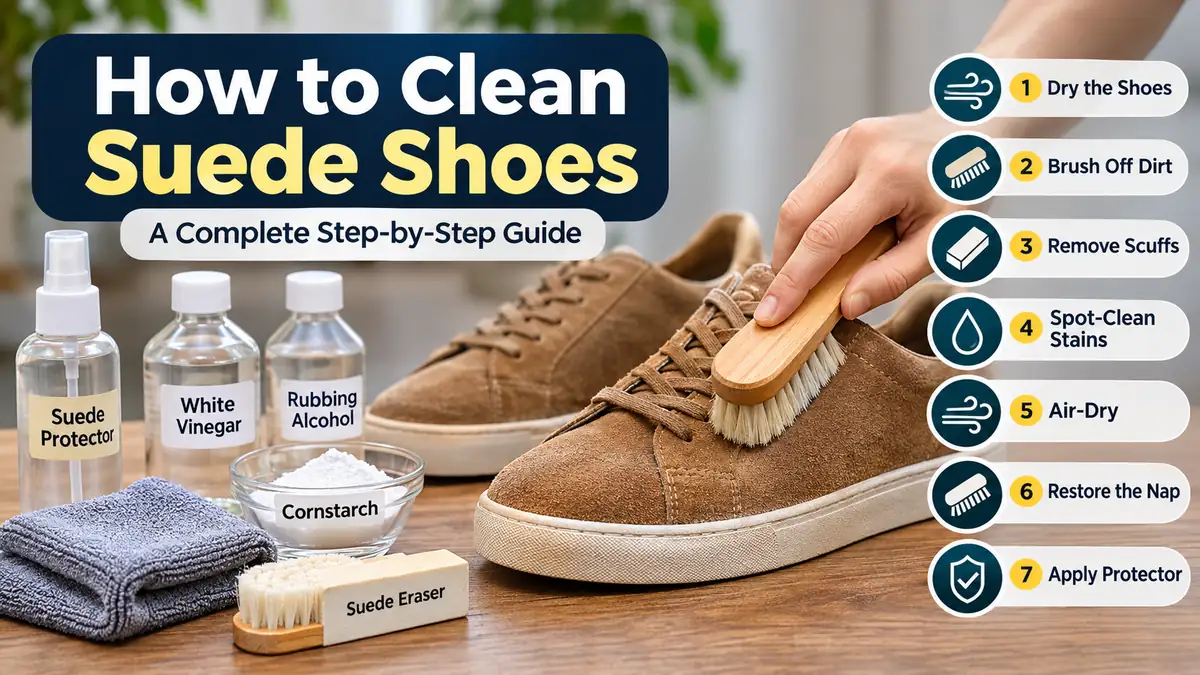
How to clean suede shoes, let them dry completely, then gently brush away surface dirt using a suede brush. Remove scuffs with a suede eraser, treat suitable stains with a small amount of white vinegar or rubbing alcohol, and allow the shoes to air-dry. Finish by brushing the suede to restore its soft texture.
The key is choosing the right cleaning method for the type of stain and avoiding excessive moisture, harsh chemicals, and aggressive scrubbing.
Understanding Suede Before You Start Cleaning
Suede is a type of leather made from the underside of an animal hide, commonly cowhide, lambskin, or goatskin. Its surface consists of tiny raised fibers that create a soft, velvety finish.
These fibers are called the nap.
Unlike full-grain leather, which has a relatively smooth and durable outer surface, suede has an open, porous texture. This makes it more vulnerable to moisture, oil, and embedded dirt.
Why Suede Shoes Are Difficult to Clean
Three characteristics make suede particularly delicate:
- Absorbency: Liquids can penetrate the material and leave visible marks.
- Sensitive fibers: Rough brushing or scrubbing can flatten or damage the nap.
- Color variation: Moisture and cleaning products can temporarily or permanently change the appearance of dyed suede.
Suede is also different from nubuck. Although both have a velvety appearance, nubuck is made by sanding the outer surface of leather, while suede comes from the inner side.
Some shoes use synthetic suede or microfiber instead of genuine leather. These materials may have different cleaning requirements, so checking the manufacturer’s care instructions is essential.
What You Need to Clean Suede Shoes
Clean Suede Shoes: 4 Super Steps for Flawless Finish
Cómo limpiar zapatos de gamuza paso a paso en casa
Best Suede Cleaner for Shoes – Jason Markk
11
You do not need an extensive collection of cleaning products to maintain suede footwear. A few gentle tools can handle most routine cleaning tasks.
| Cleaning tool | Primary purpose |
|---|---|
| Suede brush | Removes dust and restores the nap |
| Suede eraser | Lifts dry marks and minor scuffs |
| Soft toothbrush | Alternative for light brushing |
| Microfiber cloth | Blots moisture and removes loose debris |
| White vinegar | Spot treatment for certain dried marks |
| Rubbing alcohol | Alternative spot treatment for some stains |
| Cornstarch | Absorbs fresh oil and grease |
| Paper towels | Helps maintain shape while drying |
| Suede protector spray | Adds resistance to water and stains |
A dedicated suede brush may have rubber, crepe, nylon, or brass-bristle sections. Softer sections are generally better for delicate suede, while metal bristles require extra caution and should only be used when the product instructions permit.
Avoid using ordinary shoe polish, household bleach, laundry detergent, or stiff scrubbing brushes.
how to clean suede shoes Step by Step
For general maintenance, dry cleaning should always be your starting point. This method is suitable for dusty shoes, minor scuffs, and ordinary surface dirt.
Step 1: Let the Shoes Dry Completely
Never begin brushing suede while it is wet or muddy.
Moisture makes the fibers more vulnerable to distortion, and brushing wet mud can push dirt deeper into the material.
Place your shoes in a well-ventilated room away from direct sunlight and heat sources.
If they are damp, insert plain white paper towels to help absorb moisture and maintain their shape. Replace the paper when it becomes wet.
Avoid newspapers because printing ink may transfer to light-colored interiors.
Step 2: Remove Loose Dirt With a Suede Brush
Once the shoes are completely dry, gently brush the surface to remove dust and loose debris.
Start by brushing in the direction of the nap rather than scrubbing back and forth.
Pay particular attention to areas where dirt collects, including the toe box, heel, and edges near the sole.
For stubborn dry dirt, use short, controlled strokes without applying excessive pressure.
If you do not have a suede brush, a clean, soft toothbrush can help remove light surface dust.
Step 3: Remove Scuff Marks With a Suede Eraser
Suede erasers are designed to lift certain marks without soaking the material.
Rub the affected area gently using short movements. Start with minimal pressure and increase slightly only if the surface responds well.
Brush away the eraser residue afterward.
A clean white pencil eraser can sometimes help with minor marks, but a dedicated suede eraser is generally more predictable.
Avoid colored erasers because they may transfer pigment.
Step 4: Spot-Clean Remaining Stains
If brushing and erasing do not remove the stain, a carefully controlled spot treatment may help.
Lightly dampen a clean white cloth with a small amount of white vinegar or rubbing alcohol. Do not pour either liquid directly onto the shoe.
First, test the product on a small, inconspicuous area and let it dry completely to check for discoloration or texture changes.
If the test is successful, dab the stained area gently. Avoid saturating the leather.
These treatments are not appropriate for every suede finish, and they may be ineffective on deeply absorbed stains.
Step 5: Allow the Shoes to Air-Dry
After spot-cleaning, let the shoes dry naturally.
Keep them away from radiators, hair dryers, heaters, and strong direct sunlight.
Drying time depends on room temperature, ventilation, and the amount of moisture applied.
Do not proceed until the treated surface feels completely dry.
Step 6: Restore the Suede Nap
Once dry, gently brush the cleaned area to lift any flattened fibers.
Use short strokes in the direction of the surrounding nap to blend the texture.
The goal is to restore an even, velvety appearance without wearing away the material.
If the area remains noticeably stiff, discolored, or flattened, avoid repeated aggressive brushing.
Step 7: Apply Suede Protector
A suede-compatible protector spray can help reduce future staining and water absorption.
Follow the manufacturer’s instructions regarding application distance, ventilation, drying time, and the number of coats.
Always test the spray on an inconspicuous area first.
A protector can improve resistance to moisture, but it does not make suede completely waterproof.
How to Remove Different Types of Stains From Suede Shoes
Not every stain responds to the same treatment. Mud, grease, water marks, and salt residue behave differently, so identifying the stain before cleaning helps prevent unnecessary damage.
| Stain type | Recommended treatment | Main precaution |
|---|---|---|
| Dry dirt | Suede brush | Avoid aggressive scrubbing |
| Mud | Dry completely, then brush | Never scrub wet mud |
| Oil or grease | Cornstarch | Avoid rubbing oil into fibers |
| Water marks | Suede cleaner or carefully controlled moisture | Avoid soaking |
| Salt stains | Suede cleaner or diluted white vinegar | Test for color changes |
| Scuff marks | Suede eraser | Use light pressure |
| Ink | Professional suede cleaning | Avoid spreading pigment |
| Food stains | Blot residue, then use suede-safe cleaner | Do not rub fresh spills |
How to Remove Oil and Grease Stains
Oil stains can be particularly stubborn because suede absorbs greasy substances into its porous structure.
If you accidentally spill cooking oil, lotion, or another greasy substance onto your shoes, act promptly.
- Blot any excess oil with a clean paper towel without rubbing.
- Sprinkle a generous layer of cornstarch over the affected area.
- Leave the powder undisturbed for several hours or overnight.
- Gently remove it with a soft brush.
- Repeat if the stain becomes lighter but remains visible.
Cornstarch works by absorbing some of the oil before it settles further into the material.
Older grease stains may require a specialist suede degreaser or professional treatment. deichmann.com+1
How to Clean Mud Off Suede Shoes
Mud should always dry before removal.
Trying to clean wet mud often spreads it across the surface and pushes particles into the nap.
Once dry, gently break away larger pieces with a soft brush. Work gradually rather than trying to remove everything in one pass.
For remaining marks, use a suede eraser or a manufacturer-approved suede cleaner.
Pay special attention to the stitching and the junction between the upper and outsole, where dirt often accumulates.
How to Remove Water Stains From Suede
Water stains often appear as darker patches, rings, or uneven color variations.
For a fresh spill, blot the moisture immediately with a dry microfiber cloth. Do not rub.
If a water ring remains after drying, begin with gentle brushing. A suede-specific cleaner may help even out the appearance.
Some suede-care instructions recommend very lightly and evenly dampening the surrounding affected panel to reduce a distinct water boundary. However, this technique carries a risk of additional water marks and should only be attempted when the manufacturer’s instructions allow it.
Let the shoes dry naturally before assessing the result. CHARLES & KEITH US+1
How to Remove Salt Stains
Winter road salt can leave white or chalky marks on suede boots and shoes.
Start by allowing the footwear to dry, then gently brush away any loose salt crystals.
If the residue remains, use a suede-safe cleaner according to its instructions.
A small amount of diluted white vinegar may help with certain salt marks. Test it on a hidden area first, dab carefully with a white cloth, and allow the material to dry.
Salt stains can sometimes penetrate deeply, so repeated household treatments may not completely restore the original appearance.
How to Remove Ink Stains
Ink is one of the most difficult substances to remove from suede.
If the ink is fresh, carefully blot any excess without spreading it. Do not scrub the area or apply random solvents.
Permanent ink, marker, and deeply absorbed dye can permanently discolor suede.
Professional leather cleaning is generally the safer option, especially for expensive or light-colored footwear.
how to clean suede shoes Without a Suede Brush or Cleaner
A dedicated cleaning kit is useful, but light cleaning is still possible with a few common household items.
The safest substitutes depend on the condition of the shoes and the type of stain.
Can You Use a Toothbrush to Clean Suede?
Yes, a clean, soft-bristled toothbrush can help remove light dust and surface dirt.
Make sure the toothbrush is completely dry and free of toothpaste or other residues.
Use gentle strokes in the direction of the nap. Avoid applying enough pressure to flatten or fray the fibers.
A toothbrush is not a complete replacement for a specialized suede brush, particularly when dealing with heavily matted material.
Can You Clean Suede Shoes With White Vinegar?
White vinegar may help remove some dried stains and residue.
However, vinegar is not universally safe for every suede finish. It can affect dyes, leave an odor, or change the appearance of delicate material.
If the shoe manufacturer permits its use, apply a small amount to a clean cloth rather than directly onto the shoe.
Test first, use minimal moisture, and allow the treated area to dry naturally.
Is Rubbing Alcohol Safe for Suede?
Rubbing alcohol is sometimes used as a spot treatment because it evaporates relatively quickly.
However, it may remove dye or affect finishes, adhesives, and delicate leather treatments.
Use it only when compatible with the shoe’s care instructions, and always test it on a concealed area.
For valuable footwear, a suede-specific cleaner is a more controlled starting point.
Can Baking Soda Clean Suede Shoes?
Baking soda is sometimes used to absorb grease or reduce odors, but it is not a universal suede cleaner.
Fine powder can become trapped in the nap, particularly on dark shoes.
For oily stains, cornstarch is often a more practical first option. For unpleasant odors, address the inside of the shoe separately rather than covering the suede upper with powder.
Household substitutes can help with simple maintenance, but they should not be treated as risk-free alternatives to proper suede-care products. Maytag+1
Cleaning Different Colors and Types of Suede Shoes
The basic cleaning principles remain similar across most suede footwear, but color and construction can affect the safest approach.
Cleaning Black Suede Shoes
Black suede can develop gray-looking patches when dust accumulates or the nap becomes flattened.
Begin with gentle dry brushing to remove particles and lift the fibers.
A suede eraser may help with localized scuffs, although excessive rubbing can create lighter areas.
If the color has genuinely faded, cleaning alone will not restore lost pigment. A color-matched suede renovator may help, but it should be tested first because it can change the shade or finish.
Avoid ordinary black shoe polish, which can flatten the nap and leave an unwanted shine.
Cleaning White and Light-Colored Suede
White, beige, cream, and light gray suede show dirt and dye transfer more readily than darker colors.
Use clean, white tools whenever possible.
Start with a soft brush and a suede eraser. Avoid colored cloths, sponges, or cleaning products that could transfer pigment.
For stubborn stains, choose a cleaner specifically approved for light-colored suede.
Be especially cautious around denim dye transfer, which may not be fully removable.
Cleaning Brown and Tan Suede
Brown and tan suede commonly show dark water marks and oily patches.
Dry brushing is suitable for ordinary dust and light scuffs.
If a stain requires liquid treatment, test carefully because moisture can produce uneven darkening.
After cleaning, brush the entire affected section gently to help maintain a consistent appearance.
Cleaning Suede Sneakers
Suede sneakers often combine several materials, including suede panels, mesh, synthetic leather, rubber, and textile linings.
Clean each material separately.
Remove the laces, then brush the suede panels while dry. Use an appropriate cleaner for the rubber outsole and non-suede sections, taking care not to transfer liquid or detergent onto the suede.
For mixed-material shoes from brands such as New Balance, Adidas, Puma, or Nike, follow the specific model’s care instructions when available.
Cleaning Suede Boots
Suede boots have larger exposed surfaces and may experience more contact with mud, rain, and road salt.
A soft brush can remove loose dirt from the shaft and toe area.
Use boot shapers or suitable paper stuffing while drying to help maintain their structure.
For winter boots, check whether the material is genuine suede, nubuck, or a treated synthetic alternative before applying cleaning products.
Common Mistakes That Can Ruin Suede Shoes
Many suede-cleaning problems result from using techniques that work well on ordinary sneakers but are unsuitable for delicate leather.
Putting Suede Shoes in the Washing Machine
Machine washing exposes shoes to prolonged moisture, detergent, agitation, and spinning.
This can cause shrinking, stiffness, discoloration, damage to adhesives, and permanent changes to the nap.
Major footwear-care guides generally advise against machine washing genuine suede. New Balance FAQ+1
Using Too Much Water
Water can leave marks, especially when it wets one part of the suede more heavily than another.
Do not soak suede shoes in a bucket or rinse them under a running tap.
When moisture is necessary, use a product and method approved for the material.
Drying Shoes With Direct Heat
Hair dryers, radiators, and heaters may seem like convenient ways to speed up drying.
Unfortunately, concentrated heat can make leather stiff, distort the shoe’s shape, and weaken adhesives.
Air-drying at room temperature is the safer choice.
Scrubbing Too Hard
Aggressive scrubbing can wear away the delicate raised fibers.
Once the nap is physically damaged, brushing may not fully restore it.
Start with the gentlest method and stop if the surface begins to look rough, shiny, or noticeably different from the surrounding material.
Using Regular Leather Polish
Smooth-leather polish is designed for a different surface.
Applying waxes, creams, or oily conditioners intended for smooth leather can darken suede and flatten its texture.
Only use conditioning or color-restoration products explicitly labeled as compatible with suede or nubuck.
How to Restore Suede Shoes That Look Old or Worn
Cleaning can improve the appearance of older suede shoes, but restoration depends on whether the problem is accumulated dirt, flattened fibers, faded color, or permanent physical damage.
Restoring Flattened Suede
If the nap looks smooth or shiny, begin by gently brushing the area with an appropriate suede brush.
Work carefully to lift the fibers without scraping the leather.
A specialized suede cleaning or restoration product may help with stubborn matted areas.
Avoid aggressive home steaming techniques, which can introduce too much heat and moisture.
Restoring Faded Suede
Sun exposure, friction, and repeated wear can gradually reduce color intensity.
A suede renovator formulated for the appropriate color may improve the appearance.
However, color restoration is not the same as cleaning. Pigment treatments can alter the original shade and may transfer if applied incorrectly.
Always follow the product instructions and test on a hidden area.
Fixing Stiff Suede After Getting Wet
Suede may feel stiff after becoming saturated or drying improperly.
Allow it to dry fully, then use a soft suede brush to gently separate the fibers.
If the leather remains hard or misshapen, professional restoration is preferable to repeated household treatments.
Severe water damage cannot always be reversed.
How to Protect Suede Shoes and Keep Them Clean Longer
Prevention is generally easier than removing deeply absorbed stains.
A simple maintenance routine can reduce dirt buildup and help preserve the original appearance of your footwear.
Apply a Water- and Stain-Repellent Spray
Use a protector specifically formulated for suede or nubuck.
Apply it to clean, dry shoes in a well-ventilated area, following the manufacturer’s application and drying instructions.
Some products require more than one light coat.
Reapply according to the product label, especially after cleaning or significant exposure to moisture.
Even treated suede should not be considered completely waterproof.
Brush Suede Regularly
Light brushing after several wears helps remove dust before it becomes embedded.
You do not need to scrub the entire shoe aggressively.
A few gentle strokes are usually sufficient for routine maintenance.
Store Shoes Properly
Keep suede footwear in a cool, dry location away from direct sunlight.
Avoid airtight plastic bags if the shoes may contain residual moisture.
Breathable storage bags and shoe trees can help maintain the footwear’s condition and shape.
Cedar shoe trees may also help manage moisture inside suitable shoes.
Avoid Wearing Suede in Heavy Rain
Even when treated with a protector, suede can become stained or stiff after prolonged exposure to water.
For heavy rain, deep snow, or particularly muddy conditions, more weather-resistant footwear is usually a better choice.
If your suede shoes become wet unexpectedly, blot away excess moisture and let them dry naturally.
How Often Should You Clean Suede Shoes?
Cleaning frequency depends on how often the shoes are worn and the conditions they encounter.
| Cleaning activity | Suggested frequency |
|---|---|
| Light brushing | After several wears or when dusty |
| Spot cleaning | As soon as a suitable stain can be treated safely |
| Thorough inspection | Every few weeks during regular use |
| Protector application | According to the product instructions |
| Professional cleaning | When stains or damage exceed safe home treatment |
These are practical maintenance suggestions rather than fixed requirements.
Shoes worn occasionally indoors may need very little attention, while everyday suede sneakers exposed to dust and dirt may benefit from more frequent brushing.
Excessive cleaning can also cause wear, so avoid unnecessary treatments.
When Should You Take Suede Shoes to a Professional Cleaner?
Home cleaning works best for surface dirt, minor scuffs, and some fresh stains.
Professional assistance is worth considering when shoes have extensive oil contamination, permanent-marker stains, mold growth, severe water damage, or significant color loss.
It is also sensible for expensive designer shoes, vintage footwear, and delicate dyed suede.
A professional leather cleaner may have specialized tools and treatments unavailable for home use. However, even professional cleaning cannot guarantee complete stain removal.
For suspected mold, avoid dry brushing indoors because it can spread spores. Keep the footwear isolated and seek appropriate professional advice, particularly if the contamination is extensive.
Final Thoughts on how to clean suede shoes
Learning how to clean suede shoes is mainly about patience, gentle handling, and understanding how the material responds to moisture.
Start with dry brushing, use a suede eraser for minor scuffs, and choose stain-specific treatments only when necessary. Always test unfamiliar products before applying them to visible areas.
For long-term care, regular brushing, careful storage, and a suede-compatible protector can make a noticeable difference.
The simplest rule is also the most useful: remove dirt gently, keep moisture under control, and allow suede to dry naturally. These habits help preserve the soft texture and appearance that make suede shoes distinctive.
