
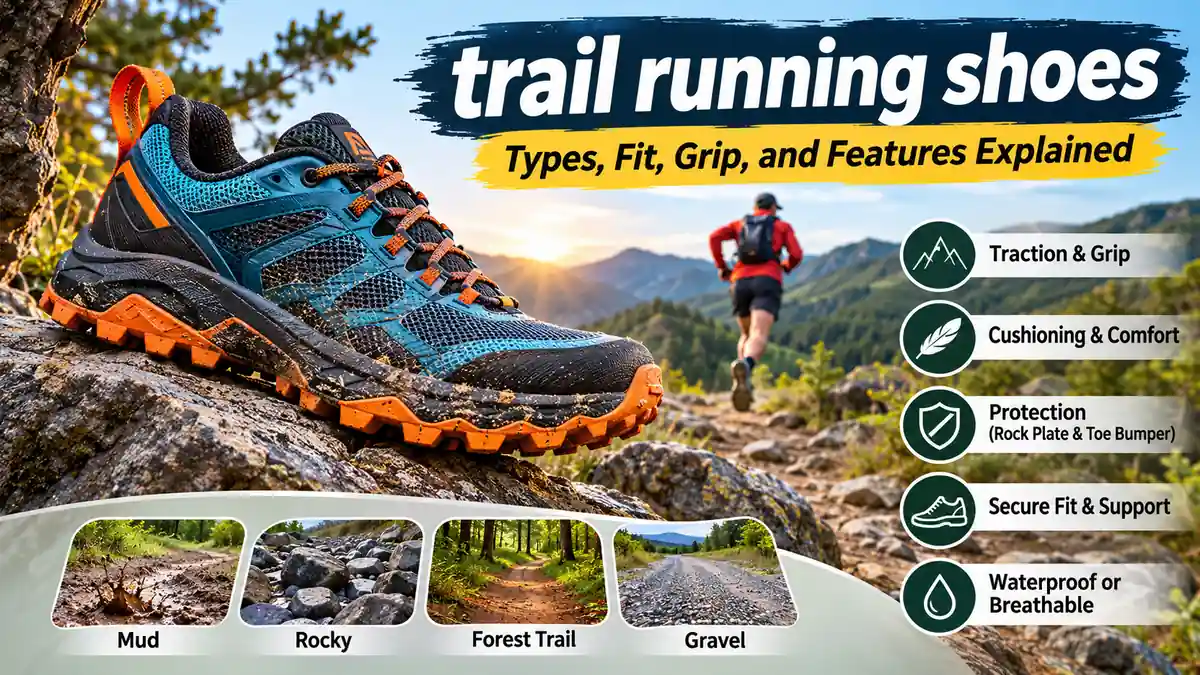
Road running shoes can feel comfortable on pavement but become slippery, unstable, or easily damaged on rocky trails. The difference becomes especially noticeable when running over loose gravel, wet roots, mud, or steep hills.
Trail running shoes are specialized athletic footwear designed for running on natural, uneven terrain. They typically feature grippy rubber outsoles, protective uppers, reinforced toe areas, and tread patterns that improve traction on dirt, rocks, and mud. The right design depends on terrain, running distance, foot shape, weather conditions, and personal comfort.
Unlike hiking boots, most trail shoes emphasize flexibility and running efficiency. Unlike conventional road shoes, they prioritize traction, foot protection, and stability when the ground is unpredictable.
Understanding these differences makes it easier to select suitable footwear, avoid common fitting mistakes, and recognize when a particular shoe design may not work well.
What Are Trail Running Shoes?
Trail running shoes are footwear designed for running on off-road surfaces, including woodland paths, mountain trails, dirt tracks, rocky routes, and muddy terrain.
Their main purpose is to help runners maintain traction and comfort while adapting to uneven ground.
The design usually combines several features:
- Aggressive outsole tread: Rubber lugs grip loose and irregular surfaces.
- Protective upper: Reinforced fabric helps resist abrasion from rocks and vegetation.
- Toe protection: A toe bumper reduces direct impacts against stones and roots.
- Stable platform: The sole and upper help control unwanted foot movement.
- Terrain-specific cushioning: The midsole absorbs impact while balancing ground feel and stability.
- Secure fit: Heel counters, lacing systems, and midfoot support help reduce internal sliding.
Not every trail shoe includes all these features. Lightweight models intended for smooth dirt paths may resemble road shoes, while mountain-oriented footwear can have deeper lugs, rock plates, and more protective materials.
Trail Running Shoes vs. Road Running Shoes
The biggest differences involve traction, protection, and how each shoe responds to uneven terrain.
| Feature | Trail running shoes | Road running shoes |
|---|---|---|
| Primary surface | Dirt, rocks, gravel, mud | Pavement, asphalt, tracks |
| Outsole | Pronounced lugs | Relatively flat tread |
| Upper | Often reinforced | Usually lighter and more breathable |
| Toe protection | Common | Usually minimal |
| Stability | Adapted for uneven ground | Optimized for predictable surfaces |
| Rock protection | Available in many models | Usually absent |
| Weight | Varies; protective models can be heavier | Often lighter at comparable cushioning levels |
| Best use | Off-road running | Roads and smooth paths |
Road shoes can work on dry, smooth trails, especially where the surface is compact and free of technical obstacles. However, their relatively shallow tread may struggle in mud or on loose slopes.
Conversely, using aggressive trail shoes exclusively on pavement can accelerate lug wear and sometimes feel less comfortable than running in shoes designed for roads.
Are Trail Running Shoes Different From Hiking Shoes?
Yes, although the two categories overlap.
Trail running shoes are generally designed around repeated running strides, flexibility, and relatively low weight. Hiking shoes often prioritize durability, carrying loads, and walking stability.
Many hikers prefer trail running shoes for day hikes because they feel lighter and allow natural foot movement. However, lightweight trail shoes may provide less structural support and long-term abrasion resistance than heavier hiking footwear.
For backpacking, the right choice depends on pack weight, terrain, ankle mobility, experience, and individual fit rather than a universal rule.
Types of Trail Running Shoes
Trail footwear is often grouped by terrain, cushioning, and intended use. These categories are helpful, but they are not rigid industry classifications.
Light Trail and Door-to-Trail Shoes
Light trail shoes are designed for relatively smooth routes such as maintained park trails, hard-packed dirt, and gravel paths.
They usually feature moderate tread depth, flexible midsoles, and a running feel similar to road footwear.
Door-to-trail models go a step further by balancing pavement comfort with off-road traction. They are useful when a route begins on city streets and continues onto natural paths.
Examples of footwear commonly associated with this category include the Nike Pegasus Trail line and some Hoka Challenger models.
Their main limitation is traction on deep mud and highly technical terrain.
Technical Trail Shoes
Technical trail running shoes are intended for more challenging surfaces, including exposed rocks, roots, steep descents, and irregular mountain paths.
Common characteristics include secure heel and midfoot construction, protective toe bumpers, durable overlays, and specialized rubber compounds.
Some also contain a rock plate, a protective layer between the foot and outsole that helps reduce discomfort from sharp stones.
The Salomon Speedcross family is associated with aggressive soft-ground traction, while models such as the La Sportiva Bushido emphasize precision and control on technical terrain.
These are examples of design approaches, not universal recommendations for every runner.
Mud and Soft-Ground Shoes
Shoes for muddy trails usually have deeper, more widely spaced lugs.
The open spaces between lugs help release accumulated soil, allowing the tread to engage the ground repeatedly.
Soft-ground designs are particularly useful for muddy woodland routes, fell running, and wet grass.
However, deep lugs may feel awkward on pavement and can offer less rubber contact with smooth, hard rock.
Long-Distance and Ultra-Trail Shoes
Long-distance trail footwear emphasizes comfort over many hours.
These models may provide additional cushioning, space for foot swelling, and durable uppers. Some use rocker-shaped midsoles to encourage a smooth transition through each stride.
Examples include the Hoka Speedgoat and Brooks Caldera families, although specific construction and fit vary by generation.
More cushioning is not automatically better. A high stack height can reduce ground feel, and some runners find tall shoes less predictable on slanted or uneven terrain.
Minimalist and Low-Drop Trail Shoes
Minimalist footwear uses relatively little cushioning and often offers greater ground feedback.
Low-drop or zero-drop shoes reduce or eliminate the height difference between the heel and forefoot.
Altra is known for zero-drop trail designs, while brands such as Topo Athletic offer models with different drop heights and anatomically shaped toe boxes.
These designs may suit certain runners, but changing abruptly from conventional footwear can increase stress on the calves, Achilles tendons, and feet.
A gradual transition is especially important when adopting lower-drop or minimalist footwear.
Key Features of Trail Running Shoes
Understanding the parts of a trail shoe is more useful than relying on marketing descriptions. Two shoes advertised as highly cushioned or exceptionally grippy can perform very differently.
Outsole Grip and Lug Depth
The outsole is the rubber layer that contacts the ground. Its raised tread elements are called lugs.
Lug depth influences how effectively a shoe penetrates soft surfaces. Lug shape, spacing, orientation, and rubber compound also affect traction.
| Lug depth | Typical terrain | Main advantage |
|---|---|---|
| 2–3 mm | Pavement transitions, firm dirt, gravel | Smooth running on harder surfaces |
| 3–4 mm | Mixed trails, woodland paths | Balanced versatility |
| 4–5 mm | Loose dirt, moderately muddy routes | Stronger off-road traction |
| 5–7 mm | Deep mud, soft ground | Greater penetration and mud shedding |
These are approximate guidelines rather than standardized performance categories. Laboratory testing and field conditions can produce different results, even between shoes with identical lug depths. RunRepeat+1
Rubber composition matters just as much as tread depth.
For example, Vibram Megagrip is a recognized outsole compound used in numerous trail shoes, including certain models from Hoka, Brooks, and Topo Athletic.
Continental rubber appears in selected Adidas Terrex footwear, while Salomon uses proprietary Contagrip outsole technologies.
A softer, stickier rubber compound may improve traction on smooth rock, but durability and performance depend on the specific formulation.
Cushioning and Stack Height
Stack height describes the thickness of material beneath the foot, usually measured at the heel and forefoot.
Trail shoes generally fall into three broad cushioning approaches.
Low cushioning: Provides closer ground contact and feedback. It can help runners feel small changes in terrain, although sharp stones may become more noticeable.
Moderate cushioning: Balances comfort, protection, and ground awareness. This is a versatile option for many recreational trail runners.
Maximum cushioning: Uses a thicker midsole to reduce the sensation of repeated impacts over long distances.
Higher cushioning does not necessarily mean greater stability or fewer injuries. Foam firmness, platform width, foot position, and terrain also influence the running experience.
A wide, stable platform can sometimes feel more controlled than a narrower shoe with a lower stack.
Heel-to-Toe Drop
Heel-to-toe drop is the difference between the height of the heel and the forefoot above the ground.
For example, a shoe with a 32 mm heel stack and a 26 mm forefoot stack has a 6 mm drop.
Common categories include:
- Zero drop: 0 mm difference
- Low drop: approximately 1–4 mm
- Moderate drop: approximately 5–8 mm
- Higher drop: approximately 9–12 mm or more
A lower drop generally increases the demands placed on the calf and Achilles tendon, particularly when a runner changes from a higher-drop shoe.
Higher-drop shoes can feel familiar to runners accustomed to traditional road footwear, but neither design is universally superior.
Comfort, previous footwear experience, running mechanics, and gradual adaptation are more meaningful than choosing a particular number.
Rock Plates and Underfoot Protection
A rock plate is a protective component placed within the sole, typically between the midsole and outsole or integrated into the midsole structure.
It distributes concentrated pressure from sharp stones and other trail obstacles.
Rock plates may be made from flexible plastics, composite materials, or other engineered structures.
They are especially useful on routes containing:
- Sharp rocks and scree
- Exposed roots
- Uneven mountain trails
- Repeated impacts against hard, irregular objects
However, a separate plate is not always necessary. Some modern trail shoes achieve adequate protection through their foam geometry and midsole construction.
For example, the Brooks Cascadia 20 uses an updated cushioning system without the rock plate found in earlier generations. iRunFar
Upper Materials and Toe Protection
The upper determines how securely the foot sits inside the shoe and how the footwear handles moisture, abrasion, and heat.
Engineered mesh promotes ventilation and can dry relatively quickly.
Reinforced textile panels provide additional resistance against rough vegetation and rocks.
Thermoplastic polyurethane (TPU) overlays may strengthen high-wear areas without requiring a completely rigid upper.
A protective toe bumper is particularly useful on rocky trails, where accidental contact with stones is common.
Some models also use gusseted tongues, which connect to the upper along their sides to help limit debris entering the shoe.
Heel Lockdown and Lacing Systems
Foot movement inside a shoe can become a problem during steep descents.
When the heel slips or the forefoot slides forward, friction increases and toes may strike the front of the shoe.
A secure heel counter and appropriately tensioned laces can reduce this movement.
Traditional laces offer adjustable tension across different sections of the foot. Quick-lacing systems, such as those found on many Salomon shoes, offer convenient adjustment but may feel different from conventional laces.
A runner’s loop, also called heel-lock lacing, can improve heel retention in shoes with an additional upper eyelet.
The aim is a secure midfoot and heel without excessive pressure across the top of the foot.
How to Choose Trail Running Shoes for Different Terrain
The most useful starting point is identifying the surface encountered most often.
A shoe designed for deep mud will not necessarily perform well on wet rock, even though both conditions are slippery.
Hard-Packed Dirt and Gravel
For compact dirt paths and gravel roads, moderate cushioning and relatively shallow lugs are usually sufficient.
These surfaces do not require extremely aggressive tread.
A flexible shoe with a comfortable upper can be preferable to a heavily reinforced mountain-running design.
Door-to-trail footwear is particularly practical when a run includes significant pavement sections.
Rocky and Technical Trails
Rocky routes demand a combination of traction, secure fit, and protection.
Look for a stable platform, durable toe protection, and rubber that performs well on rock.
Rock plates or protective midsoles can reduce discomfort from sharp surfaces.
A precise midfoot fit also helps prevent the foot from shifting sideways on uneven ground.
On steep, rocky descents, confidence often comes from the interaction of outsole grip and secure foot retention rather than cushioning alone.
Muddy and Wet Trails
Deep, widely spaced lugs generally work better in mud because they can penetrate soft ground and release accumulated material.
However, wet rock presents a different challenge.
Smooth, wet stone often benefits from a suitable sticky rubber compound and sufficient rubber contact area rather than simply the deepest possible tread.
This distinction explains why a mud-specific shoe can feel secure on soft earth but less predictable on a smooth, wet rock slab.
Snow, Ice, and Winter Conditions
Standard trail shoes may work on shallow, non-icy snow, depending on temperature and surface conditions.
Packed ice is different. Ordinary rubber lugs cannot reliably provide the traction needed for icy slopes.
Compatible traction devices, such as running-specific microspikes, may be necessary.
Deep snow, severe cold, or mountaineering terrain can require more specialized footwear and equipment.
Waterproofing, insulation, and traction should be considered separately rather than assuming one winter-oriented feature solves every problem.
Terrain-Based Selection Summary
| Running environment | Useful footwear characteristics |
|---|---|
| Park trails | Lightweight construction, shallow lugs |
| Gravel roads | Moderate cushioning, durable outsole |
| Forest singletrack | Multidirectional lugs, secure fit |
| Rocky mountains | Toe protection, rock protection, stable platform |
| Deep mud | Deep, widely spaced lugs |
| Mixed road and trail | Flexible midsole, moderate tread |
| Long-distance trails | Comfortable fit, suitable cushioning, durable upper |
| Icy trails | Appropriate winter traction equipment |
How Should Trail Running Shoes Fit?
Fit is one of the most important factors in trail footwear.
Even an excellent outsole cannot compensate for a shoe that causes toe compression, heel movement, or repeated friction.
The ideal fit combines a secure heel and midfoot with enough space for the toes to move naturally.
Toe Box Space
The toes should not press against the front of the shoe while standing or running downhill.
A common starting guideline is approximately a thumbnail’s width of space between the longest toe and the front of the shoe.
However, the correct allowance depends on foot shape, shoe construction, and personal preference.
A roomy toe box can accommodate natural toe movement and swelling during longer runs.
Brands such as Altra and Topo Athletic are associated with anatomically shaped toe boxes, although fit varies between models.
A wide toe box is not automatically beneficial for every runner. Excessive internal movement can also create friction.
Heel and Midfoot Security
The heel should remain reasonably stable during walking, jogging, and descending.
Some minor movement may be acceptable, but repeated slipping can cause blisters.
The midfoot should feel supported without numbness, tingling, or pressure.
If tightening the laces enough to secure the heel causes discomfort, the shoe’s overall shape may not match the foot.
When to Try On Trail Shoes
Feet often become slightly larger during the day, so trying shoes later in the afternoon can provide a useful fit check.
Wear the socks normally used for running.
Try both shoes because foot dimensions are not always identical.
If possible, walk on an incline or decline to assess forward sliding and heel retention.
A suitable trail shoe should feel comfortable immediately rather than depending on a prolonged break-in period. REI Expert Advice
Wide Feet and Narrow Feet
Shoe width affects more than toe comfort.
A runner with a wide forefoot may need additional space around the metatarsals, while someone with a narrow heel may require a more structured rearfoot fit.
Some manufacturers offer dedicated wide versions, which may provide a better fit than simply increasing shoe length.
Sizing up excessively can create unnecessary movement and reduce control.
The shape of the shoe’s last—the form around which it is constructed—is therefore as important as its labeled size.
Waterproof vs. Breathable Trail Running Shoes
Waterproof trail running shoes often use membranes such as GORE-TEX to help prevent external water from passing through the upper.
They can be useful in cold rain, wet grass, and shallow puddles.
However, waterproof footwear has limitations.
Water can still enter over the ankle opening. Once inside, it may remain trapped longer than in a highly breathable mesh shoe.
Waterproof membranes also generally reduce ventilation compared with otherwise similar non-waterproof constructions.
| Condition | Often preferable |
|---|---|
| Hot, dry weather | Breathable mesh |
| Warm, rainy conditions | Quick-draining, non-waterproof shoe |
| Cold, wet grass | Waterproof membrane |
| Frequent stream crossings | Quick-draining footwear |
| Light snow and cold rain | Waterproof footwear with suitable socks |
| Hot, humid trails | Highly breathable upper |
For warm-weather running with frequent stream crossings, drainage and drying ability can be more useful than keeping water out initially.
For colder conditions with limited water entry, a waterproof membrane may improve comfort.
Waterproofing does not make a shoe completely moisture-proof in every situation, and it does not provide insulation unless the shoe includes additional insulating materials.
Trail Running Shoes for Beginners and Experienced Runners
Experience level changes which features are likely to be useful.
What Should Beginners Look For?
A beginner generally benefits from a versatile shoe that feels comfortable on common local trails.
Moderate cushioning, dependable traction, and a secure fit are sensible starting points.
There is usually no need to prioritize extreme lug depth, racing-focused weight reduction, or highly specialized mountain features when most running takes place on maintained paths.
The Brooks Cascadia family illustrates a general-purpose trail design. In 2026 testing, the Cascadia 20 was highlighted for its versatility, although its heel fit may not suit everyone on demanding terrain. iRunFar
The key is choosing a shoe that matches actual running conditions rather than the most challenging terrain a runner might occasionally encounter.
What Matters for Experienced Trail Runners?
Experienced runners may develop more specific preferences based on distance, speed, terrain, and running style.
Some prioritize low weight and ground feedback for short technical races.
Others prefer substantial cushioning and foot protection for ultramarathons.
A runner tackling steep mountain terrain may value precision and lateral stability, while someone covering long, nontechnical trails may prioritize comfort and efficient transitions.
Many experienced runners use different shoes for different conditions, although a single versatile pair can still cover a wide range of routes.
Are Lightweight Trail Running Shoes Better?
Lighter footwear may reduce the effort associated with repeatedly lifting the feet, but the overall running experience depends on more than shoe weight.
Reducing material can also reduce cushioning, durability, or protection.
A lightweight shoe that causes discomfort on sharp rocks may be less useful than a slightly heavier model with better underfoot protection.
For recreational running, fit and terrain suitability generally deserve more attention than small weight differences.
Common Trail Running Shoe Technologies and Brands
Different manufacturers approach trail footwear design in different ways.
Understanding these approaches can help readers interpret product specifications without assuming that a particular brand is universally superior.
| Brand or technology | Common design association |
|---|---|
| Hoka | Cushioned midsoles and rocker-based designs |
| Salomon | Technical trail construction and Contagrip outsoles |
| Brooks | Versatile trail footwear, including the Cascadia line |
| Altra | Zero-drop platforms and foot-shaped toe boxes |
| Topo Athletic | Anatomically shaped toe boxes with varied drop options |
| La Sportiva | Technical mountain and rocky-terrain footwear |
| Saucony | Versatile trail models such as the Peregrine |
| Nike | Road-to-trail and performance-oriented trail footwear |
| Adidas Terrex | Outdoor-focused footwear, including Continental rubber models |
| Vibram Megagrip | Outsole rubber technology used by multiple manufacturers |
| GORE-TEX | Waterproof membrane technology |
These associations describe general product characteristics. Individual models can differ substantially.
For example, the Saucony Peregrine 16 uses a 4 mm drop and Vibram Megagrip outsole, while the Altra Lone Peak 9 uses a zero-drop platform. These differences illustrate how two trail shoes can emphasize different running sensations. iRunFar
Model generations also change. A new version may have a different outsole, foam, upper, weight, or fit from its predecessor.
Checking the exact model specifications is more reliable than assuming every generation performs identically.
How Long Do Trail Running Shoes Last?
Trail running shoe lifespan depends on terrain, running mechanics, construction, maintenance, and frequency of use.
A commonly discussed starting estimate is approximately 300–500 miles (480–800 kilometers), but this is not a guaranteed replacement interval.
Some shoes remain comfortable and functional beyond that distance, while harsh rocky terrain can damage certain components much sooner.
The condition of the shoe matters more than mileage alone.
Signs That Trail Shoes Need Replacing
Inspect the footwear for:
- Outsole lugs that have become rounded or noticeably worn
- Reduced grip on familiar surfaces
- Midsole compression or uneven deformation
- Tears that compromise upper security
- Damaged heel counters
- Persistent discomfort that was not present previously
- Separation between outsole and midsole materials
A shoe may remain comfortable for walking after its grip has become inadequate for technical running.
Likewise, worn outsole tread does not necessarily mean the midsole has completely lost its cushioning.
Evaluate each component according to the intended terrain.
How to Clean Trail Running Shoes
Proper cleaning can help maintain the shoe’s materials and make wear easier to identify.
- Remove loose mud using a soft brush.
- Take out the insoles and loosen or remove the laces.
- Rinse or wipe the upper with cool or lukewarm water.
- Use a small amount of mild soap when necessary.
- Remove soap residue without soaking the shoe unnecessarily.
- Allow the footwear to air-dry in a ventilated area.
- Reinsert the insoles only when the interior is dry.
Avoid direct high heat from radiators, heaters, or tumble dryers unless the manufacturer explicitly permits it.
Excessive heat can damage adhesives, foam structures, and synthetic materials.
For waterproof shoes, follow the membrane manufacturer’s care instructions. A suitable durable water-repellent treatment may help restore surface water beading when recommended.
Can Trail Running Shoes Be Used Every Day?
Yes, trail running shoes can be worn for walking and everyday activities.
However, their suitability depends on outsole design and comfort.
Aggressive mud lugs may wear faster on abrasive pavement and can feel less smooth than road-oriented footwear.
Shoes with moderate tread and flexible cushioning are generally more practical for mixed daily use.
For frequent pavement running, a dedicated road shoe or door-to-trail design may be more comfortable and efficient.
Common Mistakes When Choosing Trail Running Shoes
Several mistakes can reduce comfort or performance even when the shoe itself is well constructed.
Choosing Based Only on Appearance
Color, shape, and brand reputation provide little information about whether a shoe will fit correctly or grip the intended surface.
Prioritize foot shape, terrain, outsole construction, and comfort.
Assuming Deeper Lugs Always Mean Better Grip
Deep lugs are useful in soft ground but do not automatically improve traction on smooth, wet rock.
Rubber formulation and the amount of outsole contact with the surface are also important.
Buying Shoes That Are Too Small
Running downhill pushes the foot forward.
Insufficient toe clearance can cause repeated impacts against the front of the shoe, potentially leading to discomfort or toenail problems.
Check fit on slopes rather than relying only on standing comfort.
Changing Heel Drop Too Quickly
Moving suddenly from a conventional higher-drop shoe to zero-drop footwear can increase loading on tissues that are not accustomed to the change.
Introduce unfamiliar footwear gradually and reduce use if persistent pain develops.
Assuming Waterproof Means Better
Waterproof shoes can retain water after deep immersion and may feel warmer in humid weather.
Choose waterproofing according to climate and expected water exposure.
Ignoring Surface-Specific Wear
A shoe with a healthy-looking upper may still have heavily worn lugs.
Inspect the outsole regularly, especially after repeated running on abrasive rock or pavement.
Practical Trail Running Tips for Better Comfort and Traction
Footwear is only one part of moving safely and efficiently on trails.
Running technique and route awareness also influence stability.
Use Shorter Strides on Uneven Ground
Shorter strides can make it easier to adjust foot placement when the surface changes suddenly.
Avoid reaching too far ahead with the foot on steep descents, where braking forces can increase.
Look Ahead Rather Than Directly Down
Scan the route several steps ahead to identify rocks, roots, loose gravel, and changes in direction.
Use peripheral vision to monitor the immediate ground.
This helps maintain a smoother rhythm and provides more time to react.
Adjust Speed to Conditions
Wet roots, loose stones, and steep slopes can remain slippery even with specialized outsoles.
Reduce speed when traction becomes uncertain.
A shoe improves the available grip but cannot eliminate the risk of slipping.
Use Suitable Running Socks
Moisture-managing synthetic or merino-wool socks can help control friction and maintain comfort.
Sock thickness also affects fit, so footwear should be tested with the socks intended for regular use.
Consider Gaiters on Debris-Heavy Trails
Trail gaiters cover the opening around the ankle to reduce the entry of sand, gravel, and small debris.
They are particularly useful on dusty trails, sandy routes, and loose scree.
Some trail shoes have integrated attachment points, while others require compatible external systems.
Build Trail Running Fitness Gradually
Uneven surfaces place different demands on the feet, ankles, calves, and balance systems than predictable pavement.
Increase distance and technical difficulty progressively.
Allow time to adapt, especially when combining unfamiliar terrain with a new shoe design.
Persistent or worsening pain should not be treated as a normal part of adapting to footwear.
Final Thoughts on trail running shoes
The most suitable trail running shoes are those that fit securely, provide appropriate traction, and remain comfortable on the terrain encountered most often.
Smooth dirt paths typically require less aggressive tread than deep mud. Rocky routes benefit from dependable rubber, protective construction, and secure foot retention. Long-distance running places greater emphasis on sustained comfort, while technical terrain may demand precision and stability.
Start by identifying your usual terrain, then assess fit, outsole grip, cushioning, heel-to-toe drop, and protection. Test the shoes on a short, familiar route before relying on them for a demanding run.
No single design works best for every runner or every surface. Understanding the construction and limitations of trail footwear makes it easier to select shoes that support comfortable, confident off-road running.