
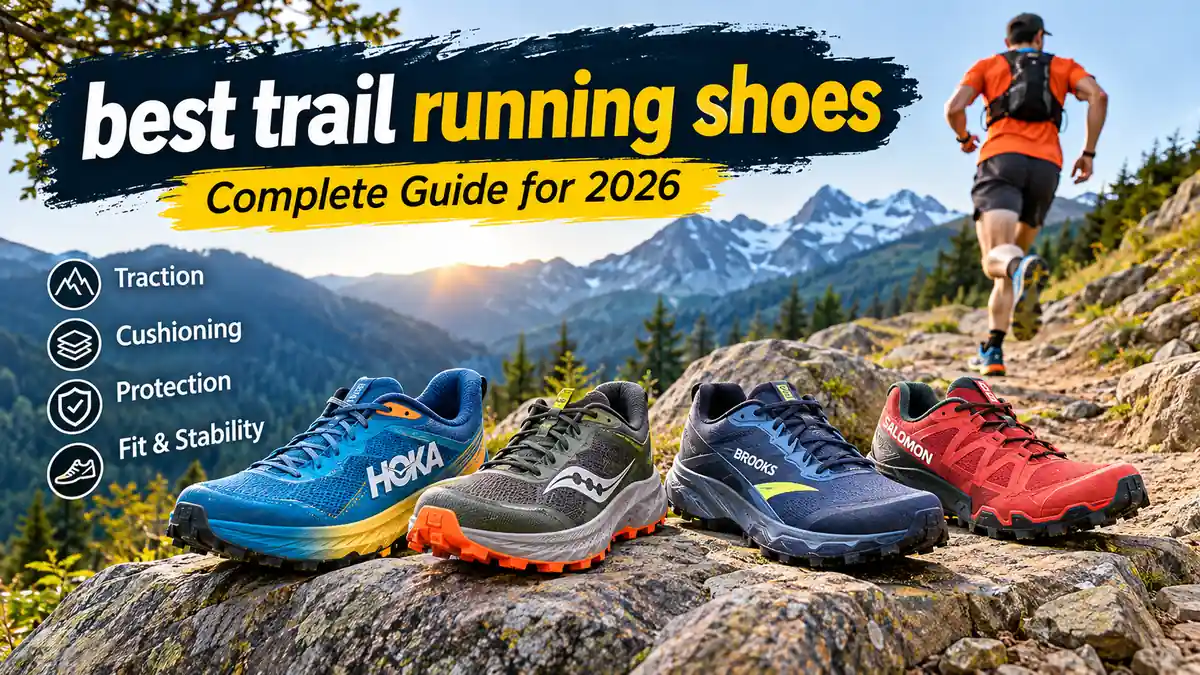
A trail running shoe that feels comfortable on a smooth forest path can become frustrating on a rocky mountain descent. The difference often comes down to traction, cushioning, stability, and how securely the shoe fits your foot.
Finding the best trail running shoes isn’t about choosing the most expensive pair or the model with the thickest sole. It’s about understanding where you run, how your feet move, and which features genuinely improve comfort and confidence on uneven ground.
The best trail running shoes combine reliable grip, comfortable cushioning, a secure fit, and appropriate foot protection for the terrain. For 2026, standout models include the Hoka Speedgoat 7 for cushioned mountain running, Saucony Peregrine 16 for versatility, Brooks Cascadia 20 for beginners, Salomon Speedcross 6 for muddy conditions, and Altra Lone Peak 9 for a roomy toe box and zero-drop platform.
These selections reflect published testing by established running publications, including iRunFar, OutdoorGearLab, REI, and Outside. Different testing teams favor different models, which reinforces an essential point: no single shoe performs best for every runner. iRunFar+3
What Makes the Best Trail Running Shoes Different?
Trail running footwear is engineered to handle conditions that ordinary road running shoes may struggle with.
Road shoes generally prioritize smooth transitions, predictable surfaces, and repetitive forward movement. Trail shoes must also handle loose stones, roots, sharp rocks, steep slopes, wet soil, and frequent changes in direction.
Four characteristics distinguish a capable trail running shoe.
1. Traction and outsole grip
The outsole is the rubber surface beneath the shoe. Trail shoes use raised rubber projections called lugs to grip uneven surfaces.
Lug depth, spacing, shape, and rubber compound all affect traction.
- Shallow lugs are generally suitable for hard-packed dirt and gravel.
- Moderate lugs balance versatility across mixed surfaces.
- Deep, widely spaced lugs help penetrate soft soil and release mud.
- Sticky rubber compounds can improve friction on rock, although wet rock remains challenging.
A shoe designed for deep mud may feel awkward on pavement because its aggressive lugs are not optimized for flat, hard surfaces.
2. Cushioning and shock absorption
The midsole sits between your foot and the outsole. Its foam influences comfort, impact absorption, and ground feel.
Highly cushioned shoes can reduce the sensation of repeated impacts during long runs. However, greater cushioning does not automatically mean better stability.
On technical trails, some runners prefer a lower platform that makes uneven surfaces easier to sense.
3. Protection against trail hazards
Sharp rocks, branches, and exposed roots create hazards rarely encountered on paved roads.
Protective features may include reinforced toe caps, durable mesh uppers, rock plates, and protective midsole materials.
A rock plate is a protective layer incorporated into the sole structure. It helps distribute pressure from sharp objects beneath the foot.
Not every trail shoe needs a separate rock plate. Some use dense foam or other construction methods to provide sufficient protection.
4. Stability on uneven ground
Trail stability depends on more than arch support.
The shoe’s platform width, heel security, outsole geometry, midsole firmness, and flexibility all influence how it behaves on uneven surfaces.
A wide platform can feel reassuring on moderate trails, while a lower, more flexible shoe may offer better control when carefully placing your feet between rocks.
The REI trail-running shoe guide explains these construction differences and their practical effects. REI Expert Advice
Best Trail Running Shoes in 2026: Top Models Compared
The following models stand out for different running environments and preferences.
| Trail running shoe | Best suited for | Main consideration |
|---|---|---|
| Hoka Speedgoat 7 | Cushioned mountain running | Snugger fit |
| Saucony Peregrine 16 | Versatile daily trail running | Less specialized for deep mud |
| Brooks Cascadia 20 | Beginners and everyday trails | Heavier than some speed-focused shoes |
| Salomon Speedcross 6 | Mud and soft ground | Aggressive outsole |
| Altra Lone Peak 9 | Natural toe splay and zero drop | Requires adaptation for some runners |
| Topo Ultraventure 5 | Roomy forefoot and longer outings | Less focused on aggressive technical grip |
| La Sportiva Prodigio Pro | Fast technical trail running | Performance-oriented design |
| Nike ACG Pegasus Trail | Road-to-trail transitions | Less specialized for extreme terrain |
| Hoka Tecton X 4 | Long-distance trail racing | Specialized, expensive construction |
These are terrain-based comparisons, not results from one standardized head-to-head test. iRunFar+2
Hoka Speedgoat 7: Best for Cushioned Mountain Running
Hoka One One Speedgoat 7 Black White Men’s – 1171928-BWHT – US
The Hoka Speedgoat 7 is a strong example of a modern mountain running shoe that combines substantial cushioning with an aggressive trail outsole.
Its design suits runners who frequently encounter rocky paths, sustained climbs, uneven descents, and long training sessions.
The Speedgoat series is known for its combination of underfoot protection and trail traction. The seventh generation continues that approach with updated cushioning and outsole geometry.
Strengths: Cushioned ride, capable traction, protective construction, and suitability for long mountain outings.
Limitations: Its relatively snug fit may not accommodate every forefoot comfortably, and the elevated platform can feel less natural to runners accustomed to minimal footwear.
OutdoorGearLab and iRunFar both identify the Speedgoat 7 as a leading option in their 2026 comparisons. iRunFar+1
Saucony Peregrine 16: Best Versatile Trail Shoe
Men’s Saucony Peregrine 16 – Commonwealth Running Co.
The Saucony Peregrine 16 is designed for runners who want one pair to handle a broad variety of trail conditions.
It balances traction, comfort, flexibility, and protection without focusing exclusively on maximum cushioning or racing performance.
Its Vibram outsole compound is a notable feature in the 2026 version, helping improve grip on challenging surfaces.
The Peregrine is particularly relevant to runners who regularly encounter dry dirt, loose gravel, occasional wet rocks, and moderate technical terrain.
Strengths: Versatile traction, secure midfoot fit, manageable weight, and an adaptable ride.
Limitations: It is not specifically designed for sustained deep mud or snow, and some runners may prefer more cushioning for very long outings.
OutdoorGearLab selected it as its men’s best overall trail running shoe in April 2026, while Outside named it a best-value choice in its October update. Tested & Ranked+1
Brooks Cascadia 20: Best for Beginners
Brooks Cascadia 20 Herren | Herren Schuhe Trailrunning Brooks
The Brooks Cascadia 20 is an approachable option for runners transitioning from pavement to natural terrain.
A beginner-friendly shoe should provide predictable footing, comfortable cushioning, and enough protection to make unfamiliar trails less intimidating.
The Cascadia line emphasizes dependable trail performance rather than an extremely minimal or highly specialized ride.
Strengths: Supportive trail-oriented construction, protective feel, and everyday versatility.
Limitations: Runners focused on minimizing shoe weight may prefer a lighter alternative.
iRunFar lists the Cascadia 20 as its beginner-focused selection for 2026. iRunFar
Salomon Speedcross 6: Best for Muddy Trails
Salomon Speedcross 6 Quiet Shade/Black/Blue Running Shoe Men’s US Sizes 7-14NEW | eBay
The Salomon Speedcross 6 is designed around traction in soft, loose, and muddy conditions.
Its prominent outsole lugs penetrate surfaces where shallow-tread footwear can lose grip.
This makes it particularly relevant for forest paths after rainfall, muddy singletrack, and soft hillside trails.
Strengths: Aggressive grip, secure upper construction, and effective traction in loose terrain.
Limitations: The pronounced tread is less suitable for extended pavement running, and its fit and stability characteristics may not suit every runner.
REI includes the Speedcross 6 among its top-tested 2026 trail shoes. REI Expert Advice
Altra Lone Peak 9: Best for a Roomy Toe Box
Lone Peak 9 Men’s Trail Running Shoe – Flint Grey/Dawn Blue | Altra Running US
The Altra Lone Peak 9 offers two distinctive characteristics: a foot-shaped forefoot and a zero-drop platform.
Zero drop means the heel and forefoot sit at the same nominal height above the ground.
The spacious forefoot can accommodate natural toe spreading, particularly during long outings when feet may swell.
Strengths: Roomy toe area, natural-feeling platform, and versatility for trail running and hiking.
Limitations: Zero-drop footwear changes the loading demands on the calf and Achilles tendon. Runners accustomed to higher-drop shoes should transition gradually rather than immediately switching all their mileage.
The Lone Peak 9 and 9+ feature in REI’s 2026 testing, while iRunFar highlights the Lone Peak 9 for zero-drop running. iRunFar+1
Topo Ultraventure 5: Best for a Roomy Forefoot on Long Runs
The Topo Ultraventure 5 emphasizes long-distance comfort and space around the toes.
Unlike zero-drop models, it uses a moderate heel-to-toe offset, making it potentially easier to adapt to for runners familiar with conventional running footwear.
Its design is particularly relevant for runners who experience forefoot pressure during long outings.
Strengths: Roomy toe box, comfortable cushioning, and suitability for less aggressive trails.
Limitations: It is less specialized for extremely muddy or highly technical terrain.
iRunFar includes the Ultraventure 5 among its leading wide-toe-box choices. iRunFar
La Sportiva Prodigio Pro: Best for Fast Technical Trails
The La Sportiva Prodigio Pro targets runners who prioritize efficient movement over challenging terrain.
Technical running demands precise foot placement, dependable traction, and sufficient protection without excessive bulk.
This model combines a performance-oriented design with features intended for demanding mountain routes.
Strengths: Responsive running feel, capable traction, and suitability for faster technical efforts.
Limitations: Its specialized performance characteristics may be unnecessary for runners who primarily use easy gravel paths.
Both iRunFar and OutdoorGearLab include the Prodigio Pro in their 2026 evaluations. iRunFar+1
Nike ACG Pegasus Trail: Best for Road-to-Trail Running
The Nike ACG Pegasus Trail is designed for mixed-surface outings.
Many runners start at home, cover several kilometers of pavement, and then enter a park or forest trail. A road-to-trail shoe addresses this combination.
Compared with aggressive mountain footwear, this category generally prioritizes smoother transitions on firm surfaces.
Strengths: Adaptability across pavement and moderate trails, comfortable running feel, and everyday versatility.
Limitations: Less specialized than dedicated mountain shoes for deep mud, sharp rocks, or highly technical descents.
The ACG Pegasus Trail appears in both iRunFar’s and Outside’s 2026 recommendations. iRunFar+1
Hoka Tecton X 4: Best for Long-Distance Trail Racing
The Hoka Tecton X 4 belongs to the specialized performance category.
Unlike conventional daily trail trainers, racing-oriented shoes may incorporate advanced foams, propulsion-focused structures, and geometry designed for faster movement.
Such designs can be useful for experienced runners competing in mountain races and ultramarathons.
Strengths: Performance-oriented construction, cushioning for sustained efforts, and racing-focused efficiency.
Limitations: Higher cost, specialized ride characteristics, and limited practical benefit for casual trail outings.
iRunFar identifies the Tecton X 4 as an ultramarathon-focused option. iRunFar
How to Choose the Best Trail Running Shoes for Different Terrain
The ground beneath your feet should influence footwear selection more than marketing labels.
A model that excels on wet forest trails may be less effective on smooth gravel. Understanding these differences helps narrow the field.
Rocky and technical trails
Rocky routes require a combination of protection, stability, and reliable outsole grip.
Look for reinforced toe protection, secure heel retention, a stable platform, and enough underfoot protection to reduce pressure from sharp stones.
Shoes with rock plates can be particularly useful on trails containing frequent pointed rocks.
However, excessive stiffness may reduce flexibility when moving across irregular terrain.
For technical mountain running, models such as the Salomon Genesis 2, La Sportiva Prodigio Pro, and Hoka Speedgoat 7 illustrate different approaches to protection and control.
Muddy and wet trails
500 Sportler im Schönbuch aktiv – Meldungen – Trailrunning
Mud creates a different traction problem from rock.
Rather than relying only on rubber friction, the outsole must penetrate soft ground and release accumulated mud.
Deep, widely spaced lugs generally work better than shallow tread patterns.
Shoes such as the Salomon Speedcross 6 and Inov8 TrailTalon are designed with soft-ground conditions in mind.
Water drainage also matters. A shoe that allows water to escape can be more practical during repeated stream crossings than a waterproof model that traps water after it enters from above.
Gravel and hard-packed dirt
Gravel trails are usually less technically demanding, although loose stones can still cause slipping.
For these surfaces, prioritize moderate traction, comfortable cushioning, and smooth transitions.
Road-to-trail shoes often work particularly well because their outsoles are less aggressive.
The Nike ACG Pegasus Trail and Salomon Aeroblaze 4 GRVL illustrate footwear designed around mixed or firmer surfaces.
Steep mountain descents
Downhill running places substantial demands on shoe fit.
Even a well-cushioned shoe can become uncomfortable if the foot repeatedly slides forward and the toes strike the front.
A secure midfoot, reliable heel hold, and sufficient toe clearance are essential.
Outsole braking traction also matters, especially on loose gravel.
Before attempting a long descent, test the shoe on shorter downhill sections to identify slipping, pressure points, or instability.
Trail Running Shoe Cushioning: How Much Do You Need?
Cushioning influences comfort, ground feedback, and the sensation of impact.
It does not operate independently of fit, running technique, terrain, or stability.
Minimal cushioning
Minimal shoes have relatively little material between the foot and ground.
They offer greater ground feedback and may appeal to runners who prefer flexible, lightweight footwear.
However, they provide less isolation from sharp rocks and may require adaptation of the foot and lower-leg tissues.
Moderate cushioning
Moderately cushioned shoes balance protection and terrain awareness.
They are often suitable for daily training, varied trails, and runners who want one adaptable shoe.
This category is a sensible starting point when the runner has no established preference for either minimal or maximal cushioning.
Maximum cushioning
Maximum-cushion shoes provide a substantial foam platform.
They can feel comfortable during long outings, particularly when trails contain repeated hard impacts.
However, a thicker sole raises the foot farther from the ground and can change how the shoe behaves on uneven terrain.
A high stack height does not necessarily make a shoe unstable, because platform width, foam characteristics, and outsole geometry also contribute.
The practical goal is to find cushioning that feels comfortable without compromising control.
Understanding Heel-to-Toe Drop and Foot Shape
Heel-to-toe drop is the difference in sole height between the heel and forefoot.
It is distinct from total stack height.
For example, a shoe may have substantial cushioning while still maintaining zero drop.
| Drop category | Approximate range | Typical characteristics |
|---|---|---|
| Zero drop | 0 mm | Level heel and forefoot |
| Low drop | 1–4 mm | Small heel-to-forefoot difference |
| Moderate drop | 5–8 mm | Common conventional running-shoe geometry |
| Higher drop | 9 mm or more | More elevated heel |
These ranges are descriptive rather than universal industry standards.
Is zero drop better for trail running?
Not necessarily.
Zero-drop footwear may appeal to runners who prefer a level platform and already tolerate that geometry.
However, it can increase demands on the calf muscles and Achilles tendon, particularly during adaptation.
A runner switching from a conventional higher-drop shoe should introduce zero-drop footwear gradually.
Does a wide toe box improve comfort?
A sufficiently spacious toe box can reduce pressure and allow the toes to spread naturally.
This becomes especially relevant during long-distance running, when feet may swell.
However, a roomy forefoot should not come at the expense of secure midfoot and heel retention.
A shoe that is too loose can allow excessive movement during descents.
What about arch support and pronation?
Pronation is a normal component of foot movement.
Trail surfaces constantly change foot placement, so road-running stability classifications do not always translate directly to trail conditions.
Rather than selecting a shoe solely because it is labeled neutral or supportive, prioritize a comfortable fit and stable movement on the surfaces you actually run.
Persistent pain or recurrent injuries may warrant an assessment by a qualified sports medicine professional.
Best Trail Running Shoes for Beginners
Beginners often benefit from predictable footwear rather than highly specialized racing designs.
The ideal first trail shoe should feel comfortable immediately, grip the terrain commonly encountered, and provide enough protection for occasional rocks and roots.
Models such as the Brooks Cascadia 20, Saucony Peregrine 16, and Hoka Torrent 4 represent different approaches to beginner-friendly trail running.
The Cascadia emphasizes everyday trail protection. The Peregrine offers broad versatility, while the Torrent provides a lighter, balanced alternative.
Can beginners use regular running shoes on trails?
Yes, on some surfaces.
Ordinary road shoes can work on smooth, dry park paths and maintained dirt tracks, especially for occasional short runs.
They become less suitable when terrain includes loose stones, deep mud, sharp rocks, or steep technical sections.
A dedicated trail outsole generally provides more appropriate traction for those conditions.
Should beginners choose waterproof shoes?
Waterproof trail shoes can be useful in cold, wet conditions or when moving through shallow moisture.
However, waterproof membranes often reduce breathability and can make drying slower after water enters from above the collar.
For warm-weather running and frequent stream crossings, breathable non-waterproof footwear may be more practical.
Best Trail Running Shoes for Long Distances and Ultramarathons
Long-distance trail running changes footwear priorities.
A shoe that feels comfortable during a 30-minute run may produce pressure points after several hours.
Ultramarathon footwear needs to balance cushioning, stability, protection, and the effects of foot swelling.
The Hoka Speedgoat 7, Topo Ultraventure 5, and Hoka Tecton X 4 illustrate different approaches to longer outings.
The Speedgoat focuses on cushioned mountain versatility. The Ultraventure emphasizes comfort and forefoot space, while the Tecton X targets racing performance.
Why foot swelling matters
During prolonged exercise, feet can change in volume.
A shoe that fits tightly at the beginning may become uncomfortable later.
Allowing adequate toe clearance and avoiding excessive pressure across the forefoot can help.
However, simply selecting a much larger size is not the answer. The heel and midfoot still need secure retention.
Are carbon-plated trail shoes worth using?
Some high-performance trail shoes use carbon-fiber or other stiffening plates to influence running mechanics and propulsion.
Their effectiveness depends on the design, runner, terrain, and pace.
On relatively runnable trails, a racing shoe’s geometry may feel efficient. On highly irregular ground, control and precise foot placement can matter more.
Carbon-plated footwear is not a requirement for completing an ultramarathon.
For many runners, reliable comfort and predictable traction are more useful than advanced racing technology.
How to Find the Right Trail Running Shoe Fit
Fit is one of the most important factors in footwear performance.
Even a highly rated model can be unsuitable if it creates pressure, slipping, or instability.
Follow these steps when evaluating a pair.
- Check the toe clearance. Allow enough space in front of the longest toe to prevent contact during descents.
- Assess forefoot width. The shoe should not squeeze the toes together or create pressure along the sides.
- Check heel retention. The heel should remain reasonably secure when walking uphill and downhill.
- Evaluate midfoot lockdown. The lacing system should hold the foot without excessive pressure.
- Wear your running socks. Sock thickness can noticeably change fit.
- Test movement. Walk, jog, turn, and simulate descending a slope if possible.
Trying shoes later in the day can be useful because foot volume may change during daily activity.
Should trail running shoes be a size bigger?
Not automatically.
Some runners benefit from additional toe clearance, particularly for long mountain runs. But sizing varies across brands and models.
The correct fit is based on actual foot length, width, toe clearance, and secure retention rather than a universal rule to increase shoe size.
How tight should trail running shoes feel?
They should feel secure without being restrictive.
The midfoot and heel need enough hold to prevent excessive movement, while the toes should have room to move.
Numbness, pinching, or persistent pressure are signs that the fit or lacing may need adjustment.
Outsole Rubber, Lug Depth, and Rock Protection Explained
Traction is one of the most misunderstood trail shoe features.
Deep lugs are useful in some environments, but they do not guarantee superior grip everywhere.
How lug depth affects traction
| Approximate lug depth | Typical application |
| 2–3 mm | Hard-packed trails and mixed pavement |
| 3–4 mm | General-purpose trail running |
| 4–5 mm | Loose dirt and varied technical trails |
| 5 mm or deeper | Soft ground and muddy conditions |
These are practical guidelines, not universal performance thresholds. Lug geometry and rubber compound also matter.
Vibram Megagrip and other rubber compounds
Vibram Megagrip is a rubber compound commonly used in outdoor footwear.
It is designed to balance grip and durability across varied surfaces.
Other manufacturers use proprietary outsole compounds, including Continental rubber on selected Adidas footwear and Contagrip technology on Salomon models.
No compound guarantees secure footing on every surface.
Wet polished stone, algae-covered rocks, ice, and loose gravel can remain slippery even with high-quality trail outsoles.
Do you need a rock plate?
A rock plate is most useful when repeated contact with sharp stones would otherwise cause discomfort.
Runners who spend most of their time on smooth dirt trails may not need one.
Shoes with thick, protective midsoles may also provide sufficient isolation without a separate rigid plate.
The decision should depend on terrain and underfoot comfort rather than the presence of a particular component.
Trail Running Shoes vs. Hiking Shoes
Trail running shoes and hiking footwear overlap in several ways.
Both may feature aggressive tread, reinforced uppers, and protection against uneven ground.
The main differences relate to movement, structure, and intended use.
| Feature | Trail running shoes | Traditional hiking shoes or boots |
|---|---|---|
| Primary purpose | Running on natural terrain | Walking and hiking |
| Weight | Often lighter | Often heavier |
| Flexibility | Generally greater | Varies; often more structured |
| Cushioning | Designed for running movement | Designed for walking and load support |
| Ankle coverage | Usually low-cut | Low, mid, or high-cut |
| Drying | Often faster with breathable mesh | Depends on construction and waterproofing |
Trail running shoes can be suitable for hiking, especially on maintained trails and with lighter loads.
However, demanding backpacking routes may call for different footwear characteristics.
The most appropriate choice depends on terrain, pack weight, weather, and personal comfort.
How Long Do Trail Running Shoes Last?
Trail running shoes commonly last several hundred miles, but there is no universal replacement distance.
Durability depends on outsole compound, foam construction, runner weight, gait, terrain, and frequency of use.
A shoe used on abrasive rock may show significant outsole wear earlier than one used on soft forest paths.
Signs your shoes may need replacing
- Outsole lugs have worn down enough to reduce traction.
- The upper has developed holes or structural damage.
- The midsole feels noticeably less protective than before.
- The heel no longer holds securely.
- The shoe has developed persistent uneven wear or instability.
Mileage is useful for tracking wear, but physical condition and performance matter more than an arbitrary number.
How to extend trail shoe lifespan
Remove accumulated mud after particularly dirty runs and allow shoes to dry naturally.
Avoid placing them directly beside heaters or exposing them to excessive heat, which can damage adhesives and materials.
A soft brush and mild soap are generally sufficient for routine cleaning.
Rotating footwear can also allow wet shoes to dry completely between runs.
Common Mistakes When Choosing Trail Running Shoes
Several mistakes repeatedly lead to discomfort or poor performance.
Choosing maximum cushioning without considering stability. A soft, tall shoe may feel comfortable initially but may not provide the control a particular runner wants on technical terrain.
Assuming deeper lugs are always better. Aggressive mud-focused tread can feel inefficient on hard-packed surfaces and pavement.
Ignoring toe-box shape. A shoe with excellent traction can still cause discomfort if the forefoot is too narrow.
Switching abruptly to zero drop. Changes in footwear geometry can alter loading on muscles and tendons. Gradual adaptation is sensible.
Buying waterproof shoes for every environment. Waterproof membranes are useful in some conditions but can be less comfortable in hot weather.
Selecting footwear solely by reviews. Expert testing is valuable for comparing performance, but reviewers cannot determine whether a shoe matches your individual foot shape.
Using worn-out outsoles on technical trails. Reduced tread depth can compromise grip, particularly on loose or wet surfaces.
The best approach combines reliable testing information with careful consideration of fit, terrain, and running habits.
How to Compare Trail Running Shoes Before Making a Decision
Instead of relying on an overall ranking, evaluate each shoe across the factors most relevant to your running.
A practical comparison should include traction, fit, cushioning, stability, protection, durability, and intended terrain.
For example, a runner who frequently encounters muddy forest paths should place greater emphasis on lug geometry and secure foot retention.
A runner training for a long-distance race over dry, rocky ground may prioritize sustained comfort, underfoot protection, and stability.
Someone who alternates between pavement and maintained trails may benefit more from a versatile road-to-trail design.
Published testing provides useful evidence. OutdoorGearLab, for instance, evaluates comfort and fit, stability, traction, foot protection, and weight rather than relying on a single feature. Tested & Ranked
The relative importance of these characteristics changes according to the runner.
A simple trail shoe selection checklist
Before settling on a model, confirm that:
- Its outsole matches the surfaces you regularly encounter.
- The heel and midfoot feel secure without pressure.
- The forefoot provides adequate space.
- The cushioning suits your preferred running feel.
- The shoe offers appropriate protection for the terrain.
- Its heel-to-toe drop is familiar or can be introduced gradually.
- You have tested it on a short run before relying on it for a demanding outing.
Final Thoughts on the Best Trail Running Shoes
The best trail running shoes are those that provide the right balance of grip, comfort, stability, and protection for your individual needs.
For cushioned mountain running, the Hoka Speedgoat 7 stands out. The Saucony Peregrine 16 offers a versatile option for varied terrain, while the Brooks Cascadia 20 provides an approachable starting point for beginners.
Runners dealing with frequent mud may prefer the Salomon Speedcross 6. Those who value a spacious toe box and zero-drop geometry can consider the Altra Lone Peak 9, while road-to-trail runners have different requirements altogether.
Ultimately, footwear should be evaluated by how it performs on the trails you actually use—not simply by its position in a ranking.
Start by identifying your most common terrain, then narrow your options according to fit, cushioning, and traction. A shoe that feels secure and comfortable during real trail movement is more valuable than one with impressive specifications that does not suit your feet.