
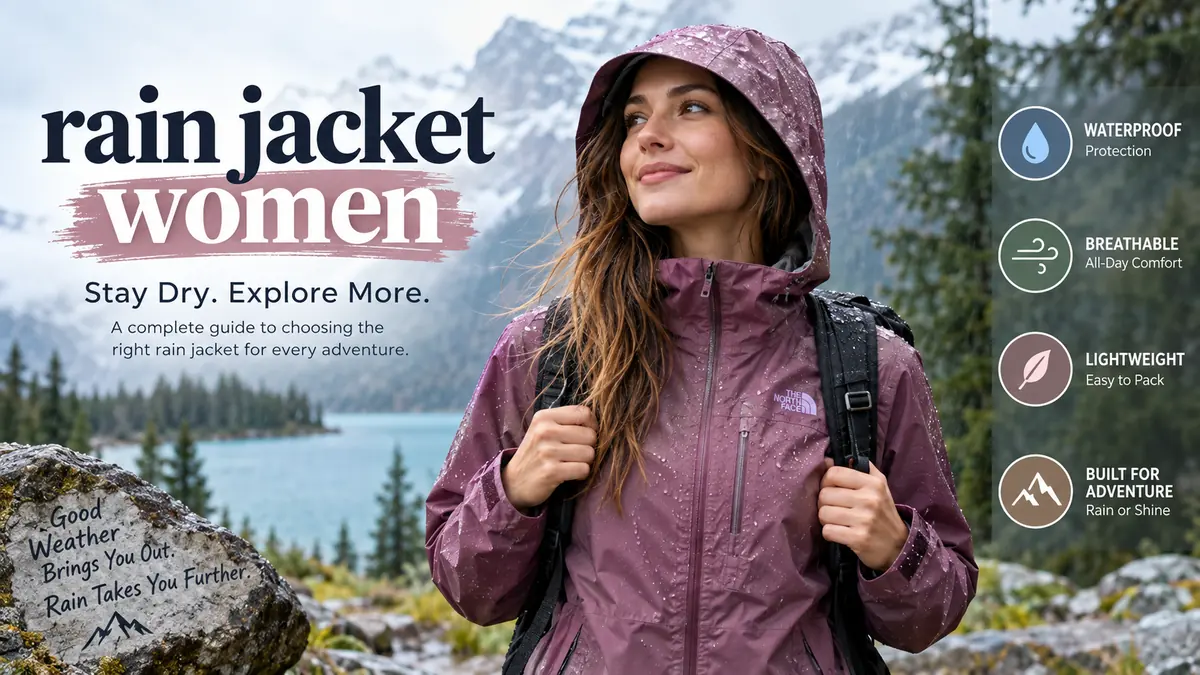
A rain jacket can look completely waterproof on the rack and still leave you damp, clammy, or uncomfortable once the weather turns. The difference is rarely just the fabric. Construction, sealed seams, ventilation, hood design, fit, and even how the jacket is maintained all affect real-world protection.
For anyone researching rain jacket women options, the most useful approach is to match the jacket to the conditions and activity. A waterproof membrane and sealed seams protect against sustained rain, while breathability, ventilation, fit, hood adjustment, and a durable water repellent finish determine how comfortable and practical the jacket feels in actual use.
What Makes a rain jacket women Design Truly Waterproof?
“Waterproof” and “water-resistant” are not interchangeable terms.
A water-resistant jacket can shed drizzle or brief showers, but it generally isn’t designed to withstand prolonged rain. A waterproof rain shell uses a membrane or coating that acts as a barrier against incoming water. Fully waterproof construction also depends on details such as seam sealing.
Think of a modern waterproof jacket as a system rather than a single fabric.
It normally combines:
- An outer face fabric
- A waterproof membrane or coating
- Sealed or taped seams
- A durable water repellent (DWR) treatment
- Protective zipper construction
- An adjustable hood, cuffs, and hem
If one part performs poorly, water can find its way inside even when the main fabric itself is waterproof.
Waterproof vs. water-resistant jackets
The distinction matters most when rain lasts longer than expected.
| Feature | Water-Resistant Jacket | Waterproof Rain Jacket |
|---|---|---|
| Light drizzle | Usually suitable | Suitable |
| Short showers | Often suitable | Suitable |
| Sustained rain | Limited protection | Designed for it |
| Waterproof membrane/coating | Not always | Typically yes |
| Seam sealing | Often absent | Expected on fully waterproof designs |
| Hiking in wet weather | Limited | Better choice |
| Everyday emergency use | Useful | Useful |
A lightweight windbreaker with a water-repellent finish, for example, should not automatically be treated as a true waterproof shell.
What does DWR actually do?
Durable water repellent, usually shortened to DWR, is a treatment on the jacket’s exterior. It encourages droplets to bead up and roll away rather than soaking into the face fabric.
DWR is not the waterproof membrane itself.
That distinction explains a common source of confusion. A jacket may still have a functioning waterproof membrane even when its outer fabric begins absorbing water. However, a saturated face fabric can make the jacket feel cold and clammy and can reduce effective moisture-vapor transfer.
Waterproof and Breathable Rain Jackets Explained
Keeping rain out is only half the job.
When you’re walking quickly, hiking uphill, cycling, or carrying a backpack, your body produces heat and moisture. If that moisture cannot escape, condensation and sweat accumulate inside the shell. You may then assume the jacket is leaking even when the water came from your own body.
Waterproof/breathable fabrics attempt to solve both problems: block liquid water from outside while allowing moisture vapor to move outward.
There is an important limitation, though. There is no single universal breathability test or independent certification system that makes every manufacturer’s breathability figure directly comparable.
That makes practical design features particularly valuable.
Pit zips can matter as much as the membrane
Pit zips are openings beneath the arms that allow warm, humid air to escape quickly.
For high-output activities, mechanical ventilation can make a major difference because it doesn’t depend entirely on moisture passing through the fabric.
They are especially useful for:
- Hiking uphill
- Backpacking
- Humid climates
- Fast walking
- Travel involving changing temperatures
- Wearing a shell over insulating layers
Some jackets sacrifice pit zips to reduce weight and bulk. That tradeoff can make sense for an emergency shell that spends most of its life inside a backpack, but it may be less appealing for sustained activity.
2-Layer vs. 2.5-Layer vs. 3-Layer Rain Jackets
One of the most useful specifications on a rain jacket is its construction.
You will frequently encounter 2L, 2.5L, and 3L descriptions. These refer to how the waterproof system is constructed rather than the literal thickness of the jacket.
REI’s rainwear guidance characterizes 2-layer designs as generally midweight, 2.5-layer shells as often lightweight to ultralight, and 3-layer construction as offering particularly strong waterproof protection, breathability, and durability, though usually at a higher price.
| Construction | Typical Strength | Typical Tradeoff | Useful For |
|---|---|---|---|
| 2-layer | Comfort and everyday practicality | Often heavier | Commuting, casual wear |
| 2.5-layer | Low weight and packability | Can feel less comfortable against skin | Travel, day hikes, emergency shell |
| 3-layer | Durability and technical performance | Usually more expensive | Hiking, backpacking, frequent wet weather |
2-layer construction
A 2-layer jacket bonds the waterproof membrane or coating to the outer fabric, while a separate lining protects the waterproof component.
This approach often works well for everyday rainwear because comfort may matter more than minimizing every gram.
2.5-layer construction
A 2.5-layer shell removes the traditional separate inner lining and instead uses a lightweight protective treatment or print on the inside.
The result can be remarkably compact.
For someone who wants a packable rain jacket for women to carry during travel, occasional hikes, or uncertain forecasts, this construction can provide an appealing balance of protection and weight.
The tradeoff is interior feel and, depending on the jacket, long-term durability under frequent hard use.
3-layer construction
A 3-layer shell sandwiches the waterproof membrane between an outer face fabric and an inner backer.
This is common in more technical rain shells because it creates an integrated fabric package designed for regular exposure to challenging conditions.
Patagonia’s current Women’s Torrentshell, for example, uses a three-layer H2No construction with a recycled nylon face fabric, polyurethane membrane, tricot backer, pit zips, and an adjustable hood.
Three-layer does not automatically mean “best for everyone.” It means the design prioritizes characteristics such as durability and weather performance. Someone needing a jacket for ten-minute walks between buildings may not benefit from the same construction as someone backpacking through days of rain.
Quick Takeaway: Choose construction according to use. Everyday wear favors comfort; travel favors packability; repeated hiking and prolonged wet-weather exposure make durability and ventilation more valuable.
How to Choose the Right rain jacket women Fit
Women’s rain jacket fit is more important than simply finding the correct number on a size chart.
A shell needs enough room to move and accommodate whatever clothing you expect to wear underneath.
Try to reproduce real use when checking fit.
If you expect to wear the jacket over a fleece in autumn, try it with a fleece. If it will be your summer hiking shell, test it over the lightweight layers you actually hike in.
Check shoulder and arm movement
Zip the jacket completely and reach both arms overhead.
Then reach forward as though holding trekking poles or bicycle handlebars.
The jacket should not pull severely across the shoulders, expose a large area around your waist, or restrict your arms.
A slightly longer rear hem can also provide useful coverage when bending forward or carrying a pack.
Leave room for layering
A waterproof shell is not necessarily a warm jacket.
Most uninsulated rain shells are designed primarily to manage precipitation and wind rather than provide substantial insulation. Waterproof jackets generally also offer wind protection, which helps reduce wind chill, but warmth still depends heavily on what you wear underneath.
A practical cool-weather system might include:
- A moisture-managing base layer
- A fleece or lightweight insulating midlayer
- A waterproof outer shell
Buying an extremely tight shell can undermine that flexibility.
Women’s-specific fit is not one universal shape
Terms such as “women’s fit,” “regular fit,” “slim fit,” and “relaxed fit” vary by manufacturer.
Two jackets labeled medium can fit quite differently around the bust, hips, shoulders, sleeves, and waist.
Treat the size printed on the label as a starting point, not proof of fit.
Essential Features in a Women’s Waterproof Rain Jacket
Extra features add weight, complexity, and sometimes cost. The goal isn’t to find the jacket with the longest feature list. It is to identify which features solve problems you will actually encounter.
Adjustable hood
A good hood should move with your head rather than blocking peripheral vision.
Look for adjustment around the face and, ideally, the rear of the hood. A structured or laminated brim can help direct water away from your eyes.
Helmet-compatible hoods are useful for climbing and cycling but can feel unnecessarily large for ordinary walking unless they adjust down effectively.
Sealed seams
Tiny needle holes are created when fabric panels are sewn together.
A fully waterproof jacket therefore needs a method of preventing rain from entering through vulnerable seams. This is why seam sealing is a key distinction between genuine waterproof outerwear and garments that simply use water-resistant fabric.
Zippers and storm flaps
The main zipper is another potential entry point for rain.
Different jackets solve this with water-resistant zipper designs, internal storm flaps, external storm flaps, or combinations of these approaches.
Don’t judge a jacket solely by whether the zipper looks waterproof. Consider the complete closure system.
Adjustable cuffs and hem
Rain often gets inside from openings rather than directly through fabric.
Adjustable cuffs can close around gloves or wrists, while a drawcord hem helps limit wind-driven rain entering from below.
These details become more useful as conditions get windier.
Pockets
Pocket location deserves more attention than it usually receives.
If you carry a backpack with a hip belt, ordinary low hand pockets may become inaccessible. Technical hiking shells sometimes position pockets higher for this reason.
For commuting, dog walking, and everyday use, conventional hand pockets may be more comfortable.
Packability
A lightweight rain jacket for women that packs into its own pocket is convenient for travel and unpredictable weather.
But ultralight should not automatically be treated as superior.
Reducing weight can mean lighter face fabrics, fewer pockets, fewer adjustment points, or less rugged construction. If a jacket will regularly rub against backpack straps or encounter branches and rock, durability may deserve higher priority than minimum packed size.
GORE-TEX, H2No, Omni-Tech and Other Waterproof Technologies
Brand names can make rainwear sound more complicated than it is.
The underlying objective remains consistent: create a barrier that prevents external water penetration while managing moisture generated inside the jacket.
GORE-TEX
GORE-TEX is one of the best-known waterproof/breathable technologies and appears across outdoor clothing designed for different activities.
It should not be treated as one identical fabric in every garment. Different GORE-TEX constructions are intended to balance weight, durability, weather protection, and breathability differently. Outdoor Research, for example, notes that GORE-TEX appears in multiple constructions and end-use configurations.
H2No
H2No is Patagonia’s performance standard for waterproof/breathable products.
The current Women’s Torrentshell 3L illustrates how a proprietary system can combine a three-layer construction, DWR, adjustable hood, pit zips, sealed closures, and packability rather than relying on membrane branding alone. Patagonia states that its current Torrentshell’s fabric, membrane, and DWR finish are made without intentionally added PFAS.
Omni-Tech
Columbia uses Omni-Tech across waterproof products, including women’s rain jackets. Its current range includes standard and women’s plus sizing across waterproof outerwear.
The larger lesson is simple: don’t choose a rain jacket based on the membrane logo alone.
Construction, fit, seam sealing, ventilation, face fabric, hood design, and intended activity all matter.
How Much Waterproofing Do You Actually Need?
More technical specifications do not automatically produce a better jacket for your circumstances.
Start with exposure.
Everyday commuting and errands
For walking to work, school runs, shopping, or everyday city use, prioritize:
- Reliable waterproof construction
- Comfortable lining or interior
- Useful pockets
- Good hood coverage
- Appropriate length
- Easy layering
- A style you will actually wear
A longer raincoat or parka can provide more coverage for the hips and upper legs. Shorter shells tend to offer greater freedom of movement and pack more easily.
Hiking and day trips
A women’s hiking rain jacket needs to cope with both rain and body heat.
Look closely at:
- Breathability
- Pit zips or other ventilation
- Adjustable hood
- Backpack-compatible pockets
- Hem adjustment
- Cuff adjustment
- Low enough weight to carry when dry
- Sufficient durability for backpack straps
A shell that feels perfectly comfortable while standing outside a store can feel very different after a steep climb.
Backpacking
Backpacking adds abrasion, extended exposure, and a strong incentive to reduce carried weight.
A lightweight 2.5-layer shell can suit trips where the jacket is mainly backup protection. A more durable 3-layer shell may make more sense when rain is frequent, the route is exposed, or the jacket will see substantial use.
Running and high-output activities
Breathability and ventilation become particularly important when effort increases.
No waterproof shell can make heavy perspiration disappear instantly. In warm, humid weather, even highly breathable rainwear can feel damp inside.
For intense activity, prioritize ventilation and avoid excessive insulation.
Travel
Travel changes the equation again.
Packability, versatility, low weight, and appearance can matter more than expedition-level durability. A jacket that compresses into a small pouch or pocket can live permanently in a daypack without becoming a burden.
Waterproof Ratings and Breathability Numbers
Some manufacturers provide a waterproof rating expressed in millimeters, while breathability may appear in figures such as grams per square meter per 24 hours.
These numbers can be useful, but they should not be interpreted in isolation.
A higher waterproof specification generally indicates greater resistance to water pressure under the relevant test method. Yet actual comfort also depends on seams, openings, ventilation, humidity, temperature, exertion, garment design, and maintenance.
Breathability figures require even more caution because test methods can differ. REI specifically notes the absence of a universal breathability test standard and independent certification body for rainwear breathability.
So rather than chasing one impressive number, ask:
What weather, activity level, and duration is this jacket designed to handle?
That question is usually more useful.
Lightweight vs. Durable: Understanding the Tradeoff
People often want a rain jacket that is simultaneously featherlight, extremely durable, highly breathable, inexpensive, completely waterproof, quiet, soft, and tiny when packed.
Those characteristics don’t always coexist.
A more realistic approach is to decide which compromises matter least.
| Priority | Look For | Acceptable Tradeoff |
|---|---|---|
| Travel | Low weight, packability | Less rugged fabric |
| Hiking | Ventilation, waterproofing | Slightly more weight |
| Backpacking | Weight-performance balance | Fewer casual features |
| Daily commute | Comfort, coverage, pockets | Larger packed size |
| Frequent storms | Durable waterproof construction | Higher weight/cost |
| High-output activity | Breathability, vents | Less warmth |
This is one of the biggest gaps in simplistic rain-jacket advice: specifications need context.
A heavier shell isn’t automatically outdated, and an ultralight shell isn’t automatically more advanced. They may simply be designed for different jobs.
Are Rain Jackets Warm Enough for Winter?
Usually, an uninsulated rain shell should not be considered a winter coat by itself.
Its job is to block precipitation and wind. Insulation comes primarily from the layers beneath it.
This can actually be an advantage.
A shell-and-layer system lets you change insulation as temperatures and activity levels change. Wear the shell over a T-shirt in mild wet weather, add fleece in cooler conditions, and use an appropriate insulating layer when temperatures fall further.
There are also waterproof insulated jackets that combine weather protection and insulation. To qualify as fully waterproof rather than merely water-resistant, however, the waterproof construction still needs details such as seam sealing.
Why a Waterproof Jacket Can Feel Wet Inside
Feeling moisture inside a jacket doesn’t automatically mean the membrane has failed.
There are three common explanations.
1. Perspiration
If you are generating moisture faster than the garment can move it outward, sweat accumulates.
Opening pit zips, reducing insulating layers, slowing your pace, or adjusting the front zipper can help.
2. The face fabric has wetted out
As DWR performance declines, the outer fabric may stop beading water and begin looking saturated.
That can make the jacket feel colder and clammy even if the waterproof barrier underneath is still preventing rain from passing directly through.
3. Water entered through an opening
Check the hood, collar, cuffs, pockets, hem, and zippers before assuming the fabric itself leaked.
Rain running from your hands into loose cuffs can create surprisingly wet sleeves.
Quick Takeaway: Damp inside does not always equal leaking. Determine whether the moisture is rain penetration, sweat, condensation, or water entering through an opening before deciding the jacket has failed.
How to Care for a Women’s Rain Jacket
Waterproof outerwear needs cleaning.
That surprises people because washing a technical jacket can feel risky. In reality, dirt, body oils, sweat, sunscreen, and other contamination can interfere with DWR performance and the garment’s ability to manage moisture.
Always start with the manufacturer’s care label because membranes, adhesives, fabrics, and treatments differ.
A practical care routine
- Empty and close pockets.
- Check the manufacturer’s washing instructions.
- Clean the garment using the recommended washing method.
- Avoid products specifically prohibited by the manufacturer, such as fabric softener where instructed.
- Dry according to the care label.
- Test whether water beads on the exterior.
- Restore or renew the DWR treatment when the manufacturer recommends it.
For example, Patagonia’s current Torrentshell instructions specify machine washing cold, tumble drying low, and avoiding fabric softeners.
Do not assume those exact instructions apply to every jacket; follow the label on yours.
How do you know when DWR needs attention?
Sprinkle or spray clean water onto the exterior.
If droplets bead and roll away, the treatment is behaving as expected. If large areas immediately darken and absorb water, the face fabric is wetting out and the DWR may need cleaning, reactivation, or renewal according to the manufacturer’s instructions.
Common Mistakes When Choosing a Rain Jacket
The most expensive mistakes tend to come from choosing specifications without considering real use.
Mistake 1: Assuming water-resistant means waterproof
A jacket that handles ten minutes of drizzle may fail during an hour of steady rain.
Check the construction and seam treatment rather than relying on vague weather-resistant language.
Mistake 2: Buying too tight
A fitted silhouette may look good in a changing room but become restrictive over winter layers.
Test movement and realistic layering before settling on size.
Mistake 3: Ignoring the hood
A poorly fitting hood can allow rain around the face, obstruct vision, or blow backward in wind.
Hood adjustment is one of the first things worth testing.
Mistake 4: Focusing only on waterproofing
For active use, poor moisture management can make a jacket uncomfortable even when no rain penetrates it.
Breathability and mechanical ventilation deserve equal consideration.
Mistake 5: Assuming more expensive always means more suitable
Technical 3-layer shells can provide excellent durability and weather performance, but someone who only needs an occasional travel jacket may get more practical value from a lighter, simpler design.
Mistake 6: Neglecting maintenance
When water stops beading, many people immediately assume the waterproof membrane is ruined.
Sometimes the jacket simply needs appropriate cleaning and DWR maintenance.
A Simple Way to Choose the Right rain jacket women Option
Ignore brand names for a moment and answer five questions.
How long will you normally be outside in rain? Brief showers demand less from a jacket than hours of continuous exposure.
How active will you be? Walking slowly around town and hiking uphill produce very different ventilation needs.
Will you carry the jacket frequently? If yes, weight and packed volume matter.
What will you wear underneath? Your answer determines the amount of layering room required.
How much abrasion will it face? Regular backpack use and rough outdoor environments reward stronger face fabrics and durable construction.
From there, the choice becomes much clearer.
For occasional travel and surprise showers, prioritize lightweight packability and dependable waterproof construction. For regular hiking, add breathability, pit zips, hood adjustment, and useful pocket placement. For prolonged wet-weather use, durability and robust 3-layer construction become more attractive.
Final Thoughts
Finding the right rain jacket women option is less about identifying one universally superior jacket and more about understanding how waterproof construction, breathability, layers, DWR, fit, ventilation, and durability work together.
A true waterproof shell with sealed seams is the starting point for sustained rain. After that, match the design to your activity. Lightweight and packable may suit travel; ventilation matters more for hiking; longer coverage can improve wet commutes; and 3-layer construction can make sense for frequent, demanding use.
Most importantly, try the jacket as you intend to wear it. Move your arms, adjust the hood, test it over your normal layers, check pocket access, and understand its care instructions. A rain jacket that fits your actual conditions will be far more useful than one chosen simply because it has the most impressive specification sheet.