
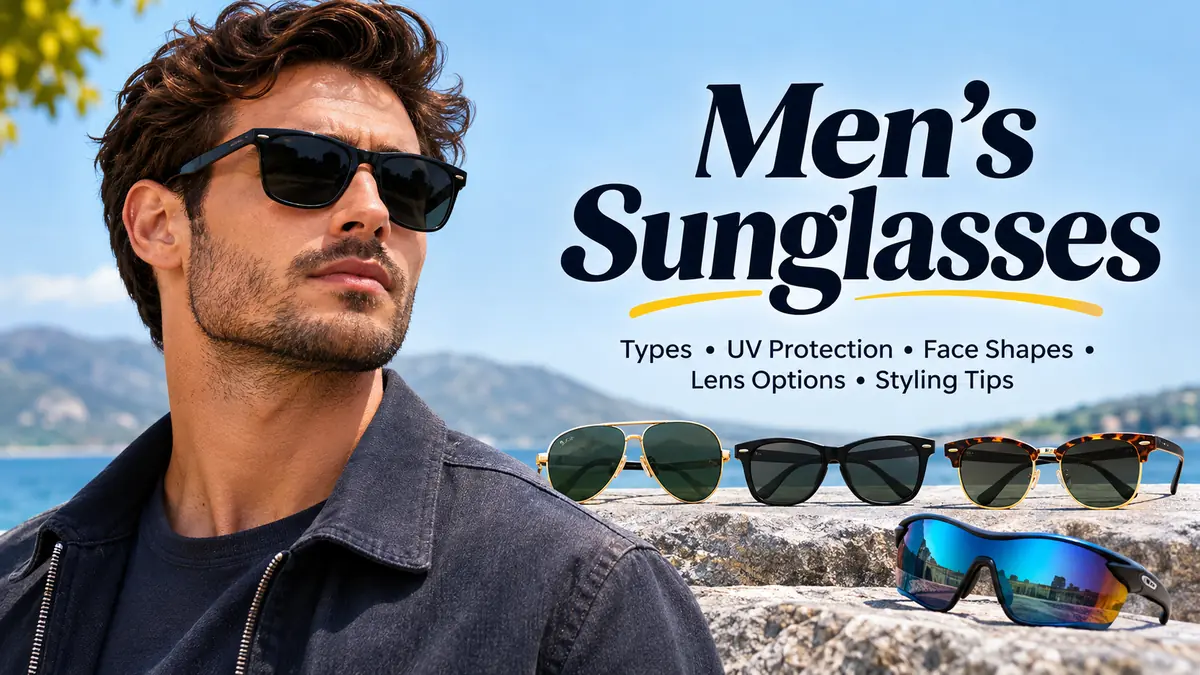
A good pair of sunglasses does more than complete an outfit. It protects your eyes from harmful sunlight, reduces uncomfortable glare, and makes outdoor activities more enjoyable. Yet with so many frame shapes, lens colors, and technical features available, understanding what actually matters can be surprisingly difficult.
men’s sunglasses are protective eyewear designed to reduce sunlight exposure while complementing different face shapes and personal styles. The most useful features include 100% UVA and UVB protection, comfortable frames, suitable lens tints, and optional polarization for glare reduction. Popular styles include aviator, wayfarer, round, square, and wraparound sunglasses.
Understanding the differences between these options helps you select eyewear based on your vision needs, daily activities, facial proportions, and comfort rather than appearance alone.
Why men’s sunglasses Are Important for Eye Health
Sunglasses serve two main purposes: protecting the eyes from ultraviolet radiation and improving visual comfort in bright environments.
Sunlight contains ultraviolet (UV) radiation, including UVA and UVB rays. Repeated exposure can affect several structures of the eye, including the cornea, lens, and surrounding tissues.
According to the American Academy of Ophthalmology (AAO), UV exposure is associated with conditions such as cataracts, photokeratitis, and certain growths on the eye’s surface. American Academy of Ophthalmology+1
Protection Against Harmful UV Rays
Ultraviolet radiation is invisible, so the brightness of sunlight does not reliably indicate how much UV exposure your eyes receive.
Properly designed sunglasses help reduce exposure to:
- UVA rays: Longer-wavelength ultraviolet radiation that can contribute to cumulative eye damage.
- UVB rays: Higher-energy ultraviolet radiation associated with damage to the cornea and other eye tissues.
- Reflected UV radiation: Sunlight reflected from surfaces such as snow, water, and sand.
Sunglasses are useful throughout the year, including during winter and on cloudy days when UV radiation can still reach the eyes.
Reduced Glare and Improved Comfort
Glare occurs when intense light makes it difficult to see comfortably. It is especially noticeable when sunlight reflects from roads, vehicle surfaces, water, or snow.
Tinted lenses reduce the amount of visible light entering the eyes. Polarized lenses go further by filtering certain reflected light, making them particularly useful for driving, fishing, and boating.
However, reducing glare and blocking UV radiation are different functions. Sunglasses should provide adequate UV protection regardless of their tint or polarization.
Popular Types and Styles of men’s sunglasses
Sunglasses come in several recognizable shapes, each offering a different appearance, field of vision, and level of facial coverage.
Aviator Classic Sunglasses in Gold and Black – RB3025 | Ray-Ban® CA
Aviator Sunglasses
Originally associated with aviation, aviators feature teardrop-shaped lenses, a thin metal frame, and often a double bridge. They offer a timeless appearance and generally suit a wide range of facial proportions.
Ray-Ban RB4940 601/87: Buy Online | Visionet
Wayfarer Sunglasses
Recognizable by their angular lenses and thicker frames, wayfarers create a structured, versatile look. The classic design is closely associated with Ray-Ban.
Round Sunglasses
Circular lenses provide a softer, vintage-inspired appearance. Round frames can balance angular facial features and are available in minimalist metal and thicker acetate designs.
Best Men’s Modern Sunglasses for an Effortless Stylish Look – Totally Reviewed
Square and Rectangular Sunglasses
These frames feature defined corners and straight edges. They often create a sharper appearance and can provide visual contrast to softer or rounder facial features.
SASA Raptor Matte Black Frame Smoke Black Lens Sports Sunglasses – sasaeyewear
Wraparound and Sport Sunglasses
Curved frames follow the contours of the face, limiting light entering from the sides. They are particularly useful for cycling, running, hiking, and other outdoor activities.
[ Manchester ] Premium Clubmaster Sunglasses | Project Shades
Browline Sunglasses
Browline designs emphasize the upper portion of the frame, often combining acetate and metal. They provide a classic, slightly formal appearance without requiring oversized lenses.
Which Sunglasses Style Is Most Versatile?
Wayfarer and aviator designs are among the most adaptable everyday styles because they work with casual clothing, business-casual outfits, and many facial shapes.
For outdoor sports, however, a lightweight wraparound frame may offer better coverage and stability than a traditional fashion-oriented design.
The most versatile sunglasses are ultimately those that fit securely, provide adequate UV protection, and feel comfortable during extended wear.
How to Choose men’s sunglasses for Your Face Shape
Face shape can provide a useful starting point when comparing sunglasses. The general styling principle is to balance facial proportions rather than duplicate them.
These are guidelines, not strict rules. Two people with the same face shape may prefer different frames because of differences in head width, nose bridge, cheekbones, and personal style.
Round Face Shape – Characteristics, Hairstyles & Glasses Guide
Round Face
Round faces generally have softer contours and similar facial width and length. Square, rectangular, and angular wayfarer frames can add definition and contrast.
Jak vybrat brýle podle tvaru obličeje — Vidím Pěkně
Square Face
A broad forehead and defined jawline characterize square faces. Round, oval, and softly curved aviator frames can balance angular features.
Oval Face
Oval faces have balanced proportions and tend to accommodate many frame shapes. Aviators, wayfarers, rectangular frames, and round sunglasses can all work well.
Jak vybrat brýle podle tvaru obličeje — Vidím Pěkně
Heart-Shaped Face
Heart-shaped faces feature a wider forehead and narrower chin. Rounded frames, teardrop aviators, and lighter designs can create a balanced appearance.
Face Shape Guide for Men: Find the Hairstyle That Suits You Best
Diamond Face
Diamond faces have prominent cheekbones with a narrower forehead and jawline. Oval, rimless, and gently curved frames can complement these proportions.
Face Shape and Frame Style Comparison
| Face shape | Commonly flattering styles | Styling effect |
|---|---|---|
| Round | Square, rectangular, wayfarer | Adds angular definition |
| Square | Round, oval, aviator | Softens sharp features |
| Oval | Most frame shapes | Maintains natural balance |
| Heart | Aviator, round, light frames | Balances forehead and chin |
| Diamond | Oval, rimless, browline | Complements prominent cheekbones |
| Oblong | Taller, oversized, square | Adds visual width |
How Wide Should Sunglasses Be?
Frame width is just as important as shape.
Ideally, sunglasses should sit comfortably across the face without squeezing the temples or extending excessively beyond the sides of the head.
The lenses should cover the eyes adequately, while the bridge should rest securely on the nose without uncomfortable pressure.
A good fit also helps prevent sunglasses from sliding when walking, bending, or moving your head.
Understanding UV400 Protection and Sunglass Lens Technology
Lens protection is the most important technical consideration when evaluating sunglasses.
A fashionable frame offers little benefit to eye health if its lenses do not adequately filter ultraviolet radiation.
What Does UV400 Mean?
UV400 indicates that lenses are designed to block ultraviolet radiation with wavelengths up to 400 nanometers.
This includes UVA and UVB radiation, making UV400 a useful label when identifying sunglasses that provide comprehensive ultraviolet protection.
The American Academy of Ophthalmology recommends sunglasses that block 99% to 100% of UV radiation. American Academy of Ophthalmology+1
Look for labeling such as:
- UV400 protection
- 100% UVA and UVB protection
- 99–100% ultraviolet protection
A UV400 claim should refer to the lens’s actual performance, not simply its appearance or darkness.
If protection is uncertain, an optical professional may be able to measure the lenses using a UV transmission testing instrument.
Polarized vs. Non-Polarized Sunglasses
Polarized sunglasses contain a special filter that reduces certain types of reflected glare.
This is particularly useful when sunlight reflects horizontally from surfaces such as water, wet roads, or vehicle hoods.
Non-polarized sunglasses reduce brightness through tinted lenses but do not filter reflected glare in the same way.
| Feature | Polarized lenses | Non-polarized lenses |
|---|---|---|
| Reduces overall brightness | Yes | Yes |
| Reduces reflected glare | Strongly | Limited |
| UV protection | Depends on lens specifications | Depends on lens specifications |
| Driving comfort | Often beneficial | Suitable with appropriate tint |
| Screen visibility | May interfere with LCD displays | Usually fewer polarization-related issues |
| Outdoor water activities | Particularly useful | Less effective against reflections |
| Typical cost | Often higher | Often lower |
Are polarized sunglasses better for your eyes?
Polarization can improve visual comfort and reduce distracting reflections, but it does not automatically provide greater UV protection.
Both polarized and non-polarized lenses can protect the eyes effectively when they meet appropriate UV-blocking requirements.
One practical drawback is that polarized lenses may make certain vehicle dashboards, phone screens, and LCD displays difficult to see. American Academy of Ophthalmology+1
Photochromic Sunglasses
Photochromic lenses change tint in response to light conditions, becoming darker outdoors and lighter in lower-light environments.
They can be useful for people who frequently move between indoor and outdoor settings.
However, some photochromic lenses do not darken as much inside vehicles because windshields filter much of the ultraviolet radiation that activates them.
Their performance also varies by lens technology and temperature.
Mirrored and Gradient Lenses
Mirrored sunglasses have reflective coatings that reduce some incoming visible light and create a distinctive appearance.
Gradient lenses are darker at the top and lighter toward the bottom.
A single-gradient design can be useful for daytime driving because it reduces overhead brightness while allowing easier viewing of dashboard instruments.
Neither mirrored coatings nor gradient tinting should be treated as proof of UV protection.
Sunglass Lens Colors, Materials, and Protection Categories
Lens color affects how the world appears through sunglasses. It can influence perceived contrast, color accuracy, and visual comfort.
However, lens color alone does not determine ultraviolet protection.
Which Sunglasses Lens Color Is Best?
| Lens color | Main characteristics | Common uses |
|---|---|---|
| Gray | Reduces brightness while preserving relatively neutral colors | Everyday wear, driving |
| Brown | Enhances perceived contrast and adds a warmer appearance | Outdoor recreation, driving |
| Green | Balances brightness reduction and color perception | General outdoor activities |
| Amber | Enhances certain contrasts in variable light | Some sports and outdoor activities |
| Yellow | Can improve perceived contrast in selected low-light situations | Specialized sporting applications |
| Rose | Alters color perception and can enhance selected contrasts | Golf and recreational activities |
| Blue | Primarily an aesthetic choice, depending on lens design | Fashion and casual wear |
Gray lenses are often a practical general-purpose choice because they reduce brightness without substantially changing the appearance of colors.
Brown and amber lenses may be preferred when contrast is more important than completely neutral color perception.
No particular lens color guarantees superior UV protection.
Sunglasses Lens Categories Explained
Sunglass categories describe how much visible light passes through the lens. This is measured as visible light transmission, or VLT.
| Category | Visible light transmission | Typical conditions |
|---|---|---|
| 0 | 80–100% | Very light tint |
| 1 | 43–80% | Low sunlight |
| 2 | 18–43% | Moderate sunlight |
| 3 | 8–18% | Strong sunlight |
| 4 | 3–8% | Extremely bright conditions |
Category 3 lenses are commonly appropriate for bright daytime conditions.
Category 4 lenses are intended for specialized environments with intense brightness, such as high-altitude mountaineering, and are not suitable for driving.
These categories describe visible-light filtering, not the amount of UV radiation blocked. Corning+1
Common Sunglass Lens Materials
Different lens materials offer different combinations of weight, optical clarity, impact resistance, and durability.
Polycarbonate lenses are lightweight and highly impact-resistant. They are widely used in sports sunglasses and active eyewear. Their main disadvantage is that they can scratch without a suitable protective coating.
Trivex lenses provide good impact resistance, low weight, and strong optical performance. They are also used in prescription eyewear.
CR-39 plastic lenses are known for good optical clarity and are commonly used in conventional eyewear. They are generally less impact-resistant than polycarbonate.
Glass lenses offer excellent optical clarity and good scratch resistance but tend to be heavier and may be more vulnerable to breakage under impact.
For activities involving flying objects or potential impacts, ordinary sunglasses should not replace appropriately certified protective sports eyewear.
Frame Materials, Comfort, and Proper Fit
The frame determines how securely sunglasses sit on the face and how comfortable they remain throughout the day.
Common frame materials include acetate, stainless steel, titanium, and flexible thermoplastics such as TR90.
Acetate Frames
Acetate is frequently used for wayfarer, square, and other fashion-oriented frames.
It supports a wide variety of colors, patterns, and finishes.
Acetate frames can be comfortable and durable, although thicker designs may feel heavier than minimalist metal frames.
Metal and Titanium Frames
Metal frames are commonly found in aviator, round, and rimless sunglasses.
Stainless steel offers strength and a relatively slim appearance.
Titanium is lightweight, corrosion-resistant, and often suitable for people who prefer minimal frame weight.
Some metal alloys contain nickel, which can cause contact reactions in sensitive individuals.
TR90 and Flexible Plastic Frames
TR90 is a lightweight thermoplastic material commonly used in sports and casual eyewear.
Its flexibility can help frames tolerate routine movement and handling.
However, frame durability also depends on hinge construction, lens mounting, and manufacturing quality.
Understanding Sunglasses Size Measurements
Many sunglasses have three measurements printed on the inside of a temple arm.
For example:
Illustrative frame measurements. *Temple length is measured along the arm, not the short line shown.
52 mm
Lens width
18 mm
Bridge width
145 mm
Temple length
Lens width measures the horizontal width of one lens. Bridge width describes the distance between the lenses, while temple length measures the arms extending toward the ears.
These measurements provide a useful starting point, but they do not fully describe the frame’s total width or how it will fit a particular face.
Signs That Sunglasses Fit Correctly
Well-fitting sunglasses should:
- Rest securely without sliding down the nose.
- Avoid uncomfortable pressure around the temples.
- Sit evenly across the face.
- Provide adequate coverage around the eyes.
- Remain stable during normal head movement.
- Avoid resting heavily against the cheeks.
A common mistake is selecting oversized frames based entirely on appearance. Large lenses can provide useful coverage, but frames that constantly slide or press against the face are unlikely to remain comfortable.
Choosing Sunglasses for Driving, Sports, and Everyday Activities
Different environments place different demands on sunglasses.
A lightweight pair suitable for walking around a city may not provide the stability or side protection needed for cycling or hiking.
Sunglasses for Driving
Driving sunglasses should reduce distracting brightness without interfering with the ability to recognize traffic signals, road markings, or dashboard information.
Useful features include:
- Verified UV400 protection.
- Suitable visible-light transmission for daytime driving.
- Gray, brown, or other appropriate lens colors.
- Polarization when reflected road glare is troublesome.
- Comfortable frames that do not obstruct peripheral vision.
Polarized lenses can be helpful when sunlight reflects from wet pavement or vehicle surfaces.
However, polarization may interfere with certain displays, so checking visibility through the windshield and dashboard is worthwhile.
Very dark category 4 sunglasses should not be used for driving. Tinted sunglasses are also inappropriate for night driving because they reduce the light available to the eyes. FDA+1
Sunglasses for Running and Cycling
Running and cycling sunglasses benefit from low weight, secure nose pads, stable temples, and lenses that provide a broad field of view.
Wraparound designs are particularly useful because they reduce light entering from the sides while helping shield the eyes from wind and airborne debris.
For cycling, impact-resistant lenses and appropriate sports eyewear standards matter more than fashion-oriented frame construction.
Sunglasses for Fishing and Boating
Water creates strong reflected glare, making polarized sunglasses especially useful.
Brown, gray, and copper-colored lenses are common choices, depending on light conditions and individual preferences.
Frames with good side coverage help limit sunlight reaching the eyes from different angles.
A retaining strap can also prevent sunglasses from falling into the water.
Sunglasses for Hiking and Mountain Activities
Hiking sunglasses should provide adequate UV protection, secure fit, and comfortable coverage.
At higher elevations, UV exposure can increase, while snow and ice may reflect substantial amounts of sunlight.
Specialized glacier glasses or mountaineering eyewear may be necessary in extreme conditions. Ordinary fashion sunglasses may not provide sufficient side protection or visible-light filtering.
Everyday Casual Sunglasses
For commuting, walking, and general outdoor use, comfort and versatility usually matter most.
A medium-weight wayfarer or aviator frame with UV400 protection and an appropriate lens tint can suit many everyday situations.
For people who frequently move between indoor and outdoor environments, photochromic prescription eyewear may also be convenient.
Prescription Sunglasses and Special Lens Features
People who normally wear prescription glasses do not need to sacrifice clear vision to obtain sun protection.
Prescription sunglasses combine corrective lenses with sunlight filtering.
Prescription vs. Non-Prescription Sunglasses
Non-prescription sunglasses generally use plano lenses, which have no corrective optical power.
Prescription sunglasses contain lenses designed to correct vision conditions such as myopia, hyperopia, or astigmatism.
Both types can provide effective UV protection when manufactured with appropriate materials and coatings.
Prescription sunglasses may also incorporate polarization, photochromic technology, or specialized tints.
Alternatives to Prescription Sunglasses
Some people prefer alternatives that allow them to continue using their existing prescription glasses.
These include:
- Clip-on sunglasses that attach to regular frames.
- Fit-over sunglasses designed to sit over prescription glasses.
- Photochromic prescription lenses.
- Contact lenses combined with non-prescription sunglasses.
UV-blocking contact lenses do not cover the entire eye or surrounding skin, so sunglasses can still provide valuable additional protection.
Anti-Reflective and Scratch-Resistant Coatings
An anti-reflective coating can reduce distracting reflections, particularly from the rear surface of sunglass lenses.
Scratch-resistant coatings help protect lens surfaces during normal use, although no ordinary coating makes lenses completely scratch-proof.
Hydrophobic and oleophobic coatings can make lenses easier to clean by reducing the adhesion of water droplets, fingerprints, and oils.
These coatings improve usability but should not be confused with UV protection unless the manufacturer specifically documents that function.
How to Evaluate Sunglasses Quality and Safety
A recognizable brand name or high price does not automatically guarantee superior eye protection.
Established eyewear manufacturers such as Oakley, Persol, and Ray-Ban offer various lens and frame technologies, but each product should still be assessed according to its actual specifications.
The same principle applies to less expensive eyewear.
Check UV Protection Claims
Look for clear labeling that states the lenses block 99–100% of UVA and UVB radiation.
If a label is missing, vague, or questionable, an optical shop may be able to verify UV transmission with suitable equipment.
Dark lenses without adequate UV protection should not be assumed safe.
Check Optical Clarity
Poor optical quality can cause distortion and visual discomfort.
A simple preliminary check involves looking through the lenses at a straight-edged pattern, such as tiles or a window frame.
Move the sunglasses slowly from side to side. Straight lines should remain reasonably straight rather than appearing warped or wavy.
This check can reveal obvious optical distortion, although it does not verify UV protection or replace professional lens testing.
Understand Sunglass Safety Standards
Several standards address the optical and protective performance of sunglasses.
ANSI Z80.3-2025 is an American standard covering non-prescription sunglass and fashion eyewear requirements, including relevant optical properties and labeling.
ISO 12312-1 is an international standard addressing sunglasses for general use, including requirements related to filters and protection against solar radiation.
ANSI/ISEA Z87.1 concerns occupational and educational eye and face protection. Ordinary sunglasses should not be treated as certified industrial safety glasses unless they meet the relevant requirements.
The U.S. Food and Drug Administration also regulates sunglasses as medical devices and addresses applicable impact-resistance requirements. The ANSI Blog+1
These standards serve different purposes. General-purpose sunglasses are not automatically suitable for industrial work, high-impact sports, laser exposure, or viewing a solar eclipse.
Common Sunglasses Myths
Myth: Darker sunglasses always provide better UV protection.
Lens darkness describes visible-light transmission, not necessarily ultraviolet filtering.
Myth: Polarized sunglasses automatically block all UV rays.
Polarization reduces reflected glare. UV protection must be provided by the lens material or appropriate filtering technology.
Myth: Expensive sunglasses always protect eyes better.
A reasonably priced pair with verified UV protection can provide effective protection.
Myth: Sunglasses are only necessary during summer.
UV radiation is present throughout the year, and reflected sunlight can be particularly intense around snow and water.
Myth: All sunglasses are suitable for sports.
Activities involving impacts may require eyewear specifically designed and tested for the relevant hazards.
Caring for men’s sunglasses and Making Them Last Longer
Proper maintenance helps preserve lens clarity, frame alignment, and everyday comfort.
Sunglasses are exposed to fingerprints, dust, sweat, sunscreen, and environmental debris. Cleaning them incorrectly can gradually damage coatings and lens surfaces.
How to Clean Sunglasses Properly
- Rinse the lenses with lukewarm water to remove loose dust and grit.
- Apply a small amount of lens-safe cleaning solution or mild, lotion-free soap when appropriate for the lens coating.
- Gently clean the lenses and frame with clean fingers.
- Rinse thoroughly to remove cleaning residue.
- Dry with a clean microfiber cloth.
Avoid wiping dusty lenses with a shirt or paper towel, as trapped particles may scratch the surface.
Household glass cleaners, abrasive products, and harsh chemicals can damage certain lens coatings.
How to Store Sunglasses
Keep sunglasses in a protective case when they are not being worn.
Avoid placing them lens-down on hard surfaces or leaving them exposed to excessive heat.
A vehicle dashboard can become extremely hot, potentially damaging plastic frames, lens coatings, or adhesives.
When removing sunglasses, using both hands can help reduce unnecessary stress on the hinges.
When Should Sunglasses Be Replaced?
Sunglasses do not have a universal replacement schedule.
Replacement may be appropriate when:
- Lenses develop significant scratches that interfere with vision.
- Frames become cracked or no longer fit securely.
- Hinges loosen beyond practical adjustment.
- Lens coatings peel or become damaged.
- UV protection cannot be verified and there is reason to question it.
UV protection does not necessarily disappear simply because sunglasses are old. If their performance is uncertain, professional testing can help determine whether they remain suitable.
Final Thoughts on Choosing men’s sunglasses
The right sunglasses combine reliable eye protection, appropriate lens technology, a comfortable fit, and a frame shape that suits the wearer.
Start with 100% UVA and UVB protection or UV400 labeling, then consider how the sunglasses will be used. Polarized lenses can improve comfort around reflective surfaces, wraparound frames offer additional side coverage, and different lens materials provide different levels of weight and impact resistance.
Face shape and style are useful considerations, but they should not outweigh optical quality or comfort.
Before relying on any pair for regular outdoor use, check its UV protection, lens clarity, fit, and suitability for your activities. These practical details matter far more than the logo on the frame.