
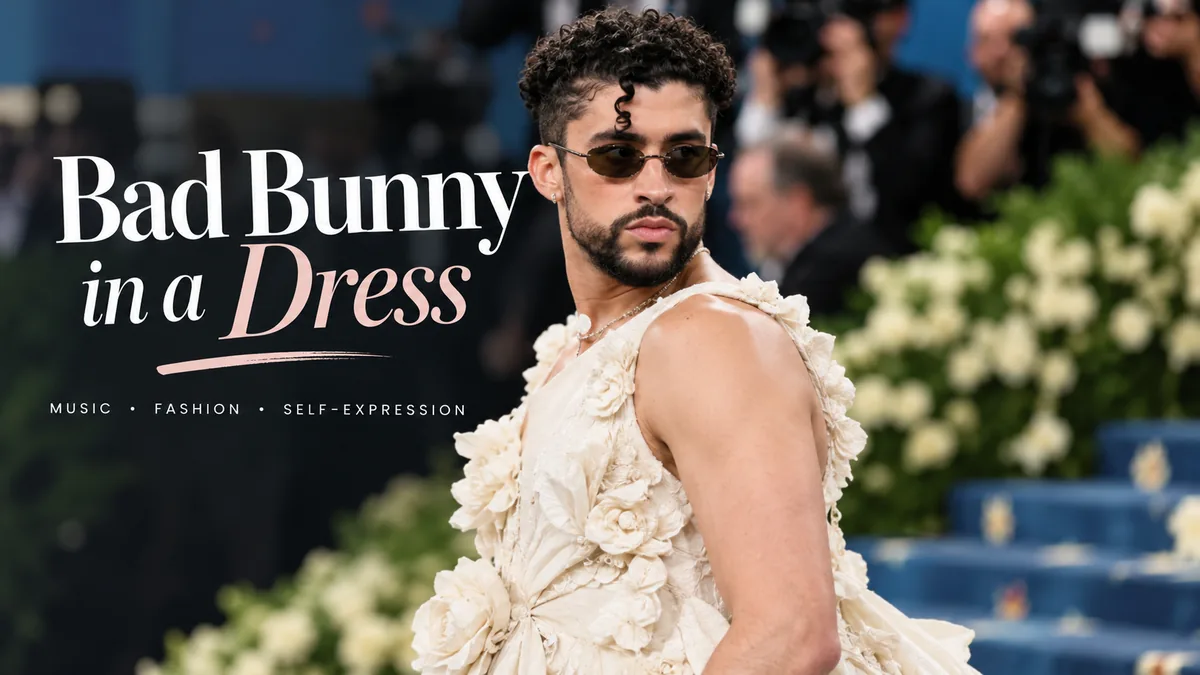
Seeing bad bunny in a dress can look like a simple celebrity-fashion moment at first. But the Puerto Rican artist’s history with dresses, skirts, corsets, drag-inspired styling, and traditionally feminine clothing tells a much bigger story about personal expression, masculinity, Puerto Rican culture, and the way clothing gets assigned a gender.
Bad Bunny, whose real name is Benito Antonio Martínez Ocasio, began attracting widespread attention for these choices in 2020. Since then, he has continued experimenting with clothing on magazine shoots, in music videos, on concert stages, and at events such as the Met Gala. His own explanation is straightforward: he does not believe a piece of clothing has to belong exclusively to men or women.
Quick answer: Bad Bunny has worn dresses and skirts for several different reasons. Some looks are simply part of his personal style, while others have carried deliberate social or artistic meaning. His best-known examples include a 2020 white dress, a black skirt worn in tribute to Alexa Negrón Luciano, drag looks in “Yo Perreo Sola,” and a skirted Burberry ensemble at the 2022 Met Gala.
Why Does Bad Bunny Wear Dresses?
There is no single explanation for every Bad Bunny dress or skirt appearance.
Sometimes the clothes have communicated a specific message. Sometimes they have been part of a character or music-video concept. In other cases, he appears to have chosen them for the same reason anyone chooses an outfit: he liked how they looked.
Bad Bunny has repeatedly explained that he does not see clothing through strict male-versus-female categories.
Speaking to GQ in 2022, he questioned the conventional boundaries between masculine and feminine clothing and summarized his outlook simply: “To me, a dress is a dress.”
That idea helps explain much of his wardrobe.
Rather than treating a skirt, dress, manicure, suit, jewelry, or pair of boots as evidence of a particular identity, he approaches them as pieces that can be combined according to mood, appearance, and context.
His interest in clothing outside conventional menswear also goes back well before his global fame. He has recalled shopping with his mother as a child and noticing that women’s departments seemed to offer more variety. In a 2022 Harper’s Bazaar interview, he remembered feeling that those pieces often fit him better and offered more options.
That history makes an important distinction: not every bad bunny in a dress appearance should automatically be interpreted as a political statement.
Some were. Others were fashion.
The 2020 Bad Bunny White Dress Look
One of the images most closely associated with searches for bad bunny in a dress appeared around the release of his 2020 album YHLQMDLG.
Bad Bunny posted photographs in which he wore a minimalist white dress underneath an oversized taupe sweatshirt. The styling was relaxed rather than theatrical—the dress was simply incorporated into a casual outfit.
Vogue reported that Bad Bunny described it as one of his favorite recent outfits at the time. He also indicated that he did not own many dresses but was interested in wearing them more often.
GQ subsequently highlighted the minimalist dress-and-outerwear combination as one of his notable looks.
The significance of this outfit is easy to miss if it is grouped together with his more explicitly symbolic appearances.
There was no elaborate stage character attached to it. There was no red-carpet dress code to satisfy. According to Vogue’s reporting, the dress did not carry the deeper message associated with another famous outfit he had worn shortly beforehand.
It therefore provides one of the clearest examples of Bad Bunny wearing a dress simply as fashion.
Was the White Outfit Actually a Dress?
Yes.
Contemporary fashion coverage specifically described the white garment as a dress. Vogue called attention to the look in March 2020, while GQ subsequently referred to his “minimalist dress and anorak.”
This matters because several different Bad Bunny outfits are frequently grouped together online.
The white 2020 garment was a dress.
His February 2020 Tonight Show outfit involved a black skirt, not the same white dress.
His 2022 Met Gala outfit also incorporated a skirt-like component but was a separate custom ensemble.
And the costumes in “Yo Perreo Sola” represented another distinct fashion moment.
The Black Skirt on The Tonight Show Had a Specific Message
One of Bad Bunny’s most consequential fashion appearances occurred on The Tonight Show Starring Jimmy Fallon in February 2020.
While performing “Ignorantes,” Bad Bunny wore a pink blazer, black skirt, and white T-shirt carrying the Spanish message:
“Mataron a Alexa, no a un hombre con falda.”
In English, the message means essentially: “They killed Alexa, not a man in a skirt.”
The statement referred to Alexa Negrón Luciano, a transgender woman who had recently been killed in Puerto Rico. Reporting surrounding her death had misgendered her and described her in terms that focused on the skirt she was wearing.
Bad Bunny deliberately reversed that framing.
Instead of allowing Alexa’s identity to be reduced to the description used about her, his shirt explicitly identified her by name while he himself appeared in a skirt.
The outfit therefore was not simply an example of experimental celebrity styling.
It was tied directly to a particular event and message.
Why the Skirt Was Important
Without its context, photographs of the performance can be misleading.
The clothing and T-shirt worked together.
Bad Bunny was drawing attention to how Alexa had been described after her death and rejecting the misgendering contained in that description. CBS News, Pitchfork, Vogue, and other publications reported the connection at the time.
The moment also demonstrated something that would become increasingly recognizable in his public image: clothing could function simultaneously as personal style and visual communication.
Bad Bunny in a Dress in “Yo Perreo Sola”
Only weeks later, Bad Bunny pushed the idea much further.
The music video for “Yo Perreo Sola,” released in March 2020, featured him in multiple drag-inspired looks.
The transformation included wigs, makeup, dresses, dramatic accessories, and other traditionally feminine styling. Vogue described the video as one of his clearest challenges to conventional gender presentation up to that point.
The visuals were also connected to the song’s perspective.
“Yo Perreo Sola” centers on a woman’s ability to dance by herself without unwanted interference. The video’s closing message reinforced the idea that if a woman does not want to dance with someone, her decision should be respected. Contemporary commentary consequently connected the fashion and drag presentation to the song’s themes of women’s autonomy and respect.
Was Bad Bunny Performing in Drag?
In this particular video, describing the presentation as drag is supported by contemporary coverage.
Vogue explicitly framed the “Yo Perreo Sola” transformation in those terms, while other publications discussed the wigs, dresses, heels, makeup, and exaggerated feminine presentation used for the character.
That does not mean every time Bad Bunny wears a skirt or dress should automatically be described as drag.
The distinction is useful:
| Appearance | Clothing/Style | Context |
|---|---|---|
| Tonight Show, 2020 | Black skirt, blazer, statement T-shirt | Tribute and social message |
| YHLQMDLG photos, 2020 | Minimal white dress with sweatshirt | Personal fashion |
| “Yo Perreo Sola,” 2020 | Dresses, wigs and drag-inspired styling | Music-video character and message |
| Met Gala, 2022 | Jacket and skirt hybrid | Historical fashion interpretation |
| Met Gala, 2024 | Corset with tailored pieces | High-fashion red carpet styling |
Looking at each appearance separately prevents very different fashion choices from being flattened into one story.
Bad Bunny’s 2022 Met Gala Dress-Like Look
Bad Bunny’s first Met Gala appearance provided another major example of his approach to masculine and feminine clothing.
For the 2022 Met Gala, whose dress code was “Gilded Glamour, White Tie,” he wore a custom Burberry ensemble created with designer Riccardo Tisci.
The outfit included a blue collared shirt and black tie beneath a tan puff-sleeved jacket with an attached skirt, producing what Vogue described as the illusion of a one-piece garment.
Bad Bunny and his team did not simply add a skirt to a conventional suit.
The concept drew on fashion from Puerto Rico during the Gilded Age and intentionally combined elements associated with men’s and women’s clothing. Bad Bunny explained that he wanted his interpretation of the American theme to include Latin America and Puerto Rico.
His stylist Storm Pablo told Vogue that they had used skirts before, but incorporating the idea of a dress into the Met Gala ensemble represented something new for the team.
The result was a hybrid rather than a straightforward men’s suit or conventional gown.
Why Puerto Rican Fashion Mattered to the Look
The cultural reference was central to the outfit.
The 2022 exhibition was titled In America: An Anthology of Fashion. Bad Bunny’s interpretation challenged the tendency to discuss “American” history only through the continental United States.
His approach brought Puerto Rican history into the conversation.
Instead of reproducing a single historical garment, the custom Burberry design blended gendered fashion references into a contemporary silhouette.
That combination—Puerto Rican history, tailoring, and gender-fluid styling—made the outfit consistent with both the Met Gala theme and Bad Bunny’s established approach to clothing.
Bad Bunny’s View: Clothes Do Not Need a Gender
The most direct explanation of Bad Bunny’s fashion philosophy comes from the artist himself.
In interviews, he has questioned why society labels garments according to gender.
Speaking with GQ, he discussed conventional ideas of masculinity and femininity before saying that he could not assign gender to clothes. He used a dress as the obvious example: putting the garment on a man does not fundamentally change what the object is.
That perspective explains why his wardrobe can move freely between streetwear, traditional tailoring, skirts, corsets, jewelry, dresses, sportswear, and elaborate couture.
It also makes attempts to interpret every garment as a declaration about his sexuality unreliable.
Clothing can communicate identity, politics, aesthetics, character, culture, or simply personal taste. Those meanings are not interchangeable.
Bad Bunny himself has discussed receiving both praise and sexist or homophobic criticism for the way he dresses. In a later Vanity Fair profile, he acknowledged that queer people may experience more severe consequences while noting that his own unconventional clothing has also generated substantial hostility.
Does Bad Bunny Wear Women’s Clothes?
He wears garments traditionally marketed or categorized as women’s clothing, but he has specifically challenged the usefulness of that distinction.
His wardrobe has included skirts, dresses, nail art, jewelry, heels in performance contexts, corsetry, and other pieces historically coded as feminine.
At the same time, he frequently wears conventional menswear, workwear, sportswear, streetwear, suits, ties, loafers, boots, and Puerto Rican-inspired clothing.
His position is less about replacing menswear with womenswear and more about having access to both.
That philosophy can be traced back to his childhood recollections. He has said that he noticed women’s clothing offered greater variety when accompanying his mother on shopping trips.
How Bad Bunny’s Met Gala Fashion Continued to Evolve
The 2022 appearance was not the end of this experimentation.
At the 2023 Met Gala, Bad Bunny wore a white Jacquemus look featuring an open back and an extraordinary floral train measuring about 26 feet. Designer Simon Porte Jacquemus described Bad Bunny as an ideal muse for the house and linked the long train to his memories of Karl Lagerfeld-era fashion imagery.
For the 2024 Met Gala, where Bad Bunny served as a co-chair, he wore a custom Maison Margiela Artisanal look by John Galliano.
The ensemble combined a black satin corset, navy barathea wool smoking jacket, black grosgrain lapels, sculptural hat, gloves, and floral bouquet. The bouquet incorporated references including Puerto Rico’s flor de maga, roses, and flax.
Then came another change in 2025.
For the Met Gala exhibition “Superfine: Tailoring Black Style,” Bad Bunny appeared in Prada, connecting the outfit to Puerto Rican Afro-Caribbean culture. Vogue reported that his team deliberately pursued a more classic direction while experimenting with textures.
By the 2026 Met Gala, his fashion had shifted yet again. Rather than arriving in a conventional dress, he appeared as an aged version of himself using detailed prosthetic makeup created by Mike Marino. His clothing was a custom all-black tuxedo developed in collaboration with Zara, including an oversized bow referencing Charles James’s 1947 “Bustle” gown.
The progression matters because Bad Bunny’s style cannot accurately be reduced to “the singer who wears dresses.”
His fashion changes constantly.
Dresses, Skirts, Corsets and Traditional Suits Are All Part of the Same Wardrobe
Bad Bunny’s more recent clothing reinforces this point.
Vogue’s retrospective of his style traces an evolution from brightly colored streetwear and neon outerwear toward increasingly sophisticated tailoring. Even when wearing suits, however, he often disrupts conventional formalwear through accessories, proportions, hats, ties, or unexpected styling.
His 2024 Vogue World Paris performance, for example, involved a double-breasted pinstripe Pressiat suit with exaggerated shoulders, red cowboy boots, yellow-tinted glasses, and jewelry from Messika.
During his 2025 Puerto Rico residency at San Juan’s Coliseo de Puerto Rico, his wardrobe ranged from basketball jerseys and denim overalls to ties, hoodies, Puerto Rican flag shorts, colorful Adidas sneakers, and even a plaid skirt.
That range is arguably a better description of Bad Bunny’s style than any single label.
He experiments.
Quick Takeaway
Bad Bunny’s fashion is not built around consistently dressing masculine or consistently dressing feminine. He moves between both traditions and frequently combines them. A dress is one option within a much larger wardrobe that includes streetwear, tailoring, Puerto Rican cultural references, luxury fashion, sportswear, and theatrical costumes.
Is Bad Bunny Trying to Challenge Masculinity?
His fashion clearly challenges some conventional expectations surrounding masculinity, but it is better to rely on his own explanations than to assign motives to every outfit.
Bad Bunny has repeatedly questioned rigid definitions of masculine and feminine presentation. He has also spoken about criticism directed at men who step outside conventional clothing expectations.
That has particular resonance within reggaeton.
The genre has historically projected plenty of familiar masculine imagery: jewelry, streetwear, athletic clothing, luxury labels, cars, and overt displays of status. Bad Bunny incorporates parts of that visual vocabulary while also appearing in skirts, dresses, nail polish, corsets, elaborate accessories, and experimental couture.
The contrast makes the clothes more visible.
But his fashion is not simply an argument against menswear. He regularly embraces suits and other traditionally masculine pieces as enthusiastically as he embraces clothing coded feminine.
His wardrobe therefore suggests that the issue is not masculinity itself, but restrictions on what masculinity is allowed to look like.
How Puerto Rican Identity Fits Into Bad Bunny’s Fashion
Another element sometimes lost in discussions of Bad Bunny’s dresses is his repeated use of Puerto Rican references.
He was born and raised in Puerto Rico, and his clothing increasingly incorporates the island’s history and visual culture.
The 2022 Met Gala ensemble drew inspiration from Puerto Rican fashion during the Gilded Age. His 2024 Margiela bouquet incorporated the flor de maga. His 2025 Met Gala styling referenced Puerto Rican Afro-Caribbean culture. His San Juan residency later encouraged audiences to interpret Puerto Rican clothing traditions for themselves.
This is why analyzing his clothes exclusively through gender can miss half the picture.
For Bad Bunny, fashion can communicate several ideas simultaneously: where he comes from, what he finds beautiful, how he interprets an event, and how little interest he has in obeying arbitrary wardrobe rules.
Did Bad Bunny’s Fashion Change Men’s Celebrity Style?
It would be difficult to attribute broader changes in menswear to one celebrity. Male performers and designers had been experimenting with skirts, dresses, makeup, and gender-fluid fashion long before Bad Bunny became famous.
What makes his position distinctive is his scale and cultural context.
Bad Bunny became one of the world’s most visible Spanish-language artists while maintaining an unusually experimental wardrobe. That placed images of skirts, dresses, manicures, corsets, and gender-mixed tailoring in front of enormous audiences, including listeners who might not regularly follow experimental fashion.
His outfits also arrived during a wider period in which designers and celebrities increasingly questioned the traditional division between men’s and women’s wardrobes.
He did not create that movement.
He became one of its most recognizable figures.
Common Confusion Around “Bad Bunny in a Dress”
Because photographs from several years circulate together on social media, different outfits are often confused.
The easiest way to understand them is chronologically.
In February 2020, Bad Bunny wore a black skirt on The Tonight Show alongside a shirt honoring Alexa Negrón Luciano.
In March 2020, photographs showed him wearing a minimal white dress under a taupe sweatshirt. This was primarily a personal-fashion look.
Later that month, “Yo Perreo Sola” presented Bad Bunny in multiple drag-inspired costumes as part of the video’s concept.
At the 2022 Met Gala, his custom Burberry outfit merged a puff-sleeved jacket and skirt into a dress-like silhouette inspired partly by historical Puerto Rican clothing.
Subsequent Met Gala appearances continued the experimentation but should not automatically be described as dresses: the 2024 Margiela outfit centered on a corset and tailoring, while his 2026 appearance involved a black tuxedo and an oversized bow.
Keeping these moments separate gives a much clearer picture of what actually happened.
What bad bunny in a dress Really Represents
The story behind bad bunny in a dress is more nuanced than a viral photograph.
Bad Bunny has worn a dress because he liked the garment. He has worn a skirt to make a specific statement. He has used drag as part of a music-video performance. He has combined men’s and women’s historical fashion for the Met Gala. And he has continued wearing conventional suits alongside all of it.
There is no contradiction between those choices.
His comments over the years consistently point toward a simple approach: clothing should give people possibilities rather than impose restrictions.
That is why the 2020 white dress remains useful for understanding his style. It was not necessarily the most theatrical outfit he has worn, nor the most politically significant. It was memorable precisely because it looked so ordinary on him—an oversized sweatshirt, sneakers, and a dress treated as another piece of clothing.
The broader history shows how that attitude developed on a much bigger stage. From YHLQMDLG and “Yo Perreo Sola” to Burberry, Jacquemus, Maison Margiela, Prada, and later Met Gala appearances, Bad Bunny has repeatedly used fashion without accepting the usual boundary between what a man or woman is supposedly meant to wear.
For anyone searching bad bunny in a dress, that is the essential context: there isn’t just one dress or one explanation. There is a years-long pattern of fashion experimentation in which personal taste, Puerto Rican identity, performance, cultural commentary, and freedom of expression often overlap.