
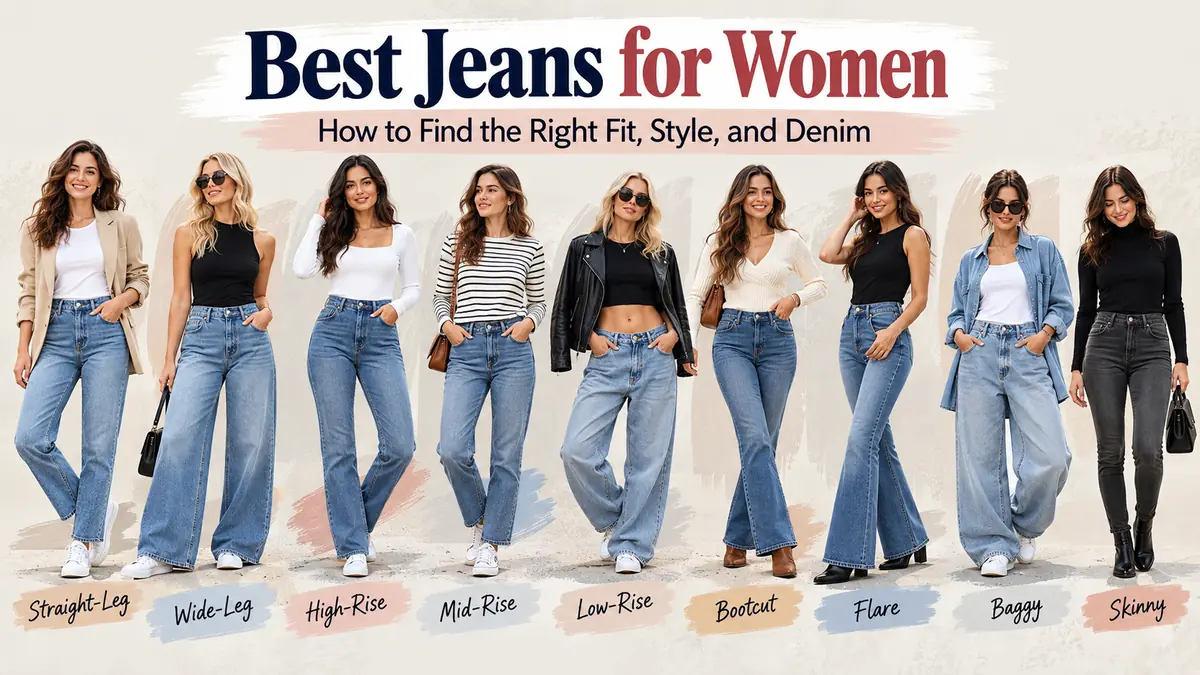
Finding jeans that look good in a product photo is easy. Finding a pair that fits comfortably at the waist, works with your proportions, holds its shape, and still feels good after hours of wear is much harder.
The best jeans for women are not defined by one brand or silhouette. The right pair combines a comfortable rise, appropriate inseam, flattering leg shape, durable denim, and a wash that works with your wardrobe. Straight-leg, wide-leg, bootcut, flare, baggy, and slim jeans can all be excellent choices when the proportions suit the wearer.
Current denim guides continue to emphasize both timeless shapes and newer relaxed silhouettes. Vogue’s 2026 denim guide, for example, spans straight-leg, wide-leg, high-rise, flare, cropped, baggy, slim, barrel-leg, and other categories rather than declaring a single universal fit the winner.
What Makes the Best Jeans for Women?
A great pair of jeans usually succeeds in five areas: fit, fabric, proportion, construction, and versatility.
Fit matters most. Jeans should sit where they are designed to sit without creating excessive pressure at the waistband or requiring constant adjustment. The rise should feel natural, the hips should have enough room, and the leg opening should create the silhouette you actually want.
Fabric comes next. Denim can range from rigid cotton with almost no give to highly flexible blends containing stretch fibers. Neither is automatically better. They simply behave differently.
Good proportions are equally important. Two women wearing the same waist size may need completely different rises and inseams because torso length, hip shape, thigh circumference, and height affect how jeans sit on the body.
Finally, useful jeans should work with more than one outfit. A pair that looks equally natural with sneakers, loafers, ankle boots, flats, or heels usually earns far more wear than an ultra-specific trend piece.
Best Jeans for Women by Style
There is no single silhouette that flatters everyone. Understanding the major jean cuts makes it easier to narrow the search before worrying about brands.
Straight-Leg Jeans
Straight-leg jeans are among the safest starting points for someone building a versatile denim wardrobe.
The leg remains relatively consistent from the thigh toward the hem rather than hugging the calf like skinny jeans or expanding dramatically like wide-leg jeans.
Their biggest strength is adaptability. Straight jeans can work with:
- T-shirts and sneakers
- Button-down shirts and loafers
- Blazers and ankle boots
- Sweaters and flats
- Blouses and heels
Classic five-pocket straight jeans also tend to survive changing trends better than extreme silhouettes. A medium or dark blue wash with minimal distressing is particularly versatile.
Levi’s 501 family remains one prominent example of the straight-jean tradition, while contemporary denim brands such as Agolde, Frame, Citizens of Humanity, Mother, and Re/Done offer their own interpretations. Current editor-tested guides continue to feature straight silhouettes alongside newer wide and relaxed shapes.
Wide-Leg Jeans
Wide-leg jeans create significantly more room from the hip or thigh downward.
They can feel relaxed without necessarily looking casual. Dark indigo or black wide-leg denim with a clean hem can resemble tailored trousers, making this silhouette useful for polished outfits as well as weekend dressing.
Good wide-leg jeans need balance. If the waistband and hips are excessively loose too, the entire silhouette can lose definition. A fitted waist combined with a wider leg often produces a cleaner shape.
Length also matters. Full-length wide jeans may nearly skim the shoe, while cropped versions expose more ankle and can work well with flats or sandals.
Good Housekeeping has highlighted Levi’s Ribcage Wide Leg as a notable example, while Vogue’s current guide also treats wide-leg denim as one of the major women’s-jeans categories.
High-Rise Jeans
High-rise jeans sit higher on the torso, generally around or above the natural waist depending on the brand and the wearer’s proportions.
They can create a defined waist and work especially well with tucked shirts, cropped jackets, bodysuits, and fitted knitwear.
But “high rise” is not a universal measurement.
A rise that feels comfortable on someone with a longer torso may feel extremely high on someone with a short torso. Check the actual front-rise measurement instead of relying entirely on labels such as high-rise or super-high-rise.
Mid-Rise Jeans
Mid-rise jeans sit between high- and low-rise styles and are one of the easiest everyday options.
They provide enough coverage for many wearers without extending far up the torso. This makes them particularly useful when high-rise denim feels restrictive.
A mid-rise straight or relaxed jean is a practical starting point if you are unsure which rise suits you.
Low-Rise Jeans
Low-rise denim sits lower on the hips and has returned as part of the broader revival of late-1990s and early-2000s fashion.
The modern interpretation does not have to mean an extremely low waistband. Many brands now offer relaxed low- or lower-mid-rise jeans that reference the look without reproducing its most exaggerated proportions.
Choose them because you enjoy where the waistband sits—not simply because the style is trending.
Bootcut Jeans
Bootcut jeans stay relatively close through the thigh before widening slightly below the knee.
That subtle flare was originally practical for accommodating boots, but it also creates useful visual balance.
Bootcut jeans work particularly well with ankle boots, heeled boots, pointed shoes, and other footwear that benefits from a little extra room at the hem.
For a more understated wardrobe, choose a clean dark wash. For a stronger retro influence, try faded blue denim.
Flare Jeans
Flare jeans take the bootcut concept further, with a more obvious expansion from the knee toward the hem.
They can visually lengthen the legs when the hem and shoe height are properly coordinated.
The most common mistake is choosing the wrong inseam. Too short, and the flare can look awkward. Too long, and the hem drags along the ground.
If you frequently wear heels, consider keeping a flare pair specifically hemmed for those shoes.
Baggy and Relaxed Jeans
Baggy denim prioritizes ease through the hips, thighs, and legs.
It has become an established alternative to fitted jeans rather than merely a short-lived novelty. Current fashion coverage continues to feature relaxed proportions prominently, while also emphasizing that relaxed denim works best when the shape still looks deliberate rather than sloppy.
The waistband remains crucial. Even intentionally oversized jeans should stay where you want them without constant pulling or adjusting.
Pairing loose jeans with a more structured jacket, fitted knit, tucked shirt, or defined shoe can help balance the volume.
Barrel-Leg Jeans
Barrel jeans curve outward through the thigh or knee before tapering back toward the ankle.
That sculptural shape makes them more distinctive than conventional straight jeans.
Because the silhouette itself provides visual interest, simple styling often works best. A plain T-shirt, knit, crisp shirt, or minimalist jacket allows the jeans’ shape to stand out.
Skinny and Slim-Fit Jeans
Skinny jeans fit closely from the hip through the ankle. Slim jeans follow the body without being quite as tight.
Neither silhouette needs to disappear simply because wider jeans are fashionable.
Close-fitting denim remains useful with tall boots, oversized sweaters, long coats, tunics, and outfits where a narrow lower silhouette creates balance.
If comfort is the priority, look for some stretch rather than forcing yourself into extremely rigid skinny denim.
How Should Women’s Jeans Fit?
The label on the waistband tells only part of the story.
Good jeans should feel secure around the waist without digging into the body. You should be able to sit, walk, bend, and move normally.
At the hips and thighs, evaluate both appearance and movement. Horizontal pulling lines can indicate that the jeans are under tension. Excessive fabric bunching may indicate that the cut is too roomy or simply wrong for your proportions.
Pay particular attention to four areas.
Waist
The waistband should remain reasonably stable when you move.
A large gap at the back can indicate that the waist-to-hip proportion of that particular pattern does not match your body. Sizing down is not always the answer because doing so may make the hips and thighs too tight.
Curvy-fit jeans can help when there is a larger difference between waist and hip measurements.
Rise
Rise measures the distance from the crotch seam toward the waistband.
It influences both comfort and appearance.
Higher rises visually emphasize the waist, while lower rises expose more of the torso. Neither is inherently more flattering. Your torso length and preferred waistband position matter more.
Inseam
The inseam determines where the hem reaches.
Different silhouettes need different lengths. Cropped straight jeans may intentionally finish above the ankle, while full-length wide or flare jeans usually need considerably more length.
This is why knowing your inseam is just as valuable as knowing your waist measurement.
Good Housekeeping specifically recommends considering both waist and inseam measurements while also remembering that sizing varies among brands.
Seat and Thighs
The seat should follow the intended silhouette without excessive sagging or strain.
With rigid denim, a close initial fit can relax slightly as the fabric breaks in. Stretch jeans usually feel comfortable immediately but may behave differently after repeated wear.
Always evaluate the fabric composition before deciding that a new pair will eventually “stretch out.”
Rigid Denim vs. Stretch Denim
One of the biggest differences between jeans is something you cannot always see in a photograph: fabric composition.
Rigid Denim
Traditional rigid denim is usually made primarily or entirely from cotton.
It feels firmer and holds a defined silhouette. Over time, quality rigid denim can soften and develop wear patterns unique to the owner.
Advantages include:
- Strong structure
- Classic denim appearance
- Natural break-in characteristics
- Good shape definition
The tradeoff is immediate comfort. Rigid jeans may feel less forgiving when sitting or bending, especially when the cut is close to the body.
Stretch Denim
Stretch denim combines cotton or other fibers with a small amount of elastane or a similar stretch fiber.
It provides greater flexibility and is common in skinny, slim, pull-on, and body-contouring jeans.
Advantages include:
- Easier movement
- Immediate comfort
- More forgiving fit
- Useful recovery in fitted silhouettes
Too much stretch, however, can make some denim feel more like leggings than traditional jeans and may affect how the garment holds its shape.
Which Is Better?
Choose according to the silhouette.
A vintage-inspired straight jean often benefits from rigid or low-stretch denim because structure is part of its appeal.
Skinny jeans generally benefit from stretch because the fabric needs to move while remaining close to the legs.
Relaxed, wide-leg, and barrel silhouettes can work beautifully in rigid denim because the cut itself provides room for movement.
Best Jeans for Women by Body Shape
Body shape can help explain why certain cuts feel easier to fit, but it should never become a restrictive fashion rule.
Wear whichever silhouette makes you comfortable.
Still, a few fitting principles can make shopping easier.
Curvy Figures
If jeans fit the hips but leave a large waistband gap, look for curvy-fit patterns.
These are typically designed with a greater difference between waist and hip measurements.
High- and mid-rise straight jeans, bootcuts, flares, and wide-leg styles can all work well. The important detail is the actual waist-to-hip construction rather than the name of the silhouette.
Petite Women
Petite shoppers should pay close attention to inseam and rise.
Standard jeans can place the knee break, flare, or crop point too low on a shorter frame. Petite-specific patterns may adjust more than the hem; they can reposition proportions throughout the garment.
Cropped straight jeans and correctly proportioned wide-leg styles are useful options, but petite women do not need to avoid long or voluminous denim.
Tall Women
Tall shoppers often have the opposite problem: insufficient inseam.
Look for brands offering dedicated tall or long lengths instead of automatically sizing up. Increasing the waist size to gain length usually creates a worse overall fit.
Full-length straight, flare, bootcut, and wide-leg jeans can be especially effective when sufficient inseam options are available.
Fuller Thighs
A comfortable thigh does not require an oversized waistband.
Look for relaxed straight, curvy straight, wide-leg, boyfriend, or athletic-inspired fits that provide additional thigh room while retaining waist definition.
Fabric with slight stretch can also improve mobility without dramatically changing the appearance of the denim.
Straighter Figures
Straight-leg, low-rise, slim, barrel, baggy, and wide-leg jeans can all work on straighter proportions.
Pocket placement and yoke construction become useful details if you want more visual shaping through the seat.
Again, these are fit strategies—not rules about what any body type should wear.
How to Measure Yourself for Jeans
Online denim shopping becomes much easier once you stop relying exclusively on the size printed inside your existing jeans.
Use a flexible measuring tape and record your actual measurements.
- Measure your waist. Measure around the point where you expect the waistband to sit.
- Measure your hips. Measure around the fullest area of the hips and seat.
- Measure your inseam. Measure from the crotch down to your desired hem position.
- Check your preferred rise. Measure a pair you already love from the crotch seam to the top of the front waistband.
- Compare those numbers with the brand’s chart. Do not assume your size is identical across manufacturers.
Marie Claire’s denim guidance similarly stresses measurement and fit considerations because the enormous variety of brands and cuts makes finding jeans more complicated than simply choosing a usual clothing size.
One particularly useful trick is measuring jeans you already own.
Lay your favorite pair flat and record the waistband, front rise, thigh, inseam, and leg opening. Those numbers give you a practical benchmark for evaluating unfamiliar styles online.
How to Tell Whether Jeans Are Good Quality
Price alone does not determine denim quality.
Instead, examine construction.
Look at the seams first. Stitching should appear consistent, particularly around high-stress areas such as pockets, belt loops, the crotch, and waistband.
Check the zipper and button. Hardware should operate smoothly and feel securely attached.
Then inspect the fabric. The ideal denim weight depends on the style: structured jeans need enough substance to maintain their silhouette, while relaxed summer denim can intentionally be lighter.
Pocket construction matters too. Poorly positioned back pockets can alter the visual proportions of otherwise well-cut jeans.
Finally, check the fiber label.
Knowing whether a pair is 100% cotton or contains stretch fibers tells you much more about how it will behave than marketing descriptions such as “premium comfort denim.”
Which Denim Wash Is Most Versatile?
Wash dramatically changes how jeans feel in an outfit even when the cut remains identical.
Dark-Wash Denim
Dark indigo looks polished and pairs naturally with blazers, button-down shirts, knitwear, loafers, boots, and heels.
Minimal fading usually makes dark jeans easier to dress up.
Medium-Wash Denim
Medium blue is arguably the classic everyday option.
It sits comfortably between polished and casual, making it suitable for T-shirts, sweaters, jackets, sneakers, sandals, and boots.
If you own only one blue pair, medium-wash straight jeans are difficult to beat for versatility.
Light-Wash Denim
Light denim feels relaxed and casual.
It works especially well with white, cream, gray, navy, pastels, and other soft tones. Faded finishes also complement vintage-inspired silhouettes.
Black Jeans
Black jeans occupy the space between denim and casual trousers.
They work particularly well for evening outfits, monochrome styling, boots, leather jackets, blazers, and winter wardrobes.
White and Ecru Jeans
White, cream, and ecru denim provide an alternative to traditional blue.
They are particularly effective in spring and summer but can work year-round with knitwear and darker outerwear.
How Many Pairs of Jeans Do You Actually Need?
There is no useful universal number.
Someone who wears denim six days a week will naturally benefit from a larger rotation than someone who wears it occasionally.
A compact wardrobe might include three complementary options:
- A classic straight jean in medium blue
- A polished dark or black pair
- A relaxed, wide, flare, or other silhouette reflecting personal style
That combination covers considerably more situations than owning six nearly identical pairs.
The goal should be useful variety, not quantity.
A good test is simple: before buying another pair, ask what it does that your existing denim cannot.
What Jeans Are in Style in 2026?
Denim in 2026 is less about one dominant silhouette and more about variety.
Wide-leg, relaxed, straight, flare, slim, barrel, and vintage-influenced fits all appear in current fashion coverage. Vogue’s 2026 guide mixes classic straight and high-rise options with wide-leg, cropped, baggy, flare, slim, barrel, and more specialized silhouettes.
Relaxed proportions are particularly visible. Current Who What Wear coverage describes 2026 denim as easier through the leg while still emphasizing deliberate structure, clean waistbands, and intentional lengths.
Skinny or slim jeans have not become unusable simply because looser silhouettes are prominent. Fashion cycles overlap, and personal styling matters more than replacing an entire wardrobe whenever a new leg shape gains attention.
A better strategy is to keep well-fitting classics and selectively add a newer silhouette if you genuinely enjoy it.
How to Style Jeans for Different Occasions
The best jeans for women earn their place in a wardrobe because they can change character depending on what surrounds them.
Casual Everyday Outfits
Try straight or relaxed jeans with:
- A cotton T-shirt
- Sneakers
- A cardigan, denim jacket, or casual outer layer
The combination is uncomplicated and works across seasons.
Smart-Casual Outfits
Choose clean dark denim with minimal distressing.
Add a button-down shirt or fine knit, a structured blazer, and loafers, ballet flats, or ankle boots.
Wide-leg jeans can also work particularly well here because their silhouette can resemble trousers.
Evening Outfits
Black, dark indigo, slim, straight, or full-length wide jeans can transition easily into evening wear.
Pair them with a refined top and sharper footwear.
Current fashion coverage demonstrates just how flexible denim remains, pairing jeans with everything from blouses and tailored layers to flats, loafers, boots, pumps, and more statement-driven footwear.
Common Mistakes When Buying Women’s Jeans
The most expensive jeans can still become closet clutter if the fit is wrong.
One common mistake is buying exclusively by size. Women’s denim sizing varies significantly among brands and even between different cuts from the same brand.
Another is ignoring inseam. The correct waist size cannot rescue a flare that breaks at the wrong place or a wide leg that drags several inches across the floor.
Avoid assuming discomfort always means you need to “break them in.” Rigid cotton may soften, but a fundamentally incorrect rise or cut will not magically change into the right pattern.
Do not buy a trend solely because it looks good on someone else, either. A pair that matches your existing tops, jackets, and shoes will usually provide more value.
Finally, try jeans while moving.
Sit down. Walk. Bend your knees. Check the waistband from the back. Look at the side profile. A fitting-room mirror while standing perfectly still does not tell the whole story.
Should Jeans Be Tight When You First Buy Them?
It depends on the fabric.
Rigid cotton denim may relax somewhat with wear, so a secure initial fit can be reasonable. But secure is different from painful.
You should still be able to sit and move.
Stretch denim should generally feel comfortable when purchased. Buying it painfully tight in anticipation of major stretching can result in a poor fit.
Always check fiber composition before deciding how much give to expect.
How to Wash Jeans So They Last Longer
Denim does not necessarily need washing after every wear.
If jeans are clean and odor-free, allowing more time between washes can reduce unnecessary abrasion and fading.
When they do need cleaning, follow the garment’s care label. A gentle, cool wash is often suitable for maintaining color and reducing stress on the fabric.
Turning jeans inside out before washing is another practical step. Good Housekeeping’s laundry guidance recommends doing so as part of protecting denim during washing.
Also consider:
- Closing zippers before washing
- Avoiding overloaded machines
- Using excessive heat cautiously
- Air-drying when appropriate
- Washing similar colors together
- Treating small stains instead of automatically washing the entire garment
Stretch denim deserves particular care because repeated high heat can be harder on elastic fibers.
Are Expensive Jeans Worth It?
Sometimes, but not automatically.
Premium jeans may offer higher-grade fabric, specialized washes, stronger construction, more sophisticated pattern cutting, or manufacturing details that justify part of the price.
But a lower-priced pair that fits your body perfectly can be a much better purchase than expensive designer denim that does not.
Think in terms of cost per wear.
A $150 pair worn 150 times costs $1 per wear. A $40 pair worn twice because it never feels comfortable effectively costs $20 per wear.
Fit and frequency matter more than the logo.
This is also why established labels at very different price levels can coexist in editor recommendations. Current guides feature accessible names such as Levi’s alongside premium labels including Agolde, Frame, Khaite, Mother, Citizens of Humanity, DL1961, and others.
How to Buy Jeans Online Without Constant Returns
Online shopping removes the fitting room, but you can compensate with better information.
Start with the size chart for the exact brand.
Next, read the product’s fabric composition and identify whether the denim is rigid, comfort-stretch, or highly stretchy.
Check the model information, but do not use the model’s height and size as your only reference. Your proportions may be completely different.
Instead, look for actual garment measurements:
- Front rise
- Waist
- Hip
- Thigh
- Inseam
- Leg opening
Then compare those numbers with a pair you already own.
Customer reviews can help identify recurring issues such as a waistband running small, denim stretching significantly after wear, or the inseam being longer than expected.
If several reviewers with different body types mention the same problem, that pattern is more informative than one isolated comment.
How to Choose Your Best Pair
If you’re overwhelmed by hundreds of denim options, simplify the decision.
First decide where you want the waistband: low, mid, or high.
Then choose the leg shape: skinny, slim, straight, bootcut, flare, barrel, relaxed, or wide.
Next decide how much structure you want. Choose rigid denim for a traditional, structured feel or stretch denim when flexibility is a priority.
After that, determine the correct inseam for both the silhouette and the shoes you expect to wear.
Only then should you worry about wash, brand, and trend details.
That order prevents a common shopping mistake: falling in love with the appearance of jeans before establishing whether their basic proportions actually work for you.
Final Takeaway
The best jeans for women are the ones that solve the practical fit puzzle while still making you want to wear them.
Straight-leg denim remains an excellent all-purpose starting point, while wide-leg and relaxed jeans offer room and modern proportions. Bootcut and flare styles create a stronger shape, skinny and slim jeans remain useful for streamlined outfits, and barrel jeans offer a more sculptural alternative.
Rather than searching for a universally “flattering” pair, focus on measurable details: waist, hips, rise, thigh room, inseam, fabric composition, and leg opening.
Once those elements are right, brand names and trends become secondary.
The simplest next step is to measure the best-fitting jeans already in your closet. Use those measurements as your personal denim blueprint, then compare new pairs against it. That small habit can turn jean shopping from guesswork into a much more predictable process.