
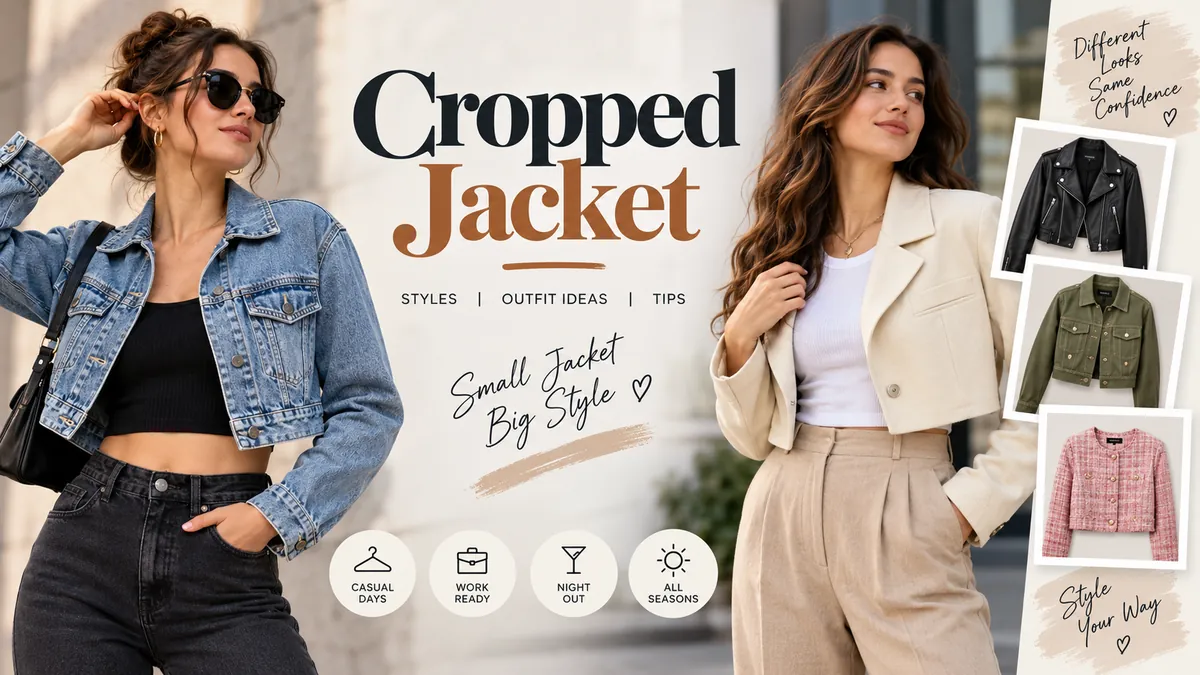
A cropped jacket can change the proportions of an outfit faster than almost any other outerwear piece. Because the hem ends higher than a standard jacket, it draws attention toward the waist and gives trousers, jeans, skirts, and dresses more visual space.
A cropped jacket is a shortened outerwear style designed to finish around the natural waist, upper hip, or sometimes higher on the torso. It can take the form of a denim jacket, bomber, blazer, leather jacket, puffer, trench, utility jacket, or tweed style. The defining feature is its intentionally shortened hem rather than a specific fabric or construction.
The style is especially useful because it combines the structure of outerwear with the proportions of a layering piece. The challenge is simply learning where the hem should fall and how to balance everything underneath it.
What Is a Cropped Jacket?
A cropped jacket is shorter than the conventional version of the same jacket style. Instead of extending over much of the hip, its hem usually finishes somewhere between the lower ribcage and upper hip.
That definition leaves plenty of room for variation.
Some designs are extremely short and expose part of the midriff. Others stop exactly at the natural waist. More conservative versions finish around the high hip and provide nearly as much coverage as a conventional jacket while still producing the cropped effect.
The important distinction is intentional proportion.
A regular jacket that happens to be too short is not necessarily cropped. A properly designed cropped style considers the hem, shoulder position, sleeves, pockets, closures, and overall volume together.
This distinction matters because a well-proportioned jacket should still look complete despite having less length.
How Cropped Is Cropped?
There is no universal measurement that makes a jacket cropped because torso lengths vary.
A practical classification is:
| Cropped length | Typical finishing point | Overall effect |
|---|---|---|
| Ultra cropped | Around lower ribs | Bold, youthful, high-impact |
| Waist cropped | Natural waist | Defined, balanced silhouette |
| Upper-hip cropped | Just below waist | Subtle and versatile |
| Boxy cropped | Waist or upper hip with extra width | Relaxed, architectural look |
For everyday wardrobes, a natural-waist or upper-hip length tends to be the easiest to combine with other clothes.
Why Cropped Jacket Proportions Work
The appeal of cropped outerwear is largely about proportion.
A conventional jacket may extend through the hip and visually divide the body lower down. A shorter jacket moves that horizontal break upward. This exposes more of the trousers, skirt, or dress underneath and can make the lower half of an outfit appear longer.
That is why high-waisted bottoms are so frequently paired with cropped styles.
Current fashion coverage continues to emphasize shorter, more fitted jackets alongside boxy cropped trenches, bombers, technical jackets, and blazers. Recent runway coverage has also documented fitted and shrunken silhouettes from houses including Gucci, Prada, Jil Sander, Dior, and Emilia Wickstead.
The underlying proportion principle, however, is useful regardless of what happens to be trending.
Waist Definition Without a Belt
A short hem naturally creates a stopping point around the waist.
This can give an outfit definition even when the jacket itself is straight or boxy. You do not necessarily need a fitted garment or belt to create that effect.
For example, compare:
Long T-shirt + wide-leg jeans + long jacket
with:
Tucked T-shirt + wide-leg jeans + cropped jacket
The second combination makes the waistband visible and creates a clearer transition between the torso and legs.
Why It Works With Volume
Cropped jackets are particularly useful with wide or flowing bottoms.
Wide-leg trousers, full skirts, barrel jeans, and maxi skirts already create substantial volume below the waist. Adding a long, oversized jacket can sometimes leave the whole outfit visually heavy.
A short jacket gives that volume somewhere to start.
Quick Takeaway: Think of a cropped jacket as a proportion tool rather than simply a shorter coat. Its hem creates a visual boundary, so the waistband, top, and lower-half silhouette determine whether the outfit feels balanced.
Types of Cropped Jacket
“Cropped” describes length, not one particular category of clothing. Almost every familiar jacket silhouette can be shortened.
Understanding the differences makes styling much easier.
Cropped Denim Jacket
A cropped denim jacket is one of the most accessible versions.
It retains recognizable denim details such as a button front, chest pockets, seams, and a collar while removing some length through the body.
Blue denim works naturally with:
- High-rise black trousers
- White dresses
- Maxi skirts
- Straight-leg jeans
- T-shirts and tank tops
- Casual knitwear
Double denim can work too. Matching washes create a coordinated appearance, while contrasting light and dark washes make the separation between pieces more obvious.
Cropped Leather Jacket
Leather adds more visual weight and structure.
A cropped leather jacket may resemble a biker jacket, minimalist zip jacket, bomber, or fitted collarless design. Because leather already creates a strong visual line, the shortened silhouette can become the focal point of an otherwise simple outfit.
Pairing one with straight trousers and a plain knit creates a different effect from wearing it with a slip dress or wide-leg jeans.
Faux leather versions create a similar silhouette for people who prefer alternative materials.
Cropped Bomber Jacket
A bomber naturally lends itself to a shorter shape because traditional bomber construction already uses a defined waistband.
Modern versions range from compact fitted designs to exaggerated boxy bombers with dropped shoulders.
The difference matters.
A fitted bomber works easily with wide-leg trousers. A voluminous bomber may look more balanced with a cleaner bottom silhouette or a visible high waistband.
Cropped Blazer
The cropped blazer takes the familiar structure of tailoring and moves the hem upward.
Single-breasted, double-breasted, collarless, lapelled, fitted, and boxy versions are all possible. Recent fashion coverage has highlighted cropped tailoring as an alternative to the oversized blazers that dominated previous seasons.
For a polished outfit, combine one with high-rise tailored trousers and a simple fitted top.
A matching trouser creates a cropped suit effect, while jeans make the tailoring feel less formal.
Cropped Puffer Jacket
A cropped puffer combines insulation with a shortened silhouette.
The volume of down or synthetic insulation can make the upper body visually larger, so proportions become especially important. High-rise straight or wide-leg trousers can anchor the lower half.
The practical trade-off is coverage. A shorter puffer exposes more of the lower torso than a standard insulated jacket, so it may be less suitable for severe cold unless layered carefully.
Cropped Trench Jacket
A cropped trench borrows details such as storm flaps, epaulettes, belts, double-breasted closures, and water-resistant fabrics from the classic trench coat but removes much of its length.
The result feels less formal and usually works better as transitional outerwear than as serious rain protection.
Boxy cropped trenches work particularly well with wide-leg jeans because the short upper silhouette allows the lower-half volume to remain visible. This pairing has also appeared prominently in recent seasonal styling coverage.
Tweed and Bouclé Jackets
Short tweed and bouclé jackets offer a more textured alternative.
They may be collarless, fitted, boxy, buttoned, or decorated with contrasting trim. Their structured fabric works naturally with jeans because the contrast between polished texture and casual denim prevents the outfit from feeling overly coordinated.
Cropped Utility and Military Jackets
Utility jackets use details such as patch pockets, stand collars, hardware, cotton twill, and structured seams.
Military-inspired cropped jackets can be much more decorative, incorporating high collars, ornamental buttons, braiding, or strong shoulders.
The shortened silhouette keeps these details concentrated around the upper body, so simpler trousers or skirts often provide enough visual balance.
How to Style a Cropped Jacket
The most dependable way to style a cropped jacket is to treat the jacket hem and the waistband below it as connected lines.
They do not have to touch, but they should look intentional together.
1. Start With High-Waisted Jeans
This is the easiest combination to understand.
A high-rise waistband reduces the distance between the bottom of the jacket and the top of the jeans. That creates a clean transition and visually gives more space to the legs.
Try:
Cropped jacket + fitted T-shirt + high-waisted straight jeans + loafers
or:
Boxy cropped jacket + tank top + high-rise wide-leg jeans + sneakers
The first feels cleaner and more structured. The second emphasizes volume.
High-rise bottoms are repeatedly recommended in contemporary cropped-jacket styling guides because of this proportional relationship.
2. Balance Wide-Leg Trousers
Wide-leg trousers are one of the strongest partners for cropped outerwear.
The formula works because the jacket occupies relatively little vertical space while the trousers create a long line below.
Keep the layer underneath relatively simple if both the jacket and trousers have volume.
A fitted T-shirt, bodysuit, lightweight sweater, or neatly tucked shirt prevents unnecessary bulk around the waist.
3. Wear It Over a Dress
A jacket can also change the apparent proportions of a dress.
A long jacket over a midi or maxi dress may conceal much of the dress’s shape. A short jacket leaves more of the skirt visible and can create a clearer waistline.
Try a denim version over a casual cotton dress, leather over a slip dress, or structured tailoring over a fitted midi.
The jacket does not need to match the exact waist seam of the dress, but the two lines should not compete awkwardly.
4. Pair It With a Midi or Maxi Skirt
Long skirts create vertical length below a short jacket.
Pleated, satin, denim, A-line, pencil, and flowing maxi skirts can all work.
The amount of volume is the main consideration.
With a full skirt, keep the jacket relatively compact. With a straight pencil skirt, a slightly boxier jacket can introduce contrast.
5. Try Straight-Leg Trousers for a Cleaner Shape
Not every outfit needs exaggerated proportions.
Straight-leg jeans or tailored trousers produce a quieter silhouette that makes a cropped jacket easier to wear in everyday settings.
This combination is useful when a wide-leg trouser feels too dramatic or when you want the jacket itself to provide the visual interest.
Do You Have to Wear High-Waisted Bottoms?
No.
High-waisted trousers are simply the easiest starting point because they create a continuous proportion between the jacket and lower half.
Mid-rise and low-rise trousers can work as well.
The difference is that lowering the waistband creates visible space between the hem and the trousers. Depending on the top underneath, this can expose skin or create an additional horizontal section across the torso.
That can be deliberate.
For a modern low-rise outfit, a fitted tank or longer top underneath can bridge the gap. Leaving some midriff visible creates a different, more overtly cropped look.
The question is not whether the waistband is high or low. It is whether the spacing looks intentional.
How Should a Cropped Jacket Fit?
Length gets most of the attention, but shoulders determine whether a jacket actually fits.
Start there.
A traditionally fitted design should sit cleanly around the shoulder joint without pulling across the back. An intentionally oversized jacket may have dropped shoulders, but the construction should still allow comfortable movement.
Then check the chest and closure.
If the jacket is intended to button or zip, you should be able to close it without obvious pulling. If you expect to wear sweaters underneath, try it with a similar layer before deciding whether the fit works.
Check the Hem Against Your Natural Waist
Find your natural waist, typically around the narrow area of the torso above the hips.
Then see where the jacket ends relative to it.
A hem close to the natural waist creates obvious definition. A hem slightly below it offers more coverage. An ultra-short design above it makes the crop much more pronounced.
There is no single correct position.
The most useful length is the one that works with the waistlines you already wear.
Sleeve Length Still Matters
Cropped body length does not mean cropped sleeves.
Full-length sleeves should generally reach the wrist appropriately unless the design intentionally uses bracelet-length or oversized sleeves.
If both the body and sleeves appear unintentionally short, the jacket may simply be the wrong size rather than the right cropped silhouette.
Consider the Layering Room
Put your arms forward. Lift them. Sit down. Zip or button the jacket.
Fashion should survive ordinary movement.
A sharply tailored piece may naturally have less room than a bomber, but it should not become uncomfortable during basic movement.
Quick Takeaway: Judge fit in this order: shoulders, movement, closure, sleeve length, then hem position. Do not choose a larger size solely to gain body length, because that can distort the shoulders and overall shape.
Can Cropped Jackets Work for Different Heights?
Yes. Height alone does not determine whether the style works.
Torso-to-leg proportion, jacket length, waistband position, volume, and footwear have a greater effect on the overall outfit.
A petite person and a tall person can wear the same category of jacket successfully while needing different actual garment lengths.
Cropped Jackets for Petite Frames
A shorter jacket can be useful on a petite frame because it prevents outerwear from covering much of the lower body.
Natural-waist styles combined with high-rise trousers create a particularly clear vertical line.
Be cautious about assuming “petite” automatically means “as short as possible,” though.
An extremely short jacket with a very boxy body and oversized sleeves may still overwhelm a smaller frame. Proportion-focused guidance similarly emphasizes that the actual hem position matters more than height alone.
Cropped Jackets for Tall Frames
Tall wearers have room to experiment with more dramatic differences between jacket hem and waistband.
However, a jacket that was designed for a shorter torso can sometimes appear accidentally undersized rather than intentionally cropped.
Checking shoulder width, sleeve length, and overall construction becomes especially useful.
What About a Long Torso?
If you have a relatively long torso, a natural-waist jacket may expose more of the top underneath.
You can either use that contrast intentionally or select an upper-hip version.
A high-rise trouser also reduces the amount of visual space between the jacket and waistband.
What About a Short Torso?
Extremely cropped designs can occupy very little torso space on a shorter-waisted frame.
Trying a jacket that finishes at or slightly below the natural waist often creates a smoother transition.
The mirror test is simple: look at the entire outfit, not the jacket in isolation.
What to Wear Under a Cropped Jacket
The underlayer controls how strongly the crop is perceived.
A fitted top creates a clean base. A longer loose shirt creates visible layering. A cropped top can align with the jacket hem for a more deliberate short silhouette.
Fitted T-Shirt or Tank
This is the simplest option.
The smooth base allows the jacket’s shape to remain visible and works particularly well with boxy bombers, denim jackets, and structured outerwear.
Fine-Knit Sweater
A lightweight knit adds warmth without excessive bulk.
This combination works well with leather, tweed, tailored, and utility styles.
Chunky knits require more space through the arms and shoulders, so make sure the jacket was designed for layering.
Button-Down Shirt
Allowing a shirt to extend below the jacket creates intentional contrast.
For a cleaner effect, tuck the shirt into the trousers.
For a more relaxed layered look, let some of the shirt hem remain visible below the jacket.
Bodysuit
A bodysuit creates an uninterrupted base and avoids fabric gathering around a high waistband.
This can be particularly useful when the jacket and trousers already have substantial volume.
Hoodie
A hoodie under a cropped bomber, denim jacket, or relaxed leather jacket creates a casual streetwear silhouette.
Check the armholes first. Two bulky layers packed into a narrow sleeve quickly become uncomfortable.
Cropped Jacket Outfit Ideas for Different Settings
One reason the silhouette remains useful is that changing the fabric can shift it from casual to polished without changing the fundamental proportions.
| Setting | Jacket | Base layer | Bottom | Footwear |
|---|---|---|---|---|
| Casual | Cropped denim | White tee | High-rise jeans | Sneakers |
| Smart casual | Tweed jacket | Fine knit | Straight trousers | Loafers |
| Office | Cropped blazer | Blouse or knit | Tailored trousers | Flats or pumps |
| Evening | Leather jacket | Simple fitted top | Maxi skirt | Boots |
| Weekend | Bomber | T-shirt | Wide-leg jeans | Trainers |
| Transitional weather | Cropped trench | Lightweight knit | Straight denim | Loafers |
| Cold casual day | Cropped puffer | Thermal knit | High-rise trousers | Boots |
These are formulas rather than rules. Switching footwear, accessories, or fabric can change the character of each combination.
How to Wear a Cropped Jacket to Work
A cropped jacket can work in professional settings when its fabric and construction are appropriate for the workplace.
Tailored versions are the most straightforward.
Choose a jacket that reaches around the natural waist or upper hip rather than an extremely short cut. Pair it with high-rise tailored trousers, a midi skirt, or a coordinating bottom.
A fine-knit top or blouse keeps the base simple.
For more conservative workplaces, minimizing exposed skin usually makes the cropped proportion easier to integrate into existing office wear.
The jacket does not have to imitate a traditional blazer. Collarless tweed, compact wool, and structured utility styles can create a similarly polished effect.
How to Wear a Cropped Jacket in Different Seasons
Short jackets are particularly effective during transitional weather because they add a layer without the coverage of a full coat.
Spring
Spring suits lighter fabrics such as cotton, denim, technical nylon, and lightweight trench materials.
Try a cropped trench with wide-leg jeans or a denim jacket over a midi dress.
Neutral shades are easy to combine, while a colorful jacket can become the main visual feature of a simple outfit.
Summer
A jacket may still be useful during cool evenings, air-conditioned environments, or breezy weather.
Look for unlined cotton, linen blends, lightweight denim, or thin technical fabrics.
Avoid unnecessary insulation.
Autumn
Autumn gives cropped jackets the widest range.
Leather, suede, denim, wool blends, bombers, utility jackets, and tweed all work naturally with knitwear and trousers.
Textured and more structured jackets are particularly visible in Fall 2026 fashion coverage, alongside renewed interest in fitted silhouettes.
Winter
Winter requires more consideration.
A cropped puffer may keep the upper body warm but provides less coverage around the hips and lower torso. High-waisted trousers, thermal layers, knitwear, scarves, and appropriate base layers can compensate somewhat.
For genuinely harsh weather, warmth should take priority over silhouette. A longer insulated coat is usually more practical.
Choosing the Right Fabric
Fabric changes both appearance and function.
Denim
Durable, casual, and relatively structured. Denim is useful for transitional weather and everyday outfits.
Leather
More substantial and visually strong. Genuine and alternative leather materials can both create structured cropped silhouettes.
Wool and Wool Blends
Useful for tailored jackets and cooler temperatures. The exact warmth depends on fabric weight, lining, and construction.
Cotton Twill
Common in utility and workwear-inspired styles. It provides structure without the heaviness of many winter materials.
Nylon and Technical Fabrics
Often used in windbreakers, bombers, and lightweight performance-inspired jackets.
Some designs include water-resistant finishes, but a cropped hem provides less overall weather protection than a longer shell.
Tweed and Bouclé
Texture gives these fabrics visual depth, making even a simple collarless shape look structured.
They pair especially well with smoother fabrics such as denim, cotton, or plain tailored trousers.
Fitted vs. Boxy Cropped Jackets
These two silhouettes create very different results.
A fitted cropped jacket follows the torso more closely and produces a defined upper-half shape.
A boxy jacket creates width through the shoulders and body while still ending relatively high.
Neither is inherently more flattering.
Choose according to the rest of the outfit.
With very wide trousers, a compact fitted jacket creates strong contrast. With slim or straight trousers, a boxier jacket can add visual volume above.
You can also combine volume with volume, but the waistline usually needs enough definition to stop the outfit from becoming shapeless.
This distinction has become especially relevant in 2026 because both sculptural cropped outerwear and closely fitted “shrunken” jackets are appearing in current fashion coverage rather than one single dominant shape.
Common Cropped Jacket Styling Mistakes
Most unsuccessful outfits are not caused by the jacket itself. They come from competing proportions.
Ignoring Where the Hem Falls
A jacket can be attractive on a hanger and awkward with your usual trousers.
Always try it with the bottoms you actually wear.
If the hem ends just above a waistband, the transition often looks deliberate. If it stops at an unrelated point between several other horizontal lines, the outfit can feel fragmented.
Making Every Piece Oversized
An oversized jacket, oversized shirt, extremely wide trousers, large bag, and heavy footwear can all work individually.
Together, they may erase the body’s visual structure.
If you like oversized silhouettes, choose one clear anchor point: visible waist, fitted underlayer, clean neckline, or streamlined footwear.
Choosing the Wrong Underlayer Length
A long top underneath a short jacket creates a visible layer below the hem.
That can look excellent when intentional.
The problem appears when only a small, uneven amount of fabric hangs below the jacket. Either tuck the top, choose a shorter one, or make the length contrast obvious enough to look deliberate.
Forgetting Function
A beautiful jacket that cannot accommodate the clothes you need underneath it may spend most of its life in the wardrobe.
Consider climate and purpose before choosing fabric and fit.
Buying the Wrong Size to Create a Crop
Sizing down in an ordinary jacket is not the same as buying a cropped design.
The shoulders, armholes, sleeves, chest, pockets, and closures may all become too small.
Look for a garment intentionally designed with a shorter body.
How to Make a Cropped Jacket Look More Polished
Small styling decisions can change the whole impression.
Start by keeping the waistband visible. This establishes the proportions immediately.
Then reduce competing lines. If the jacket has strong pockets, buttons, texture, or a dramatic collar, the pieces underneath can remain simple.
Coordinate the visual weight of the shoes with the outfit. Heavy boots work naturally with substantial leather or puffers, while loafers, ballet flats, sleek sneakers, or pumps complement lighter tailoring.
Color matters too.
A monochromatic top and trousers underneath a contrasting jacket create one long vertical base. Tonal dressing—using different shades of one color—produces a softer version of the same idea.
For an especially clean outfit, match the jacket hem closely to the waistband.
Are Cropped Jackets Still in Style?
Yes, although the exact interpretation continues to change.
Recent 2026 fashion coverage shows cropped silhouettes across tailoring, windbreakers, bombers, technical outerwear, trenches, and fitted jackets. British Vogue has documented shorter jackets as part of a move away from oversized blazer proportions, while Fall/Winter 2026 coverage has highlighted more fitted and shrunken jackets from several major fashion houses.
That does not mean every cropped jacket needs to follow runway trends.
Denim jackets, bombers, leather jackets, and waist-length tailoring have existed in numerous forms for decades. What changes from season to season is usually the preferred volume, fabric, shoulder treatment, and styling.
A useful wardrobe piece should therefore be chosen for proportion and versatility first, trend details second.
How to Choose a Cropped Jacket You’ll Actually Wear
Start with your existing wardrobe rather than the jacket itself.
Look at the trousers and skirts you wear most often.
Are they mostly high-rise or low-rise? Wide-leg or slim? Tailored or casual?
Then consider your typical layers.
If you regularly wear thick sweaters, a tightly fitted jacket with narrow sleeves is unlikely to be practical. If you mostly wear T-shirts and fine knits, you have more freedom to choose compact tailoring.
Use this simple process:
- Choose the purpose. Decide whether you need casual, professional, transitional, or cold-weather outerwear.
- Select the hem position. Natural-waist and upper-hip lengths are generally the easiest starting points.
- Check the shoulders. Make sure they fit as the design intends.
- Test your usual layers. Wear the jacket over clothes you realistically expect to use.
- Pair it with your normal bottoms. Do not judge it only with the outfit you happened to wear while trying it on.
- Check movement. Sit, reach, lift your arms, and close the jacket.
- View the whole silhouette. Step away from the mirror and assess the proportions from head to toe.
The most versatile option is rarely the most dramatic one. A jacket around the natural waist in a fabric compatible with your existing wardrobe will usually provide more combinations than an extreme crop.
Cropped Jacket: The Key Is Proportion
The cropped jacket is not simply a shorter version of ordinary outerwear. Its higher hem changes how the entire outfit is divided, which is why the right jacket can make wide trousers feel balanced, give a dress more structure, or turn basic jeans and a T-shirt into a deliberate outfit.
Start with the simplest formula: a natural-waist jacket, clean underlayer, and high-rise bottom. Once that proportion makes sense, experiment with boxy bombers, cropped blazers, denim, leather, puffers, trenches, skirts, low-rise trousers, and longer layered tops.
There is no single correct crop for every person. The best one is the length that works with your torso, your preferred waistlines, your climate, and the clothes you already wear.