
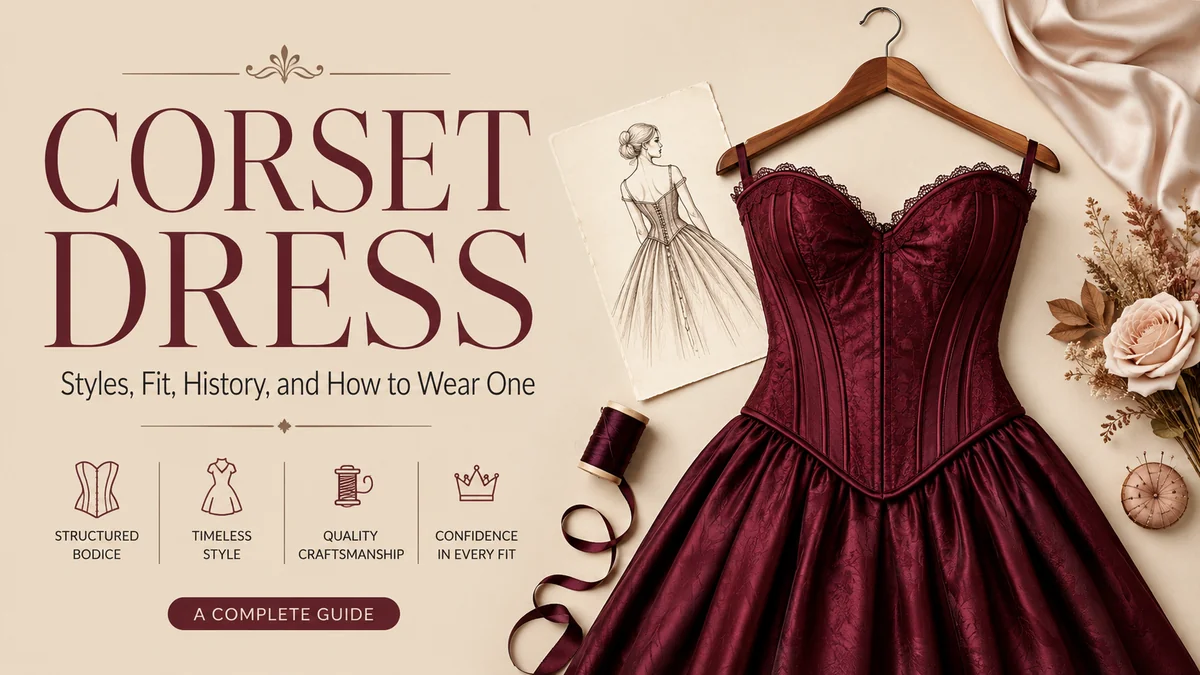
A corset dress is one of those fashion pieces that can look dramatic without requiring much else. Its defining feature is a structured, corset-inspired bodice combined with a skirt, creating a dress that shapes the upper body while remaining a complete outfit.
The idea comes from centuries of corsetry, but the modern version is far more varied. Some dresses use real boning and lace-up construction, while others simply borrow the fitted seams, shaped waist, cups, or paneled appearance associated with traditional corsets.
Quick answer: A corset dress is a dress with a fitted, corset-inspired bodice designed to define the waist and support or shape the torso. Depending on its construction, it may include boning, structured cups, a busk, lace-up fastening, hook-and-eye closures, or flexible internal support.
Understanding the difference between decorative corset styling and genuinely structured construction is the key to choosing a dress that fits comfortably and creates the silhouette you expect.
What Is a Corset Dress?
A corset dress combines two garment concepts: the structured bodice of a corset and the skirt of a dress.
Traditional corsets were foundation garments designed to shape and support the torso. Historical examples used structured materials such as baleen—commonly called whalebone—and later steel. The Metropolitan Museum of Art documents 18th-century stays made with materials including linen, leather, and whalebone, while later corsetry increasingly incorporated metal and elastic.
A modern corset dress does not necessarily function like a historical corset.
Instead, the term can describe several constructions:
- Dresses with internal boning
- Lace-up corset dresses
- Bustier-style dresses with molded cups
- Dresses with visible corset seams
- Waist-cinching structured gowns
- Soft dresses with decorative corset panels
- Corset-inspired mini, midi, and maxi dresses
That distinction matters.
A dress can look like a corset without providing meaningful waist reduction or structural support. If you want actual shaping rather than simply the aesthetic, construction details are more important than the product name.
Where Did the Corset Dress Come From?
The modern corset dress makes more sense when you look at the history behind its bodice.
Corset-like garments have existed in different forms for centuries. In Western fashion, structured stays and corsets became especially influential between the 16th and early 20th centuries. Their shapes changed repeatedly as fashionable silhouettes changed. Vogue’s historical overview notes that corsetry moved through forms ranging from conical torsos to hourglass shapes and the later S-shaped silhouette.
During the 18th century, stays could use baleen to create a firm but shaped structure. By the Victorian period, corsets played a major role in creating the fashionable waist and torso beneath dresses.
The Victoria and Albert Museum explains that Victorian clothing depended heavily on underlying structures: corsets shaped the waist, crinolines supported skirts, and bustles altered the rear silhouette. Technological developments also changed corset construction throughout the period.
By the late 19th century, steel boning and metal busks had become important parts of corsetry. An 1880 corset documented by the Fashion History Timeline at FIT, for example, contains wool, silk, steel, cotton lace, and whalebone.
Fashion eventually moved toward less rigid foundations.
The Met notes that by the 1920s and 1930s, corsets could rely more heavily on elastic and flexible materials as clothing silhouettes and social expectations changed.
From underwear to outerwear
Perhaps the biggest change was cultural rather than technical.
The corset stopped being something that always had to remain hidden.
Designer Vivienne Westwood was particularly influential in bringing historical corsetry into modern outerwear. The V&A notes that she used corsetry in daywear and later transformed the corset into sophisticated outerwear in her late-1980s collections.
That shift helped establish the foundation for today’s corset tops, bustier dresses, structured evening gowns, bridal corsets, and corset-inspired streetwear.
The Museum at FIT has similarly described the corset as both an influential fashion object and a culturally controversial garment whose meaning has continually been redefined.
How Does a Corset Dress Work?
Not every corset dress works in the same way.
The amount of shaping depends primarily on its internal construction.
Boning
Boning consists of narrow supportive strips placed vertically or diagonally within channels in the bodice.
Historically, corsetry used materials such as baleen and steel. Modern fashion may use steel, synthetic boning, plastic, or other flexible structural materials.
Boning helps prevent the bodice from collapsing or bunching around the waist.
However, boning alone does not make a dress a true waist-training corset.
Light plastic boning in a party dress, for example, may simply keep the bodice upright.
Busk
A busk is a structured element associated with corsetry. Some traditional corsets use a split metal busk at the front to make dressing and undressing easier.
The V&A notes that centre-front split busks made Victorian corsets easier for women to put on themselves.
Most fashion-oriented corset dresses do not require a traditional busk, although some historically inspired designs include one.
Lacing
Back lacing is probably the detail most people immediately associate with a corset dress.
Functional lacing can provide some adjustability around the waist and torso.
Decorative lacing, however, may provide almost none.
Check whether the laces actually alter the circumference of the bodice before assuming they can compensate for incorrect sizing.
Structured cups
Many contemporary designs combine corsetry with bustier construction.
You may see:
- Underwire cups
- Molded cups
- Seamed cups
- Padded cups
- Demi-cup shapes
- Strapless necklines
Cup construction affects fit just as much as waist measurement, particularly in strapless styles.
Panels and seams
Corset-inspired dresses frequently use vertical panels and curved seams to visually shape the body.
This is one reason a dress can create a corseted appearance even without heavy compression.
Types of Corset Dresses
There is no single standard corset dress silhouette.
Modern designers apply structured bodices to almost every dress length and occasion.
| Style | Main Characteristic | Common Use |
|---|---|---|
| Mini corset dress | Short skirt with fitted bodice | Parties, nights out |
| Midi corset dress | Mid-length skirt | Dinners, events, semi-formal wear |
| Maxi corset dress | Long skirt with structured top | Formal occasions |
| Corset gown | Dramatic structured bodice and full-length skirt | Galas, formal events |
| Bustier dress | Cup-focused fitted bodice | Parties and evening wear |
| Lace-up corset dress | Adjustable or decorative lacing | Casual to formal styling |
| Strapless corset dress | Structured bodice without shoulder straps | Weddings and events |
| Corset wedding dress | Bridal gown with corseted construction | Weddings |
| Satin corset dress | Smooth, lustrous fabric | Evening occasions |
| Mesh corset dress | Sheer or semi-sheer structured panels | Fashion-forward styling |
Mini corset dress
A mini version puts most of the visual emphasis on the bodice and legs.
Because the silhouette is already strong, accessories usually work better when they don’t compete with the dress.
Midi corset dress
Midi lengths provide a useful middle ground.
A structured waist paired with a longer skirt can feel polished without becoming as formal as a floor-length gown.
Depending on the fabric and neckline, the same general silhouette can work for dinners, celebrations, weddings, and evening events.
Maxi corset dress
A maxi style extends the visual line of the body.
The skirt may be fitted, flowing, pleated, draped, or voluminous. This means two maxi corset dresses can create completely different silhouettes even when their bodices are constructed similarly.
Corset wedding dress
Corsetry has a natural connection with bridal fashion because wedding gowns often need significant internal structure.
A corseted bridal bodice can provide:
- Bust support
- Waist definition
- A stable strapless neckline
- Structure beneath heavier fabrics
- Adjustment through back lacing
The goal should still be proper fit rather than extreme tightness.
Corset Dress vs. Bustier Dress: What’s the Difference?
These terms are often used interchangeably in fashion retail, but they traditionally emphasize different things.
A corset primarily structures and shapes the torso.
A bustier generally focuses more heavily on lifting and shaping the bust while extending down toward the waist.
In modern dresses, those boundaries are blurry.
A garment with underwired cups, light boning, and a fitted waist might be marketed as either a bustier dress or corset dress.
Instead of relying solely on the label, inspect the construction.
Ask:
- Does it contain boning?
- Are the cups structured?
- Is the lacing functional?
- Is there internal reinforcement?
- Does the garment shape the waist or simply follow it?
Those details tell you much more than the product name.
How Should a Corset Dress Fit?
This is where many people get corset styling wrong.
Tighter does not automatically mean better.
A well-fitting dress should feel secure around the torso while allowing you to stand, sit, breathe, and move normally.
Check the bust first
The bust should sit properly inside the bodice or cups.
Watch for:
- Spillage above or beside the cups
- Empty space inside molded cups
- Underwire sitting on breast tissue
- Cups positioned too high or low
- Necklines pulling away from the body
If the bust construction is wrong, tightening the waist rarely fixes it.
Check the waist
The waist should feel supported rather than painfully compressed.
A structured dress may naturally feel firmer than a loose garment. That is expected.
Pain, numbness, significant difficulty breathing, or intense pressure are not signs of a superior fit.
Historical discussions of corsetry often exaggerated some dangers, but extremely restrictive lacing was controversial even during periods when corsets were commonplace. The Met notes both historical health concerns and later scholarship questioning some sensational stories surrounding tight lacing.
The practical lesson is simple: you do not need extreme compression to wear the silhouette successfully.
Check the hips
Longline corset dresses need enough space through the hips.
If the bodice extends below the natural waist, an incorrect hip fit can cause:
- Horizontal wrinkles
- Boning that bends outward
- A bodice that rides upward
- Pressure when sitting
- A zipper that strains
Your waist measurement is therefore only part of the sizing equation.
How to Measure Yourself for a Corset Dress
Always compare your measurements with the size chart for the specific garment.
Do not assume your usual dress size will transfer perfectly.
1. Measure your bust
Wrap a flexible measuring tape around the fullest part of your bust.
Keep the tape level rather than pulling it tightly.
2. Measure your natural waist
Find the narrowest area of your torso, usually above the belly button and below the rib cage.
Keep your body relaxed.
Do not suck in your stomach to produce a smaller measurement. You’ll only make the final garment less comfortable.
3. Measure your hips
Measure around the fullest area of your hips and seat.
This becomes particularly important for fitted midi dresses, bodycon silhouettes, and longline bodices.
4. Compare all three measurements
If your bust corresponds to one size and your waist corresponds to another, investigate the garment’s construction.
Functional lacing may offer some flexibility.
A rigid zipper dress with molded cups may offer very little.
Quick Takeaway: Choose a corset dress based on your actual bust, waist, and hip measurements—not the number printed on the label. Structured garments are less forgiving of sizing mistakes than stretchy T-shirts or loose dresses.
Real Corsetry vs. Corset-Inspired Fashion
This distinction can save a lot of disappointment.
A true structured corset and a corset-look fashion dress are not necessarily designed to perform the same job.
More structured construction may include:
- Multiple boned panels
- Strong woven fabric
- Reinforced seams
- Functional back lacing
- Metal eyelets
- Waist tape
- Steel boning
- A front busk
Fashion corset construction may include:
- Plastic boning
- Stretch fabric
- Decorative seams
- Faux lacing
- A standard zipper
- Molded bust cups
- Mesh panels
Neither is automatically better.
If you’re going to dinner, a softer construction might be far more practical than a rigid waist-reducing corset.
If you’re buying an elaborate historical costume, structured bridal gown, or specialist corset, stronger construction may matter considerably more.
Choose according to purpose.
What Fabrics Work Best for a Corset Dress?
Fabric changes both the appearance and behavior of the garment.
Satin
Satin creates a smooth surface with noticeable sheen, making it popular for evening dresses, formalwear, and bridal styles.
Its downside is that wrinkles, pulling, and poor fit can be especially visible.
Cotton
Cotton can create a softer, more casual appearance.
Strong woven cotton is also historically connected with corset construction; museum collections contain numerous examples of cotton corsets reinforced with structural materials.
Lace
Lace adds texture without necessarily adding structure.
It is often layered over a stronger foundation fabric because delicate lace alone usually cannot support a heavily structured bodice.
Mesh
Mesh can produce the illusion of exposed corsetry while maintaining strategically placed coverage.
Look carefully at seam quality and reinforcement because thin mesh experiences significant tension around fitted bodices.
Velvet
Velvet gives the silhouette a richer, heavier visual quality.
It tends to suit cooler seasons and evening styling particularly well.
Denim
Denim turns corset construction into something more casual and architectural.
The stiffness of denim can help create shape, although very heavy material can become uncomfortable when combined with extensive boning.
How to Style a Corset Dress
The easiest styling principle is restraint.
A corset bodice already creates strong visual structure. You rarely need every accessory to make an equally loud statement.
For an evening look
Try pairing the dress with:
- Minimal heels
- A small clutch
- Simple earrings
- One delicate necklace, if the neckline allows it
If the dress has intricate lacing, embroidery, lace, or embellishment, reducing accessories lets those details remain the focus.
For a casual look
Corset dresses don’t have to feel formal.
A softer cotton or denim style can work with:
- Flat sandals
- Clean sneakers
- A cropped cardigan
- An oversized shirt
- A simple shoulder bag
Layering also reduces the lingerie-inspired effect if you prefer a more relaxed appearance.
For colder weather
A corset silhouette can work surprisingly well with heavier pieces.
Consider:
- A tailored blazer
- Long wool coat
- Leather jacket
- Sheer or opaque tights
- Knee-high boots
The contrast between a sharply fitted bodice and an oversized outer layer can create balance.
For formal occasions
Let the material determine the mood.
Satin, velvet, structured taffeta, lace, and embellished fabrics naturally feel more formal than cotton or denim.
Choose jewelry according to the neckline rather than automatically adding a necklace. An elaborate sweetheart or off-the-shoulder neckline may look cleaner with earrings alone.
What Should You Wear Under a Corset Dress?
Sometimes, very little.
A well-constructed corset bodice may already provide enough bust support that a conventional bra becomes unnecessary or even visible.
Strapless bra
This can work when the dress provides shaping but insufficient bust support.
Check that the bra band does not rise above the back of the dress.
Adhesive cups
These can provide coverage beneath backless or unusually cut dresses, although they don’t offer the same support as a conventional bra.
Seamless underwear
For fitted skirts, seamless underwear can reduce visible lines.
Shapewear
Shapewear is optional.
A corset dress already emphasizes structure, so adding very firm shapewear underneath can sometimes create unnecessary pressure.
If you use it, make sure its waistband doesn’t produce a visible ridge beneath the corseted waist.
Can You Wear a Corset Dress Comfortably All Day?
You can wear many modern corset dresses for extended periods, but construction and fit make an enormous difference.
Remember that today’s fashion corsetry covers a huge spectrum.
At one end is a stretchy dress with a few flexible bones.
At the other is a heavily structured garment with rigid panels and tight lacing.
For longer wear:
- Avoid excessive tightening.
- Sit down while trying the dress on.
- Bend and walk before leaving home.
- Check whether boning digs into your ribs or hips.
- Make sure you can breathe naturally.
- Watch for rubbing near the underarms.
- Loosen functional lacing if pressure becomes uncomfortable.
One of the most useful tests is simply sitting in the garment for 10–15 minutes before deciding to keep it.
A dress can look perfect while you’re standing in front of a mirror and become irritating the moment you sit down.
Common Corset Dress Fit Problems
Even an attractive design can fail if its structure does not match your body.
The bodice keeps sliding down
This commonly happens with strapless styles.
Possible causes include an oversized bodice, insufficient internal structure, poorly positioned cups, or a waist that isn’t fitted enough to anchor the garment.
The top edge gaps
Gapping around the bust often indicates that the cup or upper-bodice shape doesn’t match your proportions.
Simply sizing down can create a new problem at the waist.
The boning bends
A small amount of flexibility may be normal depending on the material.
Strong bending, twisting, or buckling can indicate poor-quality boning or excessive tension.
The zipper won’t close even though the waist fits
Check the bust, rib cage, and hips.
Structured dresses depend on several measurements at once.
The back lacing creates a huge gap
Some corsets are designed to show a modest lacing gap, while others are intended to close more fully.
Follow the manufacturer’s fit guidance rather than assuming every lace-up garment should close completely.
Are Corset Dresses the Same as Waist Trainers?
No.
This is an important distinction.
A corset dress is primarily a fashion garment. A waist trainer is designed specifically to compress the midsection, usually using firm elasticized material or structured construction.
Even a genuinely boned corset dress is not automatically designed for prolonged waist training.
If a product is marketed simply as a dress, treat it as clothing rather than specialist body-modification equipment.
Are Corset Dresses Only for Certain Body Types?
No single body shape “owns” the corset silhouette.
What changes is the construction that works best.
Someone with a fuller bust may prioritize supportive cups and stronger straps. Someone with a pronounced difference between waist and hip measurements may benefit from adjustable lacing. Someone with a straighter torso may prefer strategically curved panels that create visual definition.
The objective does not have to be creating the smallest possible waist.
Corsetry has historically been used to create very specific fashionable silhouettes, but contemporary fashion gives you much more freedom to decide how structured—or unstructured—you want the look to be.
That freedom is arguably one of the biggest differences between historical corsetry and modern corset-inspired clothing.
How to Choose a Good Corset Dress
Ignore the dramatic product photography for a moment and inspect the details.
Look at the boning
Find out whether it is steel, plastic, synthetic, or simply decorative piping.
You don’t always need steel boning, but you should know what you’re buying.
Check the lining
A lined bodice usually feels better against the skin and can help protect structural seams.
Inspect the lacing
If adjustability matters, verify that the laces are functional.
Decorative ribbons threaded through a few loops will not provide the same control as properly reinforced lacing.
Look at the eyelets
Functional corset lacing puts tension on eyelets.
Poorly reinforced eyelets can pull away from lightweight fabric.
Examine the zipper
A fitted dress places significant stress on its closure.
The zipper should move smoothly without fabric constantly catching in the teeth.
Read the fabric composition
Stretch percentage can dramatically change fit.
Two dresses with identical measurements may feel completely different if one contains stretch fibers and the other uses a rigid woven fabric.
Consider alterations
Structured garments can be more complicated to alter than ordinary dresses because changing one seam may affect boning, cups, lining, or internal support.
If you’re buying a corset wedding dress or expensive formal gown, professional alterations are often worth considering.
How to Lace a Corset Dress Properly
If your dress has functional back lacing, don’t immediately pull the laces as tight as possible.
Instead:
- Put the dress on with the lacing loosened.
- Position the bust and waist correctly.
- Begin tightening gradually.
- Distribute tension evenly through the lacing.
- Check that the back panels remain reasonably aligned.
- Stop when the dress feels secure.
- Sit, breathe deeply, and move around.
- Loosen it slightly if you feel uncomfortable pressure.
The purpose is a stable fit, not winning a competition for the smallest waist.
Historically, corsetry itself evolved partly through attempts to improve flexibility and comfort. The Met’s Royal Worcester collection, covering examples from the 18th through 20th centuries, documents changing silhouettes as well as ongoing construction innovations intended to improve wearability.
How to Care for a Corset Dress
Always start with the garment’s care label.
Structured dresses may contain several materials at once—outer fabric, lining, boning, cups, interfacing, hooks, eyelets, and embellishment—so ordinary washing can distort them.
Avoid aggressive machine washing
Machine agitation may bend boning, damage cups, distort seams, or affect decorative details.
If the label specifies dry cleaning, follow that instruction.
Store it without crushing the bodice
Don’t force a structured dress into an overcrowded drawer.
Hang it using internal hanging loops when provided, or store it flat if the garment’s weight makes hanging unsuitable.
Don’t leave the laces extremely tight
Loosen functional lacing before taking the garment off.
This reduces unnecessary tension on the eyelets and fabric.
Deal with stains carefully
Satin, silk, velvet, lace, and embellished fabrics can react differently to cleaning products.
Test any treatment according to the fabric-care instructions rather than experimenting on a visible area.
Why the Corset Dress Keeps Returning to Fashion
Corsetry has repeatedly disappeared, changed form, and returned.
That makes sense because its visual language is unusually recognizable.
Boning, lacing, curved seams, defined waists, structured cups, and sculpted bodices immediately communicate shape.
Historically, corsets were foundation garments used to create the fashionable silhouette of their period. Later designs became more flexible as clothing and social expectations changed. Designers then brought corsetry out from underneath clothing and turned its construction into something meant to be seen.
Contemporary fashion has taken that idea even further.
A modern corset dress can be romantic, minimalist, gothic, bridal, casual, glamorous, vintage-inspired, or highly experimental. It may genuinely reshape the torso or merely use a few seams to reference historical corsetry.
That versatility explains much of its staying power.
Final Thoughts on Choosing and Wearing a Corset Dress
A corset dress is best understood as a broad fashion category rather than one rigid garment type. Some versions contain substantial boning and functional lacing; others simply borrow the visual language of corsetry through fitted panels, structured cups, and defined waistlines.
The best choice depends on what you actually want from the dress.
If support matters, examine the cups, boning, lining, and internal construction. If adjustability matters, look for functional lacing and reinforced eyelets. If comfort matters most, prioritize correct measurements, flexible construction, and enough room to sit and breathe naturally.
Most importantly, don’t assume tighter means better.
Centuries of corset history show how dramatically body-shaping garments have changed alongside fashion itself. Modern versions give you something historical wearers rarely had to the same degree: the ability to choose exactly how much structure you want.
Use that choice. Pick a corset dress that fits your body rather than forcing your body to fit the dress.