
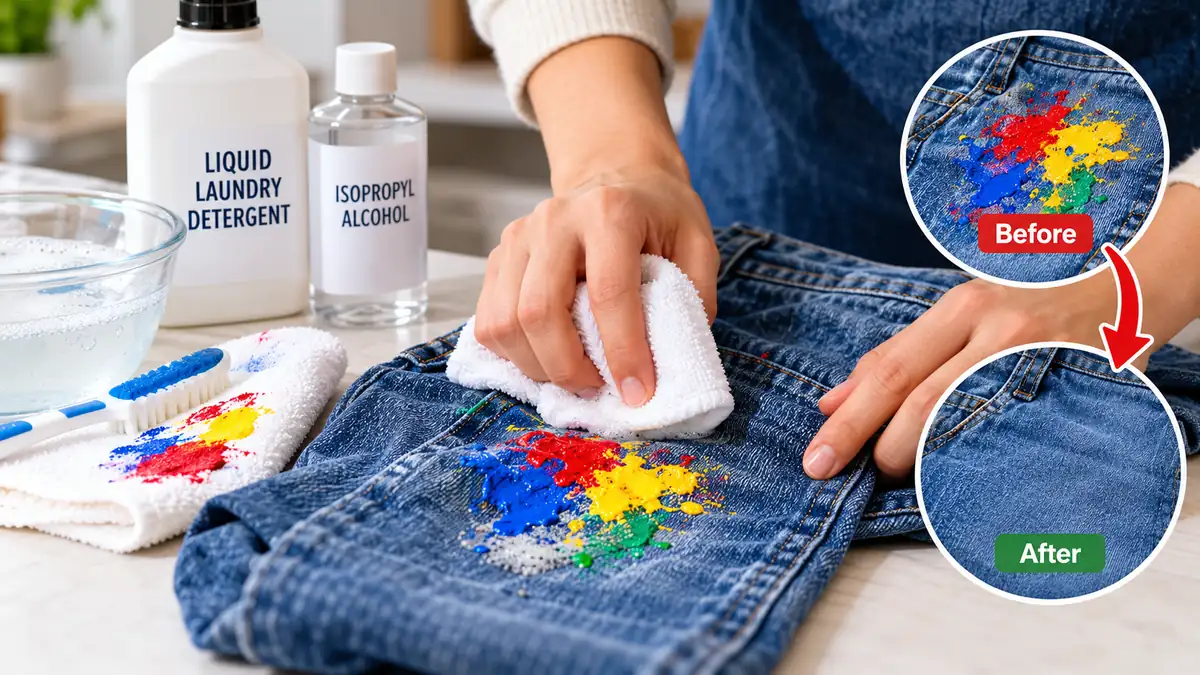
Acrylic paint looks great on canvas, but a splash on your favorite shirt, jeans, or hoodie can quickly become frustrating. The good news is that many acrylic paint stains can be removed—especially if you start cleaning before the paint has completely dried.
If you want to know how to get acrylic paint out of clothes, start by removing excess paint, flushing the stain from the back with cool water, and working liquid laundry detergent into the fibers. For dried acrylic paint, carefully scrape away the hardened layer and use fabric-safe isopropyl alcohol after testing it on a hidden area.
The keyword and informational focus used for this guide come directly from the supplied content brief.
Why Acrylic Paint Is Difficult to Remove From Clothes
Acrylic is generally considered a water-based paint while it is wet. That is why a fresh spill can often be loosened with water, detergent, and prompt cleaning.
The problem begins as the paint dries.
Acrylic paint contains pigment dispersed in an acrylic polymer emulsion. As water evaporates, the polymer forms a durable film around and between fabric fibers. Once that film has cured, simply rinsing the garment with water is much less effective.
This creates two very different stain-removal situations:
| Paint condition | Difficulty | Best first approach |
|---|---|---|
| Fresh and wet | Easier | Scrape, back-rinse, detergent |
| Partly dried | Moderate | Scrape, detergent, repeated treatment |
| Completely dried | Difficult | Scrape, spot-test isopropyl alcohol |
| Heat-dried | Very difficult | Repeated treatment may be necessary |
Timing matters. Cleaning professionals consistently recommend dealing with paint stains before they dry whenever possible.
What You Need to Remove Acrylic Paint
You probably already have most of the necessary supplies at home.
Keep these items nearby:
- A spoon, dull knife, or old plastic card
- Cool running water
- Liquid laundry detergent
- Mild dish soap
- Clean white cloths or paper towels
- Soft toothbrush or nylon brush
- Isopropyl alcohol, commonly called rubbing alcohol
- Commercial laundry stain remover, if necessary
- A basin or sink
You won’t necessarily need every item. Start with the gentlest treatment appropriate for the stain and fabric.
Before applying rubbing alcohol or another stain treatment, test it on an inconspicuous seam or inside portion of the garment. Dyes and delicate materials can react differently to cleaning products.
How to Get Acrylic Paint Out of Clothes While It Is Wet
Fresh acrylic paint gives you the best chance of completely removing the stain.
Don’t immediately rub the spill with a towel. Rubbing can spread wet paint across a larger area and work it further into the weave.
1. Remove the Excess Paint
Use the edge of a spoon, dull knife, palette knife, or plastic card to carefully lift excess paint from the garment.
Work from the outside of the spill toward the center.
The goal is to remove the thick surface paint without pushing it deeper into the material.
If there’s a large glob, scoop it away first rather than trying to absorb everything with a cloth.
2. Rinse the Stain From the Back
Turn the garment inside out or position it so you can reach the reverse side of the stain.
Run cool water through the back of the fabric.
This helps push loosened paint back out through the direction it entered rather than forcing additional pigment through the fibers. Back-rinsing is commonly recommended for fresh acrylic stains.
Continue rinsing while visible paint is being released.
3. Apply Liquid Laundry Detergent
Put a small amount of liquid laundry detergent directly on the stained area.
Gently work it into the fabric with your fingers or a soft nylon brush. Avoid aggressive scrubbing, particularly on lightweight materials.
Allow the detergent to work on the remaining residue for several minutes.
4. Rinse and Repeat
Rinse the area thoroughly.
If you can still see paint, repeat the detergent treatment rather than immediately switching to a much stronger chemical.
Fresh stains sometimes need several cycles of:
- Rinsing
- Detergent treatment
- Gentle agitation
- Rinsing again
Martha Stewart’s expert-backed guidance similarly recommends repeated detergent treatment and rinsing before moving on to alcohol when necessary.
5. Wash the Garment
Once most or all of the visible paint has disappeared, wash the garment according to its care label.
Use an appropriate laundry detergent.
Don’t assume washing automatically means the stain is gone.
6. Air-Dry and Inspect
This step is easy to overlook.
Air-dry the garment instead of immediately putting it in a tumble dryer. Inspect the stained area once the item is clean.
If pigment remains, treat it again.
Avoid exposing a remaining stain to dryer heat until you’re satisfied with the result. Several current stain-removal guides recommend air-drying until you have confirmed that the paint is gone.
Quick Takeaway: Fresh acrylic paint is much easier to remove. Lift away excess paint, rinse through the back of the fabric, treat with liquid detergent, rinse repeatedly, wash, and air-dry.
How to Get Dried Acrylic Paint Out of Clothes
Dried acrylic requires a different approach.
Once cured, acrylic no longer behaves like an ordinary water-soluble spill. You’re trying to loosen a hardened polymer film that has attached itself to the fibers.
Complete removal isn’t guaranteed, particularly if the stain is old or has already been exposed to heat.
1. Scrape Away the Hardened Paint
Place the garment on a stable surface.
Using a spoon, dull knife, or similar blunt object, carefully lift and flake off as much hardened paint as possible.
Don’t use a razor blade or sharp knife. Cutting or excessive scraping can permanently damage the fabric.
For thicker paint, removing this surface layer can make the following treatment much more effective.
2. Check the Care Label
Before using a solvent, identify what the garment is made from and review its washing instructions.
Be particularly cautious with:
- Delicate fabrics
- Specialty finishes
- Highly saturated dyes
- Dry-clean-only garments
- Fabrics that react poorly to solvents
When you’re unsure about an expensive or delicate item, a professional cleaner may be safer than experimenting with stronger products.
3. Spot-Test Rubbing Alcohol
For compatible washable fabrics, isopropyl alcohol can help loosen dried acrylic paint.
Test a small amount on a hidden area first.
Wait and check for:
- Color transfer
- Fading
- Texture changes
- Surface damage
Only continue if the material responds normally.
4. Apply Isopropyl Alcohol
Place a clean white towel underneath the stained section.
Apply a modest amount of rubbing alcohol to the dried paint and allow it to penetrate the hardened residue.
As the acrylic begins to soften, gently work at it using a clean cloth, spoon, or soft toothbrush.
Don’t aggressively scrub the stain across the garment.
Both current expert cleaning guidance and multiple paint-removal guides identify isopropyl alcohol as an option for stubborn dried acrylic stains.
5. Lift the Softened Paint
As pieces of paint loosen, remove them instead of grinding them back into the fabric.
Move to clean portions of your cloth or towel as pigment transfers.
A stubborn stain may require more than one treatment.
Patience generally works better than using excessive force.
6. Rinse Thoroughly
After treating the stain, rinse the area thoroughly.
This removes loosened paint and cleaning residue before laundering.
7. Pretreat With Laundry Detergent
Apply liquid laundry detergent to the remaining mark.
Gently work it into the material and let it sit according to the detergent’s directions.
If necessary, use a laundry stain remover that’s compatible with the fabric.
8. Wash and Air-Dry
Wash according to the garment’s care label and then let it air-dry.
Inspect the fabric before using a dryer.
If the stain remains, another treatment may improve it.
Can Dish Soap Remove Acrylic Paint From Clothes?
Dish soap can help with fresh acrylic paint, particularly when used before the paint has formed a hard film.
Mixing a small amount of dish soap with water can help loosen remaining residue after the excess paint has been removed.
However, dish soap isn’t a universal solution.
Once acrylic has fully dried and hardened, soap and water alone may not break through the polymer film. At that point, careful scraping followed by a fabric-compatible treatment such as isopropyl alcohol may be more effective.
Laundry detergent is also a strong first-line choice because it’s specifically formulated for washing textiles.
Does Rubbing Alcohol Remove Acrylic Paint?
Rubbing alcohol can be useful for dried acrylic paint because it can help soften and disrupt the hardened paint film, making it easier to lift mechanically.
That doesn’t mean you should pour alcohol onto every stained garment.
Always:
- Check the care label.
- Spot-test first.
- Use a small amount.
- Work in a ventilated area.
- Keep it away from flames and ignition sources.
- Rinse the garment thoroughly afterward.
For a fresh stain, start with water and detergent rather than automatically reaching for alcohol.
Can You Use Baking Soda on Dried Acrylic Paint?
Baking soda frequently appears in home stain-removal advice, but it isn’t usually necessary for a fresh acrylic spill.
For stubborn dried paint, one current expert-backed method combines equal amounts of baking soda, dish soap, and rubbing alcohol into a paste. The mixture is applied to the stain, gently scrubbed, rinsed, and followed by normal laundering.
Because rubbing alcohol is the stronger component of this treatment, you should still perform a hidden-area test first.
Don’t assume that because ingredients are common household products they’re automatically safe for every fabric.
Will Vinegar Remove Acrylic Paint?
Vinegar is frequently recommended online for household cleaning, but it isn’t necessarily the best choice for acrylic paint.
Acrylic becomes water-resistant after curing, and a weak household solution may not effectively break down the hardened polymer film.
Cleaning guidance cited by Martha Stewart specifically notes that vinegar’s high water content makes it less effective for this purpose than appropriate treatments for cured acrylic.
For fresh paint, concentrate on water and detergent.
For dried paint, careful scraping and spot-tested isopropyl alcohol generally make more sense.
Should You Use Acetone or Nail Polish Remover?
Be cautious.
Some guides suggest acetone or acetone-containing nail polish remover for dried acrylic, but it is substantially more aggressive than ordinary detergent treatments and may affect certain fabrics, dyes, or finishes.
Recommendations also differ between cleaning sources. The Home Depot lists alcohol-based products such as nail polish remover or rubbing alcohol as possible treatments for dried acrylic, while Martha Stewart’s expert guidance advises avoiding industrial-strength solvents such as acetone because of fabric and flammability concerns.
For ordinary home treatment, starting with the least aggressive effective method is the safer approach.
How to Remove Acrylic Paint From Jeans
Denim is relatively sturdy, but aggressive scrubbing can still fade or roughen its surface.
For wet acrylic paint on jeans:
- Lift off excess paint.
- Back-rinse with cool water.
- Apply liquid laundry detergent.
- Gently work the detergent into the fibers.
- Rinse and repeat.
- Wash according to the care label.
- Air-dry and inspect.
For dried paint, carefully scrape the hardened surface before spot-testing isopropyl alcohol.
Dark denim deserves extra caution because some dyes may transfer during solvent treatment.
How to Remove Acrylic Paint From Cotton Clothes
Cotton can absorb liquid deeply into its fibers, so quick action matters.
If the paint is wet, flush it thoroughly from the reverse side and use liquid detergent.
For dried acrylic, scrape away the crust first. If the garment’s care instructions permit it, test rubbing alcohol on an inconspicuous area before treating the visible stain.
White cotton may make residual pigment particularly noticeable, but don’t automatically jump to bleach or acetone.
Check the garment label and use a stain treatment appropriate for the fabric.
How to Handle Polyester and Synthetic Fabrics
Synthetic fabrics require the same basic principle: start gently.
Remove excess paint, rinse fresh stains, and use detergent first.
Before applying alcohol or another solvent to polyester, nylon, blends, or performance clothing, test it somewhere hidden. Synthetic garments may also contain coatings, printed designs, elastane, adhesives, or special finishes that react differently from the main fiber.
Don’t assume that two garments labeled “polyester” will respond identically.
What About Delicate or Dry-Clean-Only Clothes?
Silk, wool, acetate, embellished clothing, structured garments, and dry-clean-only items deserve additional caution.
Don’t aggressively scrape or saturate them with household solvents.
Remove excess wet paint carefully without spreading it, then consult a professional cleaner as soon as practical. Tell the cleaner that the stain is acrylic paint and mention anything you’ve already applied to it.
A costly garment isn’t a good place to experiment with increasingly strong DIY chemicals.
What Not to Do With an Acrylic Paint Stain
Sometimes the biggest difference comes from avoiding the wrong treatment.
Don’t Rub a Fresh Spill
Rubbing wet paint can spread pigment and force it farther into the weave.
Lift or scrape excess paint first.
Don’t Start With the Strongest Chemical
More powerful doesn’t automatically mean more effective.
Strong solvents can create a second problem by damaging dye, coatings, or fibers.
Begin with the least aggressive treatment likely to work.
Don’t Skip the Spot Test
A treatment that removes acrylic beautifully but leaves a faded patch hasn’t saved the garment.
Test first.
Don’t Mix Cleaning Chemicals
Never create improvised mixtures of bleach, ammonia, solvents, or unrelated cleaning products.
Use one appropriate treatment at a time and rinse thoroughly.
Don’t Put a Visible Stain Straight Into the Dryer
Inspect the garment before machine drying.
Air-drying gives you another opportunity to repeat treatment if paint remains.
Fresh vs. Dried Acrylic Paint: Which Method Works Best?
The most useful question isn’t simply, “What removes acrylic paint?”
It’s: Has the acrylic dried?
| Situation | First treatment | Next treatment |
|---|---|---|
| Paint still wet | Back-rinse with water | Liquid detergent |
| Small fresh splatter | Rinse and detergent | Repeat treatment |
| Partially dried paint | Gentle scraping | Detergent/alcohol if needed |
| Fully dried acrylic | Scrape hardened layer | Spot-tested isopropyl alcohol |
| Residual pigment | Laundry pretreatment | Wash and inspect |
| Delicate garment | Minimal handling | Professional cleaning |
Fresh and dried stains behave differently because acrylic changes as its polymer film forms. Treating them as the same type of stain is one of the most common mistakes.
Can Acrylic Paint Become Permanent on Clothes?
Yes.
Once acrylic has fully cured inside the fibers, complete removal may be impossible without damaging the material. Expert cleaning advice notes that dried acrylic can become extremely difficult to remove completely.
Your chances generally depend on several factors:
- How quickly you noticed the stain
- How much paint spilled
- Whether the paint dried completely
- The fabric’s fiber and construction
- The paint color and pigment
- Whether the garment has already been washed or dried with heat
- What cleaning treatments have already been attempted
Even when you can’t achieve perfect removal, repeated careful treatments may make the mark much less noticeable.
What If the Stain Is Still Visible After Washing?
Don’t immediately give up.
First, air-dry the garment and inspect it under good lighting.
If there’s still a visible patch:
- Gently scrape away any remaining raised paint.
- Reapply the appropriate treatment.
- Let the product work rather than aggressively scrubbing.
- Rinse thoroughly.
- Pretreat with liquid laundry detergent.
- Wash according to the care label.
- Air-dry again.
Repeated gentle treatment is often preferable to one extremely aggressive cleaning attempt.
If the fabric starts showing fading, thinning, fuzzing, or other damage, stop.
At that point, continuing may cause more harm than the original stain.
How to Prevent Acrylic Paint Stains
Prevention is much easier than removing cured acrylic.
When painting or crafting, wear an apron, smock, or clothes you don’t mind staining.
You can also:
- Roll up loose sleeves.
- Cover your workspace.
- Keep clean water and cloths nearby.
- Close paint containers when they aren’t being used.
- Treat splashes immediately.
- Keep brushes away from the edges of tables.
- Avoid wiping paint-covered hands on clothing.
If you frequently work with acrylics, keeping a dedicated painting outfit can save plenty of laundry frustration.
Final Takeaway
Learning how to get acrylic paint out of clothes comes down to identifying whether the paint is wet or dry and choosing the gentlest effective treatment.
For fresh acrylic paint, remove the excess immediately, rinse through the back of the fabric, work in liquid laundry detergent, rinse, wash, and air-dry. Fresh stains offer the best chance of complete removal.
For dried acrylic, carefully scrape away the hardened surface and, on compatible washable fabrics, spot-test isopropyl alcohol before using it to loosen the remaining paint. Follow with detergent, laundering, and air-drying.
Most importantly, don’t aggressively rub a fresh stain, don’t skip the fabric care label, and don’t machine-dry the garment until you’ve checked that the paint is gone. Acting quickly and treating the fabric carefully gives you the best chance of saving the clothing without creating additional damage.