
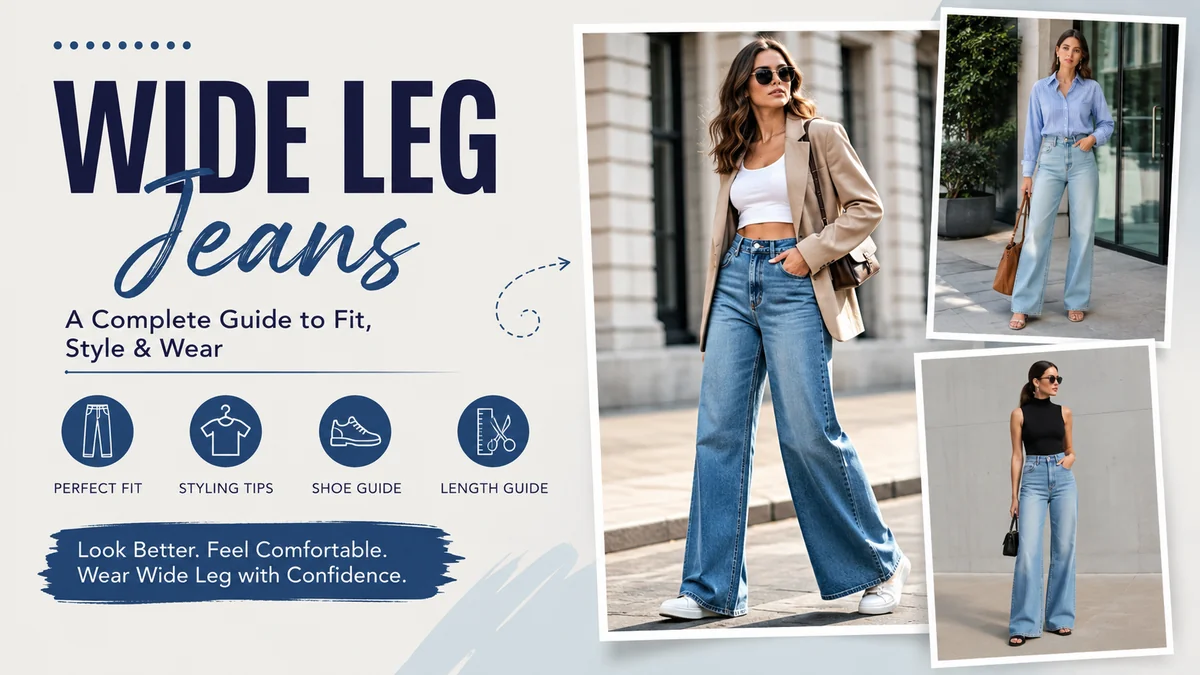
Wide leg jeans have moved well beyond being a passing denim trend. Their roomy silhouette, comfortable fit, and ability to work with everything from simple T-shirts to tailored blazers have made them a practical alternative to skinny and straight-leg denim.
The catch? A great pair can look effortless, while the wrong rise, length, or amount of volume can make the same silhouette feel awkward. The difference usually comes down to proportion rather than body shape.
Wide leg jeans are denim trousers designed with a noticeably roomy leg that continues downward from the hip or upper thigh. They can be high-, mid-, or low-rise and range from structured trouser-style denim to relaxed, baggy cuts. The right pair creates a balanced silhouette while offering more movement than close-fitting jeans.
What Are Wide Leg Jeans?
Wide leg jeans are defined primarily by the shape of the leg.
Unlike skinny jeans, they do not taper closely around the thigh, knee, and calf. Unlike many flare jeans, they do not need to remain fitted through the thigh before widening dramatically below the knee.
Instead, the silhouette creates noticeable room through much or all of the leg.
A typical pair combines:
- A defined or relaxed waist
- Room through the thigh
- A wide leg opening
- Denim ranging from rigid cotton to stretch blends
- Cropped, ankle, full-length, or puddle hems
That sounds simple, but there is enormous variation within the category.
Some wide leg jeans resemble tailored trousers. Others borrow heavily from relaxed ’90s denim. Extra-wide versions can approach a palazzo silhouette, while more restrained cuts provide only slightly more volume than straight-leg jeans.
That variety is one reason the style remains so adaptable.
Wide Leg Jeans vs. Straight, Flare, and Baggy Jeans
Denim terminology can become confusing because several modern silhouettes overlap.
Here is the easiest way to separate them.
| Jeans Style | Thigh | Knee | Hem | Overall Shape |
|---|---|---|---|---|
| Skinny | Very fitted | Fitted | Narrow | Body-hugging |
| Straight leg | Regular/fitted | Straight | Similar width | Consistent |
| Wide leg | Relaxed/wide | Wide | Wide | Roomy throughout |
| Flare | Fitted | Fitted | Very wide | Expands below knee |
| Bootcut | Fitted | Fitted | Slightly wider | Subtle flare |
| Baggy | Very loose | Loose | Varies | Oversized and relaxed |
| Barrel | Roomy | Widest around leg | Tapers | Curved |
A wide-leg cut can also be baggy, but the two terms are not interchangeable.
“Wide leg” describes the leg silhouette. “Baggy” generally describes the overall looseness and oversized fit.
Likewise, wide leg jeans and flare jeans may look similar from a distance, but the transition through the thigh and knee is different.
Why Wide Leg Jeans Remain Popular
Fashion cycles certainly play a role, but practicality helps explain the staying power of wide denim.
The silhouette offers freedom of movement without forcing the wearer into sweatpants or athletic clothing. Depending on the wash and construction, the same basic shape can look relaxed, minimalist, vintage-inspired, or polished.
Modern styling also gives the silhouette plenty of flexibility.
British Vogue has highlighted versions ranging from baggy, skater-influenced denim to flared and tailored interpretations, illustrating just how broad the category has become.
The appeal also comes down to proportion.
A defined waist paired with a wider leg creates a clear shape without requiring tight denim throughout the lower body. Changing the rise, top, footwear, and hem can dramatically alter that shape.
Recent 2026 fashion coverage continues to feature wide-leg denim, including petite-friendly cuts and more relaxed stretch versions.
The useful lesson isn’t that everyone needs to follow a trend. It is that the silhouette has become established enough to offer far more choices in rise, inseam, wash, fabric, and fit than it once did.
How Should Wide Leg Jeans Fit?
This is where shopping becomes more important than trend following.
The word “wide” does not mean every part of the jeans should be oversized.
For a classic fit, start by checking four areas.
1. The Waist
Your waistband should sit securely without requiring constant adjustment.
A small amount of room can be comfortable, particularly in rigid denim, but a waistband that slides downward changes the intended rise and makes the entire silhouette look different.
If the waist fits but the hips feel too tight, trying a curvy fit may work better than simply sizing up.
2. The Hips
Decide whether you want structure or relaxation.
Tailored wide leg jeans generally sit relatively cleanly around the hips before falling into a wider leg. Relaxed designs may intentionally include extra room in both the seat and thigh.
Neither approach is inherently better.
The question is whether the fit looks intentional.
3. The Leg
The denim should have enough room to create a recognizable wide silhouette without producing unwanted bunching.
Fabric matters here.
Heavier rigid denim holds its shape and can create a stronger architectural line. Softer denim falls closer to the body and creates more movement.
4. The Hem
Never treat the hem as an afterthought.
An excellent fit can be ruined by an inseam that does not work with your footwear.
Full-length jeans may nearly reach the floor, but they should not create a genuine walking hazard. Very long, loose trousers can catch under footwear or become problematic on stairs, making appropriate hemming a practical issue as well as a styling decision.
Quick Takeaway: Fit the waist and hips first. Then evaluate the width and inseam with the shoes you actually expect to wear.
Choosing the Right Rise
Rise describes the distance between the crotch seam and waistband and determines where the jeans sit on your torso.
High-Rise Wide Leg Jeans
High-rise styles sit at or near the natural waist.
They create a strong waistline and visually increase the amount of denim below the waist, which can produce a longer-leg effect.
They work especially well with:
- Tucked shirts
- Bodysuits
- Cropped jackets
- Fitted knitwear
- Shorter sweaters
High-rise wide leg jeans are useful when you want the waist to become a clear visual anchor.
Mid-Rise Wide Leg Jeans
Mid-rise jeans sit lower and can feel less restrictive around the torso.
They are an easy middle ground for casual outfits because they do not emphasize the waist as dramatically as high-rise denim.
Try them with:
- Basic T-shirts
- Button-down shirts
- Knit tops
- Casual jackets
- Sweatshirts
Low-Rise Wide Leg Jeans
Low-rise denim creates a more relaxed, Y2K-influenced proportion.
Because the waistband sits lower, the torso appears longer and the visible leg line begins lower.
That is not automatically flattering or unflattering—it simply creates a different proportion.
Choose your rise based on comfort and the silhouette you want rather than assuming one waist height works for everyone.
How to Style Wide Leg Jeans Without Looking Overwhelmed
The most reliable styling principle is proportion.
Wide denim introduces volume below the waist. Your other clothes can either balance that volume, emphasize it intentionally, or compete with it.
A fitted top is the easiest starting point, but it is not a rule.
Use Waist Definition
A tucked tee, bodysuit, cropped sweater, or fitted tank makes the waistband visible.
This separates the torso from the wide lower silhouette and gives the outfit structure.
You can create the same effect with a belt or a jacket that finishes close to the waist.
Try the Front Tuck
If a full tuck feels too formal, tuck only the front portion of a shirt or knit.
You retain some relaxed volume while still showing where the jeans begin.
Match Oversized Pieces Deliberately
Yes, oversized tops can work with wide leg jeans.
The outfit simply needs to look intentionally oversized.
For example:
Wide jeans + fitted tank + oversized blazer
works because the fitted layer establishes the body line beneath the blazer.
You could also try:
Wide jeans + boxy cropped jacket
because the shorter jacket provides visual separation between the upper and lower volumes.
Problems usually appear when a long, loose top ends at the widest part of equally loose jeans without any visual break.
What Tops Look Best With Wide Leg Jeans?
There is no single “correct” top.
Different tops simply produce different results.
T-Shirts
A plain T-shirt may be the easiest option.
Tuck it completely for a clean silhouette, use a front tuck for something more relaxed, or choose a slightly cropped tee that finishes around the waistband.
A jeans-and-tank formula also continues to appear in current celebrity styling, showing how effectively a simple fitted upper half can balance wider denim.
Button-Down Shirts
A crisp shirt adds structure.
Wear it tucked for a polished outfit or partially open over a fitted tank for a relaxed layered look.
Lightweight cotton and linen-style shirts work particularly well when the denim itself is heavy.
Sweaters
Consider where the sweater ends.
A waist-length knit naturally highlights high-rise jeans. Longer sweaters can work too, but a partial tuck often prevents the silhouette from becoming visually heavy.
Bodysuits and Fitted Tops
These are among the simplest choices because they create a clean contrast with the wider leg.
They are especially useful underneath jackets and blazers.
Crop Tops
A crop top does not need to expose much skin.
A top that simply meets the waistband can provide the same proportional benefit while maintaining more coverage.
What Shoes Should You Wear With Wide Leg Jeans?
Shoes affect both the visible length of the leg and where the hem falls.
That makes footwear part of the fit—not merely an accessory.
Sneakers
Low-profile sneakers create a relaxed everyday outfit.
Chunkier sneakers can also work, particularly with baggier denim, but check that the hem does not collapse awkwardly around the shoe.
Ballet Flats
Flats work particularly well with cropped or correctly hemmed jeans because the shoe remains visible.
They can also provide a useful contrast between substantial denim and delicate footwear.
Loafers
Loafers make wide leg jeans feel more structured.
Combine dark denim, loafers, a tucked shirt, and a blazer for an outfit that sits somewhere between casual and tailored.
Heels
Heeled boots, pumps, platforms, and block heels can add physical height underneath full-length denim.
If you regularly wear heels, try jeans on with a similar heel height before deciding whether the inseam is correct.
Boots
Boots are particularly practical during cooler months.
Because much of the boot may disappear beneath the denim, focus on toe shape, heel height, and how the hem falls rather than decorative details around the ankle.
Full-Length or Cropped Wide Leg Jeans?
Both work. They simply create different visual lines.
Full-Length Jeans
Full-length wide leg jeans provide maximum vertical continuity.
They often look especially effective with heels, boots, or sneakers when the hem falls cleanly.
The downside is practical: extra fabric near the ground gets dirty faster and can become inconvenient.
Cropped Wide Leg Jeans
Cropped versions expose more footwear and ankle area.
They are useful in warm weather and can make statement shoes more visible.
For petite wearers concerned about excess fabric, cropped denim is one option, although properly hemmed full-length jeans can work equally well. Current petite-focused fashion coverage also emphasizes multiple inseam choices rather than treating height as a reason to avoid the silhouette.
Can Petite People Wear Wide Leg Jeans?
Absolutely. Height alone does not determine whether the silhouette works.
The bigger issue is scale.
A petite shopper may find that standard-size jeans have:
- Too much rise
- Knees positioned incorrectly
- Excessive inseam
- Pockets sitting too low
- More leg volume than intended
That is why petite sizing can matter beyond simply shortening the hem.
For an elongated appearance, try a higher rise, clean front, appropriate inseam, and top that allows the waistband to remain visible.
Monochromatic combinations can also preserve a continuous visual line.
Avoid assuming that petites must always choose cropped jeans. A full-length pair with the correct proportions can create an equally strong silhouette.
Wide Leg Jeans for Curvy Figures
Curvy bodies often encounter the opposite fit problem: jeans fit through the hips but gap at the waist.
In this situation, changing the cut can be more effective than changing the size.
Look for:
- Contoured waistbands
- Curvy-specific fits
- Adequate hip and thigh room
- Stretch where comfort is needed
- Clean front pockets if you prefer less bulk
- A rise that stays in place while sitting and walking
A wide leg can create a smooth line below the hip rather than closely tracing every part of the leg.
Current denim ranges increasingly include curvy, petite, regular, tall, and extended-size variations, which makes it easier to choose proportions rather than forcing one standard pattern to work for everyone.
Do Wide Leg Jeans Work for Every Body Type?
There is no body shape that is automatically excluded from wearing them.
The useful question is:
Which wide-leg proportion works for you?
For example:
Pear or Triangle Shapes
A fitted waistband with enough room through the hip can provide comfort while the wide leg continues the line downward.
Try keeping the upper half relatively defined if you want clearer waist emphasis.
Hourglass Shapes
High-rise jeans can emphasize an already defined waist.
A fitted or tucked top preserves that definition.
Rectangle Shapes
A high waist, belt, front pockets, pleats, or other waist details can add visual structure.
Apple or Round Shapes
A comfortable mid- or high-rise with a smooth waistband can work well.
Rather than hiding the torso beneath excessive fabric, experiment with vertical layers such as an open shirt or jacket.
But body-shape systems are guidelines—not fitting-room laws.
Two people described as the same “shape” can have different heights, torso lengths, rises, hip proportions, and styling preferences.
Your actual measurements and comfort are more useful than a label.
How to Wear Wide Leg Jeans Casually
Casual styling is where these jeans are easiest.
Try:
Wide leg jeans + white tee + sneakers
It is simple, balanced, and difficult to overcomplicate.
Other useful combinations include:
- Tank top + denim jacket + sneakers
- Sweatshirt + cropped wide jeans + trainers
- Fitted knit + flats
- Tucked tee + cardigan + loafers
- Button-down shirt + simple sandals
Light and medium washes naturally lean casual, while distressing creates an even more relaxed effect.
How to Make Wide Leg Jeans Look Polished
Change the texture and structure of the surrounding pieces.
Start with dark-wash denim without heavy fading or distressing.
Then add:
- A clean shirt, fine knit, or fitted top
- A structured blazer or jacket
- Loafers, pointed flats, boots, or heels
- A simple belt if appropriate
- Minimal accessories
Trouser-inspired wide leg jeans are particularly useful here because their clean lines make denim feel less casual.
A cuff can also alter the look. Recent styling coverage has highlighted cuffed wide denim as a way of making the silhouette feel more deliberate and structured.
Styling Wide Leg Jeans Through the Seasons
The silhouette itself does not need to change dramatically throughout the year.
The supporting pieces do.
Spring
Pair medium- or light-wash denim with:
- Lightweight cardigans
- Cotton shirts
- Ballet flats
- Loafers
- Light jackets
Summer
Choose breathable tops and, when possible, lighter denim.
Try:
- Tanks
- Fitted T-shirts
- Linen-blend shirts
- Sandals
- Cropped denim
Heavy rigid denim can become uncomfortable in high temperatures, so fabric weight matters.
Autumn
This is an easy season for wide denim because layering creates natural balance.
Consider:
- Fine knit + belt + loafers
- T-shirt + blazer + sneakers
- Cardigan + ankle boots
- Button-down + cropped jacket
Winter
Use the width to accommodate boots comfortably underneath.
Add:
- Fitted turtlenecks
- Wool coats
- Short puffers
- Structured jackets
- Heeled or flat boots
If both your coat and jeans are oversized, pay attention to where the coat ends so the proportions still look deliberate.
Choosing the Right Denim Fabric
Two pairs with identical measurements can hang completely differently because of fabric.
Rigid Denim
Mostly or entirely cotton denim provides structure.
It generally holds the intended shape well but may initially feel firmer.
Choose rigid denim when you want:
- A defined silhouette
- Vintage character
- Less cling
- Stronger structure
Stretch Denim
A small amount of elastane or another stretch fiber can improve mobility.
Stretch is particularly useful when you want a closer waist or hip fit without giving up comfort.
Too much stretch, however, can make some jeans lose the crisp drape associated with structured wide-leg denim.
Lightweight Denim
Lighter denim moves more fluidly and can be comfortable in warmer conditions.
It may resemble a denim trouser rather than traditional workwear-style jeans.
There is no universally superior fabric. Pick according to the silhouette and comfort level you want.
How to Choose the Right Wash
Wash changes the character of wide leg jeans almost as much as fit.
Light Wash
Relaxed, casual, and vintage-inspired.
Works naturally with white, cream, grey, pastel, and other denim pieces.
Medium Wash
Probably the most versatile option.
It moves easily between casual and slightly polished outfits.
Dark Wash
Dark indigo provides a cleaner, more tailored appearance.
Choose minimal fading if you want the jeans to feel dressier.
Black
Black wide leg jeans can bridge casual denim and trouser styling.
They work particularly well with monochromatic outfits.
White or Ecru
Useful for warm-weather and minimalist outfits, although they require more attention to staining and fabric transparency.
Common Wide Leg Jeans Styling Mistakes
Most styling problems come from fit and proportion, not from the silhouette itself.
Mistake 1: Ignoring the Inseam
Do not buy jeans that are several inches too long simply because long denim is fashionable.
“Puddle” styling is intentional. Accidentally walking on your hem is not.
Mistake 2: Choosing the Wrong Size to Get More Width
If you want a wider leg, buy a wider cut rather than unnecessarily sizing up.
Sizing up can distort the waistband, crotch, pockets, and rise.
Mistake 3: Hiding Every Point of Structure
Loose jeans, a long oversized shirt, an oversized jacket, and bulky shoes can all work individually.
Together, they may remove every visual anchor.
Expose the waist, wrist, neckline, or footwear if the outfit needs more definition.
Mistake 4: Forgetting Your Shoes During Alterations
Hem length depends on footwear.
Jeans altered for flats may look noticeably shorter with heels, while jeans fitted around platforms may drag when worn with ballet flats.
Mistake 5: Following Body-Type “Rules” Too Strictly
Use styling recommendations as experiments, not restrictions.
If a supposedly “wrong” combination looks and feels good when you put it on, the rule has already failed its purpose.
How to Shop for Wide Leg Jeans
A fitting room reveals far more than the size label.
Use this simple process.
- Choose your preferred rise. Decide where you actually like a waistband to sit.
- Fit the waist and hips. They determine whether the jeans stay positioned correctly.
- Check the leg volume. Decide whether you want tailored, classic wide, baggy, or extra-wide denim.
- Test movement. Sit, walk, bend, and climb a few safe steps if possible.
- Check pocket placement. Back pockets can significantly change the visual proportions of the seat.
- Wear realistic shoes. Evaluate the inseam with footwear similar to what you will normally use.
- Look from multiple angles. The side and back fit matter just as much as the front.
- Think about your wardrobe. A great pair should work with several tops and shoes you already own.
Do not obsess over the number printed on the label.
Denim sizing varies considerably between brands and sometimes between different cuts from the same brand.
The pair that fits properly is the correct size.
How to Care for Wide Leg Jeans
Good denim care can help preserve color, shape, and fabric.
Start with the garment’s care label because fiber composition, dyes, finishes, embellishments, and stretch content can require different treatment.
As a general approach:
- Wash only when needed
- Turn jeans inside out before washing
- Use cool or cold water when the care label permits
- Wash with similar colors
- Avoid excessive detergent
- Treat stains rather than automatically washing the entire garment
- Air-dry when practical and permitted by the label
- Avoid excessive heat, particularly with stretch denim
Long hems deserve extra attention because they collect more dirt from pavements and floors.
If your jeans constantly touch the ground, shortening them slightly may improve both cleanliness and longevity.
Are Wide Leg Jeans Still in Style?
Yes, but their usefulness now matters more than their trend status.
Fashion coverage in 2025 and 2026 continues to show wide denim across street style, celebrity outfits, petite ranges, cuffed designs, stretch denim, and tailored interpretations.
More importantly, the category is broad enough that you do not have to adopt one highly specific version.
You can choose:
- High-rise or low-rise
- Structured or slouchy
- Cropped or full-length
- Dark or faded
- Minimal or distressed
- Classic wide or extra-wide
- Flat shoes or heels
That flexibility gives the silhouette more longevity than a single micro-trend.
Finding Your Best Wide Leg Jeans
The best wide leg jeans are not necessarily the widest, newest, or most fashionable pair.
They are the ones whose proportions work with your body, footwear, wardrobe, and daily routine.
Start with a secure waist and comfortable hip fit. Decide how much volume you actually want. Then choose an inseam that works with the shoes you wear most often.
If you’re new to the silhouette, a medium- or high-rise pair with a moderate wide leg and clean wash is an easy place to begin. It provides enough width to create the characteristic shape without pushing into extremely baggy territory.
From there, experiment.
Try cropped denim with flats, full-length jeans with boots, dark denim with tailoring, or relaxed light-wash jeans with a basic tee.
Wide leg jeans work best when you stop treating them as a body-type test and start treating them as what they are: a flexible denim silhouette whose fit, rise, length, fabric, and styling can all be adjusted to suit the person wearing them.