
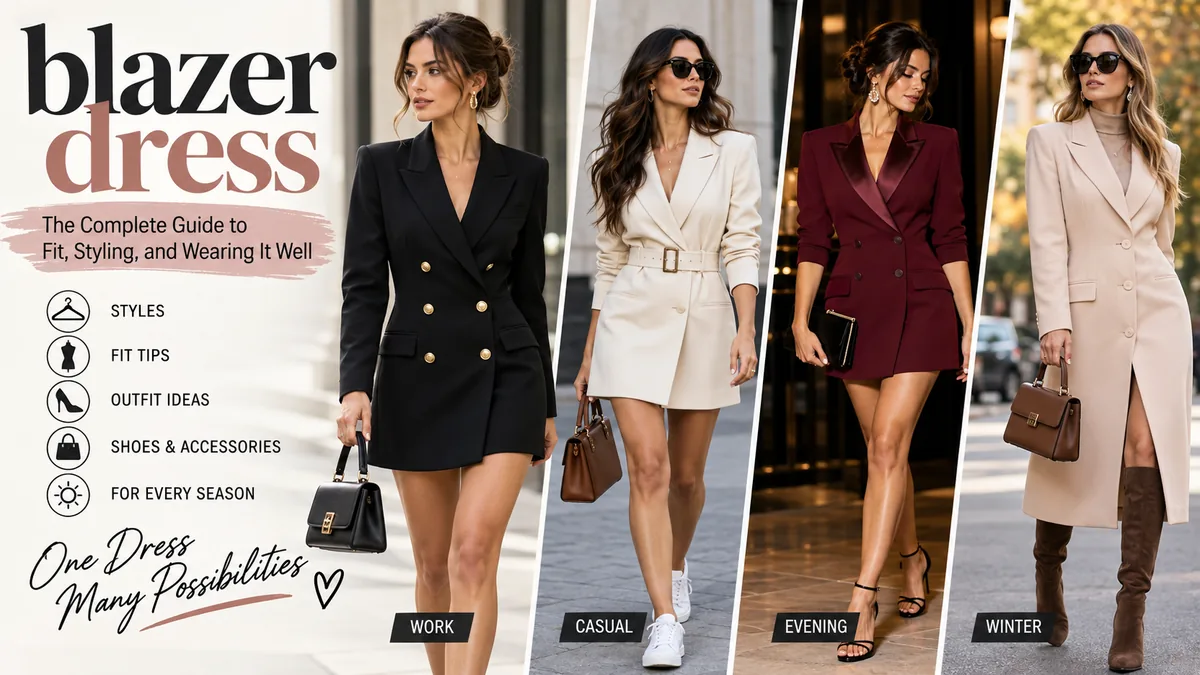
Few pieces create a polished outfit as quickly as a blazer dress. It takes the recognizable details of tailoring—lapels, buttons, structured shoulders, and clean lines—and turns them into a standalone dress. The result can look professional, sophisticated, relaxed, or dramatic depending on the cut and styling.
The challenge is proportion. A blazer dress that fits correctly looks intentional and refined. One that is too short, pulls across the buttons, or overwhelms the shoulders can feel more like an oversized jacket than a complete outfit.
A blazer dress is a dress constructed to resemble an elongated tailored blazer. It typically features lapels, a buttoned front, structured shoulders, long sleeves, and either a straight or defined waist. Styles range from fitted and belted designs to oversized, double-breasted, mini, midi, and longline silhouettes.
This guide explains how the garment works, how to choose the right silhouette, what to wear underneath it, which shoes complement it, and how to adapt it for work, evenings, casual outfits, and different seasons.
What Is a blazer dress?
At its simplest, a blazer dress combines two familiar garments: the tailored blazer and the dress.
Instead of ending around the hips like a conventional suit jacket, the garment extends far enough to function as a dress. Most designs retain recognizable tailoring details such as notch or peak lapels, a V-shaped neckline, buttons, pockets, shoulder structure, and suit-inspired fabric.
The silhouette can vary considerably.
Some blazer dresses closely resemble traditional double-breasted jackets. Others have wrap fronts, corset-inspired waists, asymmetric hems, flared skirts, embellished lapels, or deliberately oversized proportions.
Common blazer dress features
Typical design elements include:
- Notch, shawl, or peak lapels
- Structured or padded shoulders
- Single-breasted or double-breasted buttons
- Long, three-quarter, or sleeveless construction
- Welt, flap, or decorative pockets
- A V-shaped neckline
- Defined, belted, straight, or oversized waists
- Mini, knee-length, midi, or longline hems
- Suiting materials such as wool blends, crepe, twill, or polyester blends
Not every design contains every feature. What makes the garment recognizable is the overall use of tailored-jacket construction within a dress silhouette.
Why the blazer dress Works So Well
The appeal of this style comes from contrast.
Traditional tailoring creates structure and sharpness, while the dress silhouette eliminates the need to coordinate trousers or a skirt. You get much of the visual impact associated with a suit in a single garment.
That combination also makes the style unusually adaptable.
Shoes, hosiery, accessories, fabric, and length can change its character considerably. Pointed pumps make it sharper. Sneakers can make a relaxed version feel casual. Knee-high boots create a stronger autumn or winter look, while heeled sandals can shift a shorter version toward eveningwear.
The vertical lapel line can also visually lengthen the torso, while a belt or shaped waist introduces definition.
Single-breasted vs. double-breasted designs
One of the first choices is the button configuration.
| Style | Appearance | Usually Works Well For |
|---|---|---|
| Single-breasted | Clean and streamlined | Everyday wear, work, layering |
| Double-breasted | Structured and suit-inspired | Formal looks, statement outfits |
| Belted | Defined through the waist | Creating shape and adjusting fit |
| Wrap-front | Softer interpretation of tailoring | Flexible styling and waist definition |
| Oversized | Relaxed and contemporary | Casual and fashion-forward outfits |
| Tuxedo-inspired | Sharp lapels and evening feel | Dinners, parties and dressier events |
Single-breasted designs tend to create a cleaner vertical line. Double-breasted versions add more visual structure through the torso because of their wider button placement.
Neither is inherently more flattering. The better option is the one that sits smoothly when buttoned and gives you the amount of waist definition you want.
How to Choose the Right blazer dress Fit
Fit matters more here than it does with many loose dresses because blazer construction naturally draws attention to the shoulders, waist, lapels, and button closure.
Start with the shoulders.
The shoulder seam on a classic fitted design should sit close to your natural shoulder edge. Deliberately oversized dresses are different—the dropped shoulder is part of the design rather than a fitting mistake.
Next, button the garment and move around.
Sit down. Raise your arms. Walk. Turn your torso.
If the buttons pull apart, the lapels buckle, or the fabric forms strong horizontal tension lines across the bust or hips, the garment is probably too tight in that area.
Pay particular attention to length
Length affects both practicality and the overall impression of the garment.
A mini blazer dress creates a bolder, more evening-oriented silhouette. Knee-length and longer styles generally provide more coverage and can be easier to adapt to professional environments. Current styling guides similarly distinguish shorter versions as more evening-focused and longer cuts as more formal or work-friendly.
Don’t judge the hem while standing still.
Sit in a chair and check how much the dress rises. Walk several steps and see whether you constantly need to pull it down. If you do, the length may become frustrating in real life regardless of how good it looks in a mirror.
Should a blazer dress be tight or loose?
It doesn’t have to be either.
A tailored version should follow the body’s shape without pulling. An oversized version should look intentionally roomy rather than simply several sizes too large.
The distinction comes from proportion.
With an oversized cut, the shoulders, sleeve length, hem, and accessories still need to feel balanced. A belt can introduce waist definition, but leaving the garment unbelted can work when a straighter silhouette is intentional.
Quick Takeaway: Fit the shoulders and bust first. Then check the waist, hips, hem, and sitting length. A beautiful silhouette isn’t useful if you cannot comfortably move in it.
blazer dress Styles and Which Silhouette to Choose
The category extends far beyond the classic black double-breasted mini.
Understanding the main silhouettes makes choosing one much easier.
Classic tailored blazer dress
This is the most recognizable version: structured shoulders, lapels, buttons, and a clean tailored shape.
Black, navy, charcoal, beige, camel, and cream emphasize the suit-inspired character and are easy to coordinate with accessories.
Belted blazer dress
A belt breaks up the straight lines of tailoring and emphasizes the natural waist.
It can be particularly useful with relaxed designs that have enough fabric through the torso to be shaped without creating pulling or bunching.
Try positioning the belt at your actual natural waist rather than automatically placing it where the garment’s buttons happen to fall.
Oversized blazer dress
An oversized blazer dress deliberately borrows the proportions of relaxed menswear tailoring.
The trick is to maintain at least one clear proportion. That could mean showing more leg, wearing streamlined boots, pushing up the sleeves, or choosing a structured bag rather than combining several oversized elements.
Mini blazer dress
The mini version has the strongest going-out feel.
Because the hem already creates visual impact, accessories don’t need to compete with it. Simple earrings, a compact bag, and sleek footwear are often enough.
Movement testing is particularly important with a mini. A dress that appears adequately long when standing can become significantly shorter when sitting or walking.
Midi and longline styles
Longer blazer dresses offer more coverage and create an elongated tailored line.
They work especially well when you like the appearance of suiting but don’t want a short hem. Look for thoughtful shaping around the waist or strategic vents so the longer construction doesn’t restrict walking.
Tuxedo blazer dress
Tuxedo-inspired designs often use satin-like lapels, contrasting textures, strong V-necklines, covered buttons, or formal black-and-white detailing.
They naturally lean toward evening occasions and provide an alternative to a conventional cocktail dress.
How to Style a blazer dress
The easiest way to style a blazer dress is to treat the tailoring as the focal point.
You usually don’t need a large number of accessories. Instead, decide what setting you’re dressing for and use footwear, jewelry, a bag, hosiery, and optional layering to move the garment toward that level of formality.
For a polished outfit
Try:
- A well-fitted single- or double-breasted dress
- Pointed pumps, slingbacks, loafers, or refined flats
- A structured handbag
- Simple earrings or a watch
- Minimal additional jewelry
The lapels, buttons, and shoulders already provide visual detail.
For an evening outfit
A shorter black blazer dress with heels remains one of the simplest combinations, but evening styling doesn’t have to mean black.
Deep burgundy, navy, chocolate, jewel tones, metallic details, velvet, and satin accents can provide a dressier effect.
Strappy sandals or pointed heels sharpen the look. A clutch or compact shoulder bag keeps the proportions clean.
For a casual outfit
Yes, you can wear a blazer dress casually.
The easiest method is to soften its formal elements rather than trying to hide them.
A relaxed single-breasted version can work with clean sneakers, loafers, flat ankle boots, or simple sandals. A crossbody bag or understated tote further reduces the businesswear feel.
The contrast between tailored clothing and casual footwear is deliberate, which is why the combination can work.
With knee-high boots
Knee-high boots work particularly well with mini and above-the-knee styles during cooler months.
Watch the proportions between the hem and boot shaft. A visible section of leg—or continuous tonal hosiery—can prevent the outfit from appearing visually crowded.
For a softer look, try streamlined leather or suede boots. Chunkier boots make the tailoring feel more casual and assertive.
What Shoes Go With a blazer dress?
Shoes have an unusually large influence on this garment because there are no trousers or skirt separates competing for attention.
| Footwear | Effect |
|---|---|
| Pointed pumps | Sharp, polished, dressy |
| Block heels | Refined with more stability |
| Slingbacks | Elegant and lighter visually |
| Loafers | Smart and understated |
| Knee-high boots | Strong autumn/winter styling |
| Ankle boots | Modern smart-casual look |
| Clean sneakers | Relaxed contemporary contrast |
| Heeled sandals | Evening or warm-weather look |
| Minimal flats | Comfortable daytime styling |
A useful rule is to choose footwear according to the occasion before choosing jewelry.
If the shoes establish the correct level of formality, the rest of the outfit usually becomes much easier.
What to Wear Under a blazer dress
This question becomes especially relevant with deep V-necklines, short hems, wrap fronts, and loosely fitted styles.
What you wear underneath should depend on the garment’s construction rather than a universal rule.
Camisole or fitted top
A thin camisole can provide extra neckline coverage without adding much bulk.
Choose a smooth fabric so it doesn’t distort the lapels.
Bodysuit
A fitted bodysuit works when you need dependable coverage beneath a wrap or low neckline.
Because it remains tucked in, it avoids the bunching that can occur with longer tops.
Bralette
A bralette may work for intentionally evening-oriented styling when some lingerie-inspired detail is meant to remain visible.
It is less appropriate when you need conservative coverage.
Shorts or smoothing layers
Short fitted shorts can provide practical coverage beneath mini styles, particularly when sitting, walking, or dealing with wind.
The goal isn’t necessarily shapewear. Lightweight coverage can simply make the outfit easier to wear.
Tights
Opaque tights are one of the most practical ways to adapt a shorter blazer dress to cooler temperatures or situations where bare legs feel too exposed.
Black tights paired with black boots create an uninterrupted vertical line and can visually balance a shorter hem.
Can You Wear a blazer dress to Work?
You can, but the word “blazer” doesn’t automatically make every blazer dress office-appropriate.
A plunging mini designed for nightlife remains a plunging mini even when it has lapels.
For professional environments, look for adequate hem length, secure buttons, sufficient neckline coverage, comfortable sleeves, and fabric substantial enough to maintain its structure. Longer and more conservative versions are commonly recommended for professional styling.
A straightforward work combination is:
- Knee-length or midi tailored dress
- Neutral or subdued color
- Camisole if additional neckline coverage is needed
- Loafers, pointed flats, or moderate heels
- Structured bag
- Simple jewelry
Workplace dress codes differ significantly. A creative agency may accept a silhouette that would be unsuitable in a conservative law office or corporate environment.
Use the actual dress code—not the garment’s name—as your guide.
How to Wear a Black blazer dress
A black blazer dress is popular because the neutral base lets silhouette and texture become the main features.
For daytime, combine it with loafers, flats, low boots, or restrained jewelry.
For evening, switch to heeled sandals or pumps and add a small bag and stronger earrings.
For winter, try opaque tights, knee-high boots, and a long coat.
If an all-black outfit feels too severe, introduce contrast through texture rather than adding several colors. Leather boots, suede, metal jewelry, sheer hosiery, or a textured handbag can create depth while preserving a monochromatic look.
How to Wear a White blazer dress
White produces a noticeably different effect.
The clean color emphasizes the architecture of lapels, seams, pockets, and buttons, so construction quality becomes particularly visible.
Check the garment under both indoor and natural light before wearing it. Some white suiting fabrics become more transparent under strong lighting than they appear in a fitting room.
Neutral, metallic, black, tan, or transparent footwear can all work depending on the occasion.
White blazer dresses are sometimes associated with bridal showers and bachelorette styling, but the color itself isn’t restricted to wedding-related occasions.
Choosing a blazer dress for Your Body Proportions
There isn’t one blazer dress that universally “flatters every body type.” What works depends on the effect you want to create.
Instead of trying to force yourself into rigid body-shape rules, use tailoring to control proportion.
If you want more waist definition
Try a belted, wrap-front, or shaped-waist design.
Make sure the waist actually aligns with your body. A belt sitting noticeably above or below your natural waist can make the proportions feel awkward.
If you want to balance the hips
Structured shoulders can create visual balance, while an A-line or gently flared lower section provides additional room around the hips.
Avoid buttons that visibly pull when standing or sitting.
If you have broad shoulders
You don’t need to avoid blazer dresses.
If you don’t want to emphasize shoulder width, choose softer shoulder construction rather than heavy padding. A wider or subtly flared hem can also distribute visual volume through the lower half.
If you are petite
Pay attention to where the shoulders, waist, sleeves, and hem fall rather than assuming that every mini automatically works.
An oversized style with excessively long sleeves can overwhelm a smaller frame. Petite-specific tailoring or alterations may make a substantial difference.
If you are tall
Longline and midi silhouettes can make use of vertical length, while mini versions may sit considerably shorter than intended.
Always check garment measurements rather than relying exclusively on a model photograph.
Quick Takeaway: Body-shape labels can be a starting point, not a rulebook. Correct shoulder placement, comfortable button closure, usable hem length, and a waist position that works with your proportions matter more.
How to Wear a blazer dress in Different Seasons
Tailoring isn’t limited to autumn and winter. Fabric weight, sleeves, footwear, and layering determine how seasonal the garment feels.
Spring
Choose lighter suiting, softer neutrals, pastels, or brighter colors.
Slingbacks, loafers, pumps, and lightweight ankle boots transition well between cool mornings and warmer afternoons.
Summer
Look for breathable construction, lighter lining, sleeveless versions, or fabrics that don’t trap excessive heat.
Pair with minimal sandals or lightweight heels.
A structured garment can feel much warmer than an ordinary summer dress because of its lining and multiple fabric layers, so check the construction before choosing one for very hot weather.
Autumn
This is arguably the easiest season for the style.
Ankle boots, loafers, knee-high boots, tights, and richer neutral colors all complement traditional tailoring.
Winter
Use opaque tights, tall boots, and an outer coat.
For warmth, look for heavier wool-blend or substantial suiting materials rather than relying entirely on layering underneath. Too many bulky layers can distort the lapels and shoulders.
How to Accessorize a blazer dress Without Overdoing It
Tailoring already supplies several focal points: shoulders, lapels, buttons, neckline, and often a belt.
Accessories should work around those features.
Jewelry
Earrings are usually easier to coordinate than large necklaces because they don’t compete directly with the lapel.
Try hoops, studs, drop earrings, a cuff, watch, or fine chain.
If the dress already has embellished buttons, metallic lapels, crystals, or decorative hardware, reduce the jewelry accordingly.
Belts
Not every blazer dress needs one.
A belt is useful when you want to define the waist or control excess volume in an oversized silhouette.
Slim belts look subtle. Wider belts create a stronger break between the upper and lower body.
Bags
Structured top-handle bags and compact shoulder bags reinforce the tailored appearance.
A soft tote or crossbody can make the same dress feel more relaxed.
For formal evening styling, a small clutch usually creates cleaner proportions than an oversized everyday bag.
Common blazer dress Styling Mistakes
The difference between sharp tailoring and an awkward outfit is often surprisingly small.
Choosing a hem you constantly have to adjust
If you’re repeatedly pulling the garment down while walking or sitting, the dress isn’t functioning comfortably.
Test movement before committing to the outfit.
Ignoring button tension
Buttons shouldn’t look as though they are carrying the structural load of the dress.
Pulling creates horizontal lines and can distort the lapels. Sizing up and tailoring another area is often more effective than squeezing into a smaller size.
Assuming oversized means any larger size
Purpose-built oversized clothing is proportioned differently from a conventional garment purchased several sizes too large.
An intentionally oversized blazer dress may have dropped shoulders and extra body width while still maintaining appropriate sleeve and hem proportions.
Adding too many statement pieces
Strong shoulders, gold buttons, a large belt, oversized earrings, patterned tights, dramatic boots, and a statement bag can quickly compete with one another.
Choose where you want the eye to go.
Forgetting the sitting test
This is particularly important with mini designs.
Sit normally, cross and uncross your legs, reach forward, and walk upstairs if possible. Real-life comfort matters more than a perfect standing mirror pose.
Wearing the wrong underlayer
A bulky shirt can push against fitted sleeves and disrupt shoulder structure.
When layering underneath, choose thin pieces that provide the coverage or warmth you need without changing the outer silhouette.
How to Make a blazer dress Look More Expensive and Polished
Price isn’t the only factor that determines whether tailoring looks refined.
Fit and garment care can have an even bigger visual impact.
Start by steaming or pressing the fabric according to its care instructions. Creased lapels and crushed sleeves undermine the crispness that gives tailoring its character.
Check the buttons. Loose buttons are easy to reinforce and immediately improve the finish.
Pay attention to sleeve length. If the sleeves completely cover your hands or bunch heavily at the wrists, alterations can make the entire garment look more intentional.
Then simplify the styling.
A clean shoe, well-proportioned bag, restrained jewelry, and neat garment usually look more sophisticated than piling on trend-driven accessories.
Is a blazer dress Still in Style?
The blazer dress continues to appear in current 2026 fashion and styling coverage, including classic tailored, oversized, belted, mini, double-breasted, and longline interpretations. Contemporary guides connect it with both traditional power dressing and newer styling approaches that pair tailoring with boots, trainers, flats, and evening footwear.
But longevity matters more than whether a garment appears on a particular season’s trend list.
Blazers, suits, lapels, structured shoulders, and double-breasted tailoring have existed through many fashion cycles. A blazer dress borrows that established design vocabulary.
If you want a version less dependent on short-term trends, prioritize a clean cut, manageable shoulder structure, restrained hardware, and a length you can realistically wear.
Trend-led details can still be fun. Exaggerated shoulders, dramatic cutouts, unusual hardware, bold prints, corseted waists, and very short hems simply create a more distinctive look.
A Simple Formula for Getting the Look Right
When you’re unsure how to wear your blazer dress, use this sequence:
- Check the fit. Shoulders should sit correctly and buttons shouldn’t pull.
- Test the hem. Sit and walk before deciding whether the length works.
- Choose the occasion. Work, casual daytime, dinner, and parties require different levels of coverage and formality.
- Pick shoes next. Footwear establishes much of the outfit’s character.
- Add coverage if necessary. Use a camisole, bodysuit, shorts, or tights when appropriate.
- Consider waist definition. Add a belt only if it improves the silhouette.
- Keep accessories controlled. Let the tailoring remain visible.
- Check movement one final time. A polished outfit should still be comfortable enough to live in.
The biggest advantage of the blazer dress is that it doesn’t require complicated styling. Good tailoring already provides the structure.
Choose a silhouette that fits comfortably, pay close attention to shoulder placement and hem length, and let the occasion determine your footwear and accessories. From a restrained work outfit to boots for autumn or heels for an evening event, the same basic garment can take on remarkably different personalities.
The best next step is simple: judge your blazer dress while moving, sitting, and walking—not only while standing in front of a mirror. When the fit works in real life, the styling becomes much easier.