
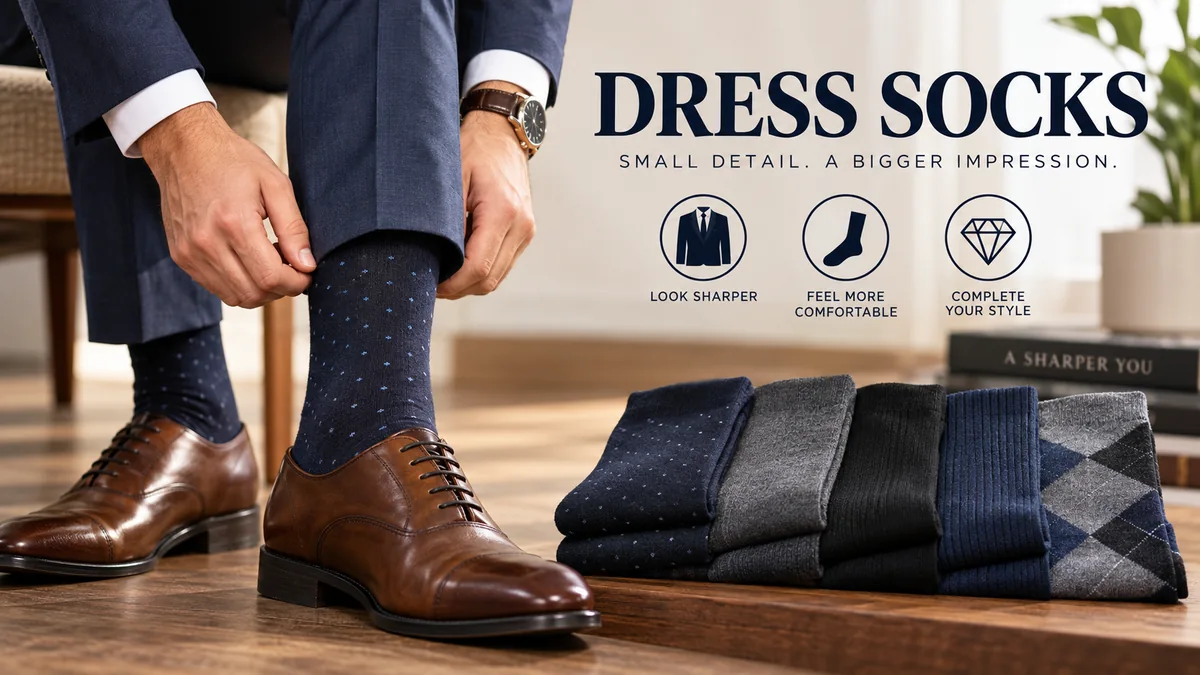
A polished suit can lose some of its visual balance when the socks are too short, bulky, faded, or constantly sliding down. Although they occupy only a small part of an outfit, dress socks create the transition between tailored trousers and dress shoes.
Dress socks are thin, refined socks designed for dress shoes, suits, tailored trousers, and smart business clothing. They are commonly made from merino wool, fine cotton, viscose, or blended fibers and usually come in mid-calf or over-the-calf lengths to provide comfortable coverage without adding unnecessary bulk inside fitted footwear.
Choosing them well comes down to more than picking black socks from a drawer. Material affects temperature and moisture management, length determines whether your leg becomes exposed when sitting, and color can either create a smooth transition or deliberately add contrast.
This guide explains those details from the ground up.
What Are Dress Socks?
Dress socks are lightweight hosiery intended to complement relatively formal clothing and footwear. Compared with many everyday or athletic socks, they typically have a finer knit and slimmer profile that works comfortably inside close-fitting leather shoes.
You will commonly see them worn with:
- Business suits
- Tuxedos and formalwear
- Dress trousers
- Blazers and tailored separates
- Oxfords
- Derbies
- Monk straps
- Dress loafers
- Business-casual outfits
A traditional dress sock is generally understated. Navy, charcoal, gray, brown and black remain useful colors, while dots, stripes and argyle provide opportunities for more personality.
The category is not defined by color alone, however. A thick black athletic sock does not become a dress sock simply because it is black.
What Makes a Sock a Dress Sock?
Several characteristics distinguish a proper dress sock.
Fine construction: A relatively fine knit creates a smoother appearance and reduces bulk inside a dress shoe.
Appropriate height: Mid-calf and over-the-calf are the principal lengths associated with men’s dress socks.
Secure fit: The cuff should remain comfortably in place rather than collapsing around the ankle.
Smooth toe area: A flat or unobtrusive toe seam can reduce pressure inside close-fitting footwear.
Refined colors and patterns: Solid colors and restrained patterns integrate easily with tailored clothing.
Breathable fibers: Wool, fine cotton and other suitable fibers help manage the enclosed environment created by leather footwear.
Good dress socks essentially do their job without demanding attention. You should not spend a meeting pulling them up, feel a thick seam pressing against your toes, or discover that they have bunched inside your shoes.
Dress Socks vs. Regular Socks: What’s the Difference?
The boundary between casual and formal socks is not absolute, but their construction and intended uses are noticeably different.
| Feature | Dress Socks | Casual Socks | Athletic Socks |
|---|---|---|---|
| Thickness | Usually thin | Thin to medium | Often medium to thick |
| Common length | Mid-calf/over-the-calf | Ankle to crew | Ankle to crew |
| Cushioning | Minimal/light | Varies | Often substantial |
| Surface | Fine and smooth | Varies | Performance-focused |
| Typical use | Tailored clothing | Everyday clothing | Exercise/sports |
| Footwear | Dress shoes/loafers | Sneakers/boots | Athletic shoes |
| Patterns | Solids or refined patterns | Almost anything | Often sporty |
| Primary goal | Appearance + comfort | Everyday comfort | Performance |
Athletic socks often use cushioning where the foot experiences impact. That makes sense in running shoes but can create too much volume inside a closely fitted Oxford.
Dress socks generally take the opposite approach: enough comfort and protection for normal walking and standing, but in a considerably slimmer package.
That difference becomes especially noticeable if your dress shoes fit properly. Shoes fitted while wearing thin socks may become uncomfortably tight when paired with heavily padded sports socks.
How Long Should Dress Socks Be?
Length is one of the most practical decisions you can make when choosing dress socks.
For traditional business and formal clothing, the goal is simple: when you sit down and your trouser hem rises, the sock should continue covering the leg.
The two main choices are mid-calf and over-the-calf.
Mid-Calf Dress Socks
Mid-calf socks extend above ordinary ankle-length socks but stop below the knee. They are widely used because they provide substantial coverage without wrapping the entire calf.
They can work particularly well for:
- Business-casual clothing
- Everyday office outfits
- People who dislike knee-high coverage
- Trousers that do not rise dramatically when seated
Their main weakness is staying power.
Because the cuff ends around the calf rather than above it, some mid-calf socks gradually slide downward. Construction, elastic recovery, sizing and the shape of your calf all influence whether this happens.
Over-the-Calf Dress Socks
Over-the-calf, or OTC, socks extend over the calf and normally finish just below the knee.
This traditional length offers two practical advantages: more reliable leg coverage and a greater tendency to remain in position. It is consequently a particularly useful option with suits and formal clothing.
When you sit or cross your legs, your trousers naturally move upward. An OTC sock helps prevent a strip of bare skin from appearing between the trouser hem and sock.
For conservative professional dress, weddings and other formal occasions, that continuous coverage usually creates the cleanest appearance.
What About Crew Socks?
The terminology becomes confusing because brands do not always use length labels consistently.
A crew sock may work with some smart-casual clothing if it is sufficiently tall, thin and refined. But for traditional tailoring, reliable mid-calf or over-the-calf coverage is preferable.
Can You Wear No-Show Socks With Dress Shoes?
Yes, but this creates a deliberately different look.
No-show socks are designed to sit below the shoe opening, producing the appearance of a bare ankle. They can work with loafers and relaxed warm-weather tailoring where exposed ankle is intentional.
They are not a substitute for traditional dress socks when wearing a conservative business suit or formal outfit.
Their practical advantage over actually going barefoot is that a sock still separates your foot from the interior of the shoe and can help manage perspiration.
Quick Takeaway: For maximum coverage and traditional tailoring, choose over-the-calf. For everyday office or smart-casual clothing, good mid-calf socks can work well. Reserve no-show socks for intentionally sockless-looking outfits.
Best Materials for Dress Socks
Material influences almost everything you experience while wearing a sock: softness, warmth, moisture management, durability, stretch and thickness.
There is no universally perfect fiber. Climate, footwear and personal preference matter.
Merino Wool Dress Socks
Fine merino wool is one of the most versatile materials available for dress hosiery.
Unlike the heavy wool socks associated with hiking or winter boots, fine merino yarn can be knitted into lightweight fabric suitable for tailored footwear.
Merino is valued for its ability to manage moisture and regulate temperature while remaining relatively comfortable against the skin. This makes lightweight merino useful beyond winter alone.
A good merino dress sock can therefore work for:
- Long office days
- Cool weather
- Frequent travelers
- Formal events
- People concerned about moisture and odor
Do not judge wool socks solely by the word “wool.” Fiber fineness, yarn, knitting density and overall construction significantly affect the finished product.
Cotton Dress Socks
Cotton remains another familiar option, especially for people who prefer the feel of plant-based fibers.
For dress clothing, finer varieties such as Pima cotton, Egyptian cotton, long-staple cotton and mercerized cotton can create a smoother surface than coarse everyday cotton. Mercerization can also produce a cleaner, more lustrous appearance suited to formal hosiery.
Cotton’s limitation is moisture behavior. It readily absorbs moisture but generally does not handle persistent dampness as effectively as suitable wool or performance blends.
That doesn’t make cotton a bad choice. It simply means the environment matters.
Fine cotton dress socks are particularly appealing when you want:
- A smooth texture
- Lightweight construction
- A crisp appearance
- Comfortable warm-weather hosiery
Bamboo Viscose
Products marketed as bamboo socks are commonly made using regenerated cellulose fibers such as bamboo viscose rather than raw bamboo fiber in anything resembling its natural form.
Viscose-based dress socks are popular for their soft hand and lightweight feel.
They can be comfortable for office use, although durability varies substantially according to the blend and construction. This is one reason reading the complete fiber composition is more useful than relying on a large “bamboo” label on the packaging.
Silk
Silk has a long association with luxury hosiery and formal clothing.
It can produce an exceptionally fine, smooth sock with an elegant appearance, but pure or silk-rich hosiery is generally less practical for routine hard wear than a carefully engineered everyday blend.
Silk makes the most sense where refinement takes priority over ruggedness, such as highly formal evening clothing.
Nylon and Polyamide
Nylon, also called polyamide in many textile labels, frequently appears as a supporting fiber.
Its presence is not automatically an indication of poor quality.
Thin natural fibers need to cope with repeated friction at the heel, toe and shoe contact points. Manufacturers can incorporate nylon to improve strength and durability while preserving a relatively fine profile.
Elastane, Spandex and Lycra
A small proportion of elastic fiber helps a sock stretch around the foot and calf and recover afterward.
Depending on the label, you might see terms such as:
- Elastane
- Spandex
- Lycra
These fibers contribute to fit and help prevent the cuff from becoming loose.
This illustrates an important point: 100% natural fiber is not automatically superior.
For everyday dress socks, a thoughtfully designed blend may perform better than a single-fiber construction because different fibers handle softness, moisture, durability and stretch.
What Fabric Blend Should You Look For?
There is no universal percentage formula that every quality manufacturer must follow.
Instead, understand what each component is supposed to accomplish.
| Fiber | Main Role | Useful Characteristics |
|---|---|---|
| Merino wool | Primary fiber | Temperature and moisture management |
| Fine cotton | Primary fiber | Smoothness and familiar feel |
| Viscose | Primary/blend fiber | Softness and drape |
| Silk | Luxury fiber | Fine texture and refined appearance |
| Nylon/polyamide | Supporting fiber | Durability and abrasion resistance |
| Elastane/spandex | Supporting fiber | Stretch and shape recovery |
A real-world example illustrates the principle. One current merino dress-sock construction uses 67% merino wool, 30% nylon and 3% spandex, combining the characteristics of wool with synthetic reinforcement and stretch. That is one formulation rather than a universal standard.
When comparing socks, therefore, read the percentages rather than stopping at marketing phrases such as “merino blend.”
How Should Dress Socks Fit?
The right fit feels close without feeling restrictive.
A dress sock should follow the shape of your foot, remain smooth inside your shoe and stay in position as you walk.
Watch for four areas.
1. The Heel Should Sit on Your Heel
If the shaped heel section rides up toward the Achilles tendon, the sock may be too large.
If it is pulled underneath your heel, it may be too small.
Proper alignment matters because badly positioned fabric can create unnecessary friction and wear.
2. The Toe Should Not Bunch
Excess material at the toes is particularly annoying inside fitted leather footwear.
A good dress sock lies relatively flat across the toes. Fine construction and a smooth or flat toe seam can improve comfort, especially in lower-volume shoes.
3. The Cuff Should Stay Up
Constantly pulling up your socks is usually a sign that something is wrong with the sizing, elastic recovery, length or construction.
A secure cuff should hold the sock against the leg without requiring repeated adjustment.
At the same time, tighter is not automatically better. A cuff that feels painfully restrictive or leaves excessive pressure is not a good fit simply because it stays up.
4. The Sock Should Not Change Shoe Fit Dramatically
Dress shoes often have less internal volume than sneakers or boots.
A bulky sock can therefore change how the shoe fits. This is one reason fine-gauge construction is so closely associated with formal hosiery.
Quick Takeaway: A properly fitted dress sock stays smooth at the toe and heel, remains up the leg, and adds minimal bulk inside the shoe.
How to Match Dress Socks With Pants and Shoes
This is where a small accessory can have a surprisingly large visual effect.
A reliable traditional approach is to coordinate the sock primarily with the trousers rather than automatically matching it to the shoes. Doing so continues the visual line of the trouser toward the footwear.
The shades do not have to be identical.
A related tone can often look more natural than attempting an exact color match.
| Trousers | Reliable Sock Colors | Common Shoe Options |
|---|---|---|
| Navy | Navy, dark blue, burgundy | Brown, oxblood, black |
| Charcoal | Charcoal, dark gray, black | Black, dark brown |
| Medium gray | Gray, charcoal, navy, burgundy | Black, brown, oxblood |
| Black | Black, charcoal | Black |
| Brown | Brown, dark brown, burgundy | Brown |
| Tan/khaki | Brown, olive, burgundy | Brown, tan |
| Olive | Olive, brown, burgundy | Brown |
Think of these as coordination principles rather than immutable rules.
Should Socks Match Pants or Shoes?
For conservative tailoring, matching or closely coordinating socks with the trousers is the easiest approach.
Imagine navy trousers, dark brown Oxfords and navy socks. The eye travels smoothly down the trouser leg before reaching the contrasting brown shoe.
Matching the shoe instead can also be intentional. Some style traditions use the sock to continue the color of the footwear, while others introduce a third complementary shade.
The important distinction is between deliberate contrast and accidental mismatch.
What Socks Go With Black Shoes?
Black shoes are straightforward with conservative clothing.
Black socks naturally work with black trousers and formal black footwear. Charcoal or dark socks may also integrate well depending on the trousers.
With a navy suit and black shoes, navy socks can preserve the continuous trouser line rather than creating a sudden black block at the ankle.
What Socks Go With Brown Shoes?
Start with the trousers.
Navy trousers and brown shoes pair naturally with navy socks. Gray trousers can take gray or charcoal, while brown or tan trousers can work with related earth tones.
Burgundy and muted olive can also provide controlled contrast with combinations involving navy, gray and brown leather.
Black Dress Socks: When Are They Appropriate?
Black socks have become almost synonymous with formal socks, but they are not the answer to every outfit.
They are especially appropriate with:
- Black trousers
- Black suits
- Black dress shoes
- Conservative evening clothing
- Some charcoal combinations
- Formal outfits requiring minimal visual contrast
Where men sometimes go wrong is wearing black socks automatically with every pair of brown shoes or every navy suit.
The better question is not simply, “Are my shoes black or brown?”
Ask, “What creates the smoothest relationship between my trousers and shoes?”
That usually leads to a more coherent choice.
Solid vs. Patterned Dress Socks
Once color and length are right, pattern determines how noticeable your socks become.
Solid Socks
Solid navy, charcoal, gray, brown and black socks provide maximum versatility.
They are particularly useful for:
- Interviews
- Conservative offices
- Business meetings
- Funerals
- Formal ceremonies
- Minimalist wardrobes
If you are building a dress wardrobe from scratch, solids cover the greatest number of situations.
Striped Socks
Stripes introduce visual interest without necessarily becoming loud.
Fine stripes using related colors can work particularly well with solid trousers. The key is maintaining enough contrast that the design appears intentional without dominating the outfit.
Dots
Small dots provide subtle texture from a distance and become more noticeable up close.
They are an easy bridge between completely solid hosiery and stronger patterns.
Argyle
Argyle has deep roots in traditional menswear and creates a more obvious visual statement.
Because the pattern already contains several shapes and often several colors, it tends to work best when the rest of the outfit is comparatively restrained.
Bright and Novelty Socks
Colorful socks are not inherently incorrect.
Context decides whether they work.
A creative office or smart-casual event leaves considerably more room for expressive hosiery than a conservative interview, funeral or black-tie occasion.
One useful rule is to make the contrast look deliberate. A muted burgundy sock under navy trousers creates controlled visual interest; a random neon color may simply break the outfit’s continuity.
Dress Socks for Suits and Formal Occasions
Formal dressing generally rewards restraint.
With a business suit, choose socks that are:
- Long enough to maintain coverage while seated
- Thin enough for dress shoes
- Secure enough not to sag
- Coordinated with the trousers
- Free from excessive logos or distracting graphics
Over-the-calf socks are especially effective here because they provide dependable coverage.
What Dress Socks Work With a Navy Suit?
Navy socks are the simplest answer.
They extend the color of the trousers and work with both black and brown footwear.
For slightly more personality, dark burgundy or another restrained complementary shade can work, particularly with brown or oxblood shoes.
What About a Gray Suit?
Gray or charcoal socks create the most seamless transition.
Navy and burgundy can provide understated contrast depending on the shoe color and formality of the setting.
Dress Socks for Black Tie
Black tie calls for greater restraint than ordinary business clothing.
Fine black hosiery, traditionally extending high enough to prevent exposed leg, is the conventional solution. Fine wool or appropriate silk hosiery can complement formal evening shoes without introducing distracting bulk or color.
This is not the setting for athletic socks, short ankle socks or conspicuous novelty graphics.
Dress Socks for Business Casual Clothing
Business casual gives you considerably more flexibility.
Chinos, wool trousers, loafers, Derbies and blazers allow textures and colors that might feel excessive with conservative business tailoring.
For example:
- Navy chinos + brown loafers + burgundy socks
- Gray wool trousers + brown Derbies + navy socks
- Olive chinos + dark brown shoes + brown socks
- Tan trousers + brown loafers + muted olive socks
Patterns can also become more visible.
The same basic principle still applies: your socks should connect with something in the outfit rather than appearing completely unrelated.
Why Do Dress Socks Keep Falling Down?
Slouching socks are one of the most common complaints about dress hosiery.
Several factors can cause it.
Weak elastic: Repeated stretching, wearing and laundering eventually reduces recovery.
Incorrect sizing: An oversized sock has less tension against the leg.
Sock length: Some mid-calf designs sit on a part of the calf that encourages the cuff to move downward.
Poor cuff construction: Even a correctly sized sock can slip if its welt cannot maintain tension.
Heat damage: Excessive washing or drying temperatures can gradually damage elastic components in some socks.
Switching to a properly sized over-the-calf design often helps because the sock extends beyond the widest portion of the calf. Modern elastane also provides the stretch and recovery that older hosiery could not achieve as easily.
Historically, sock garters helped hold long socks in position. Modern elasticized hosiery has made them unnecessary for most people.
Construction Details That Affect Quality
Two pairs can contain similar fibers yet perform very differently.
The difference often lies in construction.
Fine-Gauge Knitting
Dress socks benefit from a relatively dense, fine knit because the resulting fabric can remain smooth without becoming bulky.
Some fine dress socks are produced on machines with high needle counts. However, needle count should not be treated as the sole quality metric. Yarn quality, finishing, reinforcement and fit also matter.
Reinforced Heel and Toe
The heel and toe experience concentrated friction.
Reinforcing these areas with stronger yarn or denser construction can increase durability without requiring the entire sock to become thick.
Flat Toe Seam
A pronounced seam across the toes can become uncomfortable when pressed against the foot by a closely fitted shoe.
A flatter or hand-linked toe construction reduces that ridge and creates a smoother interior.
Ribbed Welt
The upper cuff, sometimes called the welt, plays an important role in keeping the sock in place.
It needs sufficient stretch to go comfortably around the calf and enough recovery to return toward its original shape afterward.
How Many Pairs of Dress Socks Do You Need?
There is no magic number.
The useful number depends on how frequently you wear tailored clothing and how often you do laundry.
Someone who wears a suit five days per week needs a larger rotation than someone who dresses formally once a month.
For a basic working wardrobe, prioritize versatility before variety:
- Several pairs in the color you wear most frequently
- Navy socks for navy tailoring
- Gray or charcoal for gray trousers
- Black for black footwear and more formal clothing
- One or two subtle patterns for variety
A larger rotation also reduces how frequently each individual pair is washed and worn.
That can matter because socks experience considerable friction compared with many other garments.
How to Care for Dress Socks
Fine hosiery deserves slightly gentler treatment than heavy sports socks.
The exact instructions depend on the fiber blend, so the manufacturer’s care label should always take priority.
As a general approach:
- Turn delicate socks inside out before washing when recommended.
- Use cool or appropriately warm water according to the care label.
- Avoid unnecessary high heat.
- Use a gentle cycle for fine fibers.
- Air-dry delicate wool or fine hosiery when appropriate.
- Keep hook-and-loop fasteners and abrasive garments away from fine knits.
Heat deserves particular attention because it can affect both natural fibers and the elastic components that give socks their shape.
For example, care instructions for one merino/nylon/spandex dress sock specifically recommend avoiding high washing temperatures because prolonged heat can degrade nylon and spandex.
Should Dress Socks Go in the Dryer?
Check the label.
Some blends tolerate tumble drying, while fine wool and other delicate constructions may benefit from air drying.
High heat is rarely necessary. Gentler drying can help protect elastic recovery and reduce unnecessary stress on the fibers.
When Should You Replace Dress Socks?
There is no universal replacement schedule because wear depends on rotation frequency, shoe fit, walking habits, fiber composition and laundering.
Condition is more useful than age.
Consider replacing a pair when:
- The heel or toe becomes noticeably thin
- Holes begin developing
- The cuff repeatedly falls down
- Elastic recovery is largely gone
- The sock has permanently stretched
- Severe pilling affects its appearance
- The color has faded enough to look worn with formal clothing
Pay special attention to the heel and toe. Those high-friction areas often reveal wear first.
If socks repeatedly develop holes unusually quickly, inspect the inside of your shoes as well. Rough linings, poor fit, long toenails or excessive movement inside the shoe can accelerate abrasion.
Common Dress Sock Mistakes
Most mistakes are surprisingly easy to correct.
Wearing Socks That Are Too Short
A sock may look perfectly adequate while standing and suddenly expose several inches of leg when you sit.
Test dress socks while seated before relying on them for formal clothing.
Using Thick Athletic Socks With Dress Shoes
Padding that feels comfortable in sneakers can make properly fitted leather shoes too tight.
Choose a finer sock appropriate to the volume of the shoe.
Assuming Black Works With Everything
Black is highly useful, but navy, charcoal, gray and brown often create a smoother transition with corresponding trousers.
Ignoring Fabric Composition
The large word printed on the package does not tell the whole story.
“Merino,” “cotton,” or “bamboo” may describe only part of a blend. Read the fiber percentages to understand what you are actually wearing.
Choosing Style Over Fit
A beautiful pattern cannot compensate for a heel that sits in the wrong place or a cuff that falls every hour.
Fit comes first.
Using Formal Socks for Every Situation
Dress socks are specialized clothing.
Heavy boots, long hikes and strenuous exercise may call for thicker cushioning, different moisture management and more robust construction. Use the sock that fits the activity.
How to Choose the Right Dress Socks
Instead of judging socks by color alone, work through a simple sequence.
First, choose the length. Decide whether you need the maximum coverage of over-the-calf socks or prefer mid-calf.
Second, consider the footwear. Closely fitted dress shoes generally benefit from a thin, smooth sock.
Third, choose material for the conditions. Fine merino offers broad versatility, while quality cotton is appealing for people who prefer its feel. Other blends can provide softness or specialized performance.
Fourth, inspect construction. Look at the toe seam, heel and toe reinforcement, cuff and overall fineness.
Fifth, check the fit. The heel should align properly, the toe should remain smooth, and the cuff should stay in place comfortably.
Finally, choose color and pattern. Start with your trousers for an easy, coherent combination, then consider the shoes and the level of formality.
That order prevents a common mistake: selecting socks because they look interesting before asking whether they actually function well.
The Practical Rule for Dress Socks
Good dress socks combine three jobs that are easy to overlook: they keep the foot comfortable inside relatively fitted footwear, maintain coverage between the shoe and trouser, and visually connect the two.
For traditional suits and formalwear, thin over-the-calf socks in a color related to the trousers remain a dependable choice. Fine merino wool and quality cotton are versatile primary fibers, while nylon or polyamide can add durability and elastane can improve stretch and recovery.
For business casual outfits, there is more freedom to experiment with mid-calf lengths, burgundy, olive, stripes, dots and other restrained patterns.
The simplest next step is to check the pairs already in your drawer. Look at their fiber labels, inspect the heel and toe, and sit down while wearing them. If they stay smooth, remain up, cover your leg and fit comfortably inside your dress shoes, they are doing exactly what good dress socks should.