
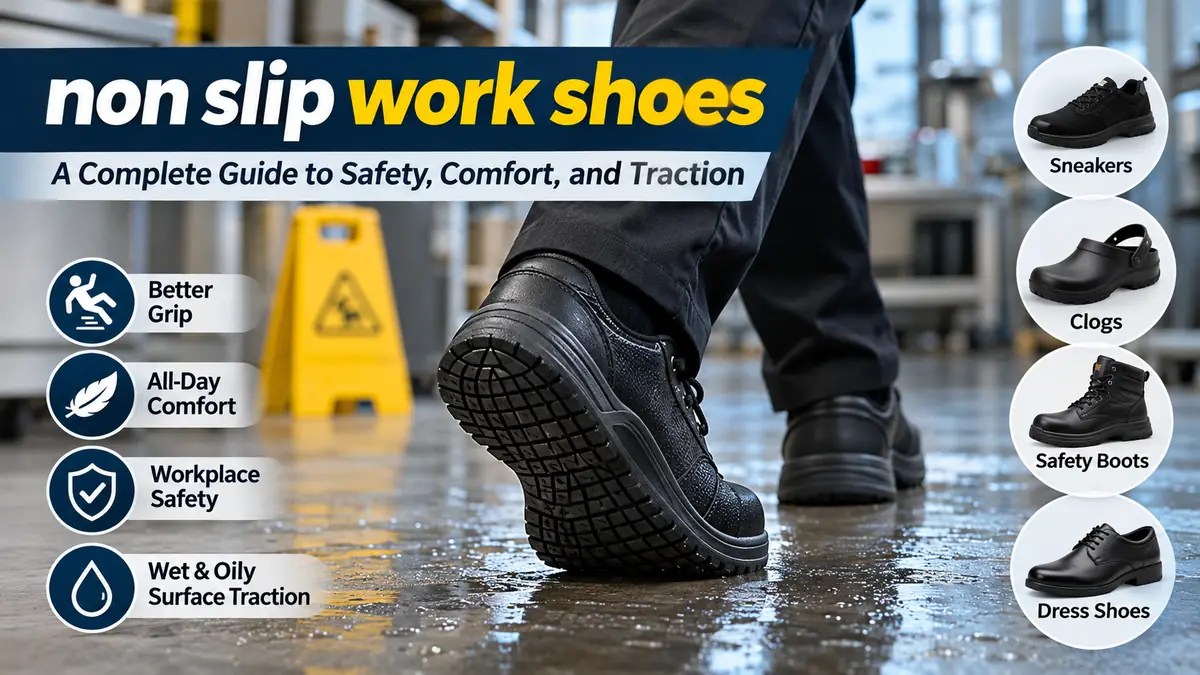
A wet restaurant floor, a freshly cleaned hospital corridor, or a greasy workshop surface can turn an ordinary step into a serious workplace hazard. Your footwear plays a major role in how safely you move through these environments.
non slip work shoes are specially designed footwear with outsoles that improve traction on potentially slippery surfaces, including wet tile, polished concrete, and some oil-contaminated floors. They use rubber compounds, tread patterns, and drainage channels to reduce slipping risks. However, no shoe is completely slip-proof, and performance depends on the surface, contaminants, and shoe condition.
For restaurant employees, nurses, warehouse workers, cleaners, and hospitality professionals, understanding slip-resistant footwear can help prevent accidents while improving comfort during long shifts.
What Are non slip work shoes?
Non-slip work shoes, also called slip-resistant work shoes, are designed to provide better grip than ordinary footwear in specified workplace conditions.
Their primary purpose is to reduce the likelihood of losing traction when walking, turning, stopping, or changing direction.
Unlike regular sneakers, which are typically designed for everyday walking or athletic activities, workplace slip-resistant shoes emphasize controlled traction on surfaces such as ceramic tile, vinyl flooring, and smooth concrete.
How slip-resistant footwear works
Three components largely determine how effectively a shoe grips the floor.
1. Outsole material
Many slip-resistant shoes use specialized rubber compounds that provide friction against smooth surfaces. Rubber flexibility, hardness, and material composition influence performance.
2. Tread pattern
The outsole contains grooves, channels, and contact surfaces designed to manage water or other contaminants between the shoe and floor.
3. Surface contact
The outsole must maintain effective contact with the walking surface. The shoe’s design, tread condition, and the amount of liquid or grease present all affect traction.
A shoe that performs well on a wet hospital corridor may behave differently on a greasy restaurant floor or an icy outdoor walkway.
That distinction matters because slip resistance is not a universal property that works equally well everywhere.
How to Identify Genuine non slip work shoes
The words non-slip and slip-resistant often appear on footwear packaging, but not every claim provides the same level of evidence.
A more reliable approach is to examine the manufacturer’s specifications, the testing method, and the conditions for which the shoe was designed.
Understanding slip-resistance testing standards
Several technical standards are associated with workplace footwear.
| Standard | What it covers | Why it matters |
|---|---|---|
| ASTM F2913 | Whole-shoe slip-resistance testing | Measures traction under defined laboratory conditions |
| ASTM F3445 | Slip-resistance performance requirements | Establishes minimum performance criteria |
| ASTM F2413 | Protective footwear requirements | Addresses hazards such as impact and compression |
| SATRA TM144 | Footwear slip-resistance testing | Provides another method for evaluating traction |
| EN ISO 20345 | Safety footwear requirements | Applies to protective footwear, including relevant slip-resistance requirements |
ASTM F2913 is a test method, while ASTM F3445 specifies performance requirements. A shoe described as tested under F2913 is not automatically certified as meeting F3445. Antpedia+1
When evaluating a shoe, look for the specific standard, edition, test conditions, and applicable performance designation rather than relying only on advertising language.
What do SR and SRO mean?
Some modern work footwear uses traction designations such as SR and SRO.
In certain U.S. work-footwear product lines, manufacturers use:
- SR: Traction intended for wet and dry surfaces.
- SRO: Traction intended for wet, dry, and oily surfaces.
For example, Skechers distinguishes its wet-and-dry SR footwear from selected SRO styles intended for additional oily-floor conditions. Safety Toe, Slip-Resistant & More
These labels should be interpreted according to the specific manufacturer’s documentation and the applicable standard. They are not interchangeable with every international slip-resistance classification.
Can you tell if shoes are non-slip by looking at the soles?
You can identify possible traction features by inspecting the outsole, but appearance alone cannot prove slip resistance.
Look for:
- Rubber rather than smooth, hard plastic contact surfaces.
- Defined tread channels that can help move liquids.
- Flexible outsole materials.
- Manufacturer markings indicating workplace slip resistance.
- Published test results or recognized performance classifications.
A deep tread pattern does not necessarily mean better grip on polished indoor floors. The rubber compound and testing conditions are equally important.
Types of Slip-Resistant Work Shoes
Different jobs create different footwear requirements. Understanding the major types makes it easier to identify suitable features.
Slip-resistant sneakers
Condor II Unisex Black | Free Delivery | Shoes for Crews – Shoes For Crews Europe
Endurance II | Gratis Versand | Shoes for Crews – Shoes For Crews Europe
Baskets antidérapantes Shoes for Crews Condor homme – P_BB166 – Nisbets
10
Slip-resistant sneakers resemble ordinary athletic shoes but use outsoles designed for workplace traction.
They are commonly used in retail, hospitality, food service, and healthcare environments.
Typical features include cushioned midsoles, breathable uppers, lace-up closures, and flexible construction.
Their athletic styling makes them suitable for jobs involving frequent walking, although some lightweight mesh designs may offer limited protection against liquid spills.
Slip-resistant work clogs
SR Max Manteo – Women’s Black Soft Toe WP Slip Resistant EVA Clog Work Shoe | eBay
Work clogs are especially common in commercial kitchens and healthcare facilities.
Many feature enclosed toes, wipe-clean surfaces, and simple slip-on construction.
Some professional clogs also include heel straps, contoured footbeds, and removable insoles.
Their main advantages are easy cleaning and convenience. However, fit and heel retention vary considerably between designs.
Slip-resistant safety shoes and boots
Men’s Kodiak Berg 6″ Waterproof Composite Toe Safety Work Boot | Kodiak® Boots CA
Industrial footwear may combine slip-resistant outsoles with additional protective features.
Depending on the job, these can include steel toes, composite toes, puncture-resistant components, and electrical-hazard protection.
Slip resistance does not automatically mean a shoe has a safety toe.
For example, a warehouse employee exposed to falling objects may need ASTM F2413-rated protective footwear in addition to appropriate traction.
Slip-resistant dress shoes
Some hospitality, security, and customer-facing jobs require professional-looking footwear.
Slip-resistant dress shoes combine formal styling with workplace-oriented outsoles.
Common designs include leather-look Oxfords, loafers, and low-profile lace-up shoes.
The appearance may be similar to ordinary dress footwear, but the outsole should be specifically rated or described for the relevant work conditions.
Choosing non slip work shoes for Different Jobs
The most useful footwear features depend on where you work and what hazards you encounter.
| Workplace | Common hazards | Important footwear features |
|---|---|---|
| Restaurants and kitchens | Grease, water, food spills | Oily-floor traction, easy-clean uppers |
| Hospitals and clinics | Wet corridors, liquid spills | Slip resistance, secure fit, cleanability |
| Warehouses | Concrete floors, moving equipment | Traction, cushioning, required toe protection |
| Hotels and housekeeping | Wet tile, cleaning solutions | Flexible soles, water-resistant uppers |
| Retail stores | Hard floors, extended walking | Cushioning, lightweight construction |
| Manufacturing facilities | Oil, machinery, dropped objects | Job-specific traction and protective ratings |
| Outdoor maintenance | Rain, mud, uneven surfaces | Suitable tread, weather protection, stability |
Restaurant and kitchen workers
Restaurant kitchens are particularly demanding because the floor may contain water, grease, soap, or food residue.
Footwear intended for these environments should have traction suited to oily or greasy surfaces, not merely dry-floor grip.
Closed-toe construction and wipe-clean uppers are also useful where spills are frequent.
For example, professional kitchen footwear from Shoes For Crews, KEEN, Crocs, and Skechers includes designs developed around these workplace needs.
However, specifications vary between models, so brand reputation alone is not enough.
Nurses and healthcare professionals
Healthcare employees often spend long shifts walking between rooms, standing beside patients, and moving across smooth corridors.
Their footwear needs to balance grip, cushioning, stability, and cleaning requirements.
A fluid-resistant upper may be preferable to highly breathable mesh in areas where liquid exposure is a concern.
The HOKA Bondi SR, for example, is known for its substantial cushioning and water-resistant leather upper, although its relatively bulky construction and limited breathability may not suit everyone. RunRepeat
Healthcare facilities may also impose specific rules about enclosed heels, materials, and infection control.
Warehouse and factory employees
Warehouse work often involves concrete flooring, frequent walking, and contact with industrial equipment.
Cushioning can help improve comfort, but protection against physical hazards may be equally important.
Workers should check whether their employer requires:
- Impact- and compression-resistant safety toes.
- Puncture-resistant footwear.
- Electrical-hazard or electrostatic-dissipative protection.
- Additional ankle support.
- Specific slip-resistance performance.
The employer’s workplace hazard assessment should determine the required protective features. Occupational Safety and Health Administration
Cleaning and housekeeping staff
Housekeeping employees regularly encounter wet tile, cleaning products, and changing floor conditions.
Shoes should be easy to clean, secure around the heel, and suitable for the surfaces encountered.
Water-resistant materials can help prevent moisture from reaching the foot, although water resistance and slip resistance are separate properties.
A waterproof shoe can still slip on a wet floor if its outsole does not provide adequate traction.
Features That Make Slip-Resistant Shoes Comfortable
Traction is essential, but comfort becomes equally noticeable when a shift lasts eight, ten, or twelve hours.
The right shoe should support natural movement without causing excessive pressure, rubbing, or instability.
Cushioning and shock absorption
Cushioned midsoles help reduce the harsh sensation of repeated steps on concrete, tile, and other hard surfaces.
Common cushioning materials include EVA foam, polyurethane, and proprietary foam compounds.
Softer cushioning is not automatically better. An excessively soft shoe may feel unstable, particularly when carrying equipment or making quick turns.
A balanced midsole should provide sufficient shock absorption while maintaining a secure platform.
Arch support and foot stability
Arch support can influence comfort, particularly for workers who spend much of the day standing.
People with flat feet, high arches, or overpronation may prefer different support characteristics.
Structured footbeds, supportive heel counters, and removable insoles can help accommodate individual needs.
However, a particular arch shape or insole cannot guarantee relief from foot pain. Persistent discomfort should be assessed by a qualified healthcare professional.
Breathability and moisture protection
Breathable mesh uppers can improve airflow, making them useful in warm indoor environments.
Leather, synthetic leather, and water-resistant materials are generally easier to wipe clean and may provide better protection against splashes.
The trade-off is that more protective uppers can retain heat.
Workers should prioritize the type of exposure they encounter most often rather than assuming that the most breathable shoe is always the most comfortable.
Proper fit and toe room
A shoe should hold the heel securely without squeezing the toes.
When trying on work footwear, check that:
- Your toes have room to move without pressing against the front.
- The heel does not lift excessively while walking.
- The shoe does not pinch the widest part of your foot.
- The laces or closure keep the foot secure.
- The shoe remains comfortable when turning and changing direction.
Try footwear with the socks you normally wear at work. Feet can swell during extended periods of standing, so fit should be assessed with that possibility in mind.
Popular Slip-Resistant Work Shoe Designs Explained
Several established footwear manufacturers offer workplace-specific designs. Their features provide useful examples of how traction, cushioning, and protection can differ.
The following models illustrate different design approaches rather than representing a laboratory-tested ranking.
| Shoe model | Notable characteristics | Common use |
|---|---|---|
| Shoes For Crews Everlight | Lightweight sneaker construction, workplace traction outsole | Restaurants and hospitality |
| HOKA Bondi SR | Thick cushioning, water-resistant leather upper | Healthcare and long indoor shifts |
| Skechers Work Arch Fit 2.0 Slip Resistant | Removable supportive insole, workplace traction | Retail and service jobs |
| Crocs Bistro | Enclosed clog design, easy-clean construction | Commercial kitchens |
| Dansko XP 2.0 | Professional clog, structured support | Healthcare and food service |
| Brooks Addiction Walker 2 | Supportive walking-shoe construction | Extended walking and standing |
| KEEN PTC Oxford | Work-oriented upper and slip-resistant outsole | Kitchens and hospitality |
These designs appear in recent workplace footwear comparisons, although their documented test standards and protective features differ. Best Walking Feet+1
Athletic-style work shoes
Models such as the Shoes For Crews Everlight and Skechers Work collections illustrate the athletic work-shoe category.
These designs emphasize flexibility, relatively familiar sneaker styling, and workplace traction.
They may suit employees who frequently move between workstations or spend much of the day walking.
Maximum-cushion work shoes
The HOKA Bondi SR illustrates a different approach, with substantial cushioning and a work-oriented outsole.
This construction may appeal to people who spend long periods on hard flooring.
However, thicker soles can feel bulky, and the shoe’s fit and stability should be evaluated individually.
Professional work clogs
Crocs Bistro and Dansko XP 2.0 demonstrate two approaches to work clogs.
The Bistro emphasizes easy-clean construction, while the XP 2.0 uses a more structured professional-clog design.
Neither style should be assumed suitable for every workplace. Heel security, surface conditions, cleaning requirements, and employer policies remain important.
How to Choose the Right Slip-Resistant Work Shoes
Selecting footwear becomes easier when the decision starts with workplace conditions rather than appearance.
Step 1: Identify your floor surfaces
Determine whether you primarily walk on ceramic tile, polished concrete, vinyl, industrial flooring, or outdoor surfaces.
Then consider what makes those floors slippery.
Water, grease, cleaning solutions, dust, and ice create different traction challenges.
Step 2: Check workplace footwear requirements
Some employers require black shoes, enclosed heels, leather uppers, or specific protective ratings.
Industrial jobs may also require safety toes or electrical protection.
Review these requirements before evaluating comfort or style.
Step 3: Verify the traction claim
Look for a clear manufacturer statement describing the surfaces and contaminants for which the outsole is intended.
Where possible, identify the testing standard and performance classification.
A vague claim such as excellent grip provides less useful information than a documented slip-resistance specification.
Step 4: Evaluate fit and support
Try the shoes on and walk on a safe, dry surface.
Pay attention to heel movement, toe pressure, arch comfort, and stability while turning.
Do not assume a shoe will become comfortable after a lengthy break-in period if it already causes significant pressure or pain.
Step 5: Consider maintenance requirements
A kitchen worker may benefit from a smooth, wipe-clean upper, while a retail employee may prefer a more breathable design.
Also consider whether the outsole grooves are easy to clean.
A shoe with excellent initial traction can lose effectiveness when grease, food debris, or dirt accumulates in its tread.
Step 6: Compare long-term durability
Look at outsole wear resistance, upper construction, stitching, and whether the insole can be replaced.
Footwear used daily on abrasive concrete may wear differently from footwear used on smooth indoor tile.
Durability should be evaluated alongside traction, not treated as a substitute for it.
Non-Slip vs. Slip-Resistant vs. Regular Shoes
These terms are often confused, but their practical meanings differ.
| Feature | Non-slip shoes | Slip-resistant shoes | Regular shoes |
|---|---|---|---|
| Common terminology | Marketing description | More technically precise description | General footwear |
| Workplace traction | Intended to improve grip | Intended to improve grip | Depends on design |
| Specialized outsole | Usually | Usually | Not necessarily |
| Published slip testing | Varies by model | Varies by model | Often unavailable |
| Guaranteed prevention of slips | No | No | No |
| Suitable for greasy floors | Only if specifically designed for them | Only if specifically designed for them | Not assumed |
In everyday use, non-slip and slip-resistant usually describe the same general footwear category.
Neither term means that slipping is impossible.
Are running shoes considered non-slip?
Not necessarily.
Running shoes are primarily designed for athletic movement and traction on the surfaces associated with their intended use.
A road-running shoe may perform well on dry pavement but lack the specialized outsole needed for greasy kitchen tile.
Likewise, a trail-running shoe may have deep lugs suited to loose ground without providing appropriate traction on smooth, wet indoor floors.
For workplace use, rely on the manufacturer’s specific slip-resistance information rather than the shoe’s athletic category.
Are waterproof shoes also slip-resistant?
Waterproofing describes how effectively the upper and construction prevent water from entering the shoe.
Slip resistance describes traction between the outsole and walking surface.
These properties are independent.
A waterproof boot can have poor traction on smooth tile, while a breathable slip-resistant sneaker may provide excellent workplace grip without being waterproof.
How to Clean and Maintain non slip work shoes
Even a well-designed outsole can become less effective when its tread is clogged or worn.
Regular maintenance helps preserve traction and allows damage to be identified before it creates a problem.
Daily cleaning
After each shift:
- Inspect the outsole for grease, food residue, mud, and debris.
- Remove loose material with a soft brush.
- Clean the outsole using a mild cleaner appropriate for the material.
- Rinse or wipe away cleaning residue according to the manufacturer’s instructions.
- Allow the shoes to dry completely before the next shift.
Avoid using harsh chemicals unless the manufacturer confirms that they are suitable.
Some cleaning agents can damage rubber compounds, adhesives, or upper materials.
Cleaning different upper materials
Leather and synthetic leather: Wipe with a damp cloth and use appropriate cleaning products.
Mesh: Gently brush away dirt and spot-clean according to the care instructions.
Molded clogs: Clean using the manufacturer’s approved method and avoid excessive heat that could deform the material.
Water-resistant footwear: Follow the manufacturer’s care instructions to preserve protective treatments and construction.
Not every work shoe is machine washable. Check the product’s instructions before placing it in a washing machine.
When should slip-resistant shoes be replaced?
There is no universal replacement schedule because footwear wear depends on frequency of use, walking surfaces, body weight, gait, and maintenance.
Replace or professionally assess footwear when you notice:
- Smooth or severely worn outsole areas.
- Loss of traction on familiar surfaces.
- Cracked or hardened rubber.
- Outsole separation.
- Uneven wear that affects stability.
- Damaged heel support or structural components.
USDA workplace training guidance identifies substantial tread wear and declining traction as warning signs that slip-resistant footwear may need replacement. fsistraining.fsis.usda.gov
Do not wait for the sole to become completely smooth.
Common Mistakes That Reduce Workplace Footwear Safety
Even suitable shoes cannot compensate for unsafe workplace conditions.
Assuming every rubber sole is slip-resistant
Rubber is commonly used in traction-focused footwear, but its performance depends on compound, tread design, floor material, and contamination.
A rubber sole without documented workplace traction performance should not automatically be treated as slip-resistant.
Choosing cushioning without considering stability
Very soft cushioning may feel comfortable initially but can be unsuitable for workers who need a firm, stable platform.
Evaluate the entire shoe, including heel security and lateral stability.
Ignoring contaminated tread
Grease and dirt can accumulate in outsole channels, reducing effective contact with the floor.
Routine cleaning is especially important in kitchens and food-processing environments.
Wearing shoes with poor heel retention
Loose shoes can affect balance and movement.
Choose a secure closure and heel design appropriate for the tasks being performed.
Treating slip-resistant shoes as complete protection
Slip-resistant footwear is one part of workplace safety.
OSHA recommends controlling wet-floor hazards through prompt spill cleanup, proper housekeeping, and safe walking surfaces. Occupational Safety and Health Administration
Even highly rated shoes cannot eliminate the danger of an uncontrolled spill.
Workplace Safety Practices Beyond Footwear
Reducing slips and falls requires attention to both equipment and the working environment.
Keep walking surfaces clean and dry
Spills should be reported and cleaned promptly.
Wet cleaning should be organized so employees are not unnecessarily exposed to slippery surfaces.
The UK Health and Safety Executive recommends suitable cleaning methods, prompt spill removal, appropriate flooring, and footwear matched to workplace conditions. HSE
Use appropriate floor mats
Properly maintained mats can help control moisture and provide additional traction in selected areas.
However, loose, curled, or poorly positioned mats may create tripping hazards.
Mats must also be suitable for the contaminants present. A design that works around water may not be appropriate for grease.
Adjust walking behavior
When a surface may be slippery, use shorter, controlled steps and avoid sudden changes of direction.
Keep your view of the walking area unobstructed and use handrails where provided.
Report repeated slip hazards
A location where workers regularly lose traction may indicate a problem with floor condition, drainage, cleaning methods, or maintenance.
Report these hazards so they can be assessed and corrected rather than relying entirely on footwear.
Final Thoughts on non slip work shoes
The right non slip work shoes combine traction suited to the workplace, secure fit, appropriate cushioning, and any additional protection required by the job.
Restaurant workers may need footwear designed for oily floors, while healthcare employees may prioritize cleanability and comfort. Warehouse and industrial workers may need slip resistance alongside certified safety-toe or other protective features.
The most reliable approach is to identify your workplace hazards, verify the manufacturer’s traction specifications, and evaluate fit before relying on a shoe for daily use.
Maintain the outsoles, monitor wear, and continue following workplace safety procedures. Slip-resistant footwear can reduce risk, but safe floors and good working practices remain essential.