
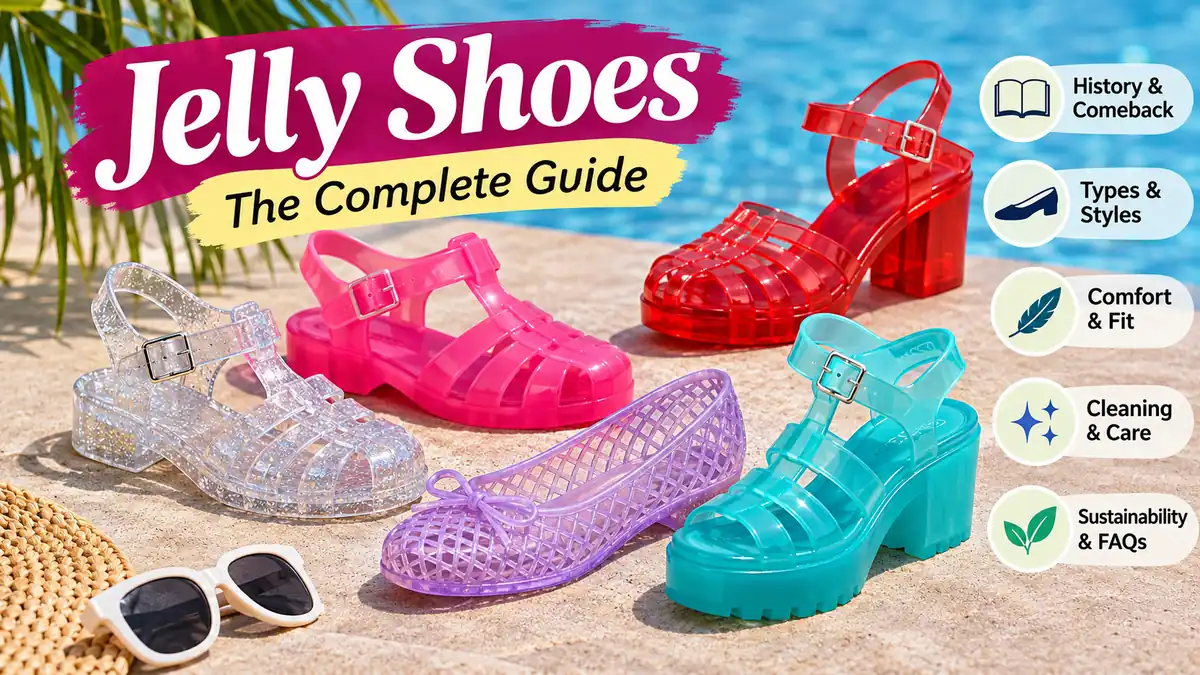
Few shoes capture the playful spirit of summer quite like jelly shoes. With their glossy finishes, bright colors, and flexible construction, these nostalgic sandals have returned to everyday fashion in styles that look surprisingly different from the versions many people remember from childhood.
Once associated mainly with beach holidays and children’s footwear, jelly shoes now appear as ballet flats, fisherman sandals, platforms, and even heels. Their appeal goes beyond nostalgia, although their distinctive plastic construction also creates practical limitations.
Jelly shoes are lightweight, flexible footwear typically made from polyvinyl chloride (PVC) or similar synthetic materials. Known for their translucent appearance, colorful designs, and water-resistant construction, they became especially popular during the 1980s. Modern versions include casual sandals, ballet flats, and fashion-forward heels, but comfort depends heavily on fit, ventilation, and sole support.
What Are jelly shoes?
Jelly shoes, often called jellies, are footwear made primarily from molded plastic. Their name refers to the soft, glossy, sometimes transparent appearance of the material, which resembles colorful jelly.
Traditional versions feature woven or cage-like straps, rounded toes, and a buckle fastening. Many modern designs retain these characteristics while introducing more streamlined shapes.
Unlike leather or fabric footwear, classic jelly sandals are commonly formed using injection molding. This manufacturing process allows liquid or softened plastic material to take the shape of a shoe mold before cooling and solidifying.
The resulting footwear can be flexible, easy to rinse, and resistant to water damage.
What Makes Jelly Shoes Different?
Several characteristics distinguish jellies from conventional sandals:
- Glossy appearance: Transparent, translucent, and opaque finishes create their recognizable look.
- Flexible construction: Molded plastic bends with the foot, although flexibility varies by design.
- Water resistance: Plastic uppers generally tolerate splashes and rain.
- Color variety: Designs range from clear and pastel shades to neon colors and glitter finishes.
- Easy cleaning: Many styles can be washed with mild soap and water.
- Distinctive texture: Plastic feels different against the skin from leather, canvas, or knitted materials.
These features make jelly footwear recognizable even when the silhouette resembles a traditional ballet flat or sandal.
The History of jelly shoes
Although jelly shoes are closely associated with 1980s fashion, their history extends further back.
Plastic footwear developed during the twentieth century as manufacturers experimented with inexpensive, versatile alternatives to leather.
Some accounts connect early plastic sandals to post-World War II material shortages. Others trace their development to the expanding use of synthetic materials during the 1950s and 1960s.
There is no universally agreed-upon single inventor of modern jelly shoes.
How Jelly Shoes Became Popular in the 1980s
The 1980s transformed plastic sandals into a mainstream fashion phenomenon.
According to the ASU FIDM Museum, businessman Preston Haag encountered Brazilian plastic footwear in 1981 and subsequently helped introduce designs associated with Brazilian manufacturer Grendene to American consumers.
The shoes appeared at the 1982 World’s Fair in Knoxville, Tennessee, and attracted attention from department-store buyers.
Fashion designers including Thierry Mugler and Jean-Paul Gaultier also worked with plastic footwear, helping establish jellies as more than inexpensive beach accessories. ASU FIDM Museum+1
Their popularity reflected broader fashion preferences of the decade: vivid colors, synthetic materials, experimental shapes, and playful accessories.
The 1990s and Early 2000s
During the 1990s, jelly sandals remained familiar children’s footwear.
Transparent glitter designs, pastel colors, and buckle-fastened styles became particularly recognizable.
Although their mainstream popularity fluctuated, the shoes never disappeared completely. Periodic revivals brought them back into fashion through retro collections, designer collaborations, and seasonal footwear trends.
The Modern Jelly Shoe Revival
The latest revival has moved jelly footwear beyond its traditional beachwear identity.
The Row helped renew interest in sophisticated jelly ballet flats, while brands such as Ancient Greek Sandals, Melissa, Chloé, and other designers explored different interpretations.
Fashion coverage throughout 2024, 2025, and 2026 highlighted jelly flats, fisherman sandals, and heeled designs as part of the broader return of nostalgic footwear. Vogue+2
Today’s versions often combine familiar transparent materials with minimalist shapes, making them easier to incorporate into contemporary wardrobes.
Different Types of jelly shoes
Not all jelly footwear looks or functions the same way. Understanding the main styles helps explain why some pairs suit beach outings while others work better for casual city wear.
Classic Jelly Sandals
Melissa The Real Jelly Possession
Fisherman Jelly Sandals For Women | J.Crew
MELISSA POSSESSION SHINY – GLITTER CLEAR SILVER – melissashoesnordics
11
Classic jelly sandals have interwoven plastic straps, an enclosed or partially enclosed toe, and a fastening around the ankle.
Their open spaces allow water to drain and provide some ventilation.
These designs are closely associated with childhood summer holidays and seaside activities.
However, the straps can rub against bare skin, especially when sand becomes trapped between the shoe and foot.
Jelly Ballet Flats
NAURU Red Mesh Ballet Flats by KG Kurt Geiger
Jelly ballet flats resemble traditional ballerina shoes but use molded plastic or flexible synthetic uppers.
Some have mesh-like patterns, while others feature smooth, rounded silhouettes.
Their popularity increased as fashion designers reinterpreted nostalgic footwear for everyday outfits.
Unlike traditional cage sandals, certain jelly flats cover more of the foot, which can reduce ventilation.
Fisherman Jelly Sandals
Fisherman-style jellies feature interlocking straps that create a structured upper.
They generally offer more toe coverage than open sandals while maintaining visible gaps between the straps.
This design balances a traditional sandal shape with the playful appearance of plastic footwear.
Fisherman sandals are commonly paired with casual summer clothing, including shorts, linen trousers, and relaxed dresses.
Platform Jelly Shoes
Platform jellies feature elevated soles that add height.
They may have thick, molded bases or layered constructions.
Although a platform can create a distinctive appearance, it does not automatically provide better cushioning or arch support.
A rigid or heavy platform may also change how naturally the foot moves while walking.
Jelly Heels
Jelly heels combine transparent or colorful synthetic materials with elevated heel designs.
They represent a more fashion-focused interpretation of traditional jellies.
Chloé and Jimmy Choo are among the labels associated with contemporary jelly-heel designs, reflecting the style’s expansion beyond casual beachwear. British Vogue
As with other heels, stability depends on heel height, sole construction, fit, and the walking surface.
Glitter and Transparent Jelly Shoes
Glitter jellies are among the most recognizable versions.
Some incorporate glitter particles directly into the plastic, while others use pearlescent or translucent finishes.
Clear jelly shoes have a particularly distinctive appearance because the foot remains visible through the upper.
However, transparent materials can reveal moisture and condensation more readily than opaque footwear.
What Are jelly shoes Made Of?
The most common material associated with jelly footwear is polyvinyl chloride, usually abbreviated as PVC.
PVC is a synthetic polymer that can be formulated to produce rigid or flexible products.
For footwear, manufacturers use flexible formulations that can be molded into straps, uppers, and sometimes soles.
Other synthetic materials, including thermoplastic elastomers and certain rubber-like compounds, may be used in shoes marketed as jelly-style footwear.
The exact composition varies by manufacturer.
PVC and Flexible Plastic Construction
PVC offers several practical characteristics:
- Resistance to water absorption
- Ability to retain molded shapes
- Compatibility with transparent and colorful finishes
- Relatively straightforward surface cleaning
- Flexibility when formulated with suitable additives
However, PVC is not naturally breathable in the same way as mesh or certain textile materials.
The material itself generally does not allow moisture vapor to pass through easily.
Ventilation therefore depends largely on openings in the shoe’s design.
Are Jelly Shoes Made of Rubber?
Not necessarily.
Although jelly shoes may feel rubbery, traditional versions are generally made from flexible PVC rather than natural rubber.
Some manufacturers use alternative polymers that produce similar flexibility.
Material descriptions should be checked rather than assuming every glossy plastic sandal has the same composition.
Are PVC Jelly Shoes Safe?
A finished PVC shoe is not automatically unsafe simply because it contains PVC.
However, material quality, manufacturing processes, additives, and product testing matter.
Some flexible PVC formulations use plasticizers, and certain additives have raised health or environmental concerns.
Products intended for children may be subject to specific chemical restrictions depending on the country.
For greater confidence, look for clear material disclosures and evidence that the product complies with applicable consumer-product requirements.
Are jelly shoes Comfortable?
Comfort is one of the most frequently debated aspects of jelly footwear.
Some wearers appreciate the lightweight feel and flexible construction. Others experience rubbing, sweaty feet, or discomfort during extended walking.
The difference often comes down to design, sizing, and individual foot shape.
Why Jelly Shoes Can Cause Blisters
Plastic straps may create friction where they contact the skin.
Common pressure points include:
- The back of the heel
- The sides of the toes
- The top of the foot
- The ankle strap
- The edges of the toe box
Moisture can make friction problems worse.
When feet become sweaty, repeated rubbing against a plastic surface may irritate the skin and contribute to blisters.
A shoe that fits too tightly can increase pressure, while one that is too loose may slide excessively.
Do Jelly Shoes Make Your Feet Sweat?
They can.
PVC does not absorb perspiration like some natural materials, and closed jelly flats may trap heat and moisture.
Open cage sandals typically provide better airflow than fully enclosed designs.
Still, even ventilated styles can become uncomfortable during prolonged activity in hot weather.
Allowing feet and footwear to dry between uses can help reduce moisture-related discomfort.
Do Jelly Shoes Have Arch Support?
Many classic jelly sandals have relatively flat footbeds and minimal structural support.
Some modern designs include contoured insoles, cushioning, or supportive soles, but these features are not universal.
People who need substantial arch support may find traditional flat jellies unsuitable for extended walking.
Footwear should be evaluated based on its actual construction rather than its appearance.
How to Make Jelly Shoes More Comfortable
A few practical adjustments can improve the wearing experience:
- Choose a pair that fits without squeezing the toes or heel.
- Wear new shoes for short periods before using them for longer outings.
- Check for rough seams, sharp edges, or stiff straps.
- Keep feet clean and dry.
- Consider suitable thin socks if the design allows.
- Stop wearing the shoes if persistent rubbing or pain develops.
Blister-prevention patches may protect specific friction points, but they cannot correct fundamentally poor sizing.
Quick takeaway: Jelly shoes can be comfortable for short, casual outings, but soft plastic alone does not guarantee adequate cushioning, ventilation, or support.
How to Choose the Right Jelly Shoe Size
Correct sizing is especially important because molded plastic generally behaves differently from leather.
Leather shoes may gradually soften and conform to the foot. PVC can flex, but it typically does not stretch permanently to the same degree.
Buying a tight pair in the hope that it will substantially expand is therefore unreliable.
How Should Jelly Shoes Fit?
A well-fitting pair should:
- Allow toes to rest naturally without being compressed
- Hold the heel securely
- Avoid excessive pressure from straps
- Provide enough room for normal foot movement
- Remain stable while walking
The foot should not spill over the sole or slide forward with every step.
For enclosed jelly flats, the toe box should accommodate the natural width of the forefoot.
Should You Size Up or Down?
There is no universal sizing rule for jelly shoes.
Some designs run narrow, while others have generous rounded toe boxes.
The most reliable approach is to compare your foot measurements with the manufacturer’s size chart.
If your measurements fall between sizes, consider the shoe’s width, fastening system, and available adjustment.
A larger size is not always better because excessive movement can cause friction.
Jelly Shoes for Wide Feet
People with wider feet may prefer designs with broader toe boxes and adjustable straps.
A wide-looking shoe is not necessarily wide internally.
Check the shape of the footbed and how the upper fits across the forefoot.
Avoid styles that press firmly against the sides of the toes.
How to Style jelly shoes for Everyday Outfits
One reason jelly footwear keeps returning to fashion is its versatility.
The same glossy material can look playful, minimalist, nostalgic, or experimental depending on the shoe’s shape and surrounding clothing.
Jelly Shoes With Jeans
501® Original Jeans – Levi’s Jeans, Jackets & Clothing
Jelly ballet flats work particularly well with straight-leg or cropped jeans.
The contrast between structured denim and glossy plastic creates a balanced casual look.
Neutral-colored jellies can keep an outfit understated, while bright red or turquoise designs create a focal point.
Jelly Shoes With Summer Dresses
Lightweight dresses pair naturally with jelly sandals.
A simple cotton or linen dress can complement the relaxed character of traditional cage-style jellies.
Pastel or transparent designs create a softer appearance, while bold colors introduce contrast.
Jelly Shoes With Shorts
Classic jelly sandals suit relaxed summer outfits featuring denim shorts, cotton shorts, or lightweight separates.
Their casual construction makes them especially appropriate for informal daytime settings.
For hot weather, open styles may provide more airflow than enclosed jelly flats.
Can You Wear Socks With Jelly Shoes?
Yes.
Socks can create a deliberate retro look while reducing direct contact between plastic and skin.
Thin cotton-blend or moisture-managing socks may help with friction, although thick socks can make a fitted shoe too tight.
The combination is particularly common with ballet-style jellies and fisherman sandals.
Choosing Jelly Shoe Colors
Different colors create different effects.
| Color | Visual effect | Outfit pairing |
|---|---|---|
| Clear | Minimal and playful | Denim, neutral separates |
| Black | Understated and versatile | Monochrome outfits |
| Red | Bold and nostalgic | Jeans, white dresses |
| Pink | Soft and playful | Pastels, summer dresses |
| Silver or glitter | Decorative | Simple evening-casual outfits |
| Brown | Subtle and contemporary | Linen, beige, earth tones |
| Turquoise | Bright and summery | White, navy, light denim |
Modern styling often favors simpler silhouettes and restrained colors, although bright glitter jellies remain a recognizable part of the category.
Can You Wear jelly shoes in Water?
Jelly shoes are commonly associated with beaches, pools, and wet environments because their plastic construction generally tolerates water.
However, water resistance and water safety are not the same thing.
A shoe that can get wet is not necessarily suitable for slippery rocks, strong currents, or demanding water activities.
Are Jelly Shoes Waterproof?
The PVC material used in traditional jellies is generally waterproof.
Water does not penetrate the solid plastic in the way it may soak through canvas or untreated fabric.
Nevertheless, most jelly sandals have openings, meaning water can easily enter around the foot.
They should therefore be understood as water-tolerant sandals rather than protective waterproof footwear.
Are Jelly Shoes Good for the Beach?
They can be useful for casual beach activities.
Plastic construction makes sand and saltwater relatively easy to rinse away.
However, sand trapped inside the straps can cause abrasion, particularly during long walks.
For rocky beaches, footwear with a secure fit, suitable tread, and protective sole is more appropriate.
Are Jelly Shoes Slippery?
Slip resistance depends on the outsole’s tread pattern, material, and the surface underfoot.
Some jelly shoes have smooth soles that offer limited traction on wet tiles or polished floors.
Others include textured outsoles designed to improve grip.
No shoe should be assumed slip-resistant simply because it is marketed for summer or water use.
Can You Wear Jelly Shoes in the Rain?
Light rain generally does not damage traditional PVC jelly sandals.
However, feet may become wet through the openings, and wet skin can increase rubbing.
Closed jelly flats may also trap moisture.
For prolonged rainy conditions, footwear with reliable traction and weather protection may be more practical.
jelly shoes vs Other Summer Footwear
Jelly sandals share characteristics with several other warm-weather shoe categories, but they are not interchangeable.
| Feature | Jelly shoes | Rubber sandals | Leather sandals | Mesh flats |
|---|---|---|---|---|
| Typical material | PVC or similar polymers | Rubber or synthetic compounds | Natural or synthetic leather | Textile mesh |
| Water tolerance | Usually high | Usually high | Varies; often lower | Varies |
| Breathability | Depends on openings | Depends on design | Depends on design | Often higher |
| Cleaning | Usually easy to rinse | Usually easy to rinse | May require special care | Depends on fabric |
| Flexibility | Varies | Varies | Varies | Varies |
| Support | Often minimal in classic styles | Design-dependent | Design-dependent | Design-dependent |
| Common appearance | Glossy, translucent, colorful | Matte or textured | Natural or polished | Lightweight, woven |
Jelly Shoes vs Crocs
Crocs are commonly associated with lightweight molded foam footwear, particularly their well-known clogs.
Traditional jelly shoes generally use flexible plastic such as PVC and often have thinner soles.
The two categories differ in their typical materials, silhouettes, and cushioning characteristics.
Neither category guarantees comfort for every wearer.
Jelly Shoes vs Flip-Flops
Flip-flops usually feature an open toe-post design that holds the shoe between the toes.
Jelly sandals often use multiple straps and may provide greater upper-foot coverage.
A secure jelly sandal can stay on the foot more effectively than a loose flip-flop, although the actual fit and construction matter more than the category name.
Jelly Shoes vs Ballet Flats
Traditional ballet flats are commonly made from leather, fabric, or synthetic textiles.
Jelly ballet flats imitate the silhouette using molded plastic or similar materials.
The jelly version may tolerate water better, but a textile ballet flat may offer improved ventilation depending on its construction.
How to Clean jelly shoes Properly
One practical advantage of jelly footwear is that many styles require relatively simple cleaning.
Because PVC does not absorb water readily, surface dirt can often be removed without specialized cleaning products.
Still, harsh chemicals and excessive heat may damage the material.
Step-by-Step Cleaning Instructions
- Remove loose dirt. Shake out sand, dust, and debris.
- Prepare mild soapy water. Mix a small amount of gentle soap with lukewarm water.
- Clean the surface. Use a soft cloth or sponge to wipe the straps, footbed, and sole.
- Reach narrow openings. A soft-bristled brush can help clean woven or cage-style designs.
- Rinse carefully. Remove remaining soap with clean water, following the manufacturer’s care instructions.
- Dry naturally. Allow the shoes to air-dry away from direct heat and intense sunlight.
If the shoes contain glued decorations, fabric linings, or removable insoles, follow any special care guidance provided for those components.
How to Remove Odor From Jelly Shoes
Odor often develops when sweat and moisture remain on the footbed.
Regular washing with mild soap can help remove surface residue.
After cleaning, dry the shoes thoroughly before wearing or storing them.
For shoes with removable insoles, clean and dry the insoles separately when permitted.
Avoid using strong fragrances to cover persistent odors without addressing moisture and hygiene.
How to Clean Clear Jelly Shoes
Transparent shoes can reveal dirt, scuffs, and discoloration more easily than opaque designs.
Use a nonabrasive cloth and gentle soap.
Avoid rough scrubbing pads, acetone, and aggressive solvents, which may cloud or damage the plastic.
Can Jelly Shoes Go in the Washing Machine?
Machine washing is generally not the safest default.
Agitation, heat, and detergents may affect decorative elements, finishes, or adhesives.
Hand cleaning provides more control and is usually sufficient.
Only machine-wash a pair when its manufacturer specifically permits it.
How to Prevent Yellowing and Damage
Transparent and lightly colored plastic footwear may gradually change appearance.
Yellowing can occur through material aging, ultraviolet exposure, oxidation, and changes involving additives.
The ASU FIDM Museum documents historical plastic jelly shoes that have yellowed with age, illustrating how synthetic footwear can change over time. ASU FIDM Museum
Why Do Clear Jelly Shoes Turn Yellow?
Possible contributing factors include prolonged sunlight exposure, heat, chemical reactions, and natural aging of the polymer formulation.
Discoloration is not always surface dirt.
When the plastic itself has changed chemically, ordinary cleaning may not restore its original transparency.
How to Store Jelly Shoes
Store them in a cool, dry place away from direct sunlight.
Avoid leaving them inside extremely hot vehicles or near heaters.
Do not place heavy objects on flexible shoes for extended periods, as this may distort their shape.
Allow shoes to dry completely before storing them in enclosed containers.
Can You Stretch Jelly Shoes?
Jelly shoes may soften slightly with warmth, but attempting to stretch them using boiling water, hair dryers, or direct heat can cause deformation or damage.
Unlike some leather footwear, molded PVC generally offers limited permanent stretching.
If a pair is painfully tight, choosing a better-fitting size or shape is safer than trying to force the material to expand.
Are jelly shoes Environmentally Friendly?
The environmental impact of jelly footwear deserves attention because many traditional designs use PVC.
PVC production involves chemical manufacturing processes, and disposal can create challenges.
The environmental effects depend on material formulation, manufacturing practices, product lifespan, and waste-management systems.
Environmental Concerns With PVC
PVC is a petroleum- and chlorine-based polymer.
Its production and disposal can involve environmental and health concerns, particularly where industrial controls and waste handling are inadequate.
Certain additives also complicate material management.
Vogue’s reporting on the sustainability challenges of jelly shoes highlights the broader environmental issues associated with PVC production and disposal. Vogue
Are Jelly Shoes Recyclable?
PVC is technically recyclable under suitable conditions.
However, that does not mean every pair of jelly shoes can be placed in household recycling.
Footwear may contain mixed materials, pigments, additives, and attached components that complicate processing.
Local recycling facilities may not accept PVC shoes.
Check available footwear collection or specialist recycling programs rather than assuming curbside recycling is appropriate.
Are There More Sustainable Alternatives?
Some manufacturers explore recycled materials, alternative polymers, or designs intended for longer use.
However, an alternative material is not automatically environmentally superior.
Durability, production impacts, repairability, and end-of-life handling all matter.
Keeping an existing pair in use for longer may reduce the need for frequent replacements.
Are jelly shoes Suitable for Children?
Jelly sandals remain popular children’s footwear because of their bright colors, washable surfaces, and playful designs.
However, children’s shoes should be evaluated for more than appearance.
Fit, traction, stability, and materials are particularly important.
Choosing Jelly Shoes for Toddlers
Toddlers benefit from footwear that allows natural toe movement and stays securely on the foot.
Consider the following characteristics:
- A roomy toe box
- A secure fastening
- Flexible but protective soles
- Suitable traction
- Smooth edges and straps
- Appropriate sizing with room for growth
Avoid shoes that repeatedly slip off or cause visible pressure marks.
Are Jelly Shoes Good for School?
Suitability depends on the school’s footwear rules and the activities involved.
For occasional casual wear, well-fitting jelly sandals may be acceptable.
For running, playground activities, and extended daily walking, supportive and securely fastened footwear with appropriate traction is generally preferable.
Can Children Wear Jelly Shoes All Day?
Some children may tolerate them comfortably, but prolonged wear can increase the risk of rubbing and moisture buildup.
Check for redness, blisters, and pressure marks, particularly when a child starts wearing a new pair.
Children may not always explain discomfort clearly, so observing how the shoes fit and how the child walks is helpful.
Common Problems With jelly shoes and How to Fix Them
Most complaints about jelly footwear relate to fit, moisture, or material limitations.
| Problem | Possible cause | Practical solution |
|---|---|---|
| Heel blisters | Friction or loose fit | Check sizing and use suitable friction protection |
| Sweaty feet | Limited ventilation | Choose more open styles and dry feet regularly |
| Tight toe area | Narrow or undersized design | Select a roomier fit |
| Slipping on wet floors | Inadequate outsole traction | Avoid slippery surfaces and choose better-treaded footwear |
| Unpleasant odor | Trapped moisture and residue | Wash gently and dry thoroughly |
| Yellowing | Aging or sunlight exposure | Store away from heat and UV exposure |
| Warped shape | Excessive heat | Avoid heat exposure; replace severely distorted shoes |
| Foot fatigue | Thin or unsupported sole | Limit prolonged walking and use more supportive footwear |
Why Do Jelly Shoes Hurt the Top of Your Feet?
Straps may press against the upper surface of the foot, especially if the shoe is too narrow or the material is stiff.
Swelling during hot weather can make the pressure more noticeable.
A different strap arrangement or adjustable design may solve the problem better than simply increasing the shoe length.
Why Do Jelly Shoes Squeak?
Squeaking may occur when moist skin rubs against plastic or when parts of the shoe flex against each other.
Keeping the footwear clean and dry may reduce the noise.
Persistent squeaking caused by the shoe’s construction may not be easily corrected.
Can Jelly Shoes Cause Foot Problems?
Poorly fitting jelly shoes can contribute to blisters, skin irritation, and discomfort.
Thin soles or inadequate support may also be unsuitable for people with certain foot needs.
These issues are not exclusive to jelly footwear.
Any shoe that causes persistent pain, numbness, or skin injury should be reassessed. If symptoms continue, consult a qualified healthcare professional.
Why Are jelly shoes Popular Again in 2026?
The renewed popularity of jelly footwear reflects several overlapping fashion movements.
Nostalgia is a major influence. Styles associated with the 1980s, 1990s, and early 2000s have repeatedly returned through contemporary fashion.
At the same time, designers have reworked traditional jellies into more sophisticated shapes.
The Row’s jelly ballet flats helped establish a modern luxury interpretation, while other brands explored colorful fisherman sandals, minimalist flats, and sculptural heels.
Fashion coverage in 2026 also highlighted jelly designs from labels including Loewe, Chloé, and Bottega Veneta. The Korea Herald+1
The Influence of Designer Fashion
Designer reinterpretations have changed how jelly footwear is perceived.
Instead of being limited to inexpensive holiday sandals, plastic shoes now appear alongside tailored trousers, structured dresses, and contemporary accessories.
This contrast between a familiar childhood material and more refined clothing contributes to their appeal.
Nostalgia and Modern Styling
The renewed interest in jelly shoes also reflects a wider preference for playful accessories.
Transparent materials, unexpected textures, and bright colors offer visual interest without requiring an entirely new wardrobe.
Jelly footwear fits naturally into this approach because its distinctive material is immediately recognizable.
Are Jelly Shoes Just a Passing Trend?
Their popularity may rise and fall, but jelly shoes have demonstrated unusual staying power.
The category has experienced multiple revivals over several decades.
Classic designs remain recognizable, while newer interpretations help the style adapt to changing preferences.
Whether an individual pair remains fashionable is less important than whether it fits comfortably and suits the wearer’s needs.
When Should You Wear jelly shoes?
Jelly footwear is most practical when its water-resistant material, casual appearance, and easy-clean construction provide a clear benefit.
Suitable occasions may include casual summer gatherings, short outings, poolside relaxation, and certain beach activities.
More structured jelly flats may also complement everyday city outfits.
However, they are not ideal for every situation.
When Jelly Shoes Work Well
They can be useful for:
- Short casual walks
- Relaxed summer events
- Poolside settings away from slippery surfaces
- Beach outings on suitable terrain
- Casual holiday outfits
- Occasional fashion-focused wear
When to Choose Different Footwear
Consider alternatives for long-distance walking, running, hiking, demanding outdoor activities, or environments requiring protective footwear.
If a jelly shoe has a thin sole, limited grip, or poor ventilation, these limitations become more significant during extended use.
For people who require orthopedic support or have sensitive feet, shoe construction and fit should take priority over appearance.
Final Thoughts on jelly shoes
Jelly shoes have evolved from colorful plastic sandals into a varied footwear category that includes classic cage designs, modern ballet flats, fisherman sandals, platforms, and heels.
Their popularity comes from a distinctive combination of nostalgia, playful styling, water resistance, and easy maintenance.
However, they also have limitations. Plastic uppers may trap moisture, stiff straps can cause friction, and traditional flat soles often provide minimal support.
The key to enjoying jelly shoes is understanding their intended use, choosing the correct fit, and caring for the material properly. A comfortable, well-constructed pair can be a practical addition to a casual summer wardrobe, while unsuitable designs are best avoided regardless of how fashionable they appear.