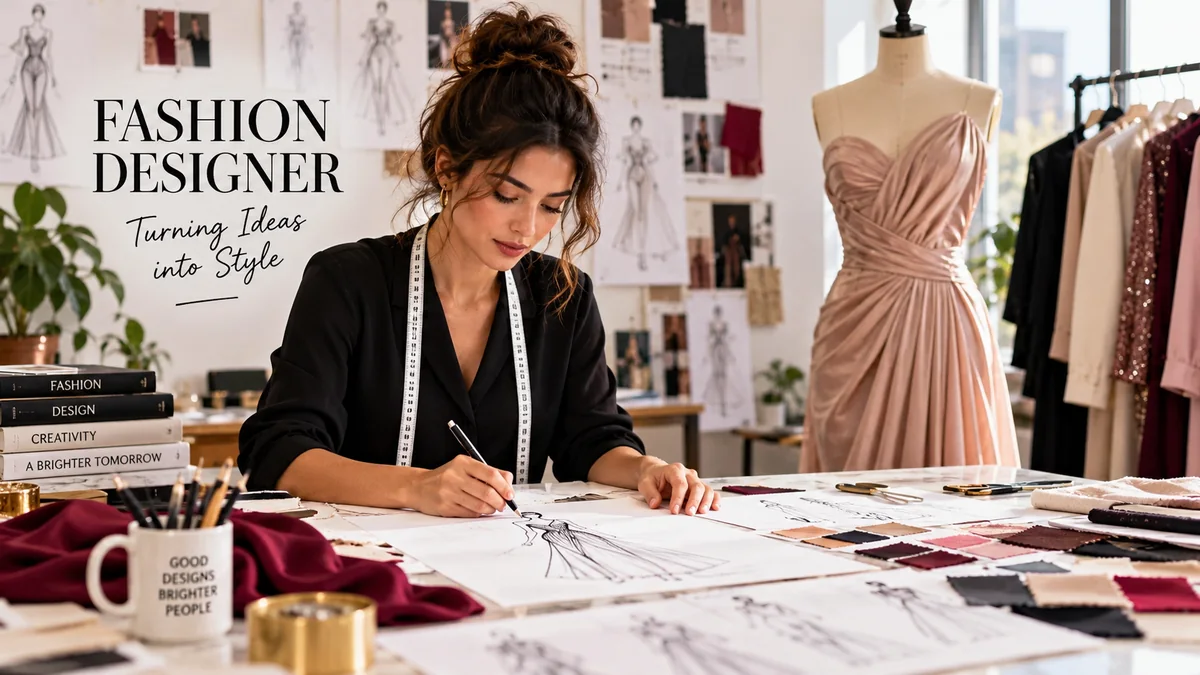
A fashion designer does far more than sketch attractive clothes. The job combines creativity with textile knowledge, garment construction, trend research, computer-aided design, commercial awareness, collaboration, and production planning. Designers must turn an idea into something that can actually be manufactured, worn, priced, marketed, and sold.
A fashion designer is a creative professional who develops clothing, footwear, or accessories from the initial concept through sampling and production. The work typically involves researching trends, sketching ideas, selecting fabrics and colors, creating prototypes, using CAD software, fitting samples, communicating technical specifications, and overseeing how the final product is made.
That combination of imagination and practical problem-solving is what separates professional fashion design from simply drawing clothes.
What Does a fashion designer Do?
The central responsibility of a fashion designer is turning a creative concept into a finished fashion product.
That might mean designing an evening dress for a luxury label, developing an affordable jacket for a mass-market retailer, creating a sneaker collection, planning costumes for a film, or producing handbags for an independent brand.
According to the U.S. Bureau of Labor Statistics, common responsibilities include researching fashion trends, choosing themes for collections, using computer-aided design programs, selecting fabrics and embellishments, developing prototypes, presenting ideas, and overseeing production.
A typical workflow may include:
- Researching fashion, consumer, cultural, and lifestyle trends.
- Defining a target customer and design brief.
- Building mood boards and visual references.
- Sketching initial concepts.
- Selecting fabrics, trims, colors, prints, and finishes.
- Creating digital drawings or technical flats.
- Developing patterns and prototypes.
- Conducting fittings and correcting problems.
- Preparing technical specifications for production.
- Reviewing samples before manufacturing begins.
Designers rarely complete every stage alone. They often collaborate with pattern makers, textile specialists, garment technologists, merchandisers, buyers, sample machinists, manufacturers, photographers, stylists, and marketing teams.
Fashion design is both creative and technical
One of the biggest misconceptions about the profession is that drawing ability is the entire job.
Sketching matters, but a commercially successful garment also has to fit correctly, use suitable materials, survive manufacturing, meet the price target, and appeal to the intended customer.
A beautiful sketch that cannot be constructed efficiently is not yet a successful product.
Professional designers therefore balance three questions:
- Does it look right?
- Can it be made properly?
- Will the intended customer want it?
That balance influences almost every design decision.
How the Fashion Design Process Works
The fashion design process varies by company, market, and product category, but most projects move through several recognizable stages.
Research and trend forecasting
Design normally starts before anyone draws a garment.
Designers study consumer behavior, runway collections, street style, historical clothing, art, architecture, music, technology, social media, textiles, cultural movements, and previous sales data.
Trend forecasting helps companies anticipate changing preferences in areas such as:
- silhouettes
- colors
- fabrications
- prints
- garment details
- footwear shapes
- accessories
- consumer lifestyles
A designer does not simply copy whatever is trending. Strong design teams interpret broader changes and adapt them to their own customer and brand identity.
Concept development
Research is usually organized into a visual direction.
Designers may create a mood board containing photographs, color references, textures, artwork, fabric samples, typography, historical references, or other sources of inspiration.
From there, they establish the collection’s visual language.
For example, a sportswear collection could combine lightweight technical fabrics, muted colors, utility pockets, oversized shapes, and outdoor references.
The concept gives individual pieces a shared identity.
Fashion illustration and sketching
Early designs can be drawn by hand or digitally.
Fashion illustration communicates the overall appearance and proportion of a garment, while a technical flat shows construction details more precisely.
Designers often draw:
- front views
- back views
- seams
- pockets
- closures
- collars
- cuffs
- stitching
- pleats
- trims
These drawings become increasingly technical as the product approaches production.
Fabric and textile selection
Fabric can completely change how a design behaves.
A silhouette designed in silk chiffon will move very differently from the same shape made in denim or wool.
Fashion designers therefore need practical textile knowledge, including:
- fiber types
- woven and knitted structures
- stretch
- drape
- durability
- weight
- texture
- shrinkage
- care requirements
- colorfastness
They may visit fabric suppliers, manufacturers, textile fairs, and trade shows to evaluate available materials. The Bureau of Labor Statistics specifically identifies fabric sourcing and selecting colors, embellishments, and materials as common parts of the role.
Pattern making, draping and garment construction
Once a design is selected, it must be translated into three-dimensional clothing.
Pattern making creates the shapes that will eventually be cut from fabric.
Draping takes a different approach: fabric is arranged directly on a dress form or mannequin to explore volume, proportion, folds, and construction.
A designer does not necessarily make every production pattern personally. Larger companies employ specialist pattern makers and technical teams.
However, understanding how patterns and garments are constructed helps designers recognize when a concept is impractical.
Prototype and sample development
The first physical version of a garment is rarely perfect.
Design teams create prototypes or samples so they can evaluate:
- fit
- proportions
- movement
- fabric behavior
- construction
- comfort
- appearance
- manufacturing difficulty
The BLS notes that designers commonly experiment with fabrics and prototypes before producing samples in the final materials.
Fittings and revisions
A garment may look excellent on paper but behave differently on the body.
During fittings, designers and technical teams inspect areas such as shoulder position, sleeve length, waist placement, garment balance, neckline shape, hemline, ease, and movement.
Adjustments are recorded and incorporated into the next sample.
Several rounds may be required before approval.
Technical specifications and production
Once the design is finalized, the manufacturer needs precise instructions.
A technical specification or tech pack may document:
- measurements
- fabrics
- trims
- construction methods
- stitching
- colors
- artwork
- labels
- placement details
- sizing
- packaging requirements
Clear technical communication matters because production may take place far away from the original design studio.
The final stage involves approving production samples and checking that the manufactured item remains consistent with the designer’s original concept.
Essential Fashion Designer Skills
Successful fashion designers need a broader skill set than many people expect.
Creativity and visual thinking
Creativity is fundamental, but professional creativity must operate within constraints.
A designer may receive a brief defining the product category, customer, season, price point, color palette, fabric limitations, and delivery deadline.
The challenge is producing something distinctive without ignoring those requirements.
Drawing and fashion illustration
Designers need a way to communicate ideas visually.
They do not necessarily need photorealistic drawing skills. What matters is being able to communicate proportion, construction, silhouette, and detail clearly enough for other people to understand the design.
Pattern making and garment construction
Knowing how clothing is assembled dramatically improves design decisions.
Understanding darts, seams, grain lines, ease, closures, interfacing, linings, hems, pleats, gathers, and structural support helps a designer anticipate manufacturing problems before sampling begins.
Textile knowledge
Fabric affects comfort, movement, cost, appearance, durability, and sustainability.
Designers therefore need to understand both traditional textiles and newer materials, including natural fibers, synthetic fibers, blended fabrics, stretch materials, technical textiles, and recycled alternatives.
Computer-aided design
Digital tools are now a routine part of professional fashion development.
The BLS specifically lists computer-aided design, or CAD, among the core tools used by fashion designers.
Depending on the company, designers may work with software for:
- illustration
- technical drawings
- print development
- textile patterns
- specification sheets
- digital garment simulation
- collection presentations
Adobe Illustrator and Photoshop are widely associated with fashion design workflows, while specialized apparel platforms can support pattern development and 3D visualization.
Technology does not replace design judgment. It makes ideas easier to communicate, test, edit, and prepare for production.
Color theory
Color is closely connected to mood, customer preference, seasonality, branding, and merchandising.
Designers must understand relationships between colors rather than choosing shades individually.
A collection usually needs a coordinated palette containing core colors, accents, neutrals, or prints that work together commercially.
Trend analysis
Fashion designers watch trends, but good designers do not blindly follow them.
Trend analysis involves determining which signals are likely to matter to a particular market.
A runway trend suitable for luxury womenswear may be completely irrelevant to children’s sportswear.
Communication
Fashion is highly collaborative.
Designers need to explain ideas to pattern makers, manufacturers, creative directors, buyers, merchandisers, clients, and production teams.
The BLS identifies communication as a key professional quality because designers regularly provide instructions about garment construction and design execution.
Business awareness
Commercial designers must understand that every product exists inside a business model.
Factors such as material costs, manufacturing complexity, retail price, customer demand, minimum order quantities, margins, delivery dates, and competition can influence what ultimately reaches the market.
This is why fashion design and fashion merchandising frequently overlap.
Different Types of Fashion Designers
Fashion design is not one uniform profession.
Most designers eventually specialize in a particular market or product category.
Womenswear designers
Womenswear includes everything from everyday clothing to formalwear, tailoring, knitwear, eveningwear, lingerie, outerwear, and luxury collections.
Because the category is enormous, designers often develop further specialties.
Menswear designers
Menswear designers work across tailoring, shirts, trousers, knitwear, denim, casualwear, sportswear, streetwear, and formal clothing.
Knowledge of fit, construction, proportion, and fabrication is especially important.
Childrenswear designers
Children’s clothing must balance appearance with comfort, movement, durability, sizing, safety, and practical care.
Design considerations differ substantially from adult apparel.
Footwear designers
Footwear combines fashion with engineering.
Designers must consider shape, materials, soles, cushioning, fastening systems, construction methods, comfort, function, and manufacturing.
The BLS recognizes footwear design as a distinct specialization within the profession.
Accessory designers
Accessory designers may develop handbags, belts, scarves, hats, luggage, eyewear, jewelry, or similar products.
Material knowledge can include leather, metals, plastics, textiles, hardware, and synthetic alternatives.
Costume designers
Costume design sits at the intersection of clothing and storytelling.
Costume designers work in theater, television, dance, film, and other performance environments.
They may research historical periods, interpret characters, collaborate with directors, and operate within production budgets.
Sportswear and activewear designers
Performance clothing can require understanding of moisture management, stretch, abrasion resistance, ventilation, ergonomic movement, lightweight construction, and technical fabrics.
Function becomes as important as visual appearance.
Bridal designers
Bridal fashion involves specialized knowledge of formal silhouettes, corsetry, lace, embroidery, structured fabrics, delicate textiles, fittings, and detailed finishing.
Sustainable fashion designers
Sustainability is increasingly influencing material and production decisions.
Designers may explore recycled fibers, lower-impact textiles, durability, repairability, waste reduction, responsible sourcing, deadstock fabrics, circular design principles, or production systems intended to reduce environmental impact.
The BLS notes that consumer interest in sustainable options has contributed to demand for designs using eco- and vegan-friendly materials.
How to Become a fashion designer
There is no single route into fashion design.
A degree remains a common pathway, particularly for people seeking positions at established apparel companies. The U.S. Bureau of Labor Statistics states that fashion designers typically need a bachelor’s degree and commonly study fashion design or fashion merchandising.
At the same time, education alone does not guarantee employment.
A strong route into the profession usually combines learning, practical experience, technical ability, and a portfolio.
1. Learn the fundamentals of design
Start with:
- drawing
- color theory
- textiles
- sewing
- pattern making
- draping
- garment construction
- fashion history
- design research
Knowing these fundamentals makes advanced design software far more useful.
2. Study fashion design
Formal education can provide structured training, equipment, experienced instructors, studio access, peer feedback, internships, and industry connections.
Common programs include:
- Bachelor of Fashion Design
- Bachelor of Fine Arts
- fashion merchandising
- textile design
- apparel design
- costume design
Fashion-focused degree programs commonly teach textiles, fabrics, CAD, and portfolio development.
3. Learn professional design software
A graduate who understands both traditional construction and digital design is generally better prepared for modern apparel development.
Practice producing:
- fashion illustrations
- technical flats
- repeating prints
- colorways
- presentation boards
- specification sheets
Digital garment visualization and 3D fashion technology are also becoming increasingly relevant to product development.
4. Build a fashion portfolio
Your portfolio is one of the most important pieces of evidence that you can actually design.
Employers use portfolios to assess creativity and technical ability, and the BLS specifically identifies portfolio development as an important part of preparing for fashion employment.
A strong portfolio should show the development process, not just finished illustrations.
Useful elements include:
- research
- mood boards
- sketches
- fabric choices
- color palettes
- technical drawings
- experimentation
- prototypes
- final garments
- photographs
Ten carefully developed projects are usually more persuasive than dozens of disconnected sketches.
5. Gain practical experience
Internships and assistant roles show you how fashion businesses operate under real deadlines.
The BLS notes that aspiring designers frequently gain experience through internships or assistant designer positions.
Real-world experience teaches lessons that are difficult to reproduce in a classroom: communicating with suppliers, correcting samples, preparing collections on schedule, responding to feedback, and solving manufacturing problems.
6. Develop a specialization
You do not need to design everything.
A focused portfolio can make your skills easier for potential employers to understand.
You might specialize in:
- knitwear
- denim
- womenswear
- menswear
- children’s wear
- accessories
- footwear
- lingerie
- sportswear
- bridalwear
- costume
- textile prints
Specialization usually develops naturally as your experience grows.
7. Understand the business of fashion
A designer who understands production, pricing, customers, and merchandising can make stronger commercial decisions.
Learn the basics of:
- sourcing
- costing
- supply chains
- manufacturing
- retail
- merchandising
- branding
- e-commerce
This becomes especially important if you eventually want to operate independently.
Can You Become a Fashion Designer Without a Degree?
Yes, it is possible, although the route can be harder.
Indeed’s current career guidance notes that people can enter fashion design without formal education if they independently develop the skills normally taught through fashion programs, including design software, sewing, and pattern making, while building a portfolio and gaining practical experience.
A self-taught designer still needs professional-level competence.
Skipping a degree does not mean skipping education.
You would need to learn many of the same subjects independently through workshops, online courses, books, apprenticeships, practice, internships, mentors, or employment.
Your portfolio becomes particularly important because it has to demonstrate what a qualification otherwise helps signal.
What Should a Fashion Designer Portfolio Include?
A common mistake is treating a portfolio like an art gallery.
Employers often want to see how you think.
Instead of showing only a beautiful final dress, show the journey:
Research → concept → experimentation → sketches → technical development → materials → prototype → fitting → final design.
This allows reviewers to assess problem-solving ability rather than illustration alone.
A strong portfolio should also reflect the role being targeted.
Someone applying for footwear design should not submit a portfolio dominated by evening dresses. Someone pursuing technical sportswear should show function, materials, performance considerations, and construction knowledge.
Quick Takeaway
A portfolio is strongest when it demonstrates design thinking, technical understanding, originality, and finished execution rather than simply showing attractive sketches.
Where Do Fashion Designers Work?
Fashion designers work in several different environments.
The BLS lists wholesale and manufacturing businesses, apparel companies, retailers, design firms, and theater or dance companies among common employers.
Possible workplaces include:
- fashion houses
- apparel manufacturers
- department-store brands
- sportswear companies
- footwear businesses
- textile companies
- costume departments
- design studios
- retailers
- private labels
- independent brands
Some designers are freelancers or self-employed.
In U.S. employment data for 2025, self-employed workers represented 36% of fashion designer jobs, followed by retail trade, apparel-related wholesalers, management companies, and apparel manufacturing.
Fashion house vs independent designer
Working inside a large fashion company usually means working as part of a specialized team.
A creative director may define the wider collection vision while individual designers focus on specific product categories.
Independent designers typically have broader responsibilities.
They may need to handle design, sampling, sourcing, manufacturing, branding, sales, marketing, e-commerce, and finance.
That freedom can be attractive, but it also means creative work becomes only one part of the job.
What Is a Typical Day Like?
There is no universal daily schedule.
One morning might involve reviewing trend research and drawing concepts. The afternoon could involve a fitting, supplier meeting, fabric review, or discussion with a pattern maker.
Another day might be almost entirely devoted to correcting samples.
A realistic working day could include:
- reviewing emails from suppliers
- updating technical drawings
- selecting fabrics
- preparing colorways
- attending fittings
- correcting measurements
- reviewing prototypes
- meeting merchandisers
- discussing production costs
- presenting designs
- checking deadlines
Busy periods can involve long hours.
The BLS reports that fashion designers sometimes work extended hours when preparing for fashion shows or meeting production deadlines, while freelancers may need to adapt to client schedules.
Fashion may appear glamorous from the outside, but much of professional design involves repeated revision and detailed problem-solving.
How Long Does It Take to Become a Fashion Designer?
The timeline depends on the route.
A bachelor’s program often takes several years, after which graduates may enter internships, assistant positions, or junior designer roles.
Someone following a self-taught route may progress faster or slower depending on the amount of structured practice and industry exposure they receive.
The better question is not simply, “How many years does it take?”
Ask whether you can demonstrate the skills expected at professional level:
- Can you research and develop a coherent concept?
- Can you communicate designs clearly?
- Do you understand fabrics?
- Can you construct or evaluate garments?
- Can you create technical drawings?
- Can you work with feedback?
- Does your portfolio demonstrate a complete design process?
Professional readiness matters more than counting years.
How Much Does a Fashion Designer Earn?
Salary varies substantially by location, experience, employer, specialization, and industry.
For a current U.S. benchmark, the Bureau of Labor Statistics reports that the median annual wage for fashion designers was $80,960 in May 2025. The lowest 10% earned below $39,490, while the highest 10% earned more than $146,870.
Pay also differed considerably by industry.
For example, the BLS reported May 2025 median wages of $105,350 for fashion designers working in management of companies and enterprises, $91,020 in apparel-related wholesale, $79,040 in apparel manufacturing, and $43,020 in retail trade.
These figures should not be interpreted as universal salaries. Fashion compensation differs widely across countries and between employed, freelance, and self-employed designers.
Is Fashion Designing a Good Career?
Fashion design can be an excellent career for someone who enjoys combining creativity with technical and commercial problem-solving.
It can also be competitive.
The U.S. Bureau of Labor Statistics projects little or no overall employment change for fashion designers from 2025 through 2035, although approximately 2,500 openings are expected each year on average, largely because existing workers leave the occupation or workforce.
The profession has clear advantages:
- creative expression
- varied projects
- multiple specializations
- international opportunities
- entrepreneurship
- collaboration across creative disciplines
But there are equally real challenges:
- competitive entry-level hiring
- strict deadlines
- repeated design revisions
- commercial constraints
- pressure around seasonal calendars
- dependence on suppliers and manufacturers
- long hours during demanding periods
People who enjoy only fashion imagery may find the technical side surprising.
People who enjoy solving practical design problems tend to understand the profession more accurately.
How Technology Is Changing Fashion Design
Technology is reshaping how collections are researched, visualized, communicated, sampled, produced, and sold.
CAD already allows designers to experiment with colors, silhouettes, and design variations digitally. The BLS notes that designers can use CAD to visualize ideas on virtual models and adjust them more efficiently than working entirely with physical fabric.
More advanced digital workflows may also involve:
- 3D garment simulation
- digital pattern development
- virtual fitting
- digital textile printing
- product lifecycle management
- online collaboration
- data-informed trend analysis
Artificial intelligence is also beginning to influence ideation, visual research, personalization, forecasting, and workflow automation.
Yet technology does not eliminate the need to understand real garments.
Fabric still has weight. Bodies move. Seams create bulk. Sizing varies. Manufacturing has tolerances.
A designer who understands both physical construction and digital tools is therefore better positioned than someone who depends entirely on software.
Fashion Designer vs Fashion Stylist
These careers are often confused.
| Fashion Designer | Fashion Stylist |
|---|---|
| Creates clothing or accessories | Creates looks using existing clothing |
| Develops original products | Selects and coordinates products |
| Works with fabrics and construction | Works heavily with presentation |
| Creates sketches and technical drawings | Creates outfits for shoots, events or clients |
| Participates in sampling and production | Often works with photographers, models and brands |
A designer creates the product.
A stylist decides how fashion products are combined and presented.
Both professions require visual judgment, but their responsibilities are fundamentally different.
Fashion Designer vs Fashion Illustrator
A fashion illustrator specializes primarily in visual communication.
They may create expressive drawings for magazines, advertising, designers, brands, or editorial projects.
A fashion designer may also illustrate, but their responsibility extends much further into materials, garment construction, prototypes, fitting, specifications, and production.
Fashion illustration can therefore be part of fashion design without being the same profession.
Fashion Designer vs Fashion Merchandiser
Fashion designers focus primarily on creating products.
Fashion merchandisers focus more closely on deciding how products fit customer demand and business strategy.
Merchandising may involve:
- product assortment
- pricing
- sales analysis
- inventory
- buying decisions
- customer trends
- seasonal planning
In commercial fashion companies, designers and merchandisers often work closely together.
The designer may want a particular fabric or detail, while the merchandising team evaluates whether it fits the target retail price and customer demand.
Neither function operates effectively in isolation.
Common Mistakes Aspiring Fashion Designers Make
Understanding the profession early can prevent years of wasted effort.
Focusing only on drawing
Good illustration is useful, but companies also need people who understand garments.
Learn pattern making, fabric behavior, construction, and technical communication.
Copying trends too literally
Researching trends is normal.
Reproducing other designers’ work is not a sustainable creative strategy.
Study why a trend is happening and develop your own interpretation.
Ignoring the customer
Design is not simply self-expression.
Commercial fashion serves a wearer.
Think about lifestyle, climate, comfort, price, function, sizing, and purchasing behavior.
Building a portfolio without process
Finished images do not always reveal how you solved a design problem.
Show research, development, experimentation, and revisions.
Avoiding technical skills
Many aspiring designers prefer concept creation because technical development seems less exciting.
That is exactly why technical knowledge creates an advantage.
Understanding construction helps turn imagination into something manufacturable.
Expecting immediate creative control
Junior designers commonly begin by supporting broader collections.
They may research references, create technical drawings, update designs, prepare colorways, source materials, or correct specifications.
Responsibility usually grows with experience.
What Actually Makes a Good fashion designer?
Talent matters, but professional success usually comes from a combination of qualities rather than one extraordinary ability.
A strong fashion designer can:
- generate original ideas
- research intelligently
- communicate visually
- understand textiles
- recognize good construction
- respond to criticism
- revise without becoming attached to weak ideas
- collaborate with technical teams
- respect budgets and deadlines
- understand the target customer
- keep learning as technology and fashion change
Perhaps the most underrated skill is judgment.
Professional designers make hundreds of decisions: which idea to pursue, which fabric to remove, where a seam belongs, whether a silhouette works, which sample needs revision, and when a design is finally finished.
Creativity produces possibilities.
Judgment determines which possibilities become products.
The Future of the Fashion Designer Profession
Fashion design continues to change as digital commerce, social media, sustainability concerns, technology, and consumer expectations reshape the industry.
The BLS specifically links ongoing demand for new fashion designs to online retail, direct-to-consumer selling, social media influence, and interest in sustainable materials.
Future designers are therefore likely to need broader knowledge than previous generations.
Creative skill remains essential, but valuable designers will increasingly understand:
- digital product development
- sustainable material choices
- global supply chains
- e-commerce
- manufacturing constraints
- consumer data
- 3D visualization
- responsible production
The fundamental job, however, remains familiar: identify a need or idea and turn it into something people can wear.
Final Thoughts on Becoming a fashion designer
A fashion designer combines artistic vision with textiles, construction, technology, customer knowledge, communication, and manufacturing. The career includes glamorous moments, but professional fashion design is largely a disciplined process of researching, sketching, testing, fitting, revising, and solving problems.
For someone considering the field, the most useful next step is practical: learn garment construction, practice fashion drawing and CAD, study fabrics, create a small original collection, and document the entire process in a portfolio.
That experience will teach you more about whether fashion design suits you than simply following trends or admiring finished collections ever could.