
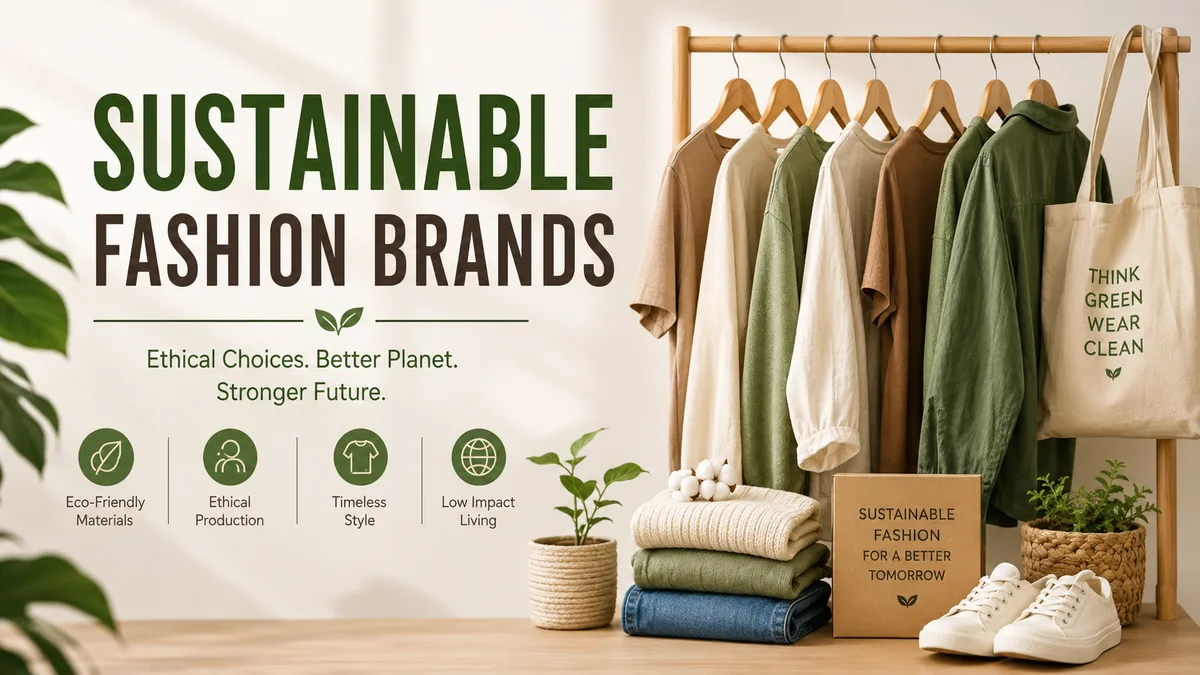
Fashion can look effortless on the rack while hiding a complicated story behind the label. Cotton farming, synthetic fibers, dyeing, factory conditions, shipping, short product lifespans, and textile waste all influence the true impact of what we wear.
That is why sustainable fashion brands deserve more scrutiny than a green-colored tag or a vague promise to “protect the planet.” The strongest labels provide evidence: traceable materials, credible certifications, responsible manufacturing, fairer labor practices, durable construction, repair programs, resale systems, and measurable environmental targets.
Sustainable fashion brands are clothing and footwear companies working to reduce environmental and social harm across their supply chains. Strong examples prioritize responsible materials, ethical production, transparency, durability, repair, reuse, recycling, and circular design, while supporting their claims with measurable data or independent standards rather than vague environmental marketing.
The distinction matters. The textile industry is responsible for an estimated 2% to 8% of global greenhouse-gas emissions and consumes enormous quantities of water, according to the United Nations Environment Programme.
So how can you tell meaningful progress from greenwashing? And which brands illustrate different approaches to responsible fashion?
What Makes sustainable fashion brands Actually Sustainable?
There is no single universally accepted threshold that turns a fashion company into a “sustainable brand.”
Sustainability is better viewed as a combination of environmental, social, and economic practices covering a garment’s entire lifecycle.
A credible brand should demonstrate progress across several areas.
| Area | What to look for |
|---|---|
| Materials | Organic, recycled, regenerative or responsibly sourced fibers |
| Manufacturing | Reduced water, energy, chemicals and waste |
| Workers | Safer conditions, labor protections and fairer compensation |
| Transparency | Supplier information, impact reports and traceability |
| Durability | Clothing designed for repeated, long-term use |
| Circularity | Repair, resale, take-back or recycling programs |
| Certifications | Independent verification where appropriate |
| Claims | Specific measurements instead of vague “eco” language |
Materials alone cannot tell the whole story.
A recycled-polyester jacket, for example, may reduce dependence on virgin fossil-based material, but synthetic textiles can still raise concerns around microplastic shedding and end-of-life recycling. Natural fibers are not automatically impact-free either; their footprint depends on farming, processing, chemicals, land and water use.
That is why judging an entire system is more useful than searching for one “perfect” fabric.
Sustainable fashion vs. ethical fashion
These terms overlap but are not identical.
Sustainable fashion generally emphasizes environmental impacts such as emissions, waste, water, chemicals, biodiversity and resource consumption.
Ethical fashion places greater emphasis on people: wages, working conditions, worker safety, exploitation and labor rights.
Responsible clothing should ideally address both.
A shirt made from organic cotton is not automatically ethical if workers making it face poor conditions. Likewise, excellent labor standards do not erase excessive waste or pollution.
What is slow fashion?
Slow fashion challenges the high-volume, rapid-turnover model associated with fast fashion.
Instead of continually pushing inexpensive new collections, slow-fashion principles encourage thoughtful production, quality construction, timeless designs, repair and longer ownership.
The concept is surprisingly practical: the clothing already hanging in your wardrobe matters.
Producing even a responsibly designed new garment consumes resources. Keeping usable clothing in circulation longer can therefore be one of the simplest ways to reduce demand for new production.
Sustainable Fashion Brands Worth Knowing in 2026
There is no scientifically defensible way to declare one company the “most sustainable” fashion brand.
Brands operate in different categories, use different materials and measure impact differently. Some excel at circularity, others at natural fibers, worker protections, traceability or innovative materials.
Independent rating platform Good On You, for example, evaluates brands across environmental impact, labor rights and animal welfare. Its 2026 roundup highlights companies including Etiko, MUD Jeans, Armedangels, LA Relaxed, Mila.Vert, No Nasties, Triarchy and Citizen Wolf among its highly rated labels.
The following brands are useful examples because each illustrates a particular sustainability strategy.
1. Patagonia — durability, repair and reuse
Patagonia has spent decades connecting outdoor clothing with environmental responsibility.
Its material portfolio includes organic cotton, recycled cotton, recycled polyester, recycled wool, recycled down, hemp, recycled nylon and other alternatives to conventional virgin materials. The company also participates in standards and programs covering areas such as Fair Trade, responsible wool, responsible down and material traceability.
Where Patagonia becomes particularly interesting is product longevity.
Its Worn Wear initiative supports repair and reuse rather than treating clothing as disposable. Patagonia says its repair efforts have helped keep more than 583,000 items out of landfills, while its partnership with iFixit provides more than 100 care and repair guides.
Best lesson from Patagonia: sustainability is not only about how clothing begins its life. Extending how long it remains useful matters too.
2. MUD Jeans — circular denim
MUD Jeans offers a useful case study in circular fashion.
Denim can be resource-intensive, so the company focuses heavily on incorporating old denim into new products.
Current MUD Jeans ranges can contain up to 40% pre- and post-consumer recycled denim, alongside OCS-certified organic cotton. Certain garments also incorporate materials such as TENCEL Lyocell with REFIBRA technology and recycled elastane. The company says it recycles 95% of water used in production.
MUD also takes back eligible old jeans for recycling and operates MUD ReLoved for pre-owned products. Its pioneering Lease A Jeans program helped introduce a circular consumption model, although new lease subscriptions have now been paused while existing agreements continue.
That last detail illustrates an important rule for sustainable-fashion research: practices change. Do not rely indefinitely on an old article describing what a company once offered.
3. Armedangels — everyday eco-conscious clothing
ARMEDANGELS is associated with the European sustainable-fashion movement and focuses heavily on more responsible fibers and certified materials.
Some of its garments carry Global Organic Textile Standard (GOTS) certification and use organic cotton.
Its relevance is practical: responsible fashion does not have to mean experimental luxury pieces.
T-shirts, denim, knitwear, sweatshirts and other wardrobe basics can also be designed around stronger material and production requirements.
4. VEJA — sneakers and material transparency
VEJA demonstrates how sustainability principles can be applied to footwear.
The company reports using organic cotton grown by farmer associations in Brazil and Peru, Amazonian rubber and materials derived from recycled plastic bottles or recycled polyester. Its sneakers are manufactured in Brazil and Portugal.
VEJA also publishes unusually detailed explanations about individual materials.
That kind of transparency is valuable because footwear is complicated. A sneaker can contain rubber, cotton, leather or alternatives, foam, adhesives, synthetic fabrics and numerous smaller components.
A simple “made with recycled material” claim tells you very little about the whole shoe.
5. Reformation — fashion-led sustainability
Reformation helped bring sustainability into mainstream contemporary fashion.
Rather than positioning responsible clothing purely around basics, the Los Angeles-founded company became known for dresses, denim, knitwear and California-inspired fashion.
This matters because sustainable fashion only creates lasting change when people actually want to wear the products.
British Vogue includes Reformation among prominent sustainably minded labels, while other fashion publications continue to feature the company in sustainability coverage.
Reformation’s broader lesson is that environmental considerations and trend-aware design do not have to exist in separate markets.
6. Stella McCartney — responsible luxury
Stella McCartney has long been one of the most recognizable names connecting luxury fashion with environmental and animal-welfare concerns.
The label has notably avoided leather and fur while exploring alternative materials.
Vogue describes Stella McCartney as a blueprint for responsible luxury and highlights its approach to leather- and fur-free products.
Luxury sustainability raises difficult questions because premium pricing does not automatically produce lower environmental impact.
The more meaningful question is whether higher-quality pieces are responsibly sourced, transparently produced and kept in use significantly longer.
7. Marine Serre — upcycling as design
Marine Serre demonstrates another route: using existing materials as a design resource.
Upcycling turns existing textiles or products into new garments instead of starting entirely with virgin resources.
Vogue has highlighted Marine Serre’s use of upcycled materials as a defining part of the label since its 2017 launch.
The approach addresses an overlooked question:
Why manufacture entirely new material when useful material already exists?
Upcycling cannot absorb the fashion industry’s entire waste stream, but it changes the way designers and consumers think about discarded textiles.
8. Another Tomorrow — traceability and timeless clothing
Another Tomorrow approaches sustainable fashion through long-lasting wardrobe pieces and responsibly sourced materials.
Rather than building its identity around rapidly changing micro-trends, the brand emphasizes clothing intended to remain wearable across seasons.
Vogue has specifically highlighted its focus on responsibly grown and ethically sourced materials alongside timeless design.
That reflects an essential sustainability principle: frequency of use matters.
A well-made jacket worn 150 times is a different consumption proposition from a trend-driven garment worn twice before being discarded.
9. Etiko — independently rated ethical fashion
Etiko is an Australian label producing footwear and apparel.
It is particularly notable because Good On You includes Etiko among the brands receiving its highest “Great” rating. The rating system evaluates companies across people, planet and animal-related criteria rather than relying solely on a brand’s own sustainability marketing.
Independent evaluation matters because self-reported sustainability information has an obvious limitation: companies control the story they tell.
10. Citizen Wolf — made-to-order thinking
Citizen Wolf is another label appearing among Good On You’s highest-rated 2026 brands.
Its made-to-order philosophy points toward an important sustainability issue that receives less attention than fabric choice: overproduction.
Traditional fashion forecasting requires companies to estimate how many units of each size and style customers will purchase. Wrong predictions can leave unsold inventory.
Producing closer to actual demand can potentially attack waste before it happens.
How to Tell Whether a Sustainable Fashion Brand Is Legitimate
A polished sustainability page should never be enough to earn your trust.
Look for evidence that can be checked.
1. Check for specific material percentages
Compare these statements:
“Made using sustainable materials.”
and:
“Body fabric contains 70% recycled cotton and 30% organic cotton.”
The second claim gives you something measurable.
Good product pages should tell you the actual fiber composition rather than simply using words such as green, conscious, responsible or planet-friendly.
2. Look for credible third-party certification
Certifications can strengthen a sustainability claim because somebody other than the company is evaluating specific requirements.
Useful standards and organizations you may encounter include:
- Global Organic Textile Standard (GOTS)
- Organic Content Standard (OCS)
- Global Recycled Standard (GRS)
- Recycled Claim Standard (RCS)
- Responsible Wool Standard (RWS)
- Responsible Down Standard (RDS)
- Fair Trade certifications
- OEKO-TEX
- B Corp
But certification names should still be interpreted correctly.
Textile Exchange explains that its standards use third-party certification and chain-of-custody systems to verify material claims through supply chains. Its standards include OCS, RCS, GRS, RWS and RDS.
OEKO-TEX STANDARD 100, meanwhile, primarily verifies that textiles have been tested against harmful substances. OEKO-TEX MADE IN GREEN extends into environmentally and socially responsible production conditions. Those labels therefore communicate different things.
A certification is evidence for whatever that particular standard assesses—not an automatic guarantee that every aspect of a company is sustainable.
3. Examine supply-chain transparency
Strong sustainable fashion brands explain where production happens.
Better disclosures may identify:
- Tier 1 garment factories
- Textile mills
- Dyeing facilities
- Raw-material sources
- Manufacturing countries
- Worker programs
- Auditing systems
- Supplier relationships
The further back a company can trace its materials, the more meaningful its transparency becomes.
A statement such as “ethically made overseas” provides almost no useful information.
4. Look for durability and repairability
One of the most overlooked questions when choosing eco-friendly clothing is remarkably simple:
Will you still be wearing it five years from now?
Inspect stitching, fabric weight, seams, zippers and replaceable components.
Then see whether the company provides repair instructions, spare components or professional repairs.
Patagonia’s Worn Wear program illustrates the principle well: keeping existing garments functioning is treated as part of the product lifecycle rather than something that happens after the brand’s responsibility ends.
5. Look at what happens after you’re finished
Circular fashion attempts to move away from the traditional:
make → buy → wear → discard
model toward:
make → wear → repair → reuse → resell → recycle
Brands may support this through repair programs, resale platforms, take-back schemes or fiber-to-fiber recycling.
Circularity is becoming particularly important because textile recycling remains difficult at scale. Recent reporting on Europe’s transition toward circular textiles notes that less than 1% of textiles currently become new textiles through recycling.
That makes reuse and longer wear especially valuable today.
Sustainable Materials: Which Fabrics Are Better?
There is no universally “best” sustainable fabric.
Every material comes with trade-offs.
| Material | Potential advantage | Important limitation |
|---|---|---|
| Organic cotton | Avoids conventional synthetic pesticide systems | Still requires land and water |
| Recycled cotton | Uses existing textile resources | Fibers can weaken during recycling |
| Hemp | Durable and potentially lower-input | Processing varies |
| Linen | Strong, long-lasting natural fiber | Impact depends on processing |
| TENCEL Lyocell | Efficient closed-loop production can reduce chemical losses | Source and manufacturing still matter |
| Recycled polyester | Reduces demand for virgin petroleum | Still synthetic and may shed microfibers |
| Wool | Durable, renewable natural fiber | Animal welfare and land impacts matter |
| Recycled wool | Uses existing fibers | Fiber quality may decline through recycling |
| Upcycled textiles | Uses material already produced | Difficult to scale consistently |
| Regenerative fibers | Can support improved agricultural systems | Claims require credible verification |
Is organic cotton always sustainable?
No.
Organic certification can address important agricultural concerns, but fiber production is only one stage of a garment’s life.
Spinning, dyeing, finishing, sewing, transportation, packaging, consumer washing and disposal all contribute to its footprint.
Think in systems rather than fabrics.
Is recycled polyester sustainable?
It can reduce demand for virgin fossil-based polyester and find another use for existing plastic resources.
But recycled polyester remains plastic.
Mechanical recycling can also have technical limitations, while microfiber pollution and eventual end-of-life disposal remain concerns.
Patagonia, for example, uses recycled synthetic fibers but simultaneously acknowledges the broader plastic problem and is investigating garment-to-garment recycling and other waste streams.
That is a more credible position than pretending recycled plastic makes a product impact-free.
How to Spot Greenwashing in Fashion
Greenwashing occurs when environmental marketing creates an impression that is stronger than the evidence behind it.
Fashion is particularly vulnerable because consumers cannot easily see a garment’s supply chain.
The cotton field, spinning mill, dye house and sewing factory may be located in completely different countries.
Watch for vague language
Be skeptical when brands repeatedly use terms such as:
- eco
- green
- conscious
- earth-friendly
- natural
- responsible
- sustainable collection
without defining them.
Ask: What exactly changed?
If a company says a garment is “made with recycled materials,” find the percentage.
Five percent and 95% are very different claims.
Don’t judge a company by one collection
A large fashion company may launch a small “conscious” collection while its core business continues producing enormous quantities of conventional clothing.
Evaluate the overall company where possible, not merely its most environmentally marketable capsule.
Beware of distant targets without current evidence
“Net zero by 2050” sounds impressive.
It tells you much less if the company does not disclose its present emissions, intermediate targets or annual progress.
Credible plans should contain measurable milestones.
Verify certifications
Logos can look authoritative even when their meaning is unclear.
Organizations such as Textile Exchange maintain systems for checking certified companies and transaction certificates, while OEKO-TEX provides its own label-checking tools.
Verification takes a minute and provides more information than trusting a product badge at face value.
Quick Takeaway: The strongest defense against greenwashing is specificity. Look for percentages, factory names, measurable targets, certification numbers, impact reports and programs you can independently verify.
Sustainable Fashion Is Moving Toward Traceability
One of the biggest changes happening in fashion sustainability is less glamorous than a new fabric: better product data.
Knowing exactly where fibers originate and what happens at each manufacturing stage has historically been difficult.
That is beginning to change.
The European Union’s Ecodesign for Sustainable Products Regulation has established a framework for Digital Product Passports (DPPs). In July 2026, the European Commission launched the DPP Registry and testing environment.
Textile apparel is one of the priority product groups under the ESPR Working Plan 2025–2030.
Future textile passports are expected to make product information easier to access throughout the lifecycle and could include details relevant to fiber composition, compliance, traceability, repair, reuse and recycling. The textile-specific delegated act is currently planned for adoption in the fourth quarter of 2027, although the Commission notes that timelines may change.
For consumers, this could eventually make sustainability claims considerably easier to investigate.
Instead of simply reading:
“responsibly made”
you may be able to access structured information attached to an individual product.
Circular Fashion May Matter More Than Constantly Buying “Better”
There is an uncomfortable contradiction at the center of sustainable fashion.
A company can manufacture products more responsibly, but endless consumption is difficult to reconcile with sustainability.
Buying 20 “eco-friendly” shirts you do not need is unlikely to be better than continuing to wear five shirts already sitting in your wardrobe.
This changes the hierarchy of responsible fashion.
A useful order is:
- Wear what you already own.
- Repair damaged clothing.
- Restyle or alter pieces you no longer wear.
- Borrow or swap occasional-use clothing.
- Buy secondhand when practical.
- Choose durable new clothing when you genuinely need it.
- Recycle textiles responsibly when reuse is no longer possible.
This approach avoids turning sustainability into another shopping trend.
Is secondhand fashion more sustainable?
Often, extending the useful life of an existing garment can reduce the need for new production.
But secondhand shopping is not a license for unlimited consumption either.
Buying large quantities of cheap used clothing that quickly gets discarded recreates the same behavioral problem.
The objective remains more use from fewer resources.
How to Build a More Sustainable Wardrobe
You do not need to throw away your current wardrobe and replace it with clothes from sustainable fashion brands.
That would defeat much of the purpose.
Start with what you own.
Step 1: Audit your wardrobe
Separate clothing into four groups:
Wear regularly: keep it.
Needs repair: fix buttons, hems, zippers or seams.
Good but unused: alter, sell, swap or donate it responsibly.
End of life: investigate textile recycling.
This immediately reveals what you genuinely need.
Step 2: Calculate cost per wear
Price alone can be misleading.
Imagine a $150 jacket worn 150 times.
Cost per wear = $1
Now consider a $30 trend-driven jacket worn three times.
Cost per wear = $10
The cheaper item was actually ten times more expensive per use.
Durability can therefore make environmental and financial sense simultaneously.
Step 3: Buy for your actual life
The most sustainable dress in the world is not useful if your lifestyle gives you nowhere to wear it.
Choose pieces based on:
- climate
- work
- daily routine
- existing wardrobe
- laundry habits
- comfort
- personal style
Avoid buying for an imaginary version of your life.
Step 4: Check care requirements
A beautiful garment requiring maintenance you will never perform may have a short lifespan.
Read washing instructions before purchasing.
Whenever appropriate for the fabric, gentler washing, lower temperatures, air drying and fewer unnecessary washes can help clothing last longer.
Step 5: Ask whether you can repair it
Before buying, inspect construction.
Could a tailor replace the zipper?
Can the shoes be resoled?
Can buttons be replaced?
Can a torn seam be stitched without destroying the garment?
Repairability turns clothing from a temporary purchase into a longer-term possession.
Are Sustainable Fashion Brands Expensive?
Some are. Some are not.
Responsible materials, lower production volumes, stronger construction, certification, traceable supply chains and better labor practices can increase production costs.
But sticker price is only one measure of affordability.
Consider:
price ÷ realistic number of wears = cost per wear
A durable $100 sweater worn 100 times costs $1 per wear.
A $20 sweater worn five times costs $4 per wear.
That does not mean everyone can afford expensive clothing upfront. Sustainable-fashion discussions sometimes overlook budget realities.
If your budget is tight, buying fewer items, maintaining existing clothes, swapping, repairing and shopping secondhand can be more accessible than purchasing premium ethical clothing.
Sustainability should not become a purity contest based on who can afford the most expensive wardrobe.
Can Fast Fashion Ever Be Sustainable?
Fast fashion’s fundamental challenge is not merely its choice of fabric.
It is the combination of high production volumes, rapid trend cycles, low prices and short periods of use.
Replacing conventional cotton with organic cotton does not automatically resolve overproduction.
Neither does putting recycled polyester into millions of garments designed around fleeting trends.
UNEP notes that people are buying considerably more clothing than they did in the past while keeping individual garments for less time.
That is why evaluating sustainable fashion brands requires looking beyond isolated environmental initiatives toward the company’s overall business model.
Ask:
Does this company make it easier for customers to buy thoughtfully—or does it depend on customers constantly wanting more?
What Is the Future of Sustainable Fashion?
The next phase is likely to be less about attaching “eco” to products and more about proving specific claims.
Several changes are already visible.
Greater traceability
Digital Product Passports and improved supply-chain systems could make fiber origins, composition and manufacturing information easier to verify.
Fiber-to-fiber recycling
Turning old garments into new textiles could reduce reliance on virgin materials, although technical and economic barriers remain substantial.
Europe’s developing circular-textile infrastructure illustrates both the potential and the challenge: recycling capacity requires significant investment, coordination and reliable demand for recovered fibers.
Better material standards
Textile Exchange is consolidating several existing standards into its new Materials Matter Standard.
Criteria were released in December 2025; the standard is scheduled to become effective on December 31, 2026, with mandatory transition for relevant certified organizations from December 31, 2027.
More repair and resale
Programs such as Patagonia Worn Wear and MUD ReLoved point toward a model in which brands maintain relationships with products after the original sale.
That can encourage longer product lifespans and make durability commercially relevant.
Greater scrutiny of environmental claims
Consumers, regulators, journalists and independent rating organizations increasingly expect evidence behind sustainability terminology.
That pressure is healthy.
“Sustainable” should become harder to use as a decorative marketing word and easier to evaluate through measurable information.
Choosing sustainable fashion brands Without Chasing Perfection
There is no impact-free T-shirt, sneaker or pair of jeans.
Every garment requires materials, energy, labor and transportation. Even the strongest sustainable fashion brands operate inside a global industry with significant environmental challenges.
The useful question is therefore not:
“Is this brand perfectly sustainable?”
Ask instead:
“What evidence shows that this company is reducing its impact, treating people responsibly and designing products to remain useful for longer?”
Look for traceable materials, independent certification, transparent factories, measurable environmental data, durable construction, repairability, resale, take-back programs and realistic sustainability reporting.
Brands such as Patagonia, MUD Jeans, Armedangels, VEJA, Reformation, Stella McCartney, Marine Serre, Another Tomorrow, Etiko and Citizen Wolf demonstrate different pieces of that puzzle. None provides a universal blueprint.
And remember that choosing a better brand is only one part of responsible fashion.
The most sustainable garment may already be hanging in your wardrobe. Wear it longer, care for it properly, repair it when necessary and replace it only when you genuinely need something new.