
A heavy object falling onto your foot can cause a serious injury in seconds. In construction sites, warehouses, factories, and workshops, everyday tasks can expose workers to crushing, impact, puncture, and slipping hazards. The right protective footwear helps reduce these risks.
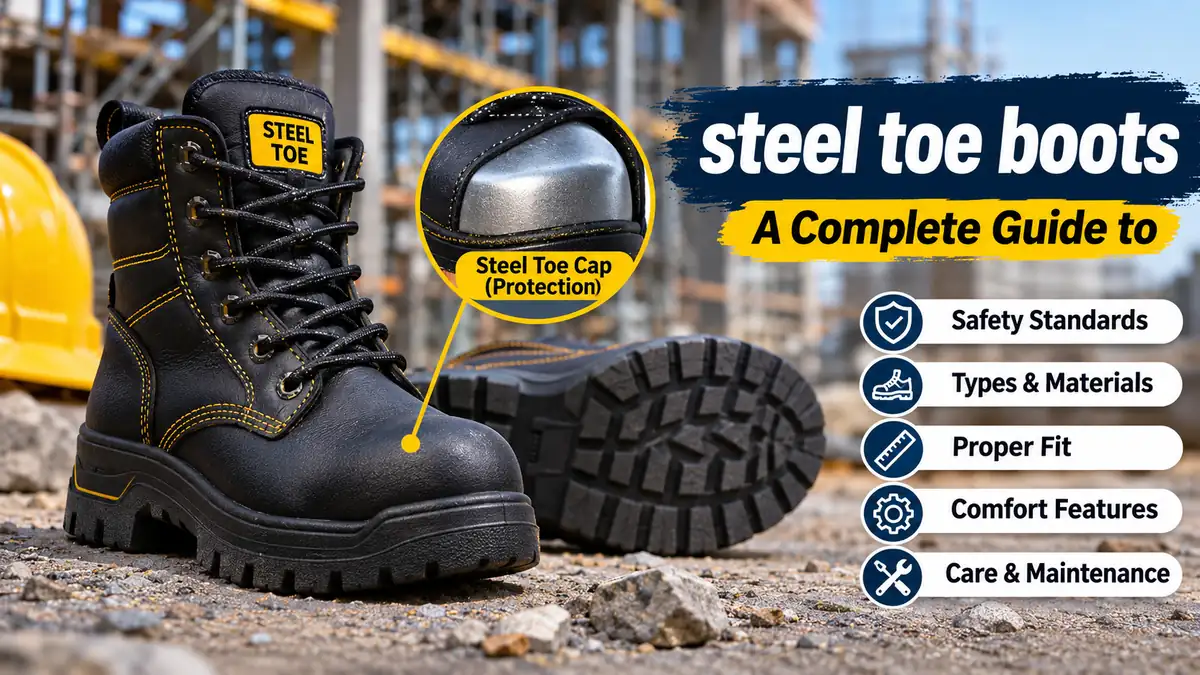
steel toe boots are protective work boots with reinforced steel caps built into the toe area to help shield feet from falling objects and compression hazards. They are commonly used in construction, manufacturing, logistics, and industrial workplaces. Their effectiveness depends on certified safety performance, proper fit, condition, and the specific hazards present.
Not all steel toe footwear provides the same protection. A boot that meets impact requirements may not necessarily resist punctures, electrical hazards, or slippery surfaces. Understanding those differences makes it easier to recognize what suitable workplace footwear should provide.
What Are Steel Toe Boots and How Do They Work?
Steel toe boots are a type of safety footwear designed with a rigid steel protective cap positioned around the front of the foot. This reinforcement helps prevent or reduce injuries when heavy objects strike or compress the toe area.
Unlike ordinary leather work boots, certified steel toe footwear undergoes standardized testing to demonstrate its ability to withstand specified impact and compression forces.
How the steel toe cap protects your feet
The protective cap forms a strong barrier over the toes. When an object strikes the boot, the cap helps resist deformation and maintain clearance around the toes.
The protective system typically includes:
- Steel toe cap: Resists specified impact and compression forces.
- Upper material: Provides coverage and supports the boot’s structure.
- Outsole: Supplies traction and may offer resistance to oils, abrasion, or other hazards.
- Midsole: Provides structural support and may contain puncture-resistant materials.
- Insole: Helps cushion the foot and manage comfort during prolonged wear.
- Heel and ankle structure: Supports stability, depending on the boot’s design.
The steel cap is not intended to make the foot invulnerable. Its protection is limited to tested conditions and the area covered by the cap.
Common workplaces that use protective toe footwear
Steel toe footwear is especially common in occupations where heavy equipment, materials, or tools could injure workers’ feet.
| Industry | Typical foot hazards |
|---|---|
| Construction | Falling tools, bricks, structural materials |
| Manufacturing | Heavy components, machinery, dropped parts |
| Warehousing | Pallets, freight, forklifts, rolling loads |
| Automotive repair | Vehicle parts, tools, equipment |
| Agriculture | Heavy equipment, machinery components |
| Oil and gas | Industrial equipment, dropped objects, slippery surfaces |
| Metal fabrication | Heavy metal stock, sharp debris, hot materials |
The specific protective features required depend on a workplace hazard assessment rather than the job title alone.
Steel Toe Boots Safety Standards Explained
Safety certification is one of the most important distinctions between genuine protective footwear and boots that merely look industrial.
Different countries use different testing systems, so labels should be interpreted according to the relevant standard.
ASTM F2413 safety requirements
In the United States, ASTM International publishes ASTM F2413, a widely used performance standard for protective footwear.
The standard addresses several types of foot protection, including impact and compression resistance.
Common markings include:
| Marking | Meaning |
|---|---|
| I | Impact protection |
| C | Compression protection |
| EH | Electrical hazard protection |
| SD | Static dissipative properties |
| PR | Puncture resistance |
| MT | Metatarsal protection |
| CD | Conductive footwear |
These markings represent different protective characteristics. A boot with impact and compression protection does not automatically have every other feature listed.
For example, electrical hazard footwear is designed to provide secondary protection under specified conditions. It is not a substitute for electrical isolation procedures or other required protective equipment.
What does ASTM I/75 and C/75 mean?
The I/75 classification refers to impact resistance tested at 75 foot-pounds of energy, approximately 101.7 joules.
The C/75 classification refers to compression resistance tested under a 2,500-pound load, approximately 11.1 kilonewtons.
These values describe laboratory test conditions, not a guarantee that a boot can prevent every injury involving that amount of force.
The standard edition and the complete marking on the footwear should always be checked.
EN ISO 20345 safety ratings
In Europe and many international markets, EN ISO 20345 establishes requirements for safety footwear.
Safety footwear under this standard includes toe protection tested for impact energy of 200 joules and compression force of 15 kilonewtons.
Common classifications under the 2022 edition include SB, S1, S2, S3, S4, S5, S6, and S7, with additional variants for specific protective features.
For example:
- SB: Basic safety footwear requirements.
- S1: Adds properties such as a closed heel, antistatic performance, and heel energy absorption.
- S2: Builds on S1 with water penetration and absorption requirements for the upper.
- S3: Adds puncture resistance and a cleated outsole to the relevant S2 requirements.
- S6: Adds whole-footwear water resistance to S2-type requirements.
- S7: Combines S3-type features with whole-footwear water resistance.
Standards and classification systems change over time. Older footwear may carry markings from earlier editions, so comparing ratings requires checking the exact standard printed on the label.
OSHA requirements for protective footwear
The U.S. Occupational Safety and Health Administration (OSHA) addresses protective footwear under 29 CFR 1910.136 for general industry.
Employers must ensure affected employees use protective footwear when hazards such as falling or rolling objects, sole-puncturing materials, or certain electrical risks make it necessary.
OSHA’s rules reference recognized safety standards and allow footwear that provides equivalent protection under applicable provisions.
The practical lesson is straightforward: footwear should be selected for the actual hazards of the work environment.
Steel Toe vs Composite Toe vs Alloy Toe Boots
Steel is not the only material used in protective toe caps. Composite and alloy alternatives are also common.
Each material offers different characteristics, but certified performance matters more than the material name alone.
| Feature | Steel toe | Composite toe | Alloy toe |
|---|---|---|---|
| Toe cap material | Steel | Nonmetallic materials such as fiberglass or polymers | Lightweight metal alloys |
| Weight | Often heavier | Often lighter | Often lighter than steel |
| Metal detectors | Usually detectable | Nonmetallic caps generally are not | Usually detectable |
| Thermal conductivity | Conducts heat and cold | Generally lower conductivity | Conducts heat and cold |
| Cap thickness | Often relatively compact | May require more space | Often relatively compact |
| Impact protection | Depends on certification | Depends on certification | Depends on certification |
| Typical use | General industrial work | Metal-sensitive or temperature-sensitive settings | Work requiring a lighter metal toe cap |
Are composite toe boots as safe as steel toe boots?
Composite toe boots can provide equivalent certified impact and compression protection when they meet the same applicable performance requirements.
A compliant composite toe boot should not be considered automatically less protective simply because its cap is not steel.
However, differences in cap construction, shape, weight, and performance outside standardized test conditions can still matter.
Do steel toe boots conduct electricity?
Steel is electrically conductive, but that fact alone does not establish whether a complete boot provides electrical hazard protection.
Some steel toe boots are designed and certified for electrical hazard protection. Their protective performance depends on the complete footwear construction, including insulating components.
Wet conditions, damaged soles, conductive contamination, and wear can compromise protection.
Workers facing electrical hazards should follow their employer’s electrical safety procedures and use footwear specifically rated for the task.
Are steel toe boots heavier?
Steel toe boots often weigh more than otherwise similar composite toe footwear, but the difference depends on the entire boot.
Outsole thickness, leather construction, waterproof membranes, insulation, and shaft height can influence weight as much as the protective cap.
A lightweight steel toe boot may weigh less than a heavily insulated composite toe boot.
How to Choose the Right Steel Toe Boots for Different Hazards
The correct protective footwear is determined by the hazards workers face, not simply by whether the boot contains a steel toe cap.
A workplace assessment should identify risks from impact, compression, punctures, electrical exposure, chemicals, heat, and slippery surfaces.
Impact and compression protection
Impact resistance matters where objects could fall onto the toes.
Compression resistance is especially relevant where heavy equipment, rolling loads, or materials could trap the foot.
Workers handling pallets, machinery components, steel sections, or heavy tools may need both.
The toe cap protects a defined area, so additional metatarsal protection may be necessary where the upper foot is exposed.
Slip-resistant outsoles
Slip resistance is particularly important on wet concrete, oily floors, smooth warehouse surfaces, and outdoor work areas.
Outsole performance depends on several factors:
- Rubber compound and tread design
- Floor surface texture
- Presence of water, oil, grease, or debris
- Wear on the tread
- Cleaning and maintenance
A boot described as slip-resistant is not slip-proof.
For European safety footwear, slip testing is incorporated into the applicable standard, with additional markings available for certain performance levels. The exact test method and standard edition matter.
Puncture-resistant protection
Steel toe caps do not protect the bottom of the foot against nails, metal shards, or other sharp objects.
Puncture-resistant footwear includes a protective layer beneath the foot.
Depending on the standard, that layer may be metallic or nonmetallic.
For EN ISO 20345:2022 footwear, markings such as P, PL, and PS distinguish different puncture-resistant insert types and test methods.
This distinction matters in construction and demolition environments, where sharp objects may penetrate ordinary soles.
Waterproof and water-resistant footwear
Water-resistant leather can repel limited moisture, but it does not necessarily keep feet dry when exposed to standing water or prolonged rainfall.
Waterproof work boots may incorporate membranes, sealed seams, or molded waterproof construction.
A waterproof membrane helps limit water entry but can also affect breathability.
Workers should distinguish between water resistance of the upper material and water resistance of the entire boot.
Insulation and temperature protection
Cold environments may require insulated footwear, while hot environments can benefit from breathable construction.
Steel conducts heat more readily than many nonmetallic toe-cap materials, but the complete boot design determines how much temperature transfer the wearer experiences.
Insulation, socks, moisture management, and the outsole all influence comfort.
Specialized heat-resistant footwear may be necessary for foundries, welding operations, or other high-temperature workplaces.
How Should Steel Toe Boots Fit?
Proper fit is essential for both protection and comfort. A certified boot that is too small, too loose, or incorrectly shaped can create pressure points, blisters, instability, and unnecessary fatigue.
Toe room and cap clearance
Your toes should have enough space to move naturally without pressing against the steel cap.
The cap itself is rigid and does not stretch during break-in.
A suitable fit should allow:
- Comfortable toe movement
- No persistent contact between toes and the cap
- Secure heel positioning
- Adequate room across the widest part of the foot
- No excessive forward sliding while walking downhill
The correct amount of clearance depends on foot shape and boot design. Simply selecting a larger size does not always solve a narrow toe-box problem.
Why steel toe boots can hurt your feet
Foot discomfort may result from:
- A toe cap that is too narrow or shallow.
- Incorrect boot length or width.
- Inadequate arch support.
- Stiff construction that does not flex naturally.
- Excessive boot weight.
- Poor sock selection.
- Loose lacing that allows the foot to slide forward.
- Long standing periods on hard surfaces.
Pain in the toes is particularly important because the steel cap will not gradually expand to accommodate the foot.
Persistent numbness, tingling, or pain should not be ignored.
How to check the fit
Try protective boots with the socks normally worn at work.
Check the fit while standing, walking, bending, and climbing a few steps.
The heel should remain reasonably secure without significant slipping. The forefoot should not feel compressed, and the toes should not strike the cap during normal movement.
If one width causes pressure while the next size feels too long, a different boot shape may be more appropriate.
Do steel toe boots stretch over time?
Leather uppers may soften and conform somewhat to the foot, but steel toe caps do not stretch.
A break-in period may improve flexibility around the ankle and upper foot. It should not be relied upon to correct painful toe-cap pressure.
If the toes are cramped from the beginning, the boot is likely the wrong fit.
Comfort Features That Matter During Long Work Shifts
Protection is the main purpose of safety footwear, but comfort becomes particularly important for workers who spend eight to twelve hours standing, walking, lifting, or climbing.
Cushioning and shock absorption
Cushioned midsoles help manage the repeated loading experienced during walking and standing.
Common materials include polyurethane (PU) and ethylene-vinyl acetate (EVA).
PU can provide durability and supportive cushioning, while EVA is often used in lightweight footwear. Actual comfort depends on material density, construction, and how the boot fits.
Arch support and foot stability
Arch support helps distribute pressure beneath the foot.
Workers with flat feet, high arches, or recurring foot discomfort may benefit from appropriately fitted insoles.
However, replacement insoles should not interfere with toe clearance or compromise the footwear’s certified protective construction.
Breathability and moisture management
Sweaty feet can contribute to friction, blisters, and discomfort.
Breathable linings, moisture-wicking socks, and appropriate ventilation help manage moisture.
Waterproof membranes can reduce water entry, but some designs retain more heat than unlined alternatives.
Boot height and ankle support
Safety footwear is available in several heights.
Low-cut safety shoes generally allow greater freedom of ankle movement. Mid-height boots provide additional coverage, while taller boots may offer more protection against environmental exposure.
Higher boots do not automatically prevent ankle injuries. Fit, outsole stability, terrain, and job requirements remain important.
Common Problems With Steel Toe Boots and How to Fix Them
Even correctly certified footwear can cause problems when the fit, construction, or maintenance does not suit the working environment.
Toes rubbing against the steel cap
Persistent rubbing usually indicates insufficient toe-box space, poor foot positioning, or an unsuitable boot shape.
Check whether the toes contact the front, sides, or upper surface of the cap.
Thicker socks may worsen the problem by reducing available space.
Changing the boot’s width or toe-box design is generally more effective than attempting to stretch the protective cap.
Heel slipping while walking
Minor movement in a new boot can occur as the upper softens, but excessive heel movement may lead to blisters.
Possible causes include incorrect sizing, loose lacing, or a heel shape that does not match the foot.
Adjusting the lacing may help. If the heel remains unstable, a different fit may be necessary.
Feet feeling tired after work
Foot fatigue can result from prolonged standing, hard flooring, repetitive movement, inadequate cushioning, or heavy footwear.
Supportive insoles, properly fitted socks, workplace anti-fatigue mats, and suitable rest breaks may help.
Persistent or worsening pain deserves professional assessment rather than continued attempts to compensate with footwear changes alone.
Boots becoming uncomfortable in cold weather
Metal toe caps transfer heat more readily than nonmetallic materials, but cold-weather comfort depends on the entire boot.
Insulated construction, dry socks, and moisture management can reduce discomfort.
Boots should remain roomy enough for circulation when thicker winter socks are worn.
How to Clean and Maintain Steel Toe Boots
Routine maintenance helps preserve comfort, material condition, traction, and the protective features of work footwear.
Different upper materials require different cleaning methods, so manufacturer instructions should take priority.
Cleaning leather work boots
- Remove loose dirt with a soft brush.
- Wipe the upper with a damp cloth.
- Apply a leather-compatible cleaner when necessary.
- Remove cleaning residue according to the product instructions.
- Allow the boots to dry naturally.
- Apply an appropriate leather conditioner if recommended.
- Inspect the stitching, sole, and toe area before reuse.
Avoid placing leather boots directly against heaters or other intense heat sources. Excessive heat can damage adhesives, leather, and waterproof components.
Cleaning synthetic and waterproof boots
Synthetic materials can often be cleaned with mild soap and water.
Waterproof footwear should be cleaned without harsh solvents or unapproved chemical treatments.
For membrane-lined boots, follow the manufacturer’s care instructions to avoid damaging the waterproof system.
Drying wet safety footwear
Remove the insoles when the manufacturer permits it, loosen the laces, and allow air to circulate.
Use a boot dryer only if its temperature and operating method are suitable for the footwear.
Never assume that a boot is safe to use for electrical hazard protection simply because the exterior appears dry.
Preventing unpleasant odors
Odors usually develop when moisture and microorganisms accumulate inside footwear.
Helpful habits include changing socks regularly, drying boots thoroughly, cleaning removable insoles, and rotating footwear when practical.
Odor-control products should be compatible with the lining and materials.
When Should Steel Toe Boots Be Replaced?
There is no universal replacement interval for all protective boots.
Service life depends on working conditions, frequency of use, materials, storage, and exposure to chemicals, water, heat, and abrasion.
Some footwear remains serviceable for a long period, while heavily used boots may deteriorate much sooner.
Warning signs of worn-out safety boots
Inspect footwear for:
- Exposed or visibly damaged protective toe caps
- Cracked, detached, or severely worn outsoles
- Deep cuts or punctures
- Damaged stitching and separated uppers
- Persistent water leakage in waterproof footwear
- Significant deformation of the toe area
- Deteriorated midsoles or heel structures
- Damage caused by chemicals or extreme heat
A major impact or compression incident can compromise protection even when damage is not obvious.
Footwear subjected to a serious crushing event should be removed from service and assessed according to the manufacturer’s guidance and workplace safety procedures.
Can damaged steel toe caps be repaired?
A damaged protective cap should not be reshaped, welded, or modified in an attempt to restore its certified performance.
Similarly, replacing major structural components may affect the footwear’s original safety certification.
Ordinary maintenance, such as replacing laces or approved removable insoles, is different from repairing safety-critical components.
When the protective structure is compromised, replacement is generally the safer course.
Common Myths About Steel Toe Boots
Several misconceptions persist about the safety and performance of steel toe footwear.
Myth: Steel toe caps are more dangerous than having no protection
One claim suggests that a heavy object can bend a steel cap and sever the toes, making ordinary footwear safer.
This misrepresents the purpose of certified protective footwear.
Steel toe caps are tested to resist specified impact and compression forces while maintaining minimum internal clearance.
Extremely severe forces can still cause injuries, but that does not mean unprotected footwear provides better protection.
Myth: All steel toe boots are waterproof
Steel toe protection and waterproofing are separate features.
A boot may have a certified steel cap and still allow water through its upper, seams, or tongue.
Waterproof performance must be evaluated independently.
Myth: Steel toe boots prevent every workplace foot injury
A steel cap protects the toe area against certain impact and compression hazards.
It does not automatically protect the metatarsals, ankles, soles, or legs.
Additional features and other protective measures may be necessary.
Myth: Steel toe boots are always uncomfortable
Discomfort is not an unavoidable consequence of steel toe protection.
A correctly shaped toe box, suitable cushioning, appropriate boot weight, and proper sizing can make a substantial difference.
Some workers may prefer composite or alloy alternatives, but comfort varies by individual foot shape and footwear design.
Myth: A higher price guarantees better protection
Price alone does not establish safety performance.
A less expensive boot that meets the correct standard and fits properly may provide more appropriate protection than a costly boot lacking the required hazard-specific features.
Certification, construction, condition, and suitability are more meaningful indicators.
Understanding Safety Labels Before Wearing Protective Footwear
Safety labels help workers and supervisors verify whether footwear meets the requirements of a particular workplace.
Labels may appear on the tongue, lining, shaft, or another designated area.
For ASTM-rated footwear, the marking typically identifies the standard and applicable protective characteristics.
For EN ISO footwear, the marking includes the relevant standard and safety classification.
The manufacturer’s model identification and accompanying documentation can provide further details.
A useful verification process is to:
- Identify the hazards established by the workplace assessment.
- Check the applicable national or workplace footwear standard.
- Read the complete safety marking.
- Confirm any additional protective features required.
- Inspect the footwear for damage.
- Check that it fits securely and comfortably.
In the United States, OSHA’s 29 CFR 1910.136 foot protection regulation provides the regulatory framework for general industry. ASTM impact and compression classifications are also documented in published standard materials. Occupational Safety and Health Administration+2
For European classifications, the EN ISO 20345:2022 system identifies protective properties such as toe impact resistance, puncture resistance, water resistance, and slip performance. cofra.it+1
Are Steel Toe Boots Suitable for Everyday Wear?
Steel toe footwear can be worn outside industrial workplaces, but it is designed primarily to address occupational hazards.
For everyday walking, the extra weight, rigid toe construction, and specialized outsole may not offer meaningful benefits.
People who spend time on construction projects, home renovations, mechanical work, or other activities involving heavy materials may find protective footwear useful.
However, wearing steel toe boots does not replace safe lifting, equipment handling, housekeeping, or other injury-prevention practices.
The best footwear for an activity depends on its hazards, surface conditions, duration, and comfort requirements.
Final Thoughts on Steel Toe Boots
steel toe boots provide valuable protection against workplace impact and compression hazards when they are properly certified, correctly fitted, and maintained. Their steel caps help protect the toes, but other hazards may require puncture-resistant soles, slip-resistant outsoles, electrical hazard protection, waterproofing, or metatarsal guards.
The most important considerations are the safety standard, workplace hazards, toe-box fit, overall comfort, and condition of the footwear.
Before relying on any protective boot, verify its safety markings, inspect it for damage, and confirm that its protective features match the work being performed.