
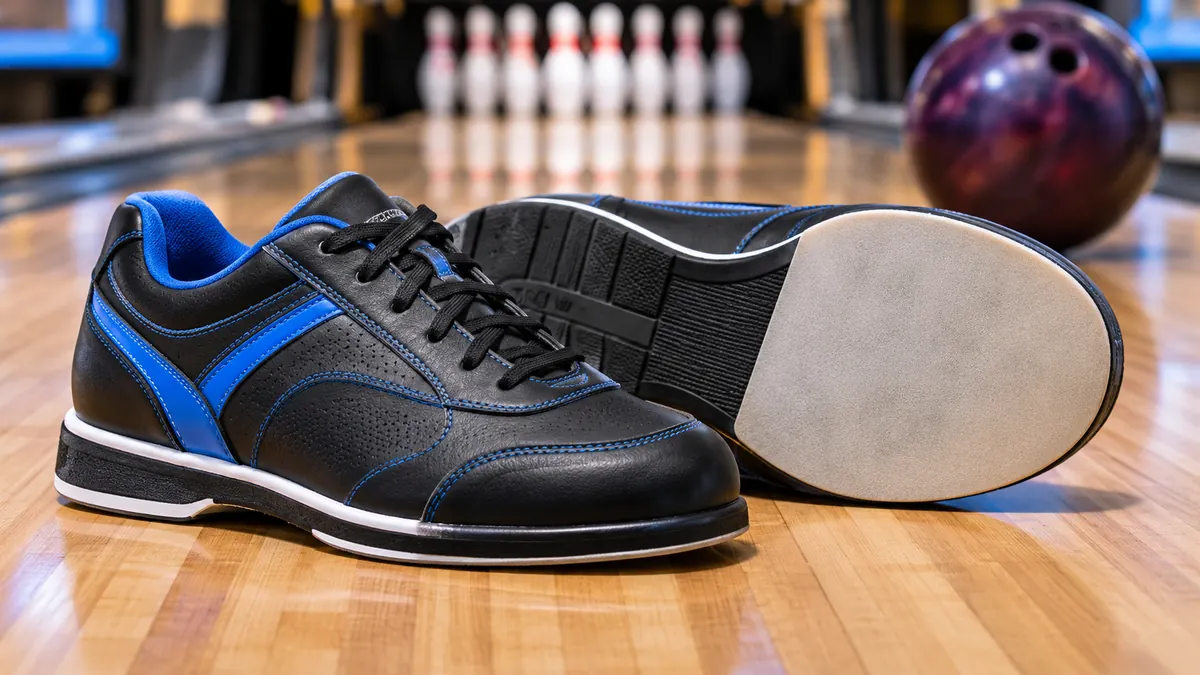
A good bowling shot depends on more than the ball in your hand. Your feet play a major role in balance, timing, and the final steps of your approach.
Regular sneakers may grip the lane approach too firmly, while worn or poorly fitted footwear can make your movements unpredictable. That is why bowling alleys use specialized footwear.
Bowling shoes are specially designed footwear that helps bowlers slide, brake, and maintain balance during their approach to the foul line. Unlike ordinary athletic shoes, they use specialized soles and heels to control friction on the bowling approach. They are available in rental, recreational, and performance styles for different skill levels.
Understanding how these shoes work can help beginners feel more comfortable and experienced players develop a more consistent delivery.
Why Are bowling shoes Necessary?
Bowling requires a combination of controlled movement and stability. During a typical four-step or five-step approach, a bowler builds momentum, lowers the ball into the swing, and finishes with a controlled slide or planted step near the foul line.
Footwear affects every part of that sequence.
Controlled sliding
One of the most recognizable features of bowling footwear is its sliding sole. The sole is designed to provide a more predictable level of friction on the approach than most street shoes.
For a right-handed bowler using a conventional sliding delivery, the left foot is usually the sliding foot. For a left-handed bowler, it is generally the right foot.
A consistent slide allows the bowler to transfer momentum into the release without abruptly stopping.
Better balance and stability
Bowling shoes help players maintain a stable finishing position. This matters because a sudden stop, unexpected slip, or uneven movement can interfere with the ball’s release.
A balanced finish supports:
- More repeatable footwork and approach timing.
- Better control over the direction of the ball.
- Reduced unnecessary strain from abrupt stopping.
- Greater confidence during the delivery.
They do not automatically improve accuracy or prevent injuries, but appropriate footwear can remove one source of inconsistency.
Protection for the bowling approach
Bowling centers also require specialized shoes to protect the approach surface.
Outdoor footwear can carry dirt, moisture, grit, and other debris onto the floor. These contaminants may change how the surface feels underfoot and affect subsequent bowlers.
Dedicated bowling footwear helps reduce that problem when kept clean and used appropriately.
Different Types of Bowling Shoes
Not all bowling footwear is designed for the same purpose. The main differences involve sole construction, adjustability, support, and the amount of control provided during the approach.
Rental bowling shoes
Rental shoes are the pairs commonly available at bowling centers. They are designed for shared use, durability, and straightforward maintenance.
Many traditional rental models have sliding material on both soles, allowing them to accommodate left-handed and right-handed bowlers.
Their main characteristics include durable uppers, reinforced construction, standardized sizing, and relatively simple sole designs.
Rental footwear is suitable for occasional bowling, although frequent players may notice differences in fit and sliding behavior between pairs.
Athletic-style bowling shoes
Men’s Athletic Bowling Shoes – Strikeforce Bowling
Athletic-style models resemble everyday sneakers but include bowling-specific sole construction.
They commonly feature lightweight synthetic or mesh uppers, cushioned insoles, padded collars, and flexible materials.
Many recreational designs use universal sliding soles, making them convenient for bowlers who want a familiar sneaker-like feel.
However, appearance alone does not determine performance. Two shoes with similar athletic styling may have very different outsole materials.
Performance bowling shoes
Dexter SST 8 BOA Power Frame Shoes – World Wide Bowling Supplies
Performance footwear is designed for players who want more control over their footwork.
A typical performance configuration separates the sliding foot from the traction foot. The sliding shoe allows controlled forward movement, while the traction shoe helps the bowler push off during the approach.
Some advanced designs include interchangeable slide soles and heels that let players modify the amount of friction.
These features are especially useful for league bowlers and tournament players who encounter different approach conditions.
Comparing the main types
| Feature | Rental | Recreational | Performance |
|---|---|---|---|
| Primary users | Casual players | Regular bowlers | League and competitive bowlers |
| Sliding design | Often both feet | Often universal | Frequently handed |
| Replaceable soles | Rare | Model-dependent | Common on advanced models |
| Fit options | General sizing | Varies by model | More specialized options |
| Maintenance | Bowling center | Personal care | Personal care and component replacement |
The most advanced design is not necessarily the most appropriate one. A beginner with a short, controlled approach may feel more comfortable in a recreational model than in a highly adjustable performance shoe.
How Bowling Shoe Soles and Heels Work
The sole is the most important functional difference between bowling footwear and ordinary sneakers.
Bowling approaches are smooth, but they are not necessarily identical from one center to another. Surface condition, cleanliness, humidity, and footwear condition all affect the way a bowler moves.
Sliding soles
Sliding soles are commonly made from leather, microfiber, or specialized synthetic materials.
Their purpose is to allow controlled movement across the approach without excessive resistance.
A bowler who slides too little may stop abruptly. A bowler who slides too far may struggle to maintain balance at the foul line.
The ideal amount of slide depends on personal technique and the approach surface.
Traction soles
A traction sole provides grip during the pushing phase of the approach.
In many handed performance shoes, the non-sliding foot has a rubber or other high-friction outsole.
This configuration supports the transfer of momentum from the push-off foot to the sliding foot.
Universal-slide recreational shoes often do not provide the same distinct traction-foot arrangement.
Interchangeable soles and heels
Some performance shoes use removable components attached with hook-and-loop fastening systems.
These components allow the bowler to adjust sliding and braking characteristics without changing the entire shoe.
A sole that produces more slide can help when the approach feels unusually tacky. A higher-friction sole can provide greater control when the bowler is sliding too far.
Heel materials also matter. The heel can contribute to braking and control during the final portion of the slide.
Manufacturers such as Dexter, Storm, and Brunswick offer bowling footwear, while certain performance lines provide replacement sole or heel systems.
Compatibility is model-specific. Replacement parts should always match the shoe manufacturer’s requirements.
What do sliding sole numbers mean?
Some interchangeable sole systems use numbered ratings to distinguish sliding characteristics.
Within certain manufacturer systems, higher numbers indicate greater sliding potential. However, these scales are not universal across brands.
A number printed on one manufacturer’s sole should not automatically be treated as equivalent to the same number from another manufacturer.
The safest approach is to consult the specific product’s sliding chart and make gradual adjustments.
How to Choose the Right Bowling Shoe Fit
Correct sizing is essential because bowling involves forward momentum, repeated steps, and a controlled finish.
A shoe that is too loose can allow the foot to move inside the upper. One that is too tight may cause pressure around the toes, instep, or sides of the foot.
Length and toe room
The toes should have enough room to move naturally without pressing against the front of the shoe.
The heel should remain secure during walking and the bowling approach.
A comfortable fit generally feels snug around the midfoot without squeezing the forefoot.
Width and foot shape
Bowling shoe sizing varies by manufacturer and model.
Some brands offer standard and wide-width options. Others use a relatively narrow or roomy last, which is the shape around which the shoe is constructed.
Players with wider feet should pay attention to the toe box rather than relying exclusively on a larger shoe size.
Increasing the length to compensate for insufficient width may create heel slippage.
Cushioning and arch support
Bowling involves repeated movement on a hard indoor surface. Cushioning can improve comfort during long practice sessions or league play.
Look for a supportive insole, a stable heel area, and sufficient flexibility through the forefoot.
Players who use orthotic insoles should check whether the original insole is removable and whether the replacement changes the fit.
How should bowling shoes feel?
A correctly fitted pair should feel secure but not restrictive.
The foot should not slide excessively inside the shoe, and the heel should not lift noticeably during the approach.
The shoe should also permit normal foot movement without creating pressure points.
Because sizing conventions differ, the number printed on the label is only a starting point.
bowling shoes for Beginners and Experienced Players
Skill level influences the type of footwear a bowler needs, but playing style is equally important.
Beginners and casual bowlers
Beginners usually benefit from predictable, uncomplicated footwear.
A universal-slide recreational shoe can be appropriate for someone who bowls occasionally and has not yet developed a pronounced sliding technique.
The main priorities are comfort, reliable fit, and a consistent feel.
Beginners should focus on smooth footwork rather than attempting to produce an exaggerated slide.
League bowlers
League bowlers repeat their approach many times throughout a session and across the season.
As technique becomes more consistent, differences in sole friction may become more noticeable.
A dedicated sliding-foot and traction-foot configuration can help players maintain a repeatable approach.
League players may also appreciate footwear with replaceable soles, particularly when moving between bowling centers.
Competitive and tournament bowlers
Competitive players often pay closer attention to approach conditions.
Changes in the surface or the player’s sliding technique can affect timing, balance, and release consistency.
Adjustable performance shoes allow players to experiment with different sliding and braking combinations.
However, adjustments should be tested carefully during practice. Changing sole friction immediately before an important delivery can introduce unfamiliar movement.
Left-handed versus right-handed bowling shoes
Handed performance footwear is designed around the bowler’s sliding foot.
For most conventional deliveries:
| Bowler | Sliding foot | Push-off or traction foot |
|---|---|---|
| Right-handed | Left | Right |
| Left-handed | Right | Left |
This arrangement is common but not universal.
Some players use unconventional footwork, including approaches that finish without a traditional slide. Two-handed bowlers also vary in their footwork patterns.
The correct configuration depends on the actual delivery, not simply which hand holds the ball.
Common Bowling Shoe Problems and How to Fix Them
Footwear problems often become noticeable when a bowler’s approach suddenly feels different.
Before changing technique, inspect the shoes and the approach conditions.
Shoes are not sliding enough
A shoe that grips unexpectedly may interrupt the approach and cause the bowler to stop abruptly.
Possible causes include a dirty sliding sole, moisture, worn material, or an approach with greater friction than usual.
Start by inspecting the sliding surface and checking for contamination.
For removable performance soles, a different manufacturer-approved sliding component may be appropriate.
Never apply household oil, powder, wax, or other substances to make the shoe slide. These materials can create unpredictable conditions and contaminate the approach.
Shoes slide too much
Excessive sliding can make it difficult to stop in a balanced position.
A bowler may feel as though the sliding foot continues moving beyond the intended finish.
Potential causes include a low-friction sole, worn braking components, or a mismatch between footwear and approach conditions.
Performance shoes may allow the player to use a higher-friction sole or heel.
Any change should be tested gradually, preferably during practice.
Uneven or unpredictable sliding
An inconsistent slide may result from debris on the outsole, uneven wear, moisture, or damaged sole material.
Inspect the entire sliding surface for worn patches or embedded dirt.
If the problem occurs only at one bowling center, approach conditions may also be contributing.
Inform bowling center staff if the approach appears contaminated or unusually slippery.
Heel slipping inside the shoe
Heel movement can interfere with foot stability.
It may be caused by an oversized shoe, loose lacing, or a shoe shape that does not match the foot.
Adjusting the laces may help, but excessive internal movement can indicate a sizing problem.
A secure heel is more important than achieving a particular labeled size.
How to Clean and Maintain Bowling Shoes
Proper maintenance helps preserve predictable sliding characteristics and extends the usable life of the footwear.
The most important principle is to keep the sliding surface clean and dry.
Cleaning the uppers
For most synthetic or leather uppers, gently remove loose dirt with a soft cloth or brush.
Use a lightly damp cloth when appropriate for the material, following the manufacturer’s care instructions.
Avoid soaking the shoes or exposing them to excessive heat.
Allow them to dry naturally before storage.
Caring for sliding soles
Sliding soles require more careful handling than ordinary outsoles.
Use a manufacturer-approved sole brush or cleaning method to remove debris.
Brush gently and follow the recommended direction and technique for the specific material.
Aggressive brushing may change the surface texture and affect sliding behavior.
Some microfiber and leather soles respond differently to brushing, so the manufacturer’s instructions should take priority.
Keeping the shoes dry
Moisture is one of the most significant causes of unpredictable friction.
Walking through a wet restroom or stepping onto a damp floor can affect a sliding sole.
Keep bowling footwear away from spills, wet surfaces, and outdoor conditions.
If the sole becomes wet, stop using it until it is properly dry and its behavior has been checked.
Storing bowling shoes
A dedicated shoe bag can help protect the footwear from dirt and accidental damage.
After bowling, allow moisture from perspiration to dissipate before sealing the shoes in a closed bag for an extended period.
Store them in a dry, ventilated area away from direct heat.
Avoid placing heavy objects on top of the shoes, particularly when the uppers or removable components could become distorted.
When should bowling shoes be replaced?
There is no universal replacement schedule.
The lifespan depends on frequency of use, construction quality, care, and the amount of wear on the soles and heels.
Signs that replacement or repair may be needed include:
- Persistent loss of predictable sliding behavior.
- Cracked, detached, or severely worn soles.
- Damaged heels or compromised traction surfaces.
- Loss of support or significant internal deterioration.
- Upper damage that affects fit or stability.
For shoes with interchangeable components, replacing a worn sole or heel may restore function without requiring a completely new pair.
Can You Bowl in Regular Shoes?
Most bowling centers require approved bowling footwear on their lanes and approaches.
Regular sneakers, running shoes, and casual footwear are not designed to produce the controlled sliding behavior associated with bowling.
Rubber athletic outsoles can grip the approach unexpectedly. Outdoor shoes may also introduce dirt or moisture.
Even shoes that look similar to bowling footwear may not have suitable outsole materials.
Some bowling centers may have specific policies for adaptive equipment or other approved footwear, so players with special requirements should consult the facility.
Are bowling shoes slippery?
They are designed to slide in a controlled way, but that does not mean they should feel dangerously slippery.
The actual friction depends on sole material, heel construction, surface condition, and the player’s technique.
A properly matched shoe should help produce predictable movement.
Can you wear bowling shoes outside?
Bowling shoes should generally be reserved for clean indoor bowling environments.
Outdoor walking can damage sliding materials and introduce grit, water, and other contaminants.
Even a short trip across a parking lot can change how the sole performs.
For this reason, experienced bowlers commonly change into their bowling footwear inside the center and remove it before leaving.
Do bowling shoes work on every approach?
No single shoe configuration guarantees identical performance on every approach.
Differences in maintenance, surface condition, humidity, and contamination can affect friction.
This is one reason interchangeable sole systems exist.
Players should assess the approach carefully and avoid assuming that a familiar shoe will behave exactly the same way at every bowling center.
Additional Features That Affect Comfort and Performance
Beyond the sole, several design features influence how bowling footwear feels during extended use.
Laces and BOA-style closures
Traditional laces allow players to adjust tightness across different parts of the foot.
Some performance models use a dial-based BOA Fit System, which tightens the shoe through a cable or lace mechanism.
Both systems can provide a secure fit when properly adjusted. Dial closures offer convenient adjustments, while conventional laces are familiar and easy to replace.
Neither closure automatically produces a better bowling score.
Breathability and upper materials
Synthetic leather, mesh, and textile uppers are common in modern bowling footwear.
Mesh can improve airflow, while structured synthetic materials may provide greater support and easier surface cleaning.
The best material depends on the player’s priorities and the shoe’s overall construction.
Toe protection and durability
Some bowlers drag the trailing foot during the delivery.
Repeated toe dragging can wear down the upper or outsole, particularly around the front of the traction shoe.
Certain performance models use reinforced toe areas or protective construction to manage this wear.
Players with noticeable toe drag should inspect that area regularly.
Shoes for children and younger bowlers
Children need the same basic qualities as adults: appropriate fit, predictable friction, and adequate stability.
Youth bowling shoes are available in smaller sizes, often with simple universal sliding soles.
Avoid choosing footwear that is excessively large to allow for future growth. A loose fit can make controlled footwork more difficult.
Understanding Bowling Approach Conditions
The bowling approach is the area where a player takes the steps leading to the ball’s release.
It is different from the oiled portion of the lane where the ball travels.
This distinction matters because bowling shoes are designed to interact with the approach, not with the lane’s oil pattern.
Wood versus synthetic approaches
Bowling centers may use wood or synthetic approach surfaces.
The way a shoe slides depends on the surface material, finish, maintenance, and environmental conditions.
Neither surface type guarantees a particular amount of friction.
A bowler should judge the actual condition of the approach rather than assuming that every wooden or synthetic surface behaves identically.
Humidity and temperature
Environmental conditions can influence how an approach feels.
Humidity, moisture, and changes in surface condition may affect the interaction between the shoe and floor.
A setup that feels comfortable during one session may feel different during another.
This is particularly relevant for tournament players who compete in unfamiliar venues.
Testing the approach safely
Before beginning a full delivery, experienced bowlers often check the approach with controlled foot movements.
A sensible process is to:
- Inspect the soles for dirt, moisture, or damage.
- Check that the approach is clean and unobstructed.
- Test foot movement carefully without a full-speed delivery.
- Make gradual adjustments if the shoe has interchangeable components.
- Begin normal bowling only when the movement feels predictable.
If an approach appears unsafe, stop and notify the bowling center staff.
How Much Do Bowling Shoes Typically Cost?
Prices vary by manufacturer, construction, and performance features.
As a general reference, a November 2026 bowling footwear guide identifies the following approximate US price ranges. bowling.com+1
| Category | Approximate US price | Typical features |
|---|---|---|
| Beginner | $45–$80 | Fixed universal sliding soles |
| Intermediate | $100–$150 | Better support, some replaceable components |
| Advanced | $200–$300 | Interchangeable soles and heels, specialized fit |
These are indicative ranges rather than guaranteed retail prices.
Price alone does not determine whether a shoe is suitable. A comfortable entry-level model may be entirely adequate for someone who bowls occasionally.
Higher-priced designs generally become more useful when a player needs adjustable sliding characteristics, improved durability, or specialized construction.
Is owning bowling shoes better than renting?
Owning a pair provides a more consistent personal fit and avoids repeatedly using shared rental footwear.
It also allows the player to become familiar with the same sole characteristics over time.
Rental shoes remain practical for occasional visits, first-time bowlers, and people who are still learning the basics.
The main advantage of personal footwear is familiarity and consistency, not an automatic increase in scoring ability.
Final Thoughts on bowling shoes
Bowling shoes are an essential part of controlled footwork. Their specialized soles and heels help bowlers manage sliding, braking, and balance during the approach.
For beginners, comfortable footwear with predictable sliding characteristics is usually sufficient. More experienced players may benefit from handed designs, interchangeable soles, and adjustable braking components.
Whatever the skill level, proper fit and maintenance matter as much as advanced features.
The best way to understand how bowling shoes affect your game is to pay attention to your footwork during practice. A consistent, comfortable approach creates a stronger foundation for improving timing, balance, and ball delivery.