
Few dress shapes can look romantic, relaxed, rebellious, and deliberately oversized at the same time. The babydoll dress does exactly that.
Recognizable for its short hem, loose silhouette, and often high waistline, this dress has moved repeatedly between nightwear, couture, youth culture, punk fashion, and mainstream wardrobes. In 2026, it is once again highly visible, appearing in celebrity looks, street style, and designer collections.
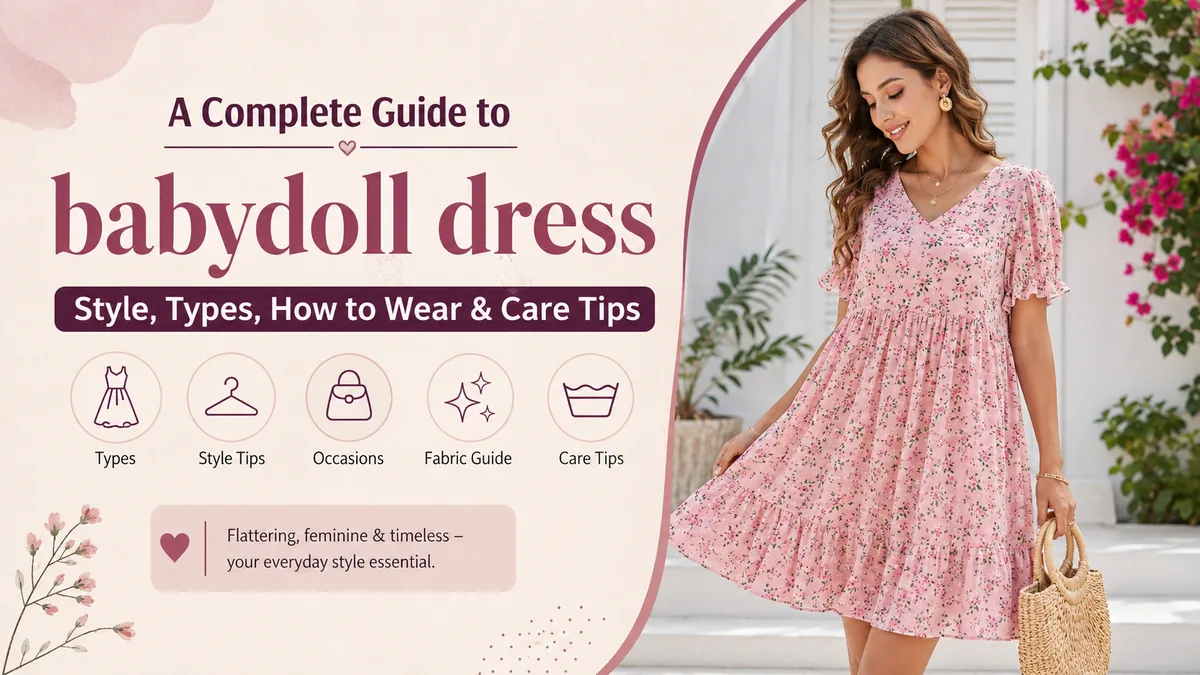
A babydoll dress is typically a short, loose-fitting dress with a skirt that falls freely away from the body, often beginning beneath the bust at an empire waist. Modern versions may feature puff sleeves, lace, ruffles, smocking, bows, or simple minimalist finishes. Its defining qualities are ease, volume, movement, and a youthful A-line shape.
Understanding the style requires more than identifying a high waist and short skirt. Its unusual history explains why designers keep returning to it—and why something that looks so simple can create such strong reactions.
What Is a babydoll dress?
The easiest way to recognize a babydoll silhouette is to look at how the fabric behaves around the torso.
Instead of following the natural waist and hips, the dress usually becomes wider higher on the body. Many designs use an empire waist, positioned around or just below the bust, followed by a gathered or flared skirt.
However, an empire seam isn’t an absolute requirement. Vogue India notes that contemporary babydoll dresses can have a loose, body-skimming shape without a clearly defined empire waist. They are generally short, commonly finishing around the mid-thigh or above the knee.
Typical characteristics include:
- A short or mini hemline
- A loose A-line or swing silhouette
- An empire or raised waist
- A skirt with noticeable volume
- Lightweight or structured fabric, depending on the design
- Short, puff, cap, long, or sleeveless construction
- Decorative details such as lace, bows, ruffles, embroidery, or Peter Pan collars
- An intentionally relaxed fit through the waist and hips
Not every dress will contain every feature.
A minimalist cotton mini with a raised seam and wide skirt can belong to the same family as an elaborate tulle dress with puff sleeves and multiple layers.
Is a babydoll dress the same as an empire waist dress?
Not necessarily.
An empire waist dress is defined primarily by the placement of its waistline. The seam sits significantly higher than the natural waist, usually beneath the bust.
A babydoll is defined by the overall silhouette.
It frequently incorporates an empire waist, but short length, fullness, and an easy shape are also central to its visual identity. Empire dresses can be ankle- or floor-length and still remain empire dresses, while traditional babydoll styles tend to be considerably shorter.
| Feature | Babydoll Dress | Empire Waist Dress | Shift Dress |
|---|---|---|---|
| Waist | Usually high or loose | High, below bust | Usually undefined |
| Skirt | Full, gathered, or flared | Can be narrow or flowing | Relatively straight |
| Typical length | Mini to above knee | Mini to maxi | Usually short to knee-length |
| Overall shape | Voluminous and playful | Elongated and flowing | Straight and simple |
| Common details | Ruffles, lace, puff sleeves, bows | Draping, pleats | Minimal detailing |
| Fit through hips | Loose | Usually loose | Skims the body |
The distinction matters when choosing a dress because two garments labeled “empire waist” can create completely different proportions.
The History of the babydoll dress
The babydoll’s history is more complicated than its playful appearance suggests.
Its roots lie in nightwear, not conventional day dresses.
From practical 1940s nightwear to a recognizable style
American lingerie designer Sylvia Pedlar is widely credited with creating a notably short nightgown in 1942, when World War II fabric restrictions encouraged manufacturers and designers to conserve material. Historical accounts say Pedlar herself did not embrace the “babydoll” name that later became associated with the garment.
Early versions were designed as sleepwear and could use materials such as chiffon, nylon, or silk. Lace, ribbons, bows, and other lingerie details became closely associated with the look.
This sleepwear connection remains visible in modern fashion. A contemporary dress made from airy fabric with lace trim and a loose skirt can deliberately resemble a vintage nightgown.
How the name became famous
The term became strongly associated with the 1956 Elia Kazan film Baby Doll, starring Carroll Baker. Fashion histories commonly connect the film with the popularization of the name, even though short nightgowns existed before its release.
That distinction is useful: the garment’s origins and the widespread use of its familiar name are not necessarily the same event.
Balenciaga and the couture transformation
The silhouette did not stay in the bedroom.
In the late 1950s, Cristóbal Balenciaga presented couture interpretations of the shape, helping move its proportions into high fashion. Historical references place Balenciaga’s versions around 1957 and 1958.
This transformation established something that designers still explore: a short, voluminous dress doesn’t have to be casual or lingerie-like. Fabric and construction can make the same basic silhouette sculptural and sophisticated.
The 1960s and shorter hemlines
The style fitted naturally into the changing fashion culture of the 1960s.
Shorter hemlines, looser silhouettes, and a rejection of heavily structured dressing gave the babydoll another identity. Models such as Twiggy became associated with the youthful mini-dress aesthetic of the period.
The dress also challenged an older assumption about women’s clothing: that fashionable garments needed to emphasize the natural waist and hourglass figure.
A dress that deliberately floated away from the torso offered a different idea of proportion.
Courtney Love and the 1990s punk interpretation
The silhouette changed meaning again during the 1990s.
Courtney Love became closely associated with a deliberately contradictory style sometimes described as kinderwhore: feminine vintage dresses, slips, babydoll silhouettes, messy styling, and aggressive punk performance.
Instead of making the dress conventionally sweet, the styling created tension.
British Vogue identifies the early-’90s Courtney Love interpretation as an important reference point for the current revival, while fashion histories have connected the silhouette with punk, rebellion, and changing ideas about femininity.
That contrast remains one of the easiest ways to make the dress feel contemporary.
Why Is the babydoll dress Popular Again?
Fashion repeatedly revisits silhouettes that can be reinterpreted rather than merely copied.
The babydoll has that flexibility.
Its 2026 resurgence combines 1990s nostalgia, coquette influences, romantic dressing, bohemian references, lingerie-inspired fashion, and a renewed interest in comfortable volume. Recent coverage also points to Gen Z’s interest in the shape and the broader cycle of nostalgic fashion.
Celebrity visibility has accelerated the revival.
Olivia Rodrigo has repeatedly worn babydoll-inspired outfits, including versions styled with boots, knee-high socks, bloomers, and Mary Jane shoes. Recent fashion coverage has consequently positioned her as one of the most visible figures behind the style’s 2026 resurgence.
The silhouette also appeared in contemporary interpretations from fashion houses and designers including Miu Miu and Chloé, while labels such as Dôen, Faithfull, and others continue to work with loose romantic dresses.
There is also a practical explanation.
A loose dress can be comfortable in warm weather because it does not need to fit closely around the waist and hips. That makes lightweight cotton and linen-blend versions particularly useful for summer.
Why is the style sometimes controversial?
Some criticism focuses on the name and visual associations with children’s clothing.
Details such as bows, puff sleeves, bloomers, knee socks, Peter Pan collars, and very short proportions can intensify that association. Rodrigo’s recent outfits, for example, generated debate about whether the aesthetic appeared overly youthful.
Yet the historical record shows that the garment has been part of adult fashion for decades.
Its meaning also depends heavily on context. Boots and an oversized jacket create a very different impression from bows, ballet flats, and knee socks.
That tension between sweetness and rebellion is not new; it is one reason the silhouette has remained culturally interesting.
Quick Takeaway: A babydoll isn’t simply a “cute mini dress.” Across different periods it has represented practical nightwear, couture experimentation, 1960s youth fashion, 1990s punk rebellion, romantic dressing, and modern nostalgic style.
How Should a babydoll dress Fit?
This is where people often get the style wrong.
A babydoll is supposed to have volume.
If you expect the fabric to define your natural waist and hips, a correctly fitted dress can initially seem too large. The better indicators are the shoulders, bust, armholes, neckline, and intended waist seam.
Check the shoulders first
For a dress with conventional shoulder seams, they should generally sit close to the natural edge of your shoulders unless the garment intentionally uses dropped shoulders.
If the shoulders are significantly too wide, sizing down may improve the fit.
Look at the bust and empire seam
When an empire seam is present, it should normally sit beneath the bust rather than cutting directly across it.
A seam riding upward can indicate insufficient bust room or a bodice that is too short for your proportions.
This is especially important for people with fuller busts. Simply sizing up isn’t always the best solution because it may make the shoulders too large while failing to correct the bodice length.
Don’t judge it by the waist
The natural waist is intentionally loose in most versions.
Trying to make that area fitted can turn the silhouette into a different type of dress entirely.
Check the hem while moving
A mini dress can appear perfectly wearable while standing still but become considerably shorter when sitting, bending, or raising your arms.
Before wearing one outside, sit down, walk, climb a step, and raise your arms in front of a mirror.
If coverage becomes uncomfortable, consider a longer version, opaque tights, fitted shorts, or bloomers underneath.
Understand the volume
Volume should look intentional rather than accidental.
If the dress overwhelms your frame, the issue may not be the numerical size. A different fabric, skirt width, sleeve shape, or hem length can change the proportions more effectively than sizing down.
Does a babydoll dress Flatter Every Body Type?
There isn’t a universal dress that flatters every person in exactly the same way.
More importantly, “flattering” is subjective.
The useful question is: What proportions do you want the outfit to create?
A babydoll can provide plenty of room through the midsection and hips while directing attention toward the neckline, shoulders, legs, fabric, or shoes.
For petite proportions
Very long or extremely voluminous versions can visually dominate a smaller frame.
A slightly shorter hem, controlled skirt volume, and a clearly positioned empire seam can maintain the babydoll character without overwhelming your proportions.
Shoes that expose more of the foot, such as simple flats or sandals, can keep the outfit visually light. Chunky footwear can work too when intentional contrast is the goal.
For a fuller bust
Pay particular attention to where the high waist seam falls.
If it sits on the bust rather than underneath it, the dress may pull forward and become shorter at the front.
Styles with adjustable straps, stretchy shirring, a longer bodice, or more bust room are often easier to fit.
For curvier hips
The naturally flared skirt provides substantial room around the hips.
The important factor is drape. Very stiff fabric can create more outward volume, whereas softer cotton, viscose, or similar flowing fabrics generally fall closer to the body.
Choose based on the shape you actually want rather than trying to hide a particular body area.
For taller frames
Hem length deserves extra attention.
A dress designed as a mini on an average-height fit model can become extremely short on a taller wearer. Checking the garment’s actual length measurement is more reliable than relying on the word “mini.”
Quick Takeaway: Fit the bodice first. The skirt is supposed to be loose. Shoulder placement, bust room, empire-seam position, hem length, and fabric volume tell you much more than whether the waist looks fitted.
Babydoll Dress Fabrics and Details Explained
Fabric determines whether the silhouette feels airy, structured, romantic, or dramatic.
Cotton
Cotton poplin is common because it can hold the skirt away from the body without requiring heavy fabric.
It works especially well for warm-weather versions with gathered skirts and puff sleeves.
Softer cotton creates a more relaxed result.
Linen
Linen and linen blends create a breathable, casual interpretation.
Because linen naturally wrinkles, it tends to make the silhouette feel less precious and more relaxed.
Chiffon
Chiffon connects directly with the garment’s lingerie heritage.
Its transparency and lightness work particularly well with layered skirts, ruffles, and romantic designs, although sheer chiffon usually requires lining or an underlayer for daywear.
Silk and satin
Silk and satin-like fabrics create more obvious lingerie references.
A simple babydoll silhouette in a glossy fabric can resemble a slip or nightdress, which can be either the desired aesthetic or something to balance with contrasting outerwear and footwear.
Tulle and organza
Tulle and organza create stronger volume.
Designers including Cecilie Bahnsen and Simone Rocha have helped popularize exaggerated romantic dresses using volume, transparency, and sculptural construction.
These fabrics are useful when the dress itself is meant to be the dominant part of an outfit.
Smocking and shirring
Smocking and elasticated shirring add texture and stretch around the bodice.
They can make a loose dress easier to fit because the upper portion adapts more readily to different measurements while the skirt remains full.
Lace, bows, and ruffles
These details strengthen the romantic or vintage character.
They aren’t essential.
Removing them produces a much cleaner version of the same silhouette, demonstrating why a babydoll can work in both maximalist and minimalist wardrobes.
How to Style a babydoll dress Without Looking Overdone
The most reliable styling principle is contrast.
Because the dress already carries volume and often has romantic details, surrounding it with equally sweet accessories can create a very specific aesthetic. That may be exactly what you want—but it isn’t the only option.
1. Add boots for contrast
This remains one of the strongest combinations.
A white cotton or floral mini paired with black leather boots balances softness with visual weight. Combat boots, motorcycle-inspired boots, ankle boots, and knee-high styles can all work.
The technique has historical links to grunge and punk styling and remains visible in current celebrity and street-style outfits.
Try: white cotton dress + black boots + simple shoulder bag.
2. Keep summer styling minimal
For hot weather, let the loose silhouette do the work.
Combine a lightweight cotton dress with flat sandals, flip-flops, or uncomplicated leather footwear and a woven bag.
Avoid adding layers merely because the dress seems visually simple. Its shape already creates interest.
3. Use ballet flats or Mary Janes deliberately
Ballet flats and Mary Jane shoes emphasize the feminine and nostalgic character.
This combination works particularly well with socks, bows, lace, or a Peter Pan collar when you intentionally want a coquette-inspired outfit.
For a quieter version, remove the socks and keep accessories minimal.
4. Make it feel more grown-up with tailoring
A blazer or structured coat creates a sharp contrast with the rounded volume underneath.
This works especially well when the dress itself is relatively simple.
The outer layer doesn’t need to hide the shape. Wearing a blazer open allows the short, wide silhouette to remain visible.
5. Layer it over trousers
Some modern styling treats a short babydoll almost like an oversized top.
A very short version can be layered over straight or wide-leg trousers. This changes the proportions substantially and provides another way to wear a garment that otherwise feels too short.
Keep the trousers relatively simple if the dress contains substantial ruffling or print.
6. Try a ’90s-inspired approach
For a stronger grunge or riot grrrl reference, pair a floral or lace-trimmed dress with heavy boots, a worn leather jacket, minimal jewelry, and deliberately unfussy hair.
The point is contrast, not costume.
Courtney Love’s 1990s styling remains a major reference for this interpretation.
7. Let an elaborate dress stand alone
If the garment already has organza, embroidery, dramatic sleeves, tiers, or a bubble-like skirt, simplifying everything else usually creates a cleaner outfit.
One statement piece is often enough.
What Shoes Go With a Babydoll Silhouette?
Footwear has an unusually large influence because the dress is short and leaves plenty of visual space around the legs.
| Shoes | Effect | Works Especially Well With |
|---|---|---|
| Combat boots | Edgy, grunge-inspired | Floral, lace, white minis |
| Knee-high boots | Strong, fashion-forward | Very short dresses |
| Ballet flats | Soft, romantic | Cotton and lace styles |
| Mary Janes | Vintage, coquette | Puff sleeves and collars |
| Flip-flops | Casual, modern | Simple summer dresses |
| Flat sandals | Relaxed | Linen and cotton |
| Kitten heels | Polished | Minimal or evening versions |
| Sneakers | Casual | Simple everyday silhouettes |
Current styling coverage frequently combines the dress with boots, ballet flats, flip-flops, kitten heels, and sandals, showing how dramatically footwear can change its character.
If the skirt is extremely full, substantial footwear can visually balance that volume.
If the dress is already elaborate, simple shoes often work better.
How to Wear a babydoll dress in Different Seasons
Despite its association with summer, the silhouette isn’t limited to hot weather.
Spring
Spring is ideal for lightweight cotton, gingham, floral prints, and pale colors.
Add a cardigan, lightweight jacket, Mary Janes, ballet flats, or ankle boots depending on the weather.
Summer
This is where the silhouette is most practical.
Choose breathable fabrics, especially cotton or linen blends, and avoid excessive synthetic layering when temperatures are high.
A sleeveless or short-sleeved loose dress with sandals requires very little styling.
Autumn
Use the contrast between a romantic dress and heavier seasonal pieces.
Leather jackets, oversized knitwear, socks, tights, loafers, and boots make lightweight dresses useful beyond summer.
Deeper colors and darker florals can shift the visual mood without changing the silhouette.
Winter
Layering requires more planning because excessive bulk around an empire waist can distort the shape.
Opaque tights, tall boots, a fitted thermal layer, and a long coat can work well.
If you add knitwear, either choose a cropped piece that allows the skirt volume to remain visible or intentionally wear an oversized sweater that transforms the dress into a skirt-like layer.
Babydoll Dress vs. Similar Dress Styles
Fashion terminology is inconsistent, particularly across retailers. Knowing the underlying construction is more useful than trusting a product label.
Babydoll vs. swing dress
A swing dress is loose and flared but doesn’t necessarily have a raised waist seam.
It may fall outward directly from the shoulders or upper torso.
Babydolls tend to be shorter and more strongly associated with an empire seam, gathered skirt, and romantic details.
Babydoll vs. shift dress
A shift dress generally falls relatively straight from the shoulders.
It doesn’t rely on a dramatically full gathered skirt.
A babydoll creates noticeably more volume through the lower portion.
Babydoll vs. smock dress
A smock dress is also loose and comfortable, and the terms sometimes overlap.
Smock dresses often use gathered panels, tiers, embroidery, or oversized shapes and can be much longer. A babydoll is usually distinguished by its short, youthful proportions.
Babydoll vs. tent dress
A tent dress expands dramatically from the upper body without necessarily having a waist seam.
Its shape is often more architectural.
A babydoll tends to concentrate fullness below a bodice or raised seam.
Babydoll vs. slip dress
A slip dress usually follows the body more closely and commonly features spaghetti straps and fluid satin or silk-like fabric.
Both styles have connections to lingerie, but their shapes are almost opposites: slips emphasize long, fluid lines while babydolls emphasize short, outward volume.
How to Choose the Right Babydoll Dress
A useful choice starts with construction rather than trends.
Decide how much volume you want
Not all babydolls are enormous.
For subtle volume, choose soft fabric with light gathering.
For a pronounced fashion silhouette, look for stiff cotton poplin, taffeta, organza, layered tulle, bubble hems, or multiple tiers.
Check garment measurements
Pay attention to:
- Bust measurement
- Shoulder width
- Total garment length
- Bodice length
- Sleeve opening
- Position of the empire seam
For a loose silhouette, hip and natural-waist measurements may be less critical than they would be for a fitted dress.
Think about opacity
White cotton, chiffon, lace, and lightweight linen can become transparent in strong daylight.
Check whether the dress is lined.
If it isn’t, consider whether a slip, fitted shorts, or another underlayer will be needed.
Consider what you already own
A dress becomes easier to wear when it works with footwear and outerwear already in your wardrobe.
Someone who owns combat boots and leather jackets can easily push it toward grunge. Someone with flats, cardigans, and delicate accessories can take the same silhouette in a romantic direction.
Avoid buying solely for the trend
The babydoll has repeatedly disappeared and returned.
That history is actually a good reason to focus on a version that suits your existing style rather than copying one highly specific 2026 outfit.
A simple cotton version can survive multiple trend cycles because its basic silhouette has already survived several decades.
Common Styling Mistakes and How to Fix Them
The babydoll looks effortless, but a few practical problems come up repeatedly.
Mistake: sizing down until the waist looks fitted
Fix: Judge the shoulders, bust, armholes, and bodice.
The lower portion is intentionally roomy.
Mistake: ignoring the front hem
A fuller bust can cause the front of a loose mini dress to sit higher than the back.
Fix: Check the dress from the side and while moving. More bust room or a longer overall length may solve the problem.
Mistake: combining every nostalgic detail at once
Bows, knee socks, Mary Janes, ribbons, lace, puff sleeves, and a tiny bag can create a very committed aesthetic.
Fix: If that isn’t your goal, introduce contrast. Replace delicate footwear with boots or remove several accessories.
Mistake: assuming loose means shapeless
Volume can still be deliberate.
Fix: Look for thoughtful shoulder construction, a well-positioned seam, controlled gathers, and fabric that behaves the way you want.
Mistake: forgetting the underlayer
Short, lightweight skirts can move considerably in wind.
Fix: Wear fitted shorts, bloomers, a slip, or another comfortable layer when needed.
Bloomers aren’t merely a modern styling trick; they also connect directly to the garment’s historical nightwear vocabulary and continue to appear in contemporary interpretations.
Can You Wear a Babydoll Dress for Formal Occasions?
Yes, but fabric and construction matter more than the basic silhouette.
Cotton poplin with casual sandals usually reads as daytime clothing.
Change the fabric to silk, taffeta, organza, embroidered tulle, or another elevated material, add considered construction, and the same proportions can become appropriate for parties and some semi-formal events.
For evening styling, consider:
- A structured mini in taffeta
- Sheer organza over an opaque lining
- Embroidered or embellished fabric
- Refined kitten heels or pumps
- Minimal jewelry
- A small structured bag
The couture history of the silhouette is useful evidence that volume and a high waist aren’t inherently casual. Balenciaga demonstrated that decades ago, and later designers have continued experimenting with the same idea.
For events with a strict dress code, however, hem length matters. A very short babydoll may not meet formal expectations even when made from expensive fabric.
Is the Babydoll Trend Just a 2026 Fashion Moment?
The current version is trendy. The silhouette itself isn’t.
That’s the crucial difference.
The garment can be traced through 1940s nightwear, 1950s couture, the short silhouettes of the 1960s, Courtney Love’s 1990s punk styling, Miu Miu’s runway reinterpretations, and the romantic mini dresses appearing in contemporary fashion.
The details change each time.
One decade emphasizes lace.
Another makes the shape architectural.
Another combines it with combat boots.
Another introduces ballet flats, bloomers, bows, or bohemian accessories.
The recurring element is the freedom of the silhouette: short, loose, and deliberately separated from the natural waist.
That adaptability is why the design keeps returning.
The Lasting Appeal of the babydoll dress
The babydoll dress is much more than a loose mini with a high waist. Its journey from Sylvia Pedlar’s 1940s nightwear through Balenciaga couture, 1960s youth fashion, Courtney Love’s punk-era styling, and today’s Olivia Rodrigo-led revival shows how easily one silhouette can acquire entirely different meanings.
For everyday wear, focus less on recreating a specific trend and more on proportion. Check that the bodice fits correctly, choose the amount of skirt volume you enjoy, confirm the hem works when you’re moving, and use footwear to determine the mood.
Combat boots can make it rebellious. Ballet flats can make it romantic. Sandals can make it effortless. Structured outerwear can make it sharper.
That versatility explains why the babydoll keeps returning: the basic shape stays recognizable, while each generation finds a different way to wear it.