
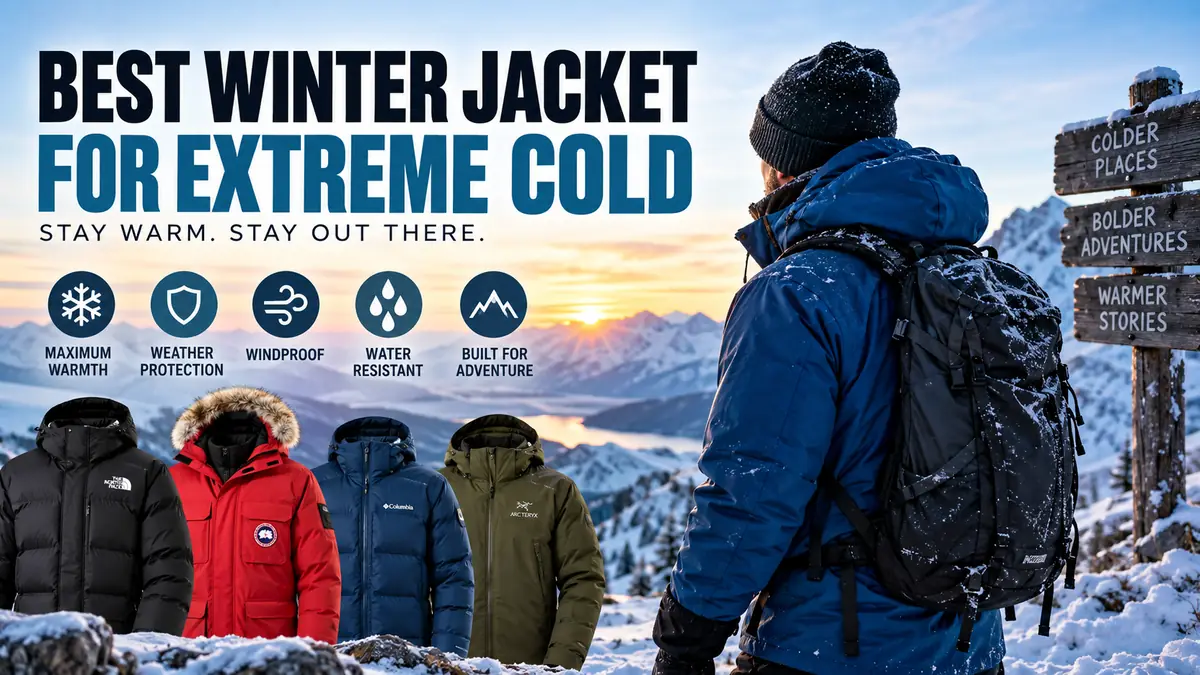
Extreme cold exposes weaknesses in a winter jacket quickly. A coat that feels perfectly warm during a short walk at 30°F (-1°C) may be inadequate when temperatures fall below 0°F (-18°C), especially when wind, snow, moisture, and long periods of inactivity enter the picture.
The best winter jacket for extreme cold combines substantial insulation with wind protection, adequate body coverage, an insulated hood, draft-blocking cuffs and closures, and weather protection appropriate for the climate. For prolonged subzero exposure, expedition-style parkas generally provide more protection than lightweight puffers, while active users often benefit from lighter technical down or synthetic jackets.
Recent cold-weather testing guides consistently highlight models such as the Fjällräven Nuuk Parka, Canada Goose Expedition Parka, The North Face McMurdo, Rab Neutrino Pro, REI Co-op Stormhenge Down Hybrid, and Feathered Friends Khumbu for different types of severe winter conditions.
Best Winter Jacket for Extreme Cold: Quick Comparison
There isn’t one universally warmest choice because “extreme cold” can mean a dry -20°F morning, a wet 20°F snowstorm, an Arctic expedition, or hours of physical activity in freezing weather.
The strongest jackets solve different versions of the problem.
| Jacket | Insulation | Weather Protection | Best Use |
|---|---|---|---|
| Fjällräven Nuuk Parka | Synthetic | Waterproof/windproof | Cold, wet, snowy winters |
| Canada Goose Expedition Parka | Down | Heavy-duty protection | Severe cold, low activity |
| Feathered Friends Khumbu | 900-fill down | Weather-resistant | Very cold, dry conditions |
| The North Face McMurdo | 600-fill down | Waterproof DryVent shell | Everyday subzero weather |
| Rab Neutrino Pro | 800-fill down | Water/wind resistant | Lightweight technical warmth |
| REI Co-op Stormhenge Down Hybrid | Down + synthetic | Waterproof shell | Wet, active winter conditions |
| Patagonia Stormshadow | 700-fill down | GORE-TEX protection | Cold, wet, windy weather |
OutdoorGearLab’s 2026 testing named the Fjällräven Nuuk its overall men’s winter-jacket winner and described the Canada Goose Expedition as particularly suitable for extreme cold exposure. It also rated the Rab Neutrino Pro highly for lightweight warmth.
The more useful question, then, isn’t simply “Which coat is warmest?” It is which design provides enough warmth for your temperature, weather, activity level, and exposure time?
What Makes a Winter Jacket Warm Enough for Extreme Cold?
Warmth comes from trapped air.
Insulation creates thousands of tiny air spaces that reduce the rate at which your body loses heat. But insulation is only part of the system. A highly insulated jacket can still feel cold if wind penetrates it, moisture collapses its insulation, or warm air escapes around the neck, wrists, waist, and zipper.
For genuinely severe winter weather, look at the whole jacket:
- insulation type and quantity
- down fill power and fill weight
- jacket length
- wind resistance
- waterproofing or water resistance
- hood construction
- collar height
- cuff design
- zipper and storm flaps
- hem or waist adjustment
- room for layering
This explains why simply buying the jacket with the highest advertised fill power can be misleading.
Fill Power Is Not a Temperature Rating
One of the most common mistakes is assuming that 900-fill down must automatically make a jacket warmer than one containing 700-fill down.
It doesn’t.
Fill power measures the loft and efficiency of down, not the total warmth of a finished jacket.
Higher-quality down creates more loft for a given weight. An 800- or 900-fill jacket can therefore achieve excellent warmth without becoming excessively heavy.
But the amount of down, often called fill weight, matters too.
A heavily filled 700-fill parka may be considerably warmer than an ultralight 900-fill jacket containing much less insulation.
OutdoorGearLab, for example, describes the Feathered Friends Khumbu as using 900-fill down in substantial quantity, producing exceptionally high warmth.
So compare the complete construction rather than fill-power numbers alone.
Down vs. Synthetic Insulation
Down remains exceptionally effective for dry extreme cold because of its warmth-to-weight ratio and compressibility.
High-loft goose or duck down can provide substantial insulation without the mass associated with many synthetic alternatives.
Its traditional weakness is moisture.
When untreated down becomes saturated, its clusters can collapse and lose loft. Modern hydrophobic treatments improve moisture resistance, but a down jacket still needs adequate protection in sustained wet weather.
Synthetic insulation uses polyester fibers designed to trap air. It is generally:
- more resistant to moisture
- quicker to dry
- able to retain more insulation when damp
- less compressible than premium down
- heavier for equivalent warmth in many designs
That makes synthetic insulation particularly useful in wet snow, freezing rain, humid winters, and situations where drying gear may be difficult.
Hybrid construction provides another option. The REI Co-op Stormhenge Down Hybrid, for example, combines high-fill-power down with synthetic insulation in moisture-prone areas and places that benefit from greater durability. CleverHiker also highlights its waterproof shell and pit zips for weather protection and heat management.
Quick takeaway: For dry, severe cold, high-quality down offers exceptional warmth for its weight. For wet cold, synthetic or well-protected hybrid insulation is often more forgiving.
How Cold Is “Extreme Cold”?
There is no universal temperature at which an ordinary winter jacket becomes an extreme-cold jacket.
A person’s comfort depends on metabolism, wind, humidity, sun exposure, clothing underneath the jacket, physical activity, and how long they remain outside.
Consider the difference between:
20°F (-7°C) while hiking uphill: Your body is producing substantial heat.
0°F (-18°C) while waiting for transportation: You may be standing nearly motionless.
-15°F (-26°C) with strong wind: Exposed skin and heat loss become much more serious concerns.
A single jacket could feel too warm in the first situation and inadequate in the third.
This is why jacket temperature claims should be treated cautiously unless the manufacturer clearly explains the test conditions.
OutdoorGearLab reported using the Fjällräven Nuuk in roughly -15°F conditions during testing in northern Sweden, while describing it as particularly strong in serious cold, wet, and snowy weather.
CleverHiker similarly reports testing several heavyweight parkas in subzero Alaskan conditions.
Wind Chill Changes the Equation
Air temperature alone doesn’t tell you how quickly exposed skin loses heat.
Wind strips away the thin layer of warm air surrounding the body. Consequently, a windproof shell can make an enormous practical difference during blizzards, exposed winter walks, snowmobile use, or long periods outdoors.
The jacket also needs to prevent drafts.
Pay particular attention to the:
- cuffs
- neck
- zipper
- waist
- hem
- hood opening
A well-designed parka creates a continuous protective envelope instead of merely putting thick insulation around your torso.
Best Extreme-Cold Parka for Maximum Protection
For long periods of relatively low activity in brutal temperatures, an expedition-style parka is difficult to beat.
These jackets prioritize insulation and coverage rather than minimal weight.
Canada Goose Expedition Parka
The Canada Goose Expedition Parka is one of the most recognizable examples.
Its construction includes 625-fill down, a substantial polyester-cotton Arctic-Tech shell, a long cut, rib-knit cuffs, hood protection, snow skirt, storm-flap-style protection, and extensive pocket storage. OutdoorGearLab’s testers gave it one of their highest warmth assessments and specifically positioned it for severe cold exposure.
The disadvantages are equally clear.
It is heavy, bulky, expensive, difficult to pack, and excessive for ordinary winter conditions.
That distinction matters. Maximum insulation isn’t automatically desirable.
If you’re walking briskly at 25°F (-4°C), an expedition parka can make you sweat heavily. Once your clothing becomes damp, temperature regulation becomes harder.
This type of coat makes much more sense for:
- long periods standing outdoors
- Arctic or sub-Arctic environments
- extremely cold commuting
- winter observation work
- low-output outdoor activities
- people who consistently feel cold
It makes less sense for running, climbing, hard hiking, or relatively mild winters.
Best Winter Jacket for Extreme Cold and Wet Snow
Cold combined with moisture creates a different challenge.
Here the shell becomes almost as important as the insulation.
Fjällräven Nuuk Parka
The Fjällräven Nuuk repeatedly performs well in this category because it combines substantial synthetic insulation with a waterproof, windproof exterior and long parka-style coverage.
REI’s staff guide describes the Nuuk as its warmest listed option, citing 250 grams of synthetic insulation and emphasizing its suitability for bitterly cold conditions rather than high-output activity.
OutdoorGearLab similarly rated it highly after exposure to serious winter conditions, including approximately -15°F nights in northern Sweden.
Synthetic insulation is particularly relevant here. If snow melts against the jacket or moisture enters the system, synthetic fibers are less dependent on perfectly dry conditions for maintaining useful loft.
The trade-off is weight.
A heavy synthetic parka generally isn’t something you’d want stuffed into a small backpack.
For commuting, outdoor work, snow clearing, spectator sports, and cold wet climates, however, that extra bulk may be entirely reasonable.
Best Lightweight Winter Jacket for Severe Dry Cold
Some people need serious warmth but can’t carry a four-pound parka.
Mountaineers, photographers, winter backpackers, climbers, and travelers may place a much higher value on warmth-to-weight ratio.
Rab Neutrino Pro
The Rab Neutrino Pro occupies this technical middle ground particularly well.
It uses 800-fill-power goose down and a lightweight Pertex Quantum Pro outer fabric. CleverHiker notes that the down is hydrophobic and treated with Nikwax, while the shell adds protection against light precipitation.
OutdoorGearLab likewise identifies the Neutrino Pro as a strong option for dry-cold climates because it provides high warmth without the mass of a traditional heavyweight parka.
Its limitation is straightforward: it isn’t a fully waterproof storm shell.
For extremely cold but predominantly dry environments, that’s often an acceptable trade.
For prolonged freezing rain or wet snow, a more protective waterproof system makes greater sense.
Feathered Friends Khumbu
At the more specialized end is the Feathered Friends Khumbu Down Parka.
Its 900-fill-power down and substantial insulation create exceptional loft. OutdoorGearLab has described it as one of the warmest down jackets its team has worn.
This illustrates why technical expedition jackets deserve their own category.
They aren’t necessarily fashionable everyday coats. Instead, weight, loft, packability, hood design, baffles, and protection around cold spots are engineered around demanding conditions.
Best Everyday Extreme-Cold Winter Parka
Most people aren’t heading to a Himalayan base camp.
They need something warm enough for bitter commutes, dog walks, outdoor events, snow clearing, errands, and long waits outside.
The North Face McMurdo Parka
The North Face McMurdo remains a useful reference point for this type of winter coat.
It combines 600-fill down with a waterproof DryVent 2L shell and long, protective construction. CleverHiker reports that it performed well during subzero testing in Alaska and particularly praises its combination of warmth and weather resistance.
Its lower fill-power figure compared with an 800- or 900-fill technical jacket should not automatically concern you.
Again, jacket warmth isn’t determined by fill power alone.
The McMurdo’s substantial construction, body coverage, weatherproof shell, hood, pockets, and draft protection make it better suited to harsh everyday weather than many ultralight down jackets.
The downside is bulk.
You probably won’t want to carry it inside a climbing pack. But that’s largely irrelevant if you’re walking to work through blowing snow.
Best Option for Cold, Wet and Windy Conditions
Wet cold can defeat a jacket that performs beautifully in dry snow.
This is where waterproof-breathable shells become especially valuable.
Patagonia Stormshadow
The Patagonia Stormshadow combines 700-fill recycled down with a waterproof GORE-TEX shell.
OutdoorGearLab found it particularly effective against cold, wind, rain, sleet, and snow, while noting features such as its insulated adjustable hood and protective cuffs.
This kind of construction illustrates an important principle:
Insulation keeps you warm; the shell protects the insulation and the microclimate around your body.
For maritime winters or regions with frequent rain-to-snow transitions, paying more attention to waterproof construction can be smarter than chasing the highest possible down fill power.
Waterproof vs. Water-Resistant
These terms shouldn’t be treated as interchangeable.
A water-resistant shell can handle snow flurries, brief showers, and light moisture.
A waterproof shell is designed for more prolonged exposure and usually relies on a membrane or coating plus seam construction that prevents water from entering through stitching.
GORE-TEX is one well-known waterproof-breathable membrane. Other brands use proprietary systems such as Patagonia’s H2No or The North Face’s DryVent.
A DWR, or durable water-repellent treatment, serves another role: it helps water bead on the outer face fabric rather than immediately saturating it.
DWR alone does not necessarily make a garment fully waterproof.
Best Winter Jacket for Extreme Cold During Active Use
Extreme cold doesn’t always require extreme insulation.
This sounds contradictory until you consider metabolic heat.
Snowshoeing, ski touring, winter hiking, mountaineering, and climbing can generate considerable body heat. Wearing an expedition parka during continuous strenuous movement may cause sweating.
That moisture can become a liability when you stop.
For active winter use, prioritize:
- adequate but not excessive insulation
- breathability
- ventilation
- freedom of movement
- low weight
- wind protection
- moisture management
- layering compatibility
The Arc’teryx Atom SV, for example, uses Coreloft synthetic insulation and is designed more around active warmth than stationary expedition-level insulation. CleverHiker highlights its moisture management, low weight, and ability to continue insulating when damp.
The REI Stormhenge is another interesting approach because pit zips allow excess heat to escape during higher-output movement.
Don’t Confuse “Warmest” With “Best”
Imagine two people outside at -5°F (-21°C).
One is standing beside a tripod photographing the night sky.
The other is climbing steep terrain with a heavy backpack.
The photographer may need an enormous expedition parka.
The climber may be more comfortable in a base layer, breathable midlayer, and lighter insulated shell, with a heavy belay parka carried for stops.
Same temperature. Completely different clothing requirements.
Down Fill Power Explained Without the Marketing Confusion
Fill-power numbers frequently appear on labels:
600 fill: commonly found in substantial everyday parkas.
650–700 fill: capable of excellent warmth when enough insulation is used.
800 fill: high-quality down with excellent loft and warmth-to-weight performance.
850–900+ fill: premium high-loft down particularly useful when reducing weight and packed volume matters.
But don’t use these numbers as a warmth ranking.
A better comparison is:
insulation quality + insulation quantity + jacket construction + coverage + weather protection.
This is also why a long 600-fill parka can feel much warmer than a tiny 900-fill ultralight puffer.
The puffer might use more efficient down, but simply contain much less of it.
Why Jacket Length Matters More Than Many Buyers Realize
Heat doesn’t only escape through your chest.
A waist-length jacket leaves the hips, rear, and upper legs exposed. A mid-thigh parka covers considerably more surface area.
That difference becomes especially noticeable while standing still.
Long parkas can also overlap more effectively with insulated pants or ordinary trousers, reducing gaps where wind can enter.
OutdoorGearLab’s women’s testing illustrates this effect with the Outdoor Research Coze Down Parka. Its long hem extends toward the mid-calf, while 700-fill down, a high collar, neck baffle, and large hood create substantial overall coverage.
Longer isn’t always better, though.
Extra length can restrict:
- running
- climbing
- steep hiking
- skiing
- getting in and out of vehicles
A two-way zipper helps because the bottom can be opened for sitting and greater leg mobility.
The Hood Can Determine How Warm a Jacket Feels
A poorly designed hood is one of the most frustrating weaknesses in an otherwise warm coat.
In severe wind, you want an insulated hood that can be adjusted around your face without repeatedly blowing backward.
Useful details include:
- insulation around the head
- a high protective collar
- rear volume adjustment
- side drawcords
- a structured brim
- enough room for a hat or helmet
- neck baffles
- face coverage
For technical mountaineering, helmet compatibility matters.
For ordinary extreme-cold use, a smaller well-sealed hood may actually feel warmer because there is less empty space for cold air to circulate.
A high collar also matters because it protects the neck and lower face even when the hood isn’t being worn.
Small Features That Make a Big Difference Below Freezing
Cold-weather performance often comes down to details you barely notice in a warm store.
Draft-Protected Zippers
A large front zipper creates a potential path for heat loss.
Insulated draft tubes or storm flaps reduce cold air penetration along the zipper.
Two-way zippers are especially useful on long parkas because they improve mobility and ventilation.
Adjustable Cuffs
Cold wind entering the sleeves can quickly undermine insulation.
Hook-and-loop tabs, elastic cuffs, or internal stretch-knit cuffs help create a seal around gloves.
Hem and Waist Cinches
A loose hem allows warmed air to escape while drawing cold air upward.
Adjustable drawcords can dramatically improve heat retention.
Insulated Pockets
Fleece-lined or insulated hand pockets aren’t merely a luxury.
They can provide temporary hand protection when you’re standing outside, although proper winter gloves or mittens remain essential in serious cold.
Large Zipper Pulls
Tiny zippers are irritating when you’re wearing thick gloves.
Technical winter clothing often uses oversized pulls for exactly this reason.
How to Layer Under a Winter Jacket in Extreme Cold
Even the best winter jacket for extreme cold works better as part of a clothing system.
The basic principle is straightforward:
Base layer → insulating midlayer → insulated/weatherproof outer layer.
1. Start With a Moisture-Managing Base Layer
Your base layer sits next to the skin.
Merino wool and performance synthetics are common choices because they manage moisture much better than ordinary cotton.
Cotton absorbs moisture and dries slowly, making it a poor choice for demanding cold-weather activity.
2. Add an Insulating Midlayer
Depending on conditions, this could be:
- fleece
- wool
- synthetic insulated jacket
- lightweight down jacket
The midlayer provides adjustable insulation.
If temperatures rise or activity increases, you can remove it instead of being trapped inside one extremely hot garment.
3. Use the Parka as the Protective Outer Layer
Your final layer should match the conditions.
For dry cold, that may be a highly insulated down parka.
For wet snow and strong wind, a waterproof insulated jacket can provide a more complete barrier.
The key is avoiding compression.
If your outer jacket is so tight that it crushes the loft of your midlayers, adding more clothing may provide less benefit than expected.
Should You Size Up an Extreme-Cold Jacket?
Not automatically.
You need enough room for appropriate layers without creating a huge empty cavity inside the jacket.
A correctly fitted winter parka should allow comfortable movement while maintaining insulation loft.
Try the jacket with the clothing you actually expect to wear underneath it.
Check whether you can:
- raise your arms
- bend your elbows
- cross your arms
- zip the collar completely
- wear your preferred midlayer
- tighten the hood properly
Pay special attention to the shoulders and armpits.
If these areas become tight when layered, the insulation and clothing underneath can become compressed.
Dry Cold vs. Wet Cold: Choose Differently
This distinction deserves more attention than it usually receives.
Dry Extreme Cold
Think interior Alaska, high mountains, continental Arctic conditions, or very cold clear winter days.
Prioritize:
- high-loft down
- excellent warmth-to-weight ratio
- wind resistance
- insulated hood
- draft control
- enough space for layering
Models such as the Rab Neutrino Pro and Feathered Friends Khumbu make particular sense when low weight and serious dry-cold insulation matter.
Wet Extreme Cold
Think freezing rain, heavy wet snow, sleet, slush, or maritime winter climates.
Prioritize:
- waterproof or highly weather-resistant shell
- synthetic or protected down insulation
- taped or protected seams
- hood coverage
- durable face fabric
- moisture management
The Fjällräven Nuuk, REI Stormhenge, The North Face McMurdo, and Patagonia Stormshadow represent different approaches to this problem.
What Is the Warmest Type of Winter Coat?
For stationary use in severe cold, a long expedition-style down parka is generally among the warmest practical designs.
Its advantage comes from combining large amounts of insulation with extensive body coverage and aggressive draft protection.
But warmth doesn’t come from down alone.
A truly protective extreme-cold parka usually incorporates:
- thick insulation
- long torso coverage
- insulated hood
- high collar
- wrist seals
- storm-protected zipper
- wind-resistant shell
- adjustable hem or waist
A shorter high-fill down jacket can deliver remarkable warmth for its weight, but it doesn’t cover as much of the body.
That’s why expedition parkas tend to look oversized: much of that bulk has a purpose.
Are Heated Jackets Better for Extreme Cold?
Heated jackets can add warmth using battery-powered heating elements, but they should not replace adequate passive insulation in environments where failure could become dangerous.
Batteries lose performance in cold conditions and eventually run out.
For casual activities near shelter—such as watching outdoor sports, commuting, or working close to a vehicle—electric heat can improve comfort.
For remote extreme-cold travel, however, your essential clothing system should remain protective even if every electronic component stops functioning.
Think of active heating as supplementary warmth rather than your primary survival layer.
How to Judge a Jacket When No Reliable Temperature Rating Exists
Many winter coats don’t carry standardized temperature ratings.
That’s frustrating, but you can still evaluate them systematically.
Start with six questions:
- How much insulation does it actually contain?
- How much of your body does it cover?
- Can wind penetrate the shell or openings?
- What happens to the insulation when moisture appears?
- Can the hood, wrists, waist, and neck be sealed?
- Will you be standing still or producing substantial body heat?
Then compare independent field testing where available.
A manufacturer’s warmth label is useful context, but real-world testing in snow, wind, wet weather, and subzero temperatures can reveal weaknesses that specifications don’t show.
Common Mistakes When Choosing a Jacket for Severe Winter Weather
The first is buying according to fill power alone.
An 850-fill label looks impressive, but without knowing the quantity and construction, it doesn’t tell you the finished garment’s warmth.
The second is ignoring wind.
A breathable lightweight puffer may perform wonderfully beneath a shell yet feel surprisingly cold when directly exposed to strong winter wind.
The third is overlooking moisture.
Down can be superb in dry cold but needs protection when conditions become wet.
The fourth is buying the warmest jacket possible regardless of activity.
Overheating leads to sweating, and damp clothing becomes troublesome as soon as activity stops.
The fifth is neglecting the rest of the body.
No parka can compensate completely for inadequate gloves, boots, trousers, head protection, and base layers.
Which Winter Jacket Is Best for Different Extreme-Cold Situations?
Rather than ranking every coat from “warm” to “warmest,” match its construction to the environment.
| Situation | What to Prioritize | Suitable Style |
|---|---|---|
| Long periods standing below 0°F | Maximum insulation and coverage | Expedition parka |
| Cold + heavy wet snow | Waterproofing and moisture-resistant insulation | Waterproof insulated parka |
| Dry subzero mountaineering | Warmth-to-weight ratio | Technical down jacket |
| Everyday harsh winter | Warmth, durability, pockets, weather protection | Heavy everyday parka |
| High-output winter hiking | Breathability and ventilation | Technical insulated jacket |
| Cold urban commuting | Long coverage and wind protection | Mid-thigh parka |
| Remote expedition | Maximum insulation plus layering compatibility | Expedition-grade down parka |
There is another practical factor: duration.
Walking five minutes between a heated car and office is fundamentally different from spending four hours outdoors at the same temperature.
Your jacket should be selected for the longest realistic exposure, not just the number displayed on the weather app.
Best Winter Jacket for Extreme Cold: Final Verdict
The best winter jacket for extreme cold is the one that matches both the temperature and the type of cold you’re facing.
For maximum stationary warmth, an expedition parka such as the Canada Goose Expedition or a highly insulated technical model such as the Feathered Friends Khumbu represents the heavy-duty end of the spectrum. For cold, wet and snowy conditions, the Fjällräven Nuuk’s synthetic insulation and waterproof construction provide a compelling combination.
The North Face McMurdo offers a more everyday-oriented balance of warmth and weather protection, while the Rab Neutrino Pro favors lightweight down performance for colder, drier technical use. The REI Stormhenge Down Hybrid bridges several categories by combining down, synthetic insulation, waterproof protection, and ventilation.
Don’t choose solely by brand, price, or fill-power number. Start with your lowest expected temperature, wind exposure, precipitation, activity level, and time outdoors. Then evaluate insulation quantity and type, shell protection, length, hood, cuffs, draft control, and layering space.
That approach is far more reliable than searching for one coat that promises to be the warmest everywhere.