
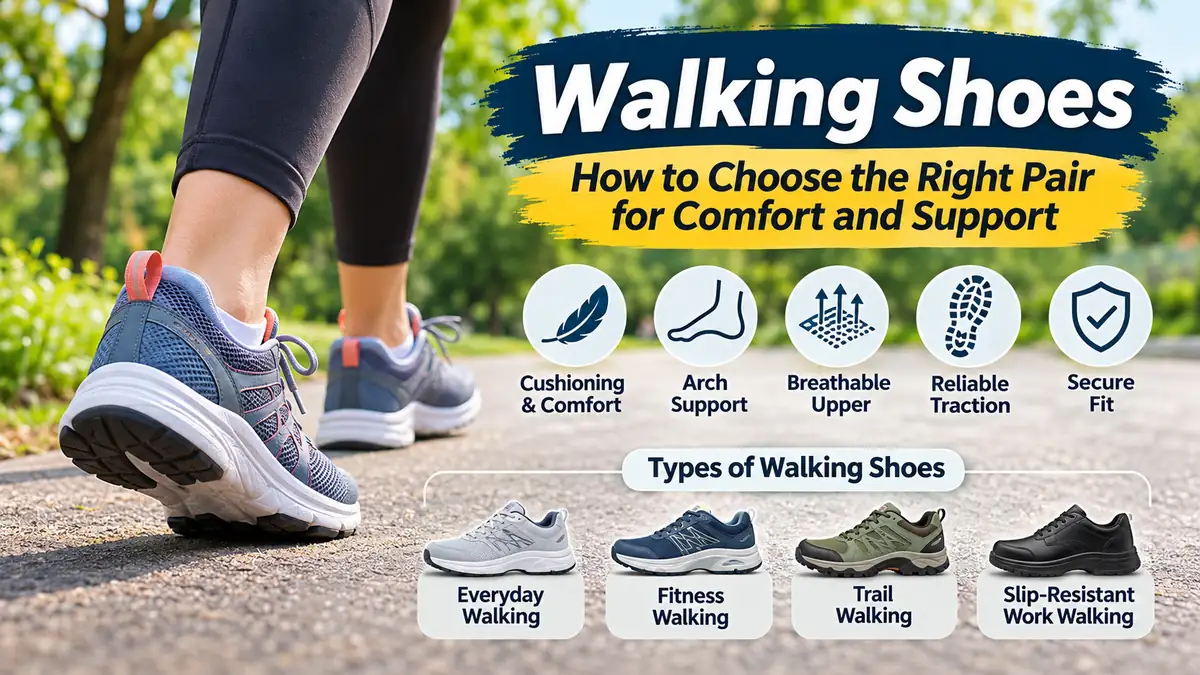
A comfortable walk can quickly become frustrating when your shoes pinch your toes, rub your heels, or leave your feet aching. The right footwear makes a noticeable difference, especially when you walk several miles, commute on hard pavement, or spend long hours standing.
walking shoes are footwear designed to support the natural heel-to-toe movement of walking. Good walking footwear combines a secure fit, appropriate cushioning, stable heel support, sufficient toe room, and traction suited to the walking surface. The ideal pair depends on your foot shape, walking distance, terrain, and individual comfort needs.
There is no single shoe that works perfectly for everyone. A lightweight sneaker that feels excellent during a short neighborhood walk may not provide the support or grip needed for a full day of sightseeing or an uneven hiking trail.
Understanding the features that matter will help you recognize comfortable, supportive footwear without relying entirely on brand names or marketing claims.
What Makes Good walking shoes?
Good walking shoes support your feet throughout the walking gait cycle without restricting natural movement.
During a typical walking step, your heel contacts the ground, your body weight moves forward across the foot, and your toes help propel you into the next step. This repeated motion places demands on the shoe’s cushioning, flexibility, and structural support.
Several features work together to make walking footwear comfortable.
Cushioning That Matches Your Walking Style
Cushioning helps moderate the pressure and impact you feel underfoot. It is especially noticeable when walking on concrete, asphalt, tile, and other hard surfaces.
Most athletic walking footwear uses a foam midsole made from materials such as ethylene-vinyl acetate (EVA), polyurethane, or specialized performance foams.
Cushioning generally falls into three categories:
- Minimal cushioning: Offers more ground feel and may suit people accustomed to flexible footwear.
- Moderate cushioning: Balances softness, stability, and ground feedback for everyday walking.
- Maximum cushioning: Provides a thicker layer of foam that some walkers prefer for long distances or extended standing.
More cushioning is not automatically better. Extremely soft foam can feel unstable to some people, particularly when combined with a narrow sole.
A useful test is whether the shoe feels comfortable and controlled while walking at your normal pace.
Arch Support and Foot Stability
The arch helps distribute pressure as your foot moves through each step.
Supportive footwear may include a contoured footbed, firm heel counter, structured midsole, or additional guidance features.
The correct amount of arch support varies between individuals. Some walkers are comfortable in neutral shoes, while others prefer more structure.
A shoe should support your foot without creating a painful pressure point beneath the arch.
A Flexible Forefoot and Secure Heel
Walking requires the forefoot to bend as you push off.
A well-designed walking shoe generally flexes near the ball of the foot rather than folding excessively through the middle.
The heel counter, located around the back of the shoe, helps keep the heel secure.
When trying on footwear, check that your heel does not repeatedly slip out and that your toes can move freely.
Breathable Upper Materials
The upper is the fabric or material covering the top and sides of the foot.
Common options include engineered mesh, knit fabric, leather, and synthetic materials.
Mesh and knit uppers generally provide better ventilation, making them useful for warm weather and fitness walking. Leather may offer greater protection from light moisture and abrasion but can feel warmer.
For wet conditions, water-resistant or waterproof membranes can help keep moisture out, although they often reduce breathability.
Durable Outsoles and Reliable Traction
The outsole is the bottom layer that contacts the ground.
Rubber outsoles provide traction and resist wear. The tread pattern should match the surface where you walk.
Smooth pavement usually requires less aggressive tread than gravel, mud, or uneven trails.
For workplaces with slippery floors, look for footwear specifically tested or labeled for slip resistance. An ordinary athletic outsole should not automatically be considered slip-resistant.
Different Types of walking shoes
Walking footwear comes in several designs because daily walking, exercise walking, and outdoor walking place different demands on the feet.
| Type | Main characteristics | Suitable use |
|---|---|---|
| Everyday walking sneakers | Moderate cushioning, flexible forefoot | Errands and casual walks |
| Fitness walking shoes | Lightweight construction, secure fit | Brisk walking and exercise |
| Cushioned walking shoes | Thick, shock-absorbing midsole | Long walks on hard surfaces |
| Stability shoes | Structured support and broad base | Walkers needing extra guidance |
| Trail walking shoes | Rugged outsole and protective upper | Dirt, gravel, uneven paths |
| Slip-resistant walking shoes | Outsole designed for workplace traction | Healthcare, hospitality, service work |
| Wide-fit walking shoes | Additional forefoot width | Wide feet and toe-space needs |
Everyday Walking Sneakers
Everyday walking sneakers are designed for comfort during ordinary activities.
They generally offer a balance of cushioning, flexibility, and durability without the heavier construction of hiking footwear.
For someone who walks to work, shops, or takes short evening walks, a comfortable everyday sneaker may provide everything necessary.
Fitness and Power-Walking Shoes
Fitness walking involves a faster pace and more deliberate exercise.
A lightweight design can make repetitive steps feel less cumbersome, while secure heel support helps reduce unwanted movement inside the shoe.
Some fitness walkers prefer rocker-shaped soles, which have a curved profile designed to encourage a smooth forward transition.
However, rocker soles feel different from traditional flat footwear and are not comfortable for everyone.
Trail Walking Shoes
Trail walking introduces loose gravel, rocks, roots, and uneven ground.
Footwear for these surfaces benefits from:
- Deeper outsole lugs for traction
- More protective upper materials
- Stable construction on uneven terrain
- Reinforced toe areas
- Weather protection when conditions require it
For technical hiking routes, dedicated hiking shoes or boots may be more appropriate than ordinary walking sneakers.
Shoes for Standing All Day
People who work in hospitals, retail stores, warehouses, and hospitality environments often spend hours on their feet.
Their footwear needs may differ from those of someone walking continuously.
A stable platform, durable cushioning, secure fit, and suitable outsole traction can matter more than extremely lightweight construction.
Workplace safety requirements should also guide footwear selection.
How to Choose walking shoes for Your Foot Type
Foot shape influences how footwear fits and feels. Two people wearing the same numerical shoe size may need completely different widths, toe-box shapes, or support features.
walking shoes for Flat Feet
Flat feet have relatively low arches, particularly when standing.
Some people with flat feet walk comfortably in neutral shoes. Others experience excessive inward rolling, known as overpronation, or prefer additional support.
Features worth considering include a stable midsole, supportive heel counter, and comfortable arch contour.
Stability models such as the ASICS Gel-Kayano series and Brooks Adrenaline GTS series are examples of structured footwear, but neither is automatically necessary for everyone with flat feet.
Foot shape alone does not determine whether motion-control footwear is needed.
walking shoes for High Arches
High-arched feet often have a more pronounced curve along the inside of the foot.
Some people with high arches prefer cushioning that distributes pressure comfortably beneath the heel and forefoot.
A neutral shoe with a comfortable footbed may work well.
However, high arches do not always require maximum cushioning. Fit, pressure distribution, and personal comfort remain more useful guides than arch height alone.
walking shoes for Wide Feet
Wide feet need adequate room across the forefoot without excessive movement around the heel.
Simply choosing a longer shoe may create heel slipping while failing to solve the width problem.
Look for footwear offered in multiple widths, such as wide or extra-wide versions, and check the actual toe-box shape.
Brands including New Balance, Brooks, and several specialty footwear manufacturers offer width options in selected models.
A spacious toe box can also benefit people with bunions or toes that feel compressed in conventional sneakers.
walking shoes for Narrow Feet
People with narrow feet may experience sliding, heel movement, or difficulty securing the midfoot.
A narrower shoe shape, adjustable lacing, and a supportive heel counter can help.
The goal is a snug fit around the heel and midfoot without squeezing the toes.
What About Overpronation and Supination?
Pronation is the natural inward movement of the foot during walking.
Overpronation describes greater inward rolling, while supination generally refers to outward loading or reduced inward movement.
Neither pattern automatically indicates a medical problem.
If your walking mechanics cause recurring discomfort, a podiatrist or qualified clinician can assess whether footwear changes, exercises, or orthotic support may help.
How to Find the Correct walking shoes Size
Shoe sizing is one of the most important parts of selecting comfortable footwear.
Even a well-designed shoe can cause problems if it is too short, too narrow, or too loose.
Measure Both Feet
Feet are not always identical in length or width.
Measure both while standing and use the larger foot as the starting point for sizing.
Because feet can expand slightly during the day, trying on shoes later in the afternoon may provide a more realistic fit for prolonged walking.
Check Toe Room
A common fitting guideline is approximately a thumb’s width of space between the longest toe and the front of the shoe, often around 10–12 millimeters.
The longest toe is not always the big toe.
Your toes should move naturally without pressing against the front or sides.
Check Heel and Midfoot Fit
The heel should feel secure without painful rubbing.
The midfoot should be comfortably held in place, but the upper should not create excessive pressure.
Walk several steps, turn, and try a slightly faster pace.
Pay attention to slipping, pinching, and instability.
Try Shoes With Your Usual Socks
Sock thickness changes the available space inside footwear.
Use the socks you normally wear for walking, particularly if you prefer thicker athletic or moisture-wicking socks.
If you use orthotic inserts, bring them along and test the shoes with the inserts installed.
Do walking shoes Need Breaking In?
Modern walking shoes should feel reasonably comfortable from the first fitting.
Some materials may soften slightly with use, but a shoe that painfully squeezes your toes is unlikely to become a good fit through normal wear.
Avoid relying on a break-in period to correct significant sizing problems.
The Cleveland Clinic similarly emphasizes selecting footwear based on individual walking needs, appropriate support, and comfortable construction.
walking shoes vs. Running Shoes: What Is the Difference?
Walking and running involve different movement patterns, although many modern athletic shoes can accommodate both activities.
Walking typically includes continuous ground contact by at least one foot. Running includes a flight phase during which both feet are briefly off the ground.
Running also generally produces greater impact forces, influencing the cushioning and construction of running footwear.
| Feature | Walking Shoes | Running Shoes |
|---|---|---|
| Primary movement | Heel-to-toe walking gait | Repeated running strides |
| Cushioning | Comfortable, often moderate | Varies from minimal to maximal |
| Flexibility | Often emphasizes forefoot movement | Depends on running shoe design |
| Heel support | Secure, stable fit | Secure fit for higher-impact movement |
| Weight | Usually light to moderate | Ranges from lightweight to heavily cushioned |
| Typical use | Walking, commuting, standing | Running, jogging, fitness |
| Sole geometry | Flat or gently curved | Flat, rocker-shaped, or specialized |
Can You Wear Running Shoes for Walking?
Yes. Many running shoes are excellent for walking.
Modern running footwear frequently combines breathable uppers, comfortable midsoles, durable outsoles, and stable platforms.
For example, neutral running shoes such as the ASICS Gel-Cumulus and HOKA Clifton are frequently evaluated for walking because their construction can suit both activities.
The main consideration is how the shoe behaves at walking speed.
Some specialized running shoes feature aggressive rocker shapes, unusually soft foam, or rigid plates that may feel awkward during slower movement.
A comfortable running shoe is not necessarily a comfortable walking shoe, even when both have similar cushioning.
Can You Run in Walking Shoes?
Occasional short jogging intervals may be comfortable in some athletic walking shoes.
However, footwear designed primarily for casual walking may not provide the cushioning, fit security, or durability preferred for regular running.
If your exercise routine includes substantial running, a suitable running shoe is generally the more versatile choice.
Best walking shoes Features for Different Activities
The ideal footwear changes depending on how far you walk, how quickly you move, and the surface beneath your feet.
Walking Long Distances
Long-distance walking places repeated demands on the feet over thousands of steps.
Prioritize cushioning that remains comfortable, sufficient toe space, breathable materials, and a secure heel.
Your feet may expand during extended activity, making adequate forefoot room particularly valuable.
A smooth heel-to-toe transition can also improve the subjective feel of walking.
Current independent footwear testing highlights models such as the ASICS Gel-Cumulus 28, Altra Experience Flow 3, and Brooks Ghost Max 4 as notable walking options, although the ideal choice depends on individual fit.
Walking on Concrete
Concrete and other hard surfaces offer little natural cushioning.
Some walkers find that moderately or highly cushioned footwear improves comfort during extended pavement walking.
However, the foam should still feel stable.
A very thick midsole with an unstable platform may be less comfortable than a moderately cushioned shoe with better support.
Walking on a Treadmill
Treadmill walking generally takes place on a predictable, even surface.
Lightweight athletic shoes with breathable uppers and comfortable cushioning are usually appropriate.
Aggressive trail tread is unnecessary for ordinary treadmill use.
Make sure the shoe remains secure when walking at different speeds or incline settings.
Walking for Travel
Travel footwear needs to handle varied activities, including airports, sightseeing, public transportation, and prolonged standing.
Useful characteristics include:
- Lightweight construction
- Comfortable all-day cushioning
- Breathable upper materials
- Reliable grip on pavement
- Sufficient toe room
- A design that is easy to put on and remove
If your itinerary includes both urban sightseeing and uneven nature trails, a versatile trail-to-town shoe may be more practical than a delicate everyday sneaker.
Walking in Rain or Wet Weather
Wet conditions require attention to both traction and moisture protection.
Waterproof membranes, including GORE-TEX, can help reduce water entry.
However, waterproof footwear may retain more heat and dry slowly if water enters from above.
For warm, humid conditions, breathable shoes that dry relatively quickly may be preferable.
Grip matters independently of waterproofing. A waterproof upper does not guarantee that the outsole will resist slipping on wet tile or polished stone.
Popular walking shoes Brands and What They Offer
Several established footwear brands produce athletic models frequently used for walking.
Rather than treating one brand as universally superior, it is more useful to understand their typical design approaches.
HOKA
HOKA is associated with cushioned midsoles and rocker-style sole geometry.
Models such as the Bondi, Clifton, and Transport serve different purposes, from road walking to versatile daily wear.
Some walkers appreciate the smooth rolling sensation of these designs. Others prefer a more traditional, flexible sole.
New Balance
New Balance produces athletic footwear across multiple cushioning levels and fit profiles.
Selected models are available in different widths, which can be useful for people who struggle with standard shoe shapes.
The Fresh Foam series emphasizes cushioned comfort, while other models offer different combinations of structure and flexibility.
Brooks
Brooks produces neutral and stability-oriented athletic footwear.
The Ghost family is associated with everyday cushioning, while the Adrenaline GTS family incorporates additional guidance features.
Brooks also offers walking-focused designs, including the Addiction Walker line.
ASICS
ASICS offers neutral and stability footwear with varying levels of cushioning.
The Gel-Cumulus and Gel-Nimbus families emphasize cushioned movement, while the Gel-Kayano family includes stability-oriented construction.
Independent reviewers have highlighted several ASICS models in 2026 walking-shoe testing.
Skechers
Skechers produces numerous casual and walking-focused designs, including the GO WALK range.
Some models emphasize lightweight construction, flexible uppers, and easy entry.
Because the designs vary considerably, assess individual models rather than assuming that all shoes within the brand provide identical support.
Nike, Adidas, Saucony, and On
Other established manufacturers offer walking-compatible footwear.
Nike produces cushioned everyday athletic shoes and walking-oriented designs such as the Motiva family.
Adidas offers models with different foam systems and upper constructions.
Saucony produces neutral and stability footwear, including cushioned options frequently considered for walking.
On is known for its CloudTec cushioning designs, although the feel and stability vary across models.
Independent testing organizations do not always agree on the best model. For example, RunRepeat’s 2026 walking-shoe evaluations highlight New Balance, Saucony, HOKA, Brooks, On, and Nike models for different purposes.
These examples illustrate footwear categories and design differences rather than establishing a universal ranking.
walking shoes for Common Foot Problems
Foot discomfort can influence footwear preferences, but shoes should not be treated as a guaranteed cure for a medical condition.
The appropriate choice depends on the cause of symptoms, foot mechanics, and personal comfort.
Plantar Fasciitis
Plantar fasciitis commonly causes pain around the heel or underside of the foot, often particularly noticeable during the first steps after resting.
Some people find supportive footwear with comfortable cushioning and a secure heel helpful.
Features to consider include a stable heel counter, supportive footbed, and cushioning that does not collapse excessively.
However, no single shoe design has been proven best for every person with plantar fasciitis.
Persistent symptoms may require a broader treatment approach involving activity modification, stretching, strengthening, or professional assessment.
Bunions
A bunion involves a change in alignment around the big-toe joint that can create a prominent bump and pressure from footwear.
A wide, anatomically accommodating toe box may help reduce irritation.
Avoid shoes that squeeze the forefoot or press directly against the affected joint.
A longer shoe is not necessarily a substitute for proper width.
Heel Pain
Heel pain can have several causes, including plantar fascia irritation, heel-pad problems, or other conditions.
Cushioned heel areas may improve comfort for some walkers.
However, excessive softness can feel unstable, and the most appropriate support depends on the underlying problem.
Knee and Back Discomfort
Footwear can influence walking mechanics and perceived comfort, but knee and back pain have many possible causes.
A stable, comfortable shoe may help some individuals walk more comfortably.
There is insufficient reason to assume that maximum cushioning, a particular heel drop, or a specific brand will consistently resolve knee or back pain.
Persistent pain, swelling, numbness, or difficulty walking warrants professional evaluation.
Do Orthotic Insoles Help?
Orthotic inserts can alter pressure distribution and provide additional support.
Over-the-counter insoles may be sufficient for some people, while others benefit from professionally prescribed devices.
If you wear orthotics, choose footwear with enough interior depth and preferably removable factory insoles.
A rigid or custom insert may not work well inside a shoe with a narrow, curved, or unstable base.
How Long Do walking shoes Last?
Walking shoes gradually lose their cushioning, traction, and structural integrity through regular use.
Their lifespan depends on walking frequency, body weight, gait, terrain, construction quality, and maintenance.
A commonly used inspection guideline is approximately 300–500 miles, or 480–800 kilometers, for many athletic shoes. This is not a universal replacement deadline, and some shoes wear out earlier or remain usable longer.
For someone walking three miles daily, that range corresponds to approximately 100–167 days.
Actual condition matters more than mileage alone.
Signs Your Shoes Need Replacing
Check your footwear for these changes:
- Outsole tread has become noticeably smooth or uneven.
- Midsole cushioning feels compressed or unusually firm.
- The heel counter has lost its shape.
- Upper fabric has developed holes or significant stretching.
- One shoe tilts noticeably when placed on a level surface.
- Previously comfortable shoes now produce recurring rubbing or discomfort.
A change in foot pain does not always mean the shoes are worn out. Consider other factors, including activity changes and medical causes.
How to Make walking shoes Last Longer
Regular care can help preserve footwear condition.
Remove loose dirt with a soft brush, clean uppers according to manufacturer instructions, and allow wet shoes to dry naturally.
Avoid placing footwear directly beside intense heat sources, which may damage adhesives, foam, and upper materials.
If you walk frequently, alternating between two suitable pairs can give each pair time to dry between uses.
Remove insoles occasionally to allow moisture to escape.
Machine washing should only be used when the manufacturer specifically permits it.
Common Mistakes When Choosing walking shoes
Even experienced walkers can select footwear based on features that do not match their needs.
Choosing Shoes Only for Their Appearance
A fashionable sneaker may be comfortable for casual use but unsuitable for several hours of walking.
Assess fit, cushioning, traction, and stability before appearance.
Assuming More Cushioning Means More Comfort
A thick foam sole can feel soft initially but unstable during movement.
Comfort depends on the relationship between cushioning, foot shape, and sole geometry.
Ignoring Width
A shoe that is long enough can still be too narrow.
Forefoot compression may cause rubbing, numbness, or irritation.
Check width independently of length.
Buying Shoes That Feel Painfully Tight
A snug fit should not create pain.
Although some materials soften slightly, significant pressure around the toes or arch is unlikely to disappear simply through continued wear.
Choosing Based Only on Foot Arch Height
Flat feet do not automatically require stability shoes, and high arches do not automatically require maximum cushioning.
Your actual comfort, walking pattern, and any symptoms provide more useful information.
Using the Same Shoes for Every Surface
A smooth road outsole may work well on pavement but provide inadequate grip on loose or muddy terrain.
Match the tread and construction to your environment.
Ignoring Workplace Requirements
Ordinary walking sneakers may not satisfy occupational requirements for slip resistance, protective toes, or electrical-hazard protection.
Choose footwear that meets the applicable safety standards for your work.
A Practical Step-by-Step walking shoes Fit Test
A simple fitting routine can reveal problems before you begin using new footwear regularly.
Walking shoe fitting checklist
of checks completed [Reset]
A brief fitting test cannot reproduce an entire day of walking, but it can identify obvious problems.
When possible, test footwear on a clean indoor surface before committing to extended outdoor use.
Pay particular attention to how your feet feel while moving, not just while standing still.
How walking shoes Affect Everyday Walking Comfort
Footwear influences the interaction between your feet and the ground, but comfort is not determined by shoes alone.
Walking pace, total distance, muscle conditioning, surface hardness, and recovery time also matter.
Walking Efficiency and Natural Movement
A shoe that fits securely can reduce distracting movement inside the footwear.
Appropriate flexibility or a comfortable rocker design may help the foot transition smoothly through each step.
However, there is no universal sole shape that produces the most efficient walking pattern for every individual.
Foot Fatigue During Long Walks
Fatigue can develop from prolonged activity even when shoes fit correctly.
Cushioning and support may influence comfort, but gradually increasing walking distance is also useful.
Someone beginning a daily walking routine may benefit from shorter walks before progressing to longer sessions.
Breathability and Moisture Management
Sweaty feet can increase friction and contribute to blisters.
Breathable footwear and moisture-wicking socks may help manage moisture.
For extended walks, changing damp socks can also improve comfort.
Blister Prevention
Blisters often result from repeated friction, pressure, and moisture.
To reduce the risk:
- Wear correctly sized footwear.
- Choose socks that fit without bunching.
- Address heel slipping or toe pressure.
- Keep feet reasonably dry.
- Increase walking distance gradually.
- Protect areas prone to rubbing before longer walks.
If a new shoe repeatedly causes blisters in the same location, the problem may be its fit or shape rather than insufficient break-in time.
Are Expensive walking shoes Better?
Higher prices do not automatically guarantee better comfort, durability, or support.
Premium footwear may incorporate specialized foams, advanced upper materials, or complex sole designs.
However, those features only provide value when they suit the person wearing them.
A moderately priced shoe with the correct width, comfortable cushioning, and secure fit may outperform a premium model that does not match your foot shape.
Independent reviews are useful because they evaluate real-world comfort, durability, traction, and construction rather than relying solely on manufacturer claims.
For example, OutdoorGearLab and RunRepeat use comparative wear testing and laboratory assessments to examine differences between walking footwear models.
When evaluating a shoe, consider its actual fit and intended use before its price or reputation.
How to Choose walking shoes for Men and Women
Men’s and women’s footwear ranges often differ in standard width, sizing systems, and last shape.
A shoe last is the three-dimensional form used to determine the shoe’s internal shape.
However, foot proportions vary considerably within each group.
Some people find that a shoe marketed for another gender provides a better fit, particularly when width options are limited.
The most important factors remain foot length, width, heel fit, toe-box shape, and comfort.
Walking Shoes for Older Adults
Older adults may prioritize ease of use, secure footing, and stability.
Useful features can include a broad sole, secure closure, adequate traction, and sufficient toe space.
Slip-on footwear may be convenient, but the heel should remain secure during movement.
For someone with balance difficulties, a very tall or unusually soft midsole may feel less stable.
Footwear selection should also account for mobility limitations and any advice from a healthcare professional.
Walking Shoes for Beginners
Someone starting a walking routine usually does not need highly specialized footwear.
A comfortable athletic shoe with a secure fit, moderate cushioning, and suitable traction is often a reasonable starting point.
As walking distance increases, individual preferences become clearer.
Some people discover that they prefer more cushioning, while others prioritize flexibility or a lighter design.
Final Thoughts on Choosing walking shoes
The best walking shoes are not necessarily the softest, most expensive, or most popular models.
They are the shoes that fit your feet properly, remain comfortable during your normal walking activities, and provide the stability and traction appropriate for your environment.
Start with correct sizing and sufficient toe room. Then evaluate cushioning, heel security, flexibility, breathability, and outsole grip.
For long-distance walking, prioritize lasting comfort and secure fit. For uneven trails, traction and stability become more important. For extended workplace standing, consider supportive construction and any occupational safety requirements.
Most importantly, judge footwear by how it feels when you actually walk. A shoe that accommodates your foot shape and movement is more valuable than one chosen solely because it appears at the top of a ranking.
With properly fitted walking shoes and a walking routine that progresses at a comfortable pace, everyday movement can become more enjoyable and sustainable.